
C语言程序设计基础 实验3 函数
#include <stdio.h>

long long fac(int n);

int main() {

    int i, n;

    printf("Enter n: ");

    scanf("%d", &n);

    for (i = 1; i <= n; ++i) printf("%d! = %lld\n", i, fac(i));

    return 0;

}

long long fac(int n) {

    static long long p = 1;

    p = p * n;

    return p;

}
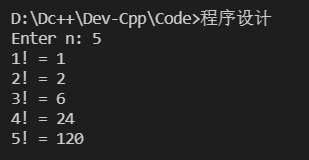
感悟:这个代码非常的细节,考虑到了同学们可能会输入较大的n从而导致对应的阶乘超出int的范围。已知long long的范围下最大的阶乘表示为26
在line22之后插入打印
#include <stdio.h>

long long fac(int n);

int main() {

    int i, n;

    printf("Enter n: ");

    scanf("%d", &n);

    for (i = 1; i <= n; ++i) printf("%d! = %lld\n", i, fac(i));

    return 0;

}

long long fac(int n) {

    static long long p = 1;

    printf("p = %lld\n", p);

    p = p * n;

    return p;

}
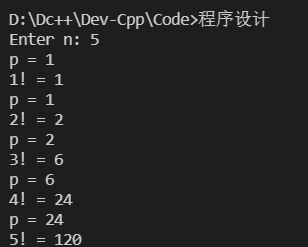
(2)
#include <stdio.h>

int func(int, int);

int main() {

    int k = 4, m = 1, p1, p2;

    p1 = func(k, m);

    p2 = func(k, m);

    printf("%d,%d\n", p1, p2);

    return 0;

}

int func(int a, int b) {

    static int m = 0, i = 2;

    i += m + 1;

    m = i + a + b;

    return (m);

}

实验二
#include <stdio.h>

void printSymbol(int n, char symbol);

int main() {

    int n;

    char symbol;

    while( scanf("%d %c", &n, &symbol) != EOF ) {

        printSymbol(n, symbol);

        printf("\n");

    }

    return 0;

}

void printSymbol(int n, char symbol){

    if(!n) return ;

    printf("%c",symbol);

    printSymbol(n-1,symbol);

}
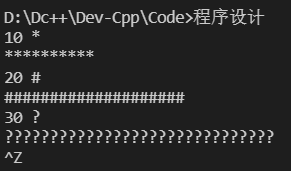
递归版
#include <stdio.h>

void printSymbol(int n, char symbol);

int main() {

    int n;

    char symbol;

    while( scanf("%d %c", &n, &symbol) != EOF ) {

        for(int i=1;i<=n;++i) printf("%c",symbol);

        printf("\n");

    }

    return 0;

}

void printSymbol(int n, char symbol){

    if(!n) return ;

    printf("%c",symbol);

    printSymbol(n-1,symbol);

}

我认为递归好一点,因为代码短
#include <stdio.h>

long long fun(int n);

int main() {

    int n; long long f;

    while (scanf("%d", &n) != EOF) {

        f = fun(n);

        printf("n = %d, f = %lld\n", n, f);

    }

    return 0;

}

long long fun(int n){

    if(n==1) return 1ll;

    return 2ll*fun(n-1)+1;

}
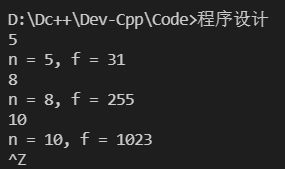
#include <stdio.h>

#define true 0

#define false 1

#define bool int

bool is_prime(int x) {

    for(int i=2; i<=x/i; ++i)

        if(x%i==0)

            return true;

    return false;

}

int main() {

    int cnt = 0;

    for(int i=101; i<=200; ++i) {

        if(!is_prime(i)) {

            cnt ++;

            printf("%d ",i);

            if(cnt%20 == 0) puts("");

        }

    }

    puts("");

    printf("101~200之间一共有%d个非素数\n",cnt);

    return 0;

}

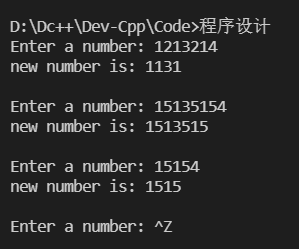
#include <stdio.h>

long fun(long s);

int main() {

    long s, t;

    printf("Enter a number: ");

    while (scanf("%ld", &s) != EOF) {

        t = fun(s);

        printf("new number is: %ld\n\n", t);

        printf("Enter a number: ");

    }

    return 0;

}

long fun(long s){

    long base = 1,ans=0;

    while(s){

        long num = s%10;

        if(num&1){

            ans += base*num;

            base*=10;

        }

        s/=10;

    }

    return ans;

}
#include <stdio.h>

double fun(int n); // 函数声明

int main() {

    int n;

    double s;

    printf("Enter n(1~10): ");

    while (scanf("%d", &n) != EOF) {

        s = fun(n); // 函数调用

        printf("n = %d, s= %f\n\n", n, s);

        printf("Enter n(1~10): ");

    }

    return 0;

}

double fun(int n){

    if(n==1) return 1;

    double ans = 1.0;

    for(int i=1;i<=n;++i) ans*=i;

    if(n&1) return fun(n-1) + 1.0/ans;

    else return fun(n-1) - 1.0/ans;

}

C语言程序设计基础 实验3 函数的更多相关文章
- C语言程序设计基础知识点概括
C语言程序设计基础知识点概括 C语言程序设计基础知识点1.函数是C语言的基本构成单位.main函数是C语言程序的唯一入口.2.C语言程序开发过程. 编译过程:将以.c或.cpp结尾的源程序文件经过编译 ...
- C语言程序设计基础
C语言程序设计基础 目录 C语言 C语言基础 C语言编程注意 C语言 C语言基础 C语言编程注意 0<9<9和0<9&&9<9是不同的 数组的声明和定义 con ...
- C语言程序设计基础-第1周作业-初步
1.安装带有计算机术语的翻译软件 2.在自己电脑上安装C编译器,windows系统建议安装dev-c++,其他系统自行查找. 3.加入课程小组,有任何疑问可以在小组中提问:https://group. ...
- 《C语言程序设计基础1》第二学期第一周学习总结
**<C语言程序设计基础1>第二学期第一周学习总结 一. 本周学习内容总结 一维数组,了解了一维数组的定义(定义一个数组,需要明确数组变量名,数组元素的类型和数组大小,即数组中元素的数量) ...
- C语言程序真正的启动函数
为什么要用”真正”这个词?因为我们从学C语言开始,都会先明白这个道理,即C语言有且仅有一个main函数,main函数是C语言的入口点和出口点!(可以参考>http://www.dotcpp.co ...
- Python语言程序设计基础(5)—— 函数和代码复用
lambda sum = lambda x,y : x + y print(sum(3,3),type(sum)) 默认参数 def prints(str,times = 2) : print(str ...
- 嵌入式LinuxC语言程序设计基础教程
第1章 嵌入式LinxuC语言开发工具 第2章 数据 第3章 数据的输入输出 第4章 运算符和表达式 第5章 程序结构和控制语句 第6章 数组 第7章 指针 第8章 函数 第9章 用户自定义数据类型 ...
- 清华大学《C++语言程序设计基础》线上课程笔记03---数据的共享和保护&数组
数据的共享和保护 对象的生存期 static类型的局部变量,生存期在整个程序,局部可见. void example() { static a=1; int b=2 } 当调用完example函数后,b ...
- 清华大学《C++语言程序设计基础》线上课程笔记04---指针
指针 static int i; static int* ptr = &i; 此处的*表示ptr是指针类型(地址类型),用来存放目标数据的地址 其本身也有地址,所以又指向指针的指针; *前面的 ...
- 清华大学《C++语言程序设计基础》线上课程笔记02---类与对象
类与对象 public是类的对外访问接口: 类内初始值 在定义类时对数据成员写初始值,在创建对象的时候,会使用类内初始值初始化数据成员: class Clock { public: void show ...
随机推荐
- clickhouse杂记
1,clickhouse show tables SHOW [TEMPORARY] TABLES [FROM ] [LIKE ''] [LIMIT ] [INTO OUTFILE ] [FORMAT ...
- python logger 按时间段滚动
import logging import logging, logging.handlers import time logging.getLogger().setLevel(logging.DEB ...
- schemer校验器的简单应用
from schemer import Schema def func(account, password): request_params = { 'account': account, 'pass ...
- 像MIUI一样做Zabbix二次开发(5)——那些坑和优化方向
踩过的那些坑 从2011年开始玩Zabbix,踩过的坑着实不少,被研发的同事吐了无数槽,所谓"情到深度又爱又恨".以下简述印象比较深刻的几个坑: 二次开发的方式:2011刚开始做的 ...
- vs2019 文件读取操作
1 #include<stdio.h> 2 #define INF 10000000 3 int main() 4 { 5 FILE* fin , * fout ; 6 errno_t a ...
- BFS板子题
#include <iostream> #include <string> #include <queue> using namespace std; int n, ...
- js两个数组对象中,获取不相同的值 非交集元素对象
查看前端面试题小程序 大量面试题和答案,请微信查看 var array1 = [ {"Num": "A " },{"Num": " ...
- react 学习笔记更新
生命周期 插槽 组件中间内容用this.props.children访问 是否组件更新 shouldcompontsupdata(props,newstatus){ return false: } 父 ...
- 5G工业网关在智能工厂的应用案例
智能工厂是5G技术的重要应用场景之一.利用5G网络将生产设备无缝连接,并进一步打通设计.采购.仓储.物流等环节,使生产更加扁平化.定制化.智能化,从而构造一个面向未来的智能制造网络. 5G 作为最优的 ...
- 杭电oj--1019题C++实现
这道题有两个问题: 首先,是求利用数论的辗转相除法求最大公约数,后再求最小公倍数m*n/gcd(m,n),其中,m*n可能会超过int 数据范围,所以,该语句换成m/gcd(m,n)*n. 然后是如果 ...