
Matlab蚁群算法求解旅行商问题
问题展现
假设有一个旅行商人要拜访全国 31 个省会城市,他需要选择所要走的路径,路径的限制是每个城市只能拜访一次,而且最后要回到原来出发的城市。路径的选择要求是:所选路径的路程为所有路径之中的最小值。
全国 31 个省会城市的坐标为 [1304 2312; 3639 1315; 4177 2244; 3712 1399; 3488 1535; 3326 1556; 3238 1229; 4196 1004; 4312 790; 4386 570; 3007 1970; 2562 1756; 2788 1491; 2381 1676; 1332 695; 3715 1678; 3918 2179; 4061 2370; 3780 2212; 3676 2578; 4029 2838; 4263 2931; 3429 1908; 3507 2367; 3394 2643; 3439 3201; 2935 3240; 3140 3550; 2545 2357; 2778 2826; 2370 2975]。
解决代码
代码1
clc; close all; clear

% 设置初始化参数

NC_max=200; % 最大迭代次数

m=50; % 蚂蚁个数

Alpha=1; % 表征信息素重要程度的参数

Beta=5; % 表征启发式因子重要程度的参数

Rho=0.1;% 信息素蒸发系数

Q=100;% 信息素增加强度系数

% n个城市的坐标,n×2的矩阵

Citys = [1304 2312;3639 1315;4177 2244;3712 1399;3488 1535;3326 1556;...

    3238 1229;4196 1044;4312 790;4386 570;3007 1970;2562 1756;...

    2788 1491;2381 1676;1332 695;3715 1678;3918 2179;4061 2370;...

    3780 2212;3676 2578;4029 2838;4263 2931;3429 1908;3507 2376;...

    3394 2643;3439 3201;2935 3240;3140 3550;2545 2357;2778 2826;...

    2370 2975];

%% 第1步:变量初始化

n = size(Citys, 1); % n表示问题的规模(城市个数)

D = distanceMatrix(Citys); % D表示完全图的赋权邻接矩阵

Eta = 1 ./ D; % Eta为启发因子,这里设为距离的倒数

Tau = ones(n, n); % Tau为信息素矩阵

Tabu = zeros(m, n); % 存储并记录路径的生成

NC = 1; % 迭代计数器,记录迭代次数

R_best = zeros(NC_max, n); % 各代最佳路线

L_best = inf .* ones(NC_max, 1); % 各代最佳路线的长度

L_ave = zeros(NC_max, 1); % 各代路线的平均长度

while NC <= NC_max % 停止条件之一:达到最大迭代次数,停止

    %% 第2步:将m只蚂蚁放到n个城市上

    Randpos = []; % 随机存取

    for i = 1:(ceil(m / n))

        Randpos = [Randpos, randperm(n)];

    end

    Tabu(:, 1) = (Randpos(1, 1:m))';

    %% 第3步:m只蚂蚁按概率函数选择下一座城市,完成各自的周游

    for j=2:n % 所在城市不计算

        for i=1:m

            visited=Tabu(i,1:(j-1)); % 记录已访问的城市,避免重复访问

            J = 1:n; % 待访问的城市

            J(ismember(J, visited)) = []; % 删除已访问城市

            % 计算待选城市的概率分布

            P = (Tau(visited(end), J).^Alpha) .* (Eta(visited(end), J).^Beta);

            % visited(end)表示蚂蚁现在所在城市编号,J(k)表示下一步要访问的城市编号

            P=P/(sum(P)); % 把各个路径概率统一到和为1

            % 按概率原则选取下一个城市

            Pcum=cumsum(P); % cumsum,元素累加即求和

            % 蚂蚁要选择的下一个城市不是按最大概率,就是要用到轮盘法则,不然影响全局收缩能力,所以用累积函数

            Select=find(Pcum>=rand); % 若计算的概率大于原来的就选择这条路线

            to_visit=J(Select(1));

            Tabu(i,j)=to_visit; % 提取这些城市的编号到to_visit中

        end

    end

    % 将当前最佳路径加入到下一次迭代

    if NC >= 2

        Tabu(1,:) = R_best(NC-1,:);

    end

    %% 第4步:记录本次迭代最佳路线

    L = zeros(m, 1); % 开始距离为0,m*1的列向量

    for i = 1:m

        R = Tabu(i, :);

        for j = 1:(n - 1)

            L(i) = L(i) + D(R(j), R(j + 1)); % 原距离加上第j个城市到第j+1个城市的距离

        end

        L(i) = L(i) + D(R(1), R(n)); % 一轮下来后走过的距离

    end

    L_best(NC) = min(L); % 最佳距离取最小

    pos = find(L == L_best(NC));

    R_best(NC, :) = Tabu(pos(1), :); % 此轮迭代后的最佳路线

    % 找到路径最短的那条蚂蚁所在的城市先后顺序

    % pos(1)中1表示万一有长度一样的两条蚂蚁,那就选第一个

    L_ave(NC) = mean(L); % 此轮迭代后的平均距离

    NC = NC + 1; % 迭代继续

    %% 第5步:更新信息素

    Delta_Tau = zeros(n, n); % 开始时信息素为n*n的0矩阵

    for i = 1:m

        R = Tabu(i, [1:n, 1]);

        indices = sub2ind(size(Delta_Tau), R(1:end-1), R(2:end));

        Delta_Tau(indices) = Delta_Tau(indices) + Q ./ L(i);

    end % 此次循环在路径(i,j)上的信息素增量

    Tau = (1 - Rho) .* Tau + Delta_Tau;

    %% 第6步:禁忌表清零

    Tabu = zeros(m, n); % 直到最大迭代次数

end

%% 第7步:输出结果

Pos = find(L_best == min(L_best));

Shortest_Route = R_best(Pos(1), :);

Shortest_Length = L_best(Pos(1));

displayResults(Citys, Shortest_Route, Shortest_Length, L_best, L_ave)

disp(['最短距离:' num2str(Shortest_Length)]);

disp(['最短路径:' num2str([Shortest_Route Shortest_Route(1)])]);

%% 函数部分

function D = distanceMatrix(C)

n = size(C, 1);

D = zeros(n, n);

for i = 1:n

    for j = 1:n

        if i ~= j

            D(i, j) = norm(C(i, :) - C(j, :));

        else

            D(i, j) = eps;

        end

        D(j, i) = D(i, j);

    end

end

end

function displayResults(Citys, Shortest_Route, Shortest_Length, L_best, L_ave)

figure(1)

N = length(Shortest_Route);

scatter(Citys(:, 1), Citys(:, 2));

hold on;

R = [Shortest_Route, Shortest_Route(1)];

for ii = 1:N

    plot(Citys(R(ii:ii+1), 1), Citys(R(ii:ii+1), 2),'o-', 'LineWidth',1.5);

    hold on;

end

text(Citys(Shortest_Route(1), 1), Citys(Shortest_Route(1), 2), '   起点');

text(Citys(Shortest_Route(end), 1), Citys(Shortest_Route(end), 2), '   终点');

xlabel('城市位置横坐标');

ylabel('城市位置纵坐标');

title('蚁群算法优化旅行商问题');

grid on;

figure(2)

plot(1:length(L_best), L_best(1:end), 'b', 'LineWidth',1.5);

hold on;

plot(1:length(L_ave), L_ave(1:end), 'r', 'LineWidth',1.5);

legend('最短距离', '平均距离');

xlabel('迭代次数');

ylabel('距离');

title('平均距离和最短距离');

end
输出结果
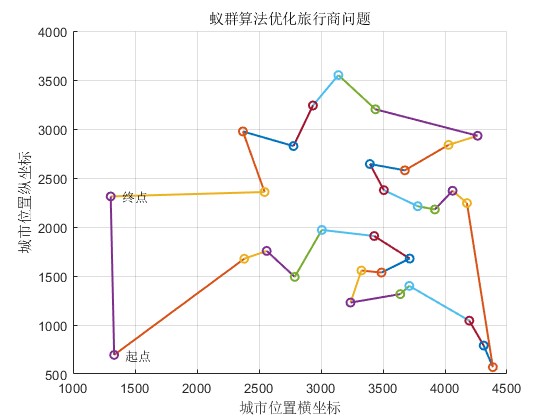
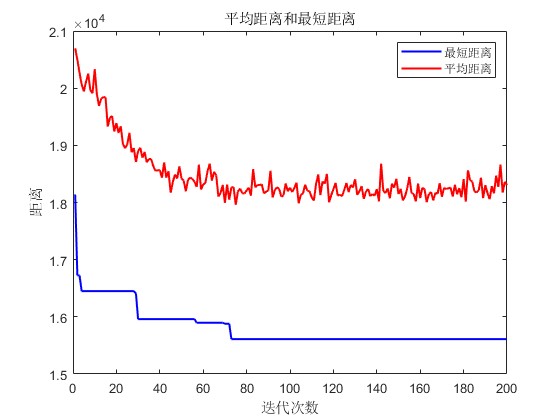
最短距离:15609.4771

最短路径:15  14  12  13  11  23  16   5   6   7   2   4   8   9  10   3  18  17  19  24  25  20  21  22  26  28  27  30  31  29   1  15
代码2
clc; close all; clear

% Initialize the parameters

num_ants = 50; % Number of ants

num_iterations = 200; % Number of iterations

alpha = 1; % Importance of pheromone

beta = 5; % Importance of heuristic information

rho = 0.1; % Evaporation rate of pheromone

coordinates = [1304 2312;3639 1315;4177 2244;3712 1399;3488 1535;3326 1556;...

    3238 1229;4196 1044;4312 790;4386 570;3007 1970;2562 1756;...

    2788 1491;2381 1676;1332 695;3715 1678;3918 2179;4061 2370;...

    3780 2212;3676 2578;4029 2838;4263 2931;3429 1908;3507 2376;...

    3394 2643;3439 3201;2935 3240;3140 3550;2545 2357;2778 2826;...

    2370 2975];

% Calculate distance matrix

n = size(coordinates, 1);

dist_matrix = zeros(n);

% error statement!!!

% start_city_custom = input(sprintf('Enter the starting city index (1 to %d): ', n));

% start_city = start_city_custom;

for i = 1:n

    for j = i+1:n

        dist_matrix(i, j) = norm(coordinates(i, :) - coordinates(j, :));

        dist_matrix(j, i) = dist_matrix(i, j);

    end

end

% Initialize the pheromone matrix

pheromone = ones(n, n);

% Start the iterations

best_distance = inf;

best_path = [];

for i = 1:num_iterations

    paths = zeros(num_ants, n + 1);

    path_lengths = zeros(num_ants, 1);

    % For each ant

    for j = 1:num_ants

        start_city = randi(n);

        paths(j, 1) = start_city;

        for step = 2:n

            current_city = paths(j, step - 1);

            not_visited = setdiff(1:n, paths(j, 1:step - 1));

            prob = (pheromone(current_city, not_visited) .^ alpha) .* ((1 ./ dist_matrix(current_city, not_visited)) .^ beta);

            probabilities = prob / sum(prob);

            next_city = not_visited(randsample(length(not_visited), 1, true, probabilities));

            paths(j, step) = next_city;

        end

        paths(j, n + 1) = paths(j, 1);

        path_lengths(j) = sum(dist_matrix(sub2ind(size(dist_matrix), paths(j, 1:n), paths(j, 2:n + 1))));

        if path_lengths(j) < best_distance

            best_distance = path_lengths(j);

            best_path = paths(j, :);

        end

    end

    % Update the pheromone matrix

    pheromone = (1 - rho) * pheromone;

    for j = 1:num_ants

        for step = 1:n

            pheromone(paths(j, step), paths(j, step + 1)) = ...

                pheromone(paths(j, step), paths(j, step + 1)) + 1 / path_lengths(j);

        end

    end

end

% Print the best path

num_cities = size(coordinates, 1);

fprintf('Optimal path:\n');

for j = 1:num_cities

    fprintf('%d -> ', best_path(j));

end

fprintf('%d\n', best_path(1));

fprintf('Optimal distance: %f\n', best_distance);

% {

% start_city=randi(n)用于为每只蚂蚁随机选择起始城市。

% n 代表城市数,randi(n) 生成1到n(含)之间的随机整数。

% 蚂蚁从不同的城市开始,这增加了探索解决方案的多样性,有助于防止算法陷入局部最优。

% }
输出结果
Optimal path:

14 -> 12 -> 13 -> 11 -> 23 -> 16 -> 5 -> 6 -> 7 -> 2 -> 4 -> 8 -> 9 -> 10 -> 3 -> 18 -> 17 -> 19 -> 24 -> 25 -> 20 -> 21 -> 22 -> 26 -> 28 -> 27 -> 30 -> 31 -> 29 -> 1 -> 15 -> 14

Optimal distance: 15609.477144
代码3
clc; close all; clear

% Coordinates of 31 provincial capital cities in China

coords = [1304 2312;3639 1315;4177 2244;3712 1399;3488 1535;3326 1556;...

    3238 1229;4196 1044;4312 790;4386 570;3007 1970;2562 1756;...

    2788 1491;2381 1676;1332 695;3715 1678;3918 2179;4061 2370;...

    3780 2212;3676 2578;4029 2838;4263 2931;3429 1908;3507 2376;...

    3394 2643;3439 3201;2935 3240;3140 3550;2545 2357;2778 2826;...

    2370 2975];

% Calculate distance matrix

n = size(coords, 1);

dist_matrix = zeros(n);

for i = 1:n

    for j = i+1:n

        dist_matrix(i, j) = norm(coords(i, :) - coords(j, :));

        dist_matrix(j, i) = dist_matrix(i, j);

    end

end

% Initialize ACO parameters

n_ants = 50;

n_iterations = 200;

alpha = 1;

beta = 5;

rho = 0.1;

Q = 100;

% ACO algorithm

[best_path, best_dist, avg_dists, best_dists] = ACO(dist_matrix, n_ants, n_iterations, alpha, beta, rho, Q);

% Display the optimal path and its distance

disp("Optimal path:");

optimal_path_str = join(string(best_path), "->");

disp(optimal_path_str);

disp("Optimal distance:");

% disp(best_dist);

fprintf('%.6f\n', best_dist);

% Plot the cities and the optimal path

figure;

plot(coords(:, 1), coords(:, 2), 'o');

hold on;

plot(coords(best_path, 1), coords(best_path, 2), '-');

title('Cities and the Optimal Path');

xlabel('X Coordinate');

ylabel('Y Coordinate');

grid on;

% Annotate city numbers

for i = 1:n

    text(coords(i, 1), coords(i, 2), num2str(i), 'HorizontalAlignment', 'left', 'VerticalAlignment', 'bottom');

end

% Plot the convergence curves

figure;

plot(1:n_iterations, best_dists, 'b-', 1:n_iterations, avg_dists, 'r-');

title('Convergence Curves');

xlabel('Number of Iterations');

ylabel('Path Distance');

legend('Best Path', 'Average Path');

grid on;

% ACO function

function [best_path, best_dist, avg_dists, best_dists] =...

    ACO(dist_matrix, n_ants, n_iterations, alpha, beta, rho, Q)

n = size(dist_matrix, 1);

best_path = zeros(1, n + 1);

best_dist = Inf;

avg_dists = zeros(1, n_iterations);

best_dists = zeros(1, n_iterations);

pheromone_matrix = ones(n, n);

visibility_matrix = 1 ./ dist_matrix;

for iter = 1:n_iterations

    paths = zeros(n_ants, n + 1);

    path_lengths = zeros(n_ants, 1);

    for ant = 1:n_ants

        start_city = randi(n);

        paths(ant, 1) = start_city;

        for step = 2:n

            current_city = paths(ant, step - 1);

            not_visited = setdiff(1:n, paths(ant, 1:step - 1));

            prob = (pheromone_matrix(current_city, not_visited) .^ alpha) .*...

                (visibility_matrix(current_city, not_visited) .^ beta);

            next_city = not_visited(randsample(length(not_visited), 1, true, prob / sum(prob)));

            paths(ant, step) = next_city;

        end

        paths(ant, n + 1) = paths(ant, 1);

        path_lengths(ant) = sum(dist_matrix(sub2ind(size(dist_matrix), paths(ant, 1:n), paths(ant, 2:n + 1))));

        if path_lengths(ant) < best_dist

            best_dist = path_lengths(ant);

            best_path = paths(ant, :);

        end

    end

    % Update pheromone matrix

    pheromone_matrix = (1 - rho) * pheromone_matrix;

    for ant = 1:n_ants

        for step = 1:n

            pheromone_matrix(paths(ant, step), paths(ant, step + 1)) = ...

                pheromone_matrix(paths(ant, step), paths(ant, step + 1)) + Q / path_lengths(ant);

        end

    end

    % Calculate average path length and record the best distance

    avg_dists(iter) = mean(path_lengths);

    best_dists(iter) = best_dist;

end

end
输出结果
Optimal path:

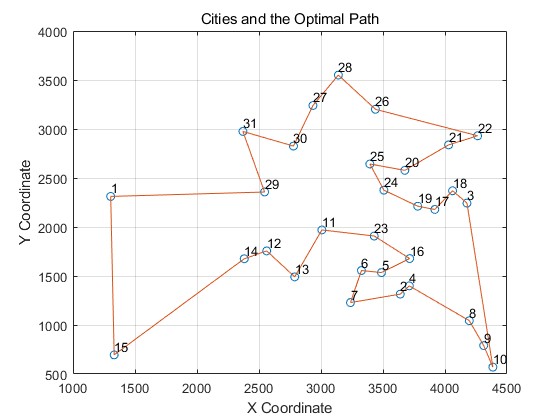
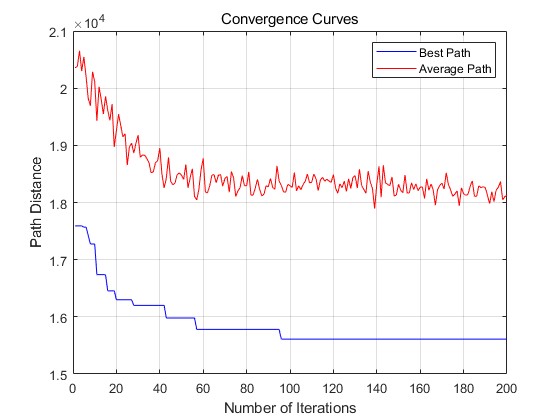
15->14->12->13->11->23->16->5->6->7->2->4->8->9->10->3->18->17->19->24->25->20->21->22->26->28->27->30->31->29->1->15

Optimal distance:

15609.477144
Matlab蚁群算法求解旅行商问题的更多相关文章
- 蚁群算法求解旅行商问题(附c和matlab源代码)
前几天写了个模拟退火算法的程序,然后又陆陆续续看了很多群智能算法,发现很多旅行商问题都采用蚁群算法来求解,于是开始写蚁群算法的模板.网上关于蚁群算法的理论很多就不再这里赘述了,下面直接上代码和进行简单 ...
- ACS蚁群算法求解对称TSP旅行商问题的JavaScript实现
本来以为在了解蚁群算法的基础上实现这道奇怪的算法题并不难,结果实际上大相径庭啊.做了近三天时间,才改成现在这能勉强拿的出手的模样.由于公式都是图片,暂且以截图代替那部分内容吧,mark一记. 1 蚁群 ...
- 利用HTML5 Canvas和Javascript实现的蚁群算法求解TSP问题演示
HTML5提供了Canvas对象,为画图应用提供了便利. Javascript可执行于浏览器中, 而不须要安装特定的编译器: 基于HTML5和Javascript语言, 可随时编写应用, 为算法測试带 ...
- 蚁群算法求解TSP问题
一.蚁群算法简介 蚁群算法是对自然界蚂蚁的寻径方式进行模似而得出的一种仿生算法:蚂蚁在运动过程中,能够在它所经过的路径上留下信息素(pheromone)的物质进行信息传递,而且蚂蚁在运动过程中能够感知 ...
- 蚁群算法(Java)tsp问题
1.理论概述 1.1.TSP问题 旅行商问题,即TSP问题(旅行推销员问题.货郎担问题),是数学领域中著名问题之一.假设有一个旅行商人要拜访n个城市,他必须选择所要走的路径,路径的限制是每个城市只 ...
- 蚁群算法MATLAB解VRP问题
Excel exp12_3_2.xls内容: ANT_VRP函数: function [R_best,L_best,L_ave,Shortest_Route,Shortest_Length]=ANT ...
- 蚁群算法和简要matlab来源
1 蚁群算法原理 从1991由意大利学者 M. Dorigo,V. Maniezzo 和 A. Colorni 通过模拟蚁群觅食行为提出了一种基于群体的模拟进化算法--蚁群优化.极大关注,蚁群算法的特 ...
- 蚁群算法matlab实现
大家好,我是小鸭酱,博客地址为:http://www.cnblogs.com/xiaoyajiang 以下用matlab实现蚁群算法: %蚂蚁算法test %用产生的一个圆上的十个点来检验蚂蚁 ...
- [matlab] 8.蚁群算法解决TSP问题
城市坐标数据下载 密码:07d5 求遍历这52座城市后最后回到最初城市的最短距离 %% 第9章 蚁群算法及MATLAB实现——TSP问题 % 程序9-1 %% 数据准备 % 清空环境变量 clear ...
- 蚁群算法MATLAB解TSP问题
Excel表exp12_3_1.xls中数据为: clc clear all [xdata,textdata]=xlsread('exp12_3_1.xls'); %加载20个城市的数据,数据按照表格 ...
随机推荐
- js 信息脱敏
前端展示信息时,往往要对身份证号.手机号.地址等这类敏感信息进行部分隐藏显示,就是要脱敏处理 一个简单粗暴的脱敏处理方法记录下: hideSensitiveData (string, saveLeng ...
- 为什么reids是单线程
我们首先要明白,reids很快,官方表示,因为reids是基于内存的操作,cpu不是reids的瓶颈,redis的瓶颈有可能是机器内存的大小或者网络带宽,既然单线程容易控制,而且cpu不会成为瓶颈,所 ...
- FtpClient上传文件异常:java.net.SocketException: Connection reset
FtpClient上传文件异常:java.net.SocketException: Connection reset 这问题折磨我快一天了,下午这会儿终于解决了,问题不在程序错误,原因还是出在上传图片 ...
- vs2013安装完VASSISTX助手之后字体变成斜体如何解决?
VC助手为最新版本. 1. 打开vc助手选项 2. 取消勾选"show stable symbols in italics"
- git合入代码过程中问题记录
问题一. 对远端仓库没有操作权限 ERROR: Repository not found. fatal: Could not read from remote repository. 定位思路 1.检 ...
- Apache Ranger系列七:Hive 和 Spark 执行过程中的文件路径配置
背景:在使用Ranger鉴权的过程中,要求必须开启impersonation功能(即执行用户与提交用户保持一致,而不是统一代理的hive/spark).但是在执行的过程中,会需要在hdfs存储临时的文 ...
- lc.977 有序数组的平方
题目描述 给你一个按非递减顺序排序的整数数组nums,返回每个数字的平方组成的新数组,要求也按非递减顺序 排序. 输入:nums = [-4,-1,0,3,10] 输出:[0,1,9,16,100] ...
- 【MSSQL】AlwaysOn集群增加发布订阅
在现有AlwaysOn集群增加发布订阅节点 配置 前提 节点1.节点2在AlwaysOn集群,节点3作为集群外节点使用订阅复制集群数据同步 发布对象必须要有主键 步骤 登录节点3配置分发distrib ...
- IPAD做电脑的绘图板
方法:Microsoft远程桌面 即 RD CLIENT
- 如何确定有价值的RPA场景
什么是RPA? RPA(Robotic Process Automation,机器人流程自动化)是通过特定的.可模拟人类在计算机界面上进行操作的技术,按规则自动执行相应的流程任务,代替或辅助人类完成相 ...