
Codeforces Round #372 (Div. 2) A B C 水 暴力/模拟 构造
2 seconds
256 megabytes
standard input
standard output
ZS the Coder is coding on a crazy computer. If you don't type in a word for a c consecutive seconds, everything you typed disappear!
More formally, if you typed a word at second a and then the next word at second b, then if b - a ≤ c, just the new word is appended to other words on the screen. If b - a > c, then everything on the screen disappears and after that the word you have typed appears on the screen.
For example, if c = 5 and you typed words at seconds 1, 3, 8, 14, 19, 20 then at the second 8 there will be 3 words on the screen. After that, everything disappears at the second 13 because nothing was typed. At the seconds 14 and 19 another two words are typed, and finally, at the second 20, one more word is typed, and a total of 3 words remain on the screen.
You're given the times when ZS the Coder typed the words. Determine how many words remain on the screen after he finished typing everything.
The first line contains two integers n and c (1 ≤ n ≤ 100 000, 1 ≤ c ≤ 109) — the number of words ZS the Coder typed and the crazy computer delay respectively.
The next line contains n integers t1, t2, ..., tn (1 ≤ t1 < t2 < ... < tn ≤ 109), where ti denotes the second when ZS the Coder typed the i-th word.
Print a single positive integer, the number of words that remain on the screen after all n words was typed, in other words, at the second tn.
6 5
1 3 8 14 19 20
3
6 1
1 3 5 7 9 10
2
The first sample is already explained in the problem statement.
For the second sample, after typing the first word at the second 1, it disappears because the next word is typed at the second 3 and 3 - 1 > 1. Similarly, only 1 word will remain at the second 9. Then, a word is typed at the second 10, so there will be two words on the screen, as the old word won't disappear because 10 - 9 ≤ 1.
题意:n个数 从左向右遍历 相邻的数的差值<=c 则计数++ 否则计数清零 输出最后结果
题解:水
 /******************************

 code by drizzle

 blog: www.cnblogs.com/hsd-/

 ^ ^    ^ ^

  O      O

 ******************************/

 #include<bits/stdc++.h>

 #include<iostream>

 #include<cstring>

 #include<cstdio>

 #include<map>

 #include<algorithm>

 #include<queue>

 #define LL __int64

 #define pii pair<int,int>

 #define MP make_pair

 using namespace std;

 int n,c;

 int a[];

 int main()

 {

     scanf("%d%d",&n,&c);

     for(int i=;i<=n;i++)

         scanf("%d",&a[i]);

     int ans=;

     int exm=a[n];

     for(int i=n-;i>=;i--)

     {

        if((exm-a[i])<=c)

         {

         ans++;

         exm=a[i];

         }

         else

         {

             break;

         }

     }

     cout<<ans<<endl;

     return ;
2 seconds
256 megabytes
standard input
standard output
ZS the Coder loves to read the dictionary. He thinks that a word is nice if there exists a substring (contiguous segment of letters) of it of length 26 where each letter of English alphabet appears exactly once. In particular, if the string has length strictly less than 26, no such substring exists and thus it is not nice.
Now, ZS the Coder tells you a word, where some of its letters are missing as he forgot them. He wants to determine if it is possible to fill in the missing letters so that the resulting word is nice. If it is possible, he needs you to find an example of such a word as well. Can you help him?
The first and only line of the input contains a single string s (1 ≤ |s| ≤ 50 000), the word that ZS the Coder remembers. Each character of the string is the uppercase letter of English alphabet ('A'-'Z') or is a question mark ('?'), where the question marks denotes the letters that ZS the Coder can't remember.
If there is no way to replace all the question marks with uppercase letters such that the resulting word is nice, then print - 1 in the only line.
Otherwise, print a string which denotes a possible nice word that ZS the Coder learned. This string should match the string from the input, except for the question marks replaced with uppercase English letters.
If there are multiple solutions, you may print any of them.
ABC??FGHIJK???OPQR?TUVWXY?
ABCDEFGHIJKLMNOPQRZTUVWXYS
WELCOMETOCODEFORCESROUNDTHREEHUNDREDANDSEVENTYTWO
-1
??????????????????????????
MNBVCXZLKJHGFDSAQPWOEIRUYT
AABCDEFGHIJKLMNOPQRSTUVW??M
-1
In the first sample case, ABCDEFGHIJKLMNOPQRZTUVWXYS is a valid answer beacuse it contains a substring of length 26 (the whole string in this case) which contains all the letters of the English alphabet exactly once. Note that there are many possible solutions, such as ABCDEFGHIJKLMNOPQRSTUVWXYZ or ABCEDFGHIJKLMNOPQRZTUVWXYS.
In the second sample case, there are no missing letters. In addition, the given string does not have a substring of length 26 that contains all the letters of the alphabet, so the answer is - 1.
In the third sample case, any string of length 26 that contains all letters of the English alphabet fits as an answer
题意:给你一个串 其中只有大写字母和'?' 现在更改问号位置的字符为大写字母 使得存在连续的长度为26的子串含有所有的大写字母
无法实现 输出-1 否则 输出更改之后的字符串
题解:枚举每个长度为 26 的区间,若区间满足条件就记录区间 [l,r] 并生成题目要求的字符串,否则输出 −1 。生成字符串的方法是,统计 [l,r] 区间中缺少哪个字符
map标记 缺少的字母种类的数量必须和当前区间的问号的数量相等
 /******************************

 code by drizzle

 blog: www.cnblogs.com/hsd-/

 ^ ^    ^ ^

  O      O

 ******************************/

 #include<bits/stdc++.h>

 #include<iostream>

 #include<cstring>

 #include<cstdio>

 #include<map>

 #include<algorithm>

 #include<queue>

 #define LL __int64

 #define pii pair<int,int>

 #define MP make_pair

 using namespace std;

 char a[];

 map<char,int> mp;

 int main()

 {

     cin>>a;

     int len=strlen(a);

     if(len<)

     {

         cout<<"-1"<<endl;

         return ;

     }

     int flag=;

     for(int i=; i<len; i++)

     {

         if(i+>=len)

             break;

         mp.clear();

         int exm=;

         int gg=;

         for(int j=; j<=; j++)

         {

             if(a[i+j-]=='?')

                 exm++;

             else

             {

                 if(mp[a[i+j-]]==)

                 {

                     mp[a[i+j-]]++;

                     gg++;

                 }

             }

         }

         if((exm+gg)==)

             flag=;

         if(flag)

         {

             flag=i+;

             break;

         }

     }

     if(flag==)

     {

         cout<<"-1"<<endl;

         return ;

     }

     flag--;

     for(int i=flag; i<=flag+; i++)

     {

         if(a[i]=='?')

         {

             for(char j='A'; j<='Z'; j++)

             {

                 if(mp[j]==)

                 {

                     a[i]=j;

                     mp[j]=;

                     break;

                 }

             }

         }

     }

     for(int i=; i<len; i++){

         if(a[i]=='?'){

             a[i]='A';

         }}

     for(int i=; i<len; i++)

         printf("%c",a[i]);

     printf("\n");

     return ;

 }
2 seconds
256 megabytes
standard input
standard output
ZS the Coder is playing a game. There is a number displayed on the screen and there are two buttons, ' + ' (plus) and ' ' (square root). Initially, the number 2 is displayed on the screen. There are n + 1 levels in the game and ZS the Coder start at the level 1.
When ZS the Coder is at level k, he can :
- Press the ' + ' button. This increases the number on the screen by exactly k. So, if the number on the screen was x, it becomes x + k.
- Press the '' button. Let the number on the screen be x. After pressing this button, the number becomes
 . After that, ZS the Coder levels up, so his current level becomes k + 1. This button can only be pressed when x is a perfect square, i.e. x = m2 for some positive integer m.
Additionally, after each move, if ZS the Coder is at level k, and the number on the screen is m, then m must be a multiple of k. Note that this condition is only checked after performing the press. For example, if ZS the Coder is at level 4 and current number is 100, he presses the '' button and the number turns into 10. Note that at this moment, 10 is not divisible by 4, but this press is still valid, because after it, ZS the Coder is at level 5, and 10 is divisible by 5.
ZS the Coder needs your help in beating the game — he wants to reach level n + 1. In other words, he needs to press the '' button n times. Help him determine the number of times he should press the ' + ' button before pressing the '' button at each level.
Please note that ZS the Coder wants to find just any sequence of presses allowing him to reach level n + 1, but not necessarily a sequence minimizing the number of presses.
The first and only line of the input contains a single integer n (1 ≤ n ≤ 100 000), denoting that ZS the Coder wants to reach level n + 1.
Print n non-negative integers, one per line. i-th of them should be equal to the number of times that ZS the Coder needs to press the ' + ' button before pressing the '' button at level i.
Each number in the output should not exceed 1018. However, the number on the screen can be greater than 1018.
It is guaranteed that at least one solution exists. If there are multiple solutions, print any of them.
3
14
16
46
2
999999999999999998
44500000000
4
2
17
46
97
In the first sample case:
On the first level, ZS the Coder pressed the ' + ' button 14 times (and the number on screen is initially 2), so the number became 2 + 14·1 = 16. Then, ZS the Coder pressed the '' button, and the number became  .
.
After that, on the second level, ZS pressed the ' + ' button 16 times, so the number becomes 4 + 16·2 = 36. Then, ZS pressed the '' button, levelling up and changing the number into  .
.
After that, on the third level, ZS pressed the ' + ' button 46 times, so the number becomes 6 + 46·3 = 144. Then, ZS pressed the '' button, levelling up and changing the number into  .
.
Note that 12 is indeed divisible by 4, so ZS the Coder can reach level 4.
Also, note that pressing the ' + ' button 10 times on the third level before levelling up does not work, because the number becomes 6 + 10·3 = 36, and when the '' button is pressed, the number becomes and ZS the Coder is at Level 4. However, 6 is not divisible by 4 now, so this is not a valid solution.
In the second sample case:
On the first level, ZS the Coder pressed the ' + ' button 999999999999999998 times (and the number on screen is initially 2), so the number became 2 + 999999999999999998·1 = 1018. Then, ZS the Coder pressed the '' button, and the number became  .
.
After that, on the second level, ZS pressed the ' + ' button 44500000000 times, so the number becomes 109 + 44500000000·2 = 9·1010. Then, ZS pressed the '' button, levelling up and changing the number into  .
.
Note that 300000 is a multiple of 3, so ZS the Coder can reach level 3.
 /******************************

 code by drizzle

 blog: www.cnblogs.com/hsd-/

 ^ ^    ^ ^

  O      O

 ******************************/

 //#include<bits/stdc++.h>

 #include<iostream>

 #include<cstring>

 #include<cmath>

 #include<cstdio>

 #define ll long long

 #define mod 1000000007

 #define PI acos(-1.0)

 using namespace std;

 int main()

 {

     int n;

     scanf("%d",&n);

     cout<<""<<endl;

     for(ll i=; i<=n; i++)

     {

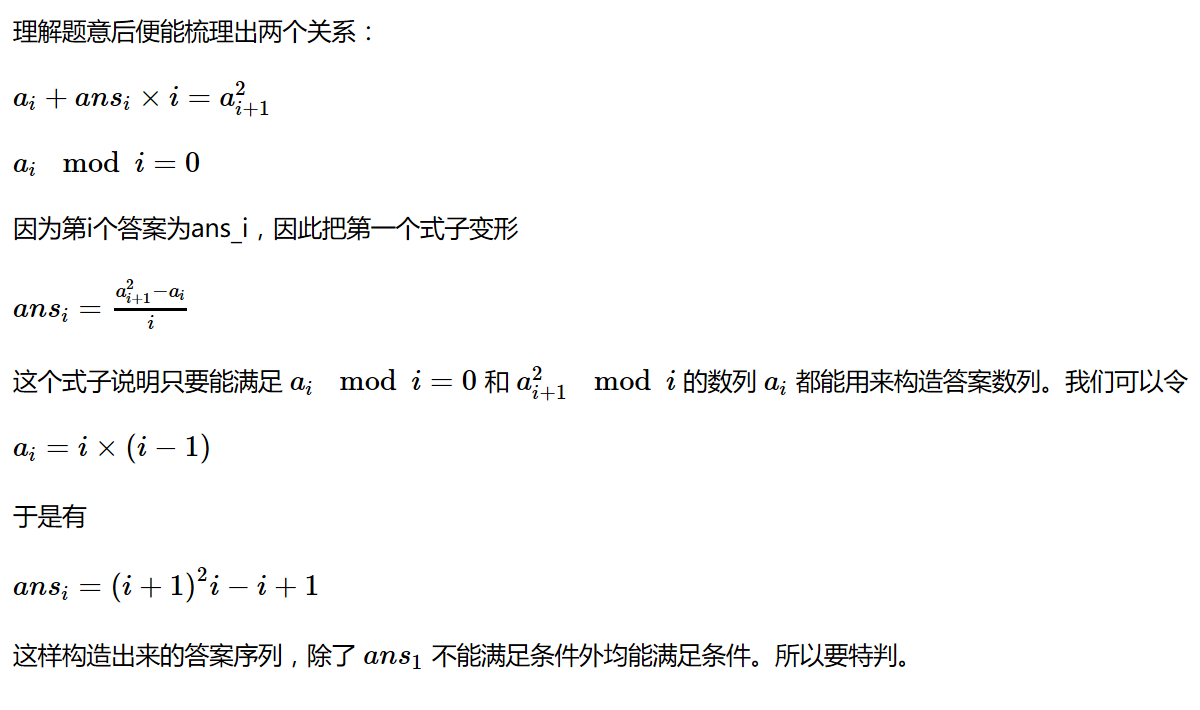
         printf("%I64d\n",(i+)*(i+)*i-i+);

     }

     return ;

 }
Codeforces Round #372 (Div. 2) A B C 水 暴力/模拟 构造的更多相关文章
- Codeforces Round #373 (Div. 2) A B C 水 贪心 模拟(四舍五入进位)
A. Vitya in the Countryside time limit per test 1 second memory limit per test 256 megabytes input s ...
- Codeforces Round #416 (Div. 2)A B C 水 暴力 dp
A. Vladik and Courtesy time limit per test 2 seconds memory limit per test 256 megabytes input stand ...
- Codeforces Round #407 (Div. 2)A B C 水 暴力 最大子序列和
A. Anastasia and pebbles time limit per test 1 second memory limit per test 256 megabytes input stan ...
- Codeforces Round #372 (Div. 2)
Codeforces Round #372 (Div. 2) C. Plus and Square Root 题意 一个游戏中,有一个数字\(x\),当前游戏等级为\(k\),有两种操作: '+'按钮 ...
- Codeforces Round #372 (Div. 2) A .Crazy Computer/B. Complete the Word
Codeforces Round #372 (Div. 2) 不知不觉自己怎么变的这么水了,几百年前做A.B的水平,现在依旧停留在A.B水平.甚至B题还不会做.难道是带着一种功利性的态度患得患失?总共 ...
- Codeforces Round #367 (Div. 2) A. Beru-taxi (水题)
Beru-taxi 题目链接: http://codeforces.com/contest/706/problem/A Description Vasiliy lives at point (a, b ...
- Codeforces Round #297 (Div. 2)D. Arthur and Walls 暴力搜索
Codeforces Round #297 (Div. 2)D. Arthur and Walls Time Limit: 2 Sec Memory Limit: 512 MBSubmit: xxx ...
- Codeforces Round #603 (Div. 2) A. Sweet Problem(水.......没做出来)+C题
Codeforces Round #603 (Div. 2) A. Sweet Problem A. Sweet Problem time limit per test 1 second memory ...
- Codeforces Round #334 (Div. 2) A. Uncowed Forces 水题
A. Uncowed Forces Time Limit: 20 Sec Memory Limit: 256 MB 题目连接 http://codeforces.com/contest/604/pro ...
随机推荐
- phonegap开发入门
做了几次开发配置了,但时间一长就忘了,特记录一下. 一.环境变量配置::右击“我的电脑”-->"高级"-->"环境变量" 1.在系统变量里新建JAV ...
- bzoj 1818: [Cqoi2010]内部白点
#include<cstdio> #include<iostream> #include<algorithm> using namespace std; struc ...
- POJ 3468 区间更新,区间求和(经典)
A Simple Problem with Integers Time Limit: 5000MS Memory Limit: 131072K Total Submissions: 72265 ...
- socket编程概述
一.基本流程如下: 整个TCP过程非常类似于电话系统.TCP是有两个不同主机上的进程需要进行通信,电话系统是有两个人位于不同地区的人需要进行通信. socket:获得可用于进程通信的端点.由于Linu ...
- 结构化视角看django
分析一个软件的整体框架,我认为应该从静态和动态两方面入手.静态方面,看它有哪些用例,即有哪些功能模块:动态方面,看主流程如何连接上这些模块 静态方面:分View.Model.Template.Sess ...
- 在oracle中创建空间索引
Oracle spatial可以方便的存储空间数据,大量的空间数据必需要使用空间索引去查询.在oracle中创建空间索引必需先建立元数据,否则无法创建索引.创建元数据的代码: insert into ...
- iOS开发之单例设计模式(完整正确版本)
单例的意思从字面上就可以略知一二,所谓单例就是确保在程序运行过程中只创建一个对象实例.可以用于需要被多次广泛或者说多次使用的资源中,比如我们常见的网络请求类.工具类以及其它管理类等.比如我iOS开发中 ...
- iOS开发多线程篇—线程间的通信(转)
这里转载 给自己一个备份 一.简单说明 线程间通信:在1个进程中,线程往往不是孤立存在的,多个线程之间需要经常进行通信 线程间通信的体现 1个线程传递数据给另1个线程 在1个线程中执行完特定任务后,转 ...
- linux下磁盘进行分区、文件系统创建、挂载和卸载
任务的原因:由于,刚购买来的服务器需要将磁盘挂载到操作系统上,为了挂载磁盘首先要对磁盘进行分区,然后进行文件系统的创建,最后将磁盘挂载到操作系统上的某个目录. MBR(Master Boot Reco ...
- uva11059
除法(Division,uva725) 输入整数n,按从小到大的顺序输出所有形如abcde/fghij=n的表达式,其中a~j恰好为数字0~9的一个排列(可以有前导0),2<=n<=79. ...