
Linux中ext2文件系统的结构
1、ext2产生的历史
最早的Linux内核是从MINIX系统过渡发展而来的。Linux最早的文件系统就是MINIX文件系统。MINIX文件系统几乎到处都是bug,采用的是16bit偏移量,最大容量为64M,文件名最长为14字符。
Linux内核0.96版本,包含了虚拟文件系统(vitual file system, VFS),VFS中提供了基础的API用于简化扩展新的文件系统——扩展的文件系统(extended file system, ext)基于VFS API。
1992年Linux发布的0.96内核版本拥有了Linux真正意义上的文件系统——扩展的文件系统(The Extended Filesystem, ext),ext采用虚拟文件系统(virtual file system, VFS)即基础的API接口简化扩展的文件系统添加于内核。ext使得单个文件的最大数据容量可达2G,文件名的最大长度扩展到了255个字符。但是ext中不支持文件访问atime,文件内容修改mtime,文件属性修改iNode中的ctime相互独立的时间戳。
为了解决文件的时间戳问题,1993年Linux 0.99版本内核推出,Linux推出了两种新的文件系统:xiafs和ext2(The Second Extended Filesystem).ext2的许多设计理念与Berkeley Fast File System相同,具有扩展的理念,在磁盘数据结构中预留了扩展空间,给将来的新版文件系统的留下了扩展空间。
之后,ext2成了VFS API中许多新扩展的测试平台。例如VFS内含的POSIX访问控制协议草案和扩展属性协议最先内嵌于ext2,归功于ext2的易扩展和易于理解的中断机制。到了Linux的2.6.17内核版本,ext2中的文件最大可达2TB。目前,ext2在闪盘和固态硬盘领域其影响仍由于日志文件系统(ext3/ext4)。因为ext2没有ext3那样额外的日志写操作。因为频繁的写操作,会降低磁盘的使用寿命,相反固态硬盘的寿命因此得以延长。闪盘因为在挂载的时候没有访问时间戳atime,寿命也得意延长。
翻译自维基百科:https://en.wikipedia.org/wiki/Ext2
2、ext2文件系统的结构
在磁盘中,ext2文件系统的结构可以用以下图来描述:
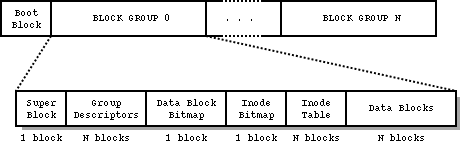
注意:以上是一个磁盘分区,第一个block,是系统启动扇区(boot sector),其余的分区空间都给了ext2文件系统,ext2将该磁盘分区分成了若干个块组(block group 0-N)。
以下是ext2数据结构(ext2_fs.h):
/*
2 * linux/include/linux/ext2_fs.h
3 *
4 * Copyright (C) 1992, 1993, 1994, 1995
5 * Remy Card (card@masi.ibp.fr)
6 * Laboratoire MASI - Institut Blaise Pascal
7 * Universite Pierre et Marie Curie (Paris VI)
8 *
9 * from
10 *
11 * linux/include/linux/minix_fs.h
12 *
13 * Copyright (C) 1991, 1992 Linus Torvalds
14 */ #ifndef _LINUX_EXT2_FS_H
#define _LINUX_EXT2_FS_H #include <linux/types.h> /*
22 * The second extended filesystem constants/structures
23 */ /*
26 * Define EXT2FS_DEBUG to produce debug messages
27 */
#undef EXT2FS_DEBUG /*
31 * Define EXT2_PREALLOCATE to preallocate data blocks for expanding files
32 */
#define EXT2_PREALLOCATE
#define EXT2_DEFAULT_PREALLOC_BLOCKS 8 /*
37 * The second extended file system version
38 */
#define EXT2FS_DATE "95/08/09"
#define EXT2FS_VERSION "0.5b" /*
43 * Debug code
44 */
#ifdef EXT2FS_DEBUG
# define ext2_debug(f, a...) { \
printk ("EXT2-fs DEBUG (%s, %d): %s:", \
__FILE__, __LINE__, __FUNCTION__); \
printk (f, ## a); \
}
#else
# define ext2_debug(f, a...) /**/
#endif /*
56 * Special inode numbers
57 */
#define EXT2_BAD_INO 1 /* Bad blocks inode */
#define EXT2_ROOT_INO 2 /* Root inode */
#define EXT2_ACL_IDX_INO 3 /* ACL inode */
#define EXT2_ACL_DATA_INO 4 /* ACL inode */
#define EXT2_BOOT_LOADER_INO 5 /* Boot loader inode */
#define EXT2_UNDEL_DIR_INO 6 /* Undelete directory inode */ /* First non-reserved inode for old ext2 filesystems */
#define EXT2_GOOD_OLD_FIRST_INO 11 /*
69 * The second extended file system magic number
70 */
#define EXT2_SUPER_MAGIC 0xEF53 /*
74 * Maximal count of links to a file
75 */
#define EXT2_LINK_MAX 32000 /*
79 * Macro-instructions used to manage several block sizes
80 */
#define EXT2_MIN_BLOCK_SIZE 1024
#define EXT2_MAX_BLOCK_SIZE 4096
#define EXT2_MIN_BLOCK_LOG_SIZE 10
#ifdef __KERNEL__
# define EXT2_BLOCK_SIZE(s) ((s)->s_blocksize)
#else
# define EXT2_BLOCK_SIZE(s) (EXT2_MIN_BLOCK_SIZE << (s)->s_log_block_size)
#endif
#define EXT2_ACLE_PER_BLOCK(s) (EXT2_BLOCK_SIZE(s) / sizeof (struct ext2_acl_entry))
#define EXT2_ADDR_PER_BLOCK(s) (EXT2_BLOCK_SIZE(s) / sizeof (__u32))
#ifdef __KERNEL__
# define EXT2_BLOCK_SIZE_BITS(s) ((s)->s_blocksize_bits)
#else
# define EXT2_BLOCK_SIZE_BITS(s) ((s)->s_log_block_size + )
#endif
#ifdef __KERNEL__
#define EXT2_ADDR_PER_BLOCK_BITS(s) ((s)->u.ext2_sb.s_addr_per_block_bits)
#define EXT2_INODE_SIZE(s) ((s)->u.ext2_sb.s_inode_size)
#define EXT2_FIRST_INO(s) ((s)->u.ext2_sb.s_first_ino)
#else
#define EXT2_INODE_SIZE(s) (((s)->s_rev_level == EXT2_GOOD_OLD_REV) ? \
EXT2_GOOD_OLD_INODE_SIZE : \
(s)->s_inode_size)
#define EXT2_FIRST_INO(s) (((s)->s_rev_level == EXT2_GOOD_OLD_REV) ? \
EXT2_GOOD_OLD_FIRST_INO : \
(s)->s_first_ino)
#endif /*
110 * Macro-instructions used to manage fragments
111 */
#define EXT2_MIN_FRAG_SIZE 1024
#define EXT2_MAX_FRAG_SIZE 4096
#define EXT2_MIN_FRAG_LOG_SIZE 10
#ifdef __KERNEL__
# define EXT2_FRAG_SIZE(s) ((s)->u.ext2_sb.s_frag_size)
# define EXT2_FRAGS_PER_BLOCK(s) ((s)->u.ext2_sb.s_frags_per_block)
#else
# define EXT2_FRAG_SIZE(s) (EXT2_MIN_FRAG_SIZE << (s)->s_log_frag_size)
# define EXT2_FRAGS_PER_BLOCK(s) (EXT2_BLOCK_SIZE(s) / EXT2_FRAG_SIZE(s))
#endif /*
124 * ACL structures
125 */
struct ext2_acl_header /* Header of Access Control Lists */
{
__u32 aclh_size;
__u32 aclh_file_count;
__u32 aclh_acle_count;
__u32 aclh_first_acle;
}; struct ext2_acl_entry /* Access Control List Entry */
{
__u32 acle_size;
__u16 acle_perms; /* Access permissions */
__u16 acle_type; /* Type of entry */
__u16 acle_tag; /* User or group identity */
__u16 acle_pad1;
__u32 acle_next; /* Pointer on next entry for the */
/* same inode or on next free entry */
}; /*
146 * Structure of a blocks group descriptor
147 */
struct ext2_group_desc
{
__u32 bg_block_bitmap; /* Blocks bitmap block */
__u32 bg_inode_bitmap; /* Inodes bitmap block */
__u32 bg_inode_table; /* Inodes table block */
__u16 bg_free_blocks_count; /* Free blocks count */
__u16 bg_free_inodes_count; /* Free inodes count */
__u16 bg_used_dirs_count; /* Directories count */
__u16 bg_pad;
__u32 bg_reserved[];
}; /*
161 * Macro-instructions used to manage group descriptors
162 */
#ifdef __KERNEL__
# define EXT2_BLOCKS_PER_GROUP(s) ((s)->u.ext2_sb.s_blocks_per_group)
# define EXT2_DESC_PER_BLOCK(s) ((s)->u.ext2_sb.s_desc_per_block)
# define EXT2_INODES_PER_GROUP(s) ((s)->u.ext2_sb.s_inodes_per_group)
# define EXT2_DESC_PER_BLOCK_BITS(s) ((s)->u.ext2_sb.s_desc_per_block_bits)
#else
# define EXT2_BLOCKS_PER_GROUP(s) ((s)->s_blocks_per_group)
# define EXT2_DESC_PER_BLOCK(s) (EXT2_BLOCK_SIZE(s) / sizeof (struct ext2_group_desc))
# define EXT2_INODES_PER_GROUP(s) ((s)->s_inodes_per_group)
#endif /*
175 * Constants relative to the data blocks
176 */
#define EXT2_NDIR_BLOCKS 12
#define EXT2_IND_BLOCK EXT2_NDIR_BLOCKS
#define EXT2_DIND_BLOCK (EXT2_IND_BLOCK + 1)
#define EXT2_TIND_BLOCK (EXT2_DIND_BLOCK + 1)
#define EXT2_N_BLOCKS (EXT2_TIND_BLOCK + 1) /*
184 * Inode flags
185 */
#define EXT2_SECRM_FL 0x00000001 /* Secure deletion */
#define EXT2_UNRM_FL 0x00000002 /* Undelete */
#define EXT2_COMPR_FL 0x00000004 /* Compress file */
#define EXT2_SYNC_FL 0x00000008 /* Synchronous updates */
#define EXT2_IMMUTABLE_FL 0x00000010 /* Immutable file */
#define EXT2_APPEND_FL 0x00000020 /* writes to file may only append */
#define EXT2_NODUMP_FL 0x00000040 /* do not dump file */
#define EXT2_NOATIME_FL 0x00000080 /* do not update atime */
/* Reserved for compression usage... */
#define EXT2_DIRTY_FL 0x00000100
#define EXT2_COMPRBLK_FL 0x00000200 /* One or more compressed clusters */
#define EXT2_NOCOMP_FL 0x00000400 /* Don't compress */
#define EXT2_ECOMPR_FL 0x00000800 /* Compression error */
/* End compression flags --- maybe not all used */
#define EXT2_BTREE_FL 0x00001000 /* btree format dir */
#define EXT2_RESERVED_FL 0x80000000 /* reserved for ext2 lib */ #define EXT2_FL_USER_VISIBLE 0x00001FFF /* User visible flags */
#define EXT2_FL_USER_MODIFIABLE 0x000000FF /* User modifiable flags */ /*
207 * ioctl commands
208 */
#define EXT2_IOC_GETFLAGS _IOR('f', 1, long)
#define EXT2_IOC_SETFLAGS _IOW('f', 2, long)
#define EXT2_IOC_GETVERSION _IOR('v', 1, long)
#define EXT2_IOC_SETVERSION _IOW('v', 2, long) /*
215 * Structure of an inode on the disk
216 */
struct ext2_inode {
__u16 i_mode; /* File mode */
__u16 i_uid; /* Low 16 bits of Owner Uid */
__u32 i_size; /* Size in bytes */
__u32 i_atime; /* Access time */
__u32 i_ctime; /* Creation time */
__u32 i_mtime; /* Modification time */
__u32 i_dtime; /* Deletion Time */
__u16 i_gid; /* Low 16 bits of Group Id */
__u16 i_links_count; /* Links count */
__u32 i_blocks; /* Blocks count */
__u32 i_flags; /* File flags */
union {
struct {
__u32 l_i_reserved1;
} linux1;
struct {
__u32 h_i_translator;
} hurd1;
struct {
__u32 m_i_reserved1;
} masix1;
} osd1; /* OS dependent 1 */
__u32 i_block[EXT2_N_BLOCKS];/* Pointers to blocks */
__u32 i_generation; /* File version (for NFS) */
__u32 i_file_acl; /* File ACL */
__u32 i_dir_acl; /* Directory ACL */
__u32 i_faddr; /* Fragment address */
union {
struct {
__u8 l_i_frag; /* Fragment number */
__u8 l_i_fsize; /* Fragment size */
__u16 i_pad1;
__u16 l_i_uid_high; /* these 2 fields */
__u16 l_i_gid_high; /* were reserved2[0] */
__u32 l_i_reserved2;
} linux2;
struct {
__u8 h_i_frag; /* Fragment number */
__u8 h_i_fsize; /* Fragment size */
__u16 h_i_mode_high;
__u16 h_i_uid_high;
__u16 h_i_gid_high;
__u32 h_i_author;
} hurd2;
struct {
__u8 m_i_frag; /* Fragment number */
__u8 m_i_fsize; /* Fragment size */
__u16 m_pad1;
__u32 m_i_reserved2[];
} masix2;
} osd2; /* OS dependent 2 */
}; #define i_size_high i_dir_acl #if defined(__KERNEL__) || defined(__linux__)
#define i_reserved1 osd1.linux1.l_i_reserved1
#define i_frag osd2.linux2.l_i_frag
#define i_fsize osd2.linux2.l_i_fsize
#define i_uid_low i_uid
#define i_gid_low i_gid
#define i_uid_high osd2.linux2.l_i_uid_high
#define i_gid_high osd2.linux2.l_i_gid_high
#define i_reserved2 osd2.linux2.l_i_reserved2
#endif #ifdef __hurd__
#define i_translator osd1.hurd1.h_i_translator
#define i_frag osd2.hurd2.h_i_frag;
#define i_fsize osd2.hurd2.h_i_fsize;
#define i_uid_high osd2.hurd2.h_i_uid_high
#define i_gid_high osd2.hurd2.h_i_gid_high
#define i_author osd2.hurd2.h_i_author
#endif #ifdef __masix__
#define i_reserved1 osd1.masix1.m_i_reserved1
#define i_frag osd2.masix2.m_i_frag
#define i_fsize osd2.masix2.m_i_fsize
#define i_reserved2 osd2.masix2.m_i_reserved2
#endif /*
301 * File system states
302 */
#define EXT2_VALID_FS 0x0001 /* Unmounted cleanly */
#define EXT2_ERROR_FS 0x0002 /* Errors detected */ /*
307 * Mount flags
308 */
#define EXT2_MOUNT_CHECK 0x0001 /* Do mount-time checks */
#define EXT2_MOUNT_GRPID 0x0004 /* Create files with directory's group */
#define EXT2_MOUNT_DEBUG 0x0008 /* Some debugging messages */
#define EXT2_MOUNT_ERRORS_CONT 0x0010 /* Continue on errors */
#define EXT2_MOUNT_ERRORS_RO 0x0020 /* Remount fs ro on errors */
#define EXT2_MOUNT_ERRORS_PANIC 0x0040 /* Panic on errors */
#define EXT2_MOUNT_MINIX_DF 0x0080 /* Mimics the Minix statfs */
#define EXT2_MOUNT_NO_UID32 0x0200 /* Disable 32-bit UIDs */ #define clear_opt(o, opt) o &= ~EXT2_MOUNT_##opt
#define set_opt(o, opt) o |= EXT2_MOUNT_##opt
#define test_opt(sb, opt) ((sb)->u.ext2_sb.s_mount_opt & \
EXT2_MOUNT_##opt)
/*
323 * Maximal mount counts between two filesystem checks
324 */
#define EXT2_DFL_MAX_MNT_COUNT 20 /* Allow 20 mounts */
#define EXT2_DFL_CHECKINTERVAL 0 /* Don't use interval check */ /*
329 * Behaviour when detecting errors
330 */
#define EXT2_ERRORS_CONTINUE 1 /* Continue execution */
#define EXT2_ERRORS_RO 2 /* Remount fs read-only */
#define EXT2_ERRORS_PANIC 3 /* Panic */
#define EXT2_ERRORS_DEFAULT EXT2_ERRORS_CONTINUE /*
337 * Structure of the super block
338 */
struct ext2_super_block {
__u32 s_inodes_count; /* Inodes count */
__u32 s_blocks_count; /* Blocks count */
__u32 s_r_blocks_count; /* Reserved blocks count */
__u32 s_free_blocks_count; /* Free blocks count */
__u32 s_free_inodes_count; /* Free inodes count */
__u32 s_first_data_block; /* First Data Block */
__u32 s_log_block_size; /* Block size */
__s32 s_log_frag_size; /* Fragment size */
__u32 s_blocks_per_group; /* # Blocks per group */
__u32 s_frags_per_group; /* # Fragments per group */
__u32 s_inodes_per_group; /* # Inodes per group */
__u32 s_mtime; /* Mount time */
__u32 s_wtime; /* Write time */
__u16 s_mnt_count; /* Mount count */
__s16 s_max_mnt_count; /* Maximal mount count */
__u16 s_magic; /* Magic signature */
__u16 s_state; /* File system state */
__u16 s_errors; /* Behaviour when detecting errors */
__u16 s_minor_rev_level; /* minor revision level */
__u32 s_lastcheck; /* time of last check */
__u32 s_checkinterval; /* max. time between checks */
__u32 s_creator_os; /* OS */
__u32 s_rev_level; /* Revision level */
__u16 s_def_resuid; /* Default uid for reserved blocks */
__u16 s_def_resgid; /* Default gid for reserved blocks */
/*
366 * These fields are for EXT2_DYNAMIC_REV superblocks only.
367 *
368 * Note: the difference between the compatible feature set and
369 * the incompatible feature set is that if there is a bit set
370 * in the incompatible feature set that the kernel doesn't
371 * know about, it should refuse to mount the filesystem.
372 *
373 * e2fsck's requirements are more strict; if it doesn't know
374 * about a feature in either the compatible or incompatible
375 * feature set, it must abort and not try to meddle with
376 * things it doesn't understand...
377 */
__u32 s_first_ino; /* First non-reserved inode */
__u16 s_inode_size; /* size of inode structure */
__u16 s_block_group_nr; /* block group # of this superblock */
__u32 s_feature_compat; /* compatible feature set */
__u32 s_feature_incompat; /* incompatible feature set */
__u32 s_feature_ro_compat; /* readonly-compatible feature set */
__u8 s_uuid[]; /* 128-bit uuid for volume */
char s_volume_name[]; /* volume name */
char s_last_mounted[]; /* directory where last mounted */
__u32 s_algorithm_usage_bitmap; /* For compression */
/*
389 * Performance hints. Directory preallocation should only
390 * happen if the EXT2_COMPAT_PREALLOC flag is on.
391 */
__u8 s_prealloc_blocks; /* Nr of blocks to try to preallocate*/
__u8 s_prealloc_dir_blocks; /* Nr to preallocate for dirs */
__u16 s_padding1;
__u32 s_reserved[]; /* Padding to the end of the block */
}; #ifdef __KERNEL__
#define EXT2_SB(sb) (&((sb)->u.ext2_sb))
#else
/* Assume that user mode programs are passing in an ext2fs superblock, not
402 * a kernel struct super_block. This will allow us to call the feature-test
403 * macros from user land. */
#define EXT2_SB(sb) (sb)
#endif /*
408 * Codes for operating systems
409 */
#define EXT2_OS_LINUX 0
#define EXT2_OS_HURD 1
#define EXT2_OS_MASIX 2
#define EXT2_OS_FREEBSD 3
#define EXT2_OS_LITES 4 /*
417 * Revision levels
418 */
#define EXT2_GOOD_OLD_REV 0 /* The good old (original) format */
#define EXT2_DYNAMIC_REV 1 /* V2 format w/ dynamic inode sizes */ #define EXT2_CURRENT_REV EXT2_GOOD_OLD_REV
#define EXT2_MAX_SUPP_REV EXT2_DYNAMIC_REV #define EXT2_GOOD_OLD_INODE_SIZE 128 /*
428 * Feature set definitions
429 */ #define EXT2_HAS_COMPAT_FEATURE(sb,mask) \
( EXT2_SB(sb)->s_es->s_feature_compat & cpu_to_le32(mask) )
#define EXT2_HAS_RO_COMPAT_FEATURE(sb,mask) \
( EXT2_SB(sb)->s_es->s_feature_ro_compat & cpu_to_le32(mask) )
#define EXT2_HAS_INCOMPAT_FEATURE(sb,mask) \
( EXT2_SB(sb)->s_es->s_feature_incompat & cpu_to_le32(mask) )
#define EXT2_SET_COMPAT_FEATURE(sb,mask) \
EXT2_SB(sb)->s_es->s_feature_compat |= cpu_to_le32(mask)
#define EXT2_SET_RO_COMPAT_FEATURE(sb,mask) \
EXT2_SB(sb)->s_es->s_feature_ro_compat |= cpu_to_le32(mask)
#define EXT2_SET_INCOMPAT_FEATURE(sb,mask) \
EXT2_SB(sb)->s_es->s_feature_incompat |= cpu_to_le32(mask)
#define EXT2_CLEAR_COMPAT_FEATURE(sb,mask) \
EXT2_SB(sb)->s_es->s_feature_compat &= ~cpu_to_le32(mask)
#define EXT2_CLEAR_RO_COMPAT_FEATURE(sb,mask) \
EXT2_SB(sb)->s_es->s_feature_ro_compat &= ~cpu_to_le32(mask)
#define EXT2_CLEAR_INCOMPAT_FEATURE(sb,mask) \
EXT2_SB(sb)->s_es->s_feature_incompat &= ~cpu_to_le32(mask) #define EXT2_FEATURE_COMPAT_DIR_PREALLOC 0x0001
#define EXT2_FEATURE_COMPAT_IMAGIC_INODES 0x0002
#define EXT3_FEATURE_COMPAT_HAS_JOURNAL 0x0004
#define EXT2_FEATURE_COMPAT_EXT_ATTR 0x0008
#define EXT2_FEATURE_COMPAT_RESIZE_INO 0x0010
#define EXT2_FEATURE_COMPAT_DIR_INDEX 0x0020
#define EXT2_FEATURE_COMPAT_ANY 0xffffffff #define EXT2_FEATURE_RO_COMPAT_SPARSE_SUPER 0x0001
#define EXT2_FEATURE_RO_COMPAT_LARGE_FILE 0x0002
#define EXT2_FEATURE_RO_COMPAT_BTREE_DIR 0x0004
#define EXT2_FEATURE_RO_COMPAT_ANY 0xffffffff #define EXT2_FEATURE_INCOMPAT_COMPRESSION 0x0001
#define EXT2_FEATURE_INCOMPAT_FILETYPE 0x0002
#define EXT3_FEATURE_INCOMPAT_RECOVER 0x0004
#define EXT3_FEATURE_INCOMPAT_JOURNAL_DEV 0x0008
#define EXT2_FEATURE_INCOMPAT_ANY 0xffffffff #define EXT2_FEATURE_COMPAT_SUPP 0
#define EXT2_FEATURE_INCOMPAT_SUPP EXT2_FEATURE_INCOMPAT_FILETYPE
#define EXT2_FEATURE_RO_COMPAT_SUPP (EXT2_FEATURE_RO_COMPAT_SPARSE_SUPER| \
EXT2_FEATURE_RO_COMPAT_LARGE_FILE| \
EXT2_FEATURE_RO_COMPAT_BTREE_DIR)
#define EXT2_FEATURE_RO_COMPAT_UNSUPPORTED ~EXT2_FEATURE_RO_COMPAT_SUPP
#define EXT2_FEATURE_INCOMPAT_UNSUPPORTED ~EXT2_FEATURE_INCOMPAT_SUPP /*
478 * Default values for user and/or group using reserved blocks
479 */
#define EXT2_DEF_RESUID 0
#define EXT2_DEF_RESGID 0 /*
484 * Structure of a directory entry
485 */
#define EXT2_NAME_LEN 255 struct ext2_dir_entry {
__u32 inode; /* Inode number */
__u16 rec_len; /* Directory entry length */
__u16 name_len; /* Name length */
char name[EXT2_NAME_LEN]; /* File name */
}; /*
496 * The new version of the directory entry. Since EXT2 structures are
497 * stored in intel byte order, and the name_len field could never be
498 * bigger than 255 chars, it's safe to reclaim the extra byte for the
499 * file_type field.
500 */
struct ext2_dir_entry_2 {
__u32 inode; /* Inode number */
__u16 rec_len; /* Directory entry length */
__u8 name_len; /* Name length */
__u8 file_type;
char name[EXT2_NAME_LEN]; /* File name */
}; /*
510 * Ext2 directory file types. Only the low 3 bits are used. The
511 * other bits are reserved for now.
512 */
enum {
EXT2_FT_UNKNOWN,
EXT2_FT_REG_FILE,
EXT2_FT_DIR,
EXT2_FT_CHRDEV,
EXT2_FT_BLKDEV,
EXT2_FT_FIFO,
EXT2_FT_SOCK,
EXT2_FT_SYMLINK,
EXT2_FT_MAX
}; /*
526 * EXT2_DIR_PAD defines the directory entries boundaries
527 *
528 * NOTE: It must be a multiple of 4
529 */
#define EXT2_DIR_PAD 4
#define EXT2_DIR_ROUND (EXT2_DIR_PAD - 1)
#define EXT2_DIR_REC_LEN(name_len) (((name_len) + 8 + EXT2_DIR_ROUND) & \
~EXT2_DIR_ROUND) #ifdef __KERNEL__
/*
537 * Function prototypes
538 */ /*
541 * Ok, these declarations are also in <linux/kernel.h> but none of the
542 * ext2 source programs needs to include it so they are duplicated here.
543 */
# define NORET_TYPE /**/
# define ATTRIB_NORET __attribute__((noreturn))
# define NORET_AND noreturn, /* balloc.c */
extern int ext2_bg_has_super(struct super_block *sb, int group);
extern unsigned long ext2_bg_num_gdb(struct super_block *sb, int group);
extern int ext2_new_block (struct inode *, unsigned long,
__u32 *, __u32 *, int *);
extern void ext2_free_blocks (struct inode *, unsigned long,
unsigned long);
extern unsigned long ext2_count_free_blocks (struct super_block *);
extern void ext2_check_blocks_bitmap (struct super_block *);
extern struct ext2_group_desc * ext2_get_group_desc(struct super_block * sb,
unsigned int block_group,
struct buffer_head ** bh); /* dir.c */
extern int ext2_add_link (struct dentry *, struct inode *);
extern ino_t ext2_inode_by_name(struct inode *, struct dentry *);
extern int ext2_make_empty(struct inode *, struct inode *);
extern struct ext2_dir_entry_2 * ext2_find_entry (struct inode *,struct dentry *, struct page **);
extern int ext2_delete_entry (struct ext2_dir_entry_2 *, struct page *);
extern int ext2_empty_dir (struct inode *);
extern struct ext2_dir_entry_2 * ext2_dotdot (struct inode *, struct page **);
extern void ext2_set_link(struct inode *, struct ext2_dir_entry_2 *, struct page *, struct inode *); /* fsync.c */
extern int ext2_sync_file (struct file *, struct dentry *, int);
extern int ext2_fsync_inode (struct inode *, int); /* ialloc.c */
extern struct inode * ext2_new_inode (const struct inode *, int);
extern void ext2_free_inode (struct inode *);
extern unsigned long ext2_count_free_inodes (struct super_block *);
extern void ext2_check_inodes_bitmap (struct super_block *);
extern unsigned long ext2_count_free (struct buffer_head *, unsigned); /* inode.c */
extern void ext2_read_inode (struct inode *);
extern void ext2_write_inode (struct inode *, int);
extern void ext2_put_inode (struct inode *);
extern void ext2_delete_inode (struct inode *);
extern int ext2_sync_inode (struct inode *);
extern void ext2_discard_prealloc (struct inode *);
extern void ext2_truncate (struct inode *); /* ioctl.c */
extern int ext2_ioctl (struct inode *, struct file *, unsigned int,
unsigned long); /* super.c */
extern void ext2_error (struct super_block *, const char *, const char *, ...)
__attribute__ ((format (printf, , )));
extern NORET_TYPE void ext2_panic (struct super_block *, const char *,
const char *, ...)
__attribute__ ((NORET_AND format (printf, , )));
extern void ext2_warning (struct super_block *, const char *, const char *, ...)
__attribute__ ((format (printf, , )));
extern void ext2_update_dynamic_rev (struct super_block *sb);
extern void ext2_put_super (struct super_block *);
extern void ext2_write_super (struct super_block *);
extern int ext2_remount (struct super_block *, int *, char *);
extern struct super_block * ext2_read_super (struct super_block *,void *,int);
extern int ext2_statfs (struct super_block *, struct statfs *); /*
611 * Inodes and files operations
612 */ /* dir.c */
extern struct file_operations ext2_dir_operations; /* file.c */
extern struct inode_operations ext2_file_inode_operations;
extern struct file_operations ext2_file_operations; /* inode.c */
extern struct address_space_operations ext2_aops; /* namei.c */
extern struct inode_operations ext2_dir_inode_operations; /* symlink.c */
extern struct inode_operations ext2_fast_symlink_inode_operations; #endif /* __KERNEL__ */ #endif /* _LINUX_EXT2_FS_H */
ext2_fs.h
2.1 超级块(Super Blook)
超级块的数据结构如下:
       /*

   337     * Structure of the super block

   338     */

       struct ext2_super_block {

           __u32    s_inodes_count;        /* Inodes count */

           __u32    s_blocks_count;        /* Blocks count */

           __u32    s_r_blocks_count;    /* Reserved blocks count */

           __u32    s_free_blocks_count;    /* Free blocks count */

           __u32    s_free_inodes_count;    /* Free inodes count */

           __u32    s_first_data_block;    /* First Data Block */

           __u32    s_log_block_size;    /* Block size */

           __s32    s_log_frag_size;    /* Fragment size */

           __u32    s_blocks_per_group;    /* # Blocks per group */

           __u32    s_frags_per_group;    /* # Fragments per group */

           __u32    s_inodes_per_group;    /* # Inodes per group */

           __u32    s_mtime;        /* Mount time */

           __u32    s_wtime;        /* Write time */

           __u16    s_mnt_count;        /* Mount count */

           __s16    s_max_mnt_count;    /* Maximal mount count */

           __u16    s_magic;        /* Magic signature */

           __u16    s_state;        /* File system state */

           __u16    s_errors;        /* Behaviour when detecting errors */

           __u16    s_minor_rev_level;     /* minor revision level */

           __u32    s_lastcheck;        /* time of last check */

           __u32    s_checkinterval;    /* max. time between checks */

           __u32    s_creator_os;        /* OS */

           __u32    s_rev_level;        /* Revision level */

           __u16    s_def_resuid;        /* Default uid for reserved blocks */

           __u16    s_def_resgid;        /* Default gid for reserved blocks */

           /*

   366         * These fields are for EXT2_DYNAMIC_REV superblocks only.

   367         *

   368         * Note: the difference between the compatible feature set and

   369         * the incompatible feature set is that if there is a bit set

   370         * in the incompatible feature set that the kernel doesn't

   371         * know about, it should refuse to mount the filesystem.

   372         *

   373         * e2fsck's requirements are more strict; if it doesn't know

   374         * about a feature in either the compatible or incompatible

   375         * feature set, it must abort and not try to meddle with

   376         * things it doesn't understand...

   377         */

           __u32    s_first_ino;         /* First non-reserved inode */

           __u16   s_inode_size;         /* size of inode structure */

           __u16    s_block_group_nr;     /* block group # of this superblock */

           __u32    s_feature_compat;     /* compatible feature set */

           __u32    s_feature_incompat;     /* incompatible feature set */

           __u32    s_feature_ro_compat;     /* readonly-compatible feature set */

           __u8    s_uuid[];        /* 128-bit uuid for volume */

           char    s_volume_name[];     /* volume name */

           char    s_last_mounted[];     /* directory where last mounted */

           __u32    s_algorithm_usage_bitmap; /* For compression */

           /*

   389         * Performance hints.  Directory preallocation should only

   390         * happen if the EXT2_COMPAT_PREALLOC flag is on.

   391         */

           __u8    s_prealloc_blocks;    /* Nr of blocks to try to preallocate*/

           __u8    s_prealloc_dir_blocks;    /* Nr to preallocate for dirs */

           __u16    s_padding1;

           __u32    s_reserved[];    /* Padding to the end of the block */

       };
struct ext2_super_block
主要的几项描述有:s_inodes_count / s_blocks_count(该分区inode/block总数),s_free_inodes_count / s_free_blocks_count(该分区空闲inode/block数),s_first_data_block(数据块中的起始块位置),s_log_block_size(块大小),s_blocks_per_group(每个块组的块数),s_magic(魔数)
struct ext2_super_block {

	__u32	s_inodes_count;		/* Inodes count */

	__u32	s_blocks_count;		/* Blocks count */

	...

	__u32	s_free_blocks_count;	/* Free blocks count */

	__u32	s_free_inodes_count;	/* Free inodes count */

	__u32	s_first_data_block;	/* First Data Block */

	__u32	s_log_block_size;	/* Block size */

	...

	__u32	s_blocks_per_group;	/* # Blocks per group */

	...

	__u16	s_magic;		/* Magic signature */     # ext2的魔数为0xEF53

	...
说明:每个块组中都有一份超级块的拷贝。当文件系统挂载时,通常只有块组0中的超级块(主备份)会被读取,其他的块组中的超级块只是作为备份,以防文件系统的崩溃。
2.2 组描述符表(Group Descriptors Table,GDT)
超级块之后就是组描述符表,是由该分区所有的块的组描述符(Group Descriptor)组成的,每个块组描述符记录了本块组的inode/block bitmap和inode table等。块组描述符数据结构如下所示:
struct ext2_group_desc

{

	__u32	bg_block_bitmap;	/* Blocks bitmap block */

	__u32	bg_inode_bitmap;	/* Inodes bitmap block */

	__u32	bg_inode_table;		/* Inodes table block */

	__u16	bg_free_blocks_count;	/* Free blocks count */

	__u16	bg_free_inodes_count;	/* Free inodes count */

	__u16	bg_used_dirs_count;	/* Directories count */

	__u16	bg_pad;

	__u32	bg_reserved[3];

};
说明:与超级类似,组描述符表也存在各块组中紧接着超级块,其目的与超级块一样,作为备份,防止文件系统的崩溃。
2.3 块位图和inode位图(block/inode bitmap)
位图(bitmap)是位(bit)的序列,每一个位代表该位图所在块组中的一个特定的数据块(block bitmap)或inode table中一个特定的inode(inode bitmap)。当bit为0时,表示对应的block/inode空闲;为1时,表示已被占用。
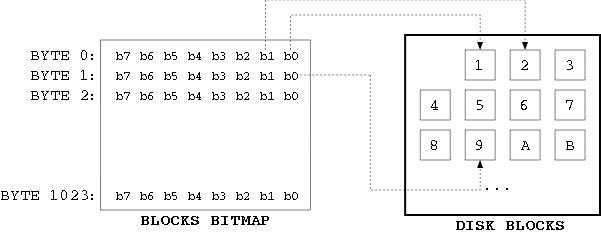
位图始终索引其所在的块组,并且block位图和inode位图均为1block大小,从而限制了该块组的大小。例如一般的block大小为1024bytes,因此一个块组总共有1024*8个block。
2.4 inode表(inode table)
inode表由一系列连续的block块组成,每个块中都预定义了一定数量的inode。inode表的起始块位置(块号)存储在组描述符的bg_inode_table字段中。
系统对inode表中的inode进行编号,从1开始,inode的数据结构被定义在ext2_fs.h文件的struct ext2_inode函数中:
       /*

   215     * Structure of an inode on the disk

   216     */

       struct ext2_inode {

           __u16    i_mode;        /* File mode */

           __u16    i_uid;        /* Low 16 bits of Owner Uid */

           __u32    i_size;        /* Size in bytes */

           __u32    i_atime;    /* Access time */

           __u32    i_ctime;    /* Creation time */

           __u32    i_mtime;    /* Modification time */

           __u32    i_dtime;    /* Deletion Time */

           __u16    i_gid;        /* Low 16 bits of Group Id */

           __u16    i_links_count;    /* Links count */

           __u32    i_blocks;    /* Blocks count */

           __u32    i_flags;    /* File flags */

           union {

               struct {

                   __u32  l_i_reserved1;

               } linux1;

               struct {

                   __u32  h_i_translator;

               } hurd1;

               struct {

                   __u32  m_i_reserved1;

               } masix1;

           } osd1;                /* OS dependent 1 */

           __u32    i_block[EXT2_N_BLOCKS];/* Pointers to blocks */

           __u32    i_generation;    /* File version (for NFS) */

           __u32    i_file_acl;    /* File ACL */

           __u32    i_dir_acl;    /* Directory ACL */

           __u32    i_faddr;    /* Fragment address */

           union {

               struct {

                   __u8    l_i_frag;    /* Fragment number */

                   __u8    l_i_fsize;    /* Fragment size */

                   __u16    i_pad1;

                   __u16    l_i_uid_high;    /* these 2 fields    */

                   __u16    l_i_gid_high;    /* were reserved2[0] */

                   __u32    l_i_reserved2;

               } linux2;

               struct {

                   __u8    h_i_frag;    /* Fragment number */

                   __u8    h_i_fsize;    /* Fragment size */

                   __u16    h_i_mode_high;

                   __u16    h_i_uid_high;

                   __u16    h_i_gid_high;

                   __u32    h_i_author;

               } hurd2;

               struct {

                   __u8    m_i_frag;    /* Fragment number */

                   __u8    m_i_fsize;    /* Fragment size */

                   __u16    m_pad1;

                   __u32    m_i_reserved2[];

               } masix2;

           } osd2;                /* OS dependent 2 */

       };
struct ext2_inode
以下是inode数据结构中比较重要的字段:
struct ext2_inode {

        __u16   i_mode;         /* File type and access rights */

        __u16   i_uid;          /* Low 16 bits of Owner Uid */

        __u32   i_size;         /* Size in bytes */

        __u32   i_atime;        /* Access time */

        __u32   i_ctime;        /* Creation time */

        __u32   i_mtime;        /* Modification time */

        __u32   i_dtime;        /* Deletion Time */

        __u16   i_gid;          /* Low 16 bits of Group Id */

        __u16   i_links_count;  /* Links count */

        __u32   i_blocks;       /* Blocks count */

        __u32   i_flags;        /* File flags */

	...

	__u32   i_block[EXT2_N_BLOCKS];  /* Pointers to blocks */

	...

};
i_mode字段中包含了文件的类型和文件的访问权限,被定义在宏文件macro (sys/stat.h)中。
| Sign | Type | Macro |
| - | Regular file | S_ISREG(m) |
| d | Directory | S_ISDIR(m) |
| c | Character Device | S_ISCHR(m) |
| b | Block Device | S_ISBLK(m) |
| f | Fifo | S_ISIFO(m) |
| s | Socket | S_ISSOCK(m) |
| l | Symbolic Link | S_ISLNK(m) |
| Domain | Read | Write | Exec | All |
| User | S_IRUSR | S_IWUSR | S_IXUSR | S_IRWXU |
| Group | S_IRGRP | S_IWGRP | S_IXGRP | S_IRWXG |
| All | S_IROTH | S_IWOTH | S_IXOTH | S_IRWXO |
i_blocks是该inode指向的文件已使用的block数量;指向数据块的指针存储于字段i_block[EXT2_N_BLOCKS]的数组结构中。
变量EXT2_N_BLOCKS定义在ext2_fs.h的第177行中:
   174	/*

   175	 * Constants relative to the data blocks

   176	 */

   177	#define	EXT2_NDIR_BLOCKS		12

   178	#define	EXT2_IND_BLOCK			EXT2_NDIR_BLOCKS

   179	#define	EXT2_DIND_BLOCK			(EXT2_IND_BLOCK + 1)

   180	#define	EXT2_TIND_BLOCK			(EXT2_DIND_BLOCK + 1)

   181	#define	EXT2_N_BLOCKS			(EXT2_TIND_BLOCK + 1)
在i_block[]数组中有15个指针,它们所代表的含义如下:
i_block[0..11]point directly to the first 12 data blocks of the file. # 序列号0-11的12个元素(指针)指向文件开头的12个数据块i_block[12]points to a single indirect block # 第13号元素指向单索引间接块i_block[13]points to a double indirect block # 第14号元素指向双索引间接块i_block[14]points to a triple indirect block # 第15号元素指向三索引间接块
由此我们可以计算出ext2文件系统单个文件的最大容量(假设block大小为1K),数组i_block[]的长度为32bit/8=4byte:
- 直接索引:12 指针
- 单间接索引:1024/4=256个直接索引,256 指针
- 双间接索引:1024/4=256个单间接索引,256*256 指针
- 三间接索引:1024/4=256个双间接索引,256*256*256 指针
因此可得到12K+256K+64M+16G,即大致为16G。如果block的大小为4K,则文件最大可为4T。(注意:真正决定文件大小的是底层的寄存器,寄存器的位数决定了其寻址的能力)
2.5 inode表中的inode指向的目录文件
inode指向的目录文件需加以注意,我们可以通过测试S_ISDIR(mode) macro来加以识别:
if (S_ISDIR(inode.i_mode)) ...
假设inode指向的块是目录实体/home,目录中的内容包含了一系列的文件名和指向inode表中的对应的,如下图:

目录文件的数据结构如下:
struct ext2_dir_entry_2 {

	__u32	inode;			/* Inode number */

	__u16	rec_len;		/* Directory entry length */

	__u8	name_len;		/* Name length */

	__u8	file_type;

	char	name[EXT2_NAME_LEN];	/* File name */

};
字段file_type总共有0-7可能的值,分别代表: 
目录内容中的各项(实体)的大小是非固定的,大小取决于文件名称的长度。文件名称最大长度为EXT2_NAME_LEN的值,一般为255;文件名称的实际长度存放于字段name_len;rec_len存储的是本目录实体的大小,该字段自然也就决定了下一目录实体的位置了。
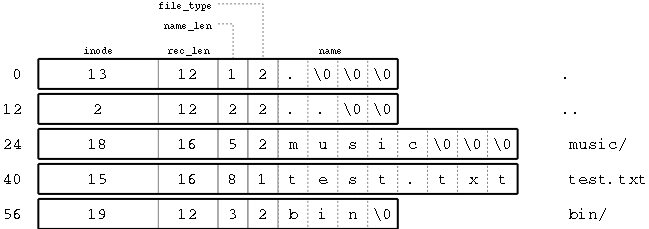 Example of EXT2 directory
注意:目录中的inode号,指向的是inode表中的inode,指向data block的是i_block[EXT2_N_BLOCKS]的数组中的指针。
2.6 文件操作(创建、查找、修改、删除)的本质
http://cs.smith.edu/~nhowe/Teaching/csc262/oldlabs/ext2.html
https://www.cnblogs.com/f-ck-need-u/p/7016077.html
待完善...
Linux中ext2文件系统的结构的更多相关文章
- Linux 下EXT2文件系统 —— 如何将蚂蚁和大象优雅的装进冰箱里
这一阵子真是偷懒,无时无刻不和自己身体中的懒癌做斗争.最终我还是被打败了,星期天两天几乎都是荒废过去的,在空闲的时候实际上我内心也是有点焦虑的,不知道去怎么度过这时间.学习吧又不想学习,看电视娱乐吧也 ...
- 文件系统的特性,linux的EXT2文件系统【转】
本文转载自:https://blog.csdn.net/tongyijia/article/details/52809281 先来提出三个概念: - superblock - inode - bloc ...
- Linux中表示“时间”的结构体和相关函数
转载于:http://blog.chinaunix.net/uid-25909722-id-2827364.html Linux中表示“时间”的结构体和相关函数 2011-09-13 17: ...
- LInux中的文件系统1
2017-03-08 10:37:55 一.虚拟文件系统VFS 文件系统用于将位于磁盘上的文件按照某种方式组织进内存,并给上层应用程序提供统一的访问接口.Linux支持多种文件系统EXT2/3,NTF ...
- Linux中进程控制块PCB-------task_struct结构体结构
Linux中task_struct用来控制管理进程,结构如下: struct task_struct { //说明了该进程是否可以执行,还是可中断等信息 volatile long state; // ...
- Linux基本操作 2-----Linux文件系统基本结构
Linux的文件系统结构 Linux文件系统为一个倒转的单根树状结构 文件系统的根为"/" 文件系统严格区分大小写 路径使用“/”来分割,在windows使 ...
- linux中proc文件系统 -- ldd3读书笔记
1./proc 文件系统概述 /proc 文件系统是由软件创建,被内核用来向外界报告信息的一个文件系统./proc 下面的每一个文件都和一个内核函数相关联,当文件的被读取时,与之对应的内核函数用于产生 ...
- linux中查看文件夹结构的小工具
tree命令是Linux/UNIX系统中常用的命令,可以非常方便地查看文件夹的结构,并且以树形目录的形式展示 在Ubuntu中安装 sudo apt-get install tree 在CentOS中 ...
- Linux中文件/文件系统的压缩、打包和备份总结(基于rhel7)
文件/文件系统的压缩.打包 Linux有哪些压缩工具可供选择 按压缩比:xz>bzip2>gzip,按压缩时长:gzip>bzip2>xz,另外还有zip可以选择. gzip只 ...
随机推荐
- C#创建DataTable的语法
namespace EazyCMS.Web.admin { public partial class ceshi1 : System.Web.UI.Page { protected void Page ...
- MySQL on Azure高可用性设计 DRBD - Corosync - Pacemaker - CRM (二)
在上一篇文章中描述了MySQL HA on Azured 设计思路,本篇文章中将描述具体的部署,每个组件的安装和配置. 整体的设计架构如下: 下面将是所有组件的安装配置过程,所有的虚拟机是CentOS ...
- Excel特殊格式的列
1.根据前两列显示天时分格式,算出所需时间列的内容=DAY(O2-N2)&"天"&HOUR(O2-N2)&"小时"&MINUTE ...
- Ruby迭代器(Iterator)
简单的讲,一个迭代器就是一个能接受代码块的方法.当初为了进行迭代操作而设置了带块方法,现在很多时候仍然称它为迭带器. 可实际上,早期版本的 Ruby 将使用代码块的方法称为迭代器,因为它们就是被设计来 ...
- POST-GET请求
在应用中最常用的Http请求无非是get和post,get请求可以获取静态页面,也可以把参数放在URL字串后面,传递给servlet.post与get的不同之处在于post的参数不是放在URL字串里面 ...
- WPF 导出Excel(合并单元格)
WPF 导出Excel(合并单元格) DataTable 导出Excel(导出想要的列,不想要的去掉) ,B1,B2,B3,B4,B5} MisroSoft.Office.Interop.Excel. ...
- LAMP 1.6 Discuz打开错误
打开discuz失败, ps aux |grep mysql ps aux |grep httpd 查看mysql apache有没有打开. 重启mysql service mysqld restar ...
- 字符编码ANSI、ASCII、GB2312、GBK、GB18030、UNICODE、UTF-8小结
编码和解码可以理解成二进制和字符(广义的字符,包括汉字等)的映射表,编码即从字符映射至二进制,解码则为逆过程. 1.英语字符编码ASCII 开始计算机只在美国用.8字节一共可以组合出256(2的8次方 ...
- MD5算法的c++实现
需要注意的几点: (1)md5存取的数据长度仅为64位,位于数据的最前端,大于令其自然溢出. (2)update函数和final函数处理得很繁琐,需要仔细分析. (3)16位md5码取32位md5码的 ...
- 6.docker常用命令
docker 常见命令 更细的配置请参考官方文档 第一大部分容器生命周期管理 01 .docker run :创建一个新的容器并运行一个命令 $ docker run [OPTIONS] IMAGE ...