
Squares UVA - 201
A children’s board game consists of a square array of dots that contains lines connecting some of the pairs of adjacent dots. One part of the game requires that the players count the number of squares of certain sizes that are formed by these lines. For example, in the figure shown below, there are 3 squares — 2 of size 1 and 1 of size 2. (The “size” of a square is the number of lines segments required to form a side.)
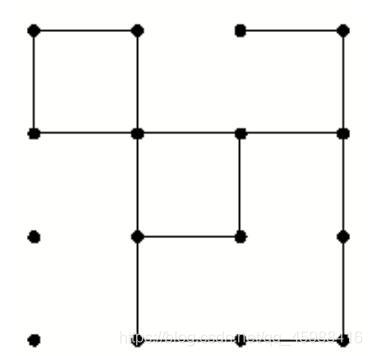
Your problem is to write a program that automates the process of counting all the possible squares.
Input
The input file represents a series of game boards. Each board consists of a description of a square array of n 2 dots (where 2 ≤ n ≤ 9) and some interconnecting horizontal and vertical lines. A record for a single board with n 2 dots and m interconnecting lines is formatted as follows:
Line 1: n the number of dots in a single row or column of the array .
Line 2: m the number of interconnecting lines.
Each of the next m lines are of one of two types:
H i j indicates a horizontal line in row i which connects
the dot in column j to the one to its right in column j + 1
or
V i j indicates a vertical line in column i which connects
the dot in row j to the one below in row j + 1
Information for each line begins in column 1. The end of input is indicated by end-of-file. The first record of the sample input below represents the board of the square above.
Output
For each record, label the corresponding output with ‘Problem #1’, ‘Problem #2’, and so forth. Output for a record consists of the number of squares of each size on the board, from the smallest to the largest. lf no squares of any size exist, your program should print an appropriate message indicating so. Separate output for successive input records by a line of asterisks between two blank lines, like in the sample below.
Sample Input
4

16

H 1 1

H 1 3

H 2 1

H 2 2

H 2 3

H 3 2

H 4 2

H 4 3

V 1 1

V 2 1

V 2 2

V 2 3

V 3 2

V 4 1

V 4 2

V 4 3

2

3

H 1 1

H 2 1

V 2 1
Sample Output
Problem #1

2 square (s) of size 1

1 square (s) of size 2

**********************************

Problem #2

No completed squares can be found.
HINT
暴力破解的,使用连两个数组分别储存竖边和横边,然后判断每一个可能的正方形。使用了4个for循环来来判断,最外层循环是正方形的大小,最大到n-1。紧接着两个循环对每一个可能的顶点来判断。最里面的才是判断标准,
#include<stdio.h>

#include<stdlib.h>

#include<string.h>

int result(int arrh[][10], int arrv[][10], int n);

int main()

{

	int n, m ,p, q;

	int problem = 1;

	while (scanf("%d %d", &n, &m) != EOF)

	{

		getchar();

		int arrh[10][10] = { 0 };

		int arrv[10][10] = { 0 };

		char ch;

		for (int i = 0;i < m;i++)

		{

			scanf("%c %d %d", &ch, &p, &q);getchar();

			if (ch == 'H')arrh[p][q]=1;

			else arrv[q][p] = 1;

		}

		if (problem != 1)printf("\n**********************************\n\n");

		printf("Problem #%d\n\n", problem++);

		if (result(arrh, arrv, n)==0)printf("No completed squares can be found.\n");

	}

}

int result(int arrh[][10], int arrv[][10], int n)

{

	int flag = 0;

	for (int i = 1;i < n;i++)

	{

		int sum = 0;

		for (int j = 1;j <= n - i;j++)

		{

			for (int k = 1;k <= n - i;k++)

			{

				int flag1 = 0;

				for (int s = 0;s<i;s++)

				{

					if (!arrh[j][k + s] || !arrh[j + i][k + s] || !arrv[j + s][k] || !arrv[j + s][k + i])

					{

						flag1 = 1;break;

					}

				}

				if (!flag1) { sum++;flag = 1; }

			}

		}

		if (sum)printf("%d square (s) of size %d\n", sum, i);

	}

	return flag;

}
Squares UVA - 201的更多相关文章
- 【每日一题】Squares UVA - 201 暴力+输出坑 + 读文件模板
题意 给你n*n的图,让你数正方形 题解:暴力for每个点,对于每个点从它出发顺时针走一个正方形.走完就ans[i]++; 坑:多输了一行******,然后在那里手摸样例,无限debug orz #d ...
- UVa 201 Squares
题意: 给出这样一个图,求一共有多少个大小不同或位置不同的正方形. 分析: 这种题一看就有思路,最开始的想法就是枚举正方形的位置,需要二重循环,枚举边长一重循环,判断是否为正方形又需要一重循环,复杂度 ...
- 【UVA】201 Squares(模拟)
题目 题目 分析 记录一下再预处理一下. 代码 #include <bits/stdc++.h> int main() { int t=0,s,n; while(scanf ...
- UVa 1453 - Squares 旋转卡壳求凸包直径
旋转卡壳求凸包直径. 参考:http://www.cppblog.com/staryjy/archive/2010/09/25/101412.html #include <cstdio> ...
- UVa 1643 Angle and Squares
题意: 如图,有n个正方形和一个角(均在第一象限中),使这些正方形与这个角构成封闭的阴影区域,求阴影区域面积的最大值. 分析: 直观上来看,当这n个正方形的对角线在一条直线上时,封闭区域的面积最大.( ...
- uva 1453 - Squares
旋转卡壳算法: 直接在这个上面粘的模板 主要用途:用于求凸包的直径.宽度,两个不相交凸包间的最大距离和最小距离··· 这题就是求凸包的直径 #include <cstdio> #inclu ...
- UVA 4728 Squares(凸包+旋转卡壳)
题目链接:http://acm.hust.edu.cn/vjudge/problem/viewProblem.action?id=17267 [思路] 凸包+旋转卡壳 求出凸包,用旋转卡壳算出凸包的直 ...
- UVA 12113 Overlapping Squares
题意: 总共有6个2*2的正方形,判断是否能够成所给的形状. 思路: 一个正方形总共有9种摆放方式,对于整个地图来说摆放方式总共有2的9次方种摆放方式.然后将地图用9*5的数组表示,正方形的位置用其8 ...
- UVa 1643 Angle and Squares (计算几何)
题意:有n个正方形和一个角(均在第一象限中),使这些正方形与这个角构成封闭的阴影区域,求阴影区域面积的最大值. 析:很容易知道只有所有的正方形的对角形在一条直线时,是最大的,然后根据数学关系,就容易得 ...
随机推荐
- DisplayFormat属性
DataFormatString="{0:格式字符串}" 在DataFormatString 中的 {0} 表示数据本身,而在冒号后面的格式字符串代表所们希望数据显示的格式: 数字 ...
- Asp.NET Core 限流控制-AspNetCoreRateLimit
起因: 近期项目中,提供了一些调用频率较高的api接口,需要保障服务器的稳定运行:需要对提供的接口进行限流控制.避免因客户端频繁的请求导致服务器的压力. 一.AspNetCoreRateLimit 介 ...
- 学习笔记 - 快速傅里叶变换 / 大数A * B的另一种解法
转: 学习笔记 - 快速傅里叶变换 / 大数A * B的另一种解法 文章目录 前言 ~~Fast Fast TLE~~ 一.FFT是什么? 二.FFT可以干什么? 1.多项式乘法 2.大数乘法 三.F ...
- 一个 java 文件的执行过程详解
平时我们都使用 idea.eclipse 等软件来编写代码,在编写完之后直接点击运行就可以启动程序了,那么这个过程是怎么样的? 总体过程 我们编写的 java 文件在由编译器编译后会生成对应的 cla ...
- CSS相关知识(持续更新中)
1. 弹性布局 一种当页面需要适应不同的屏幕大小以及设备类型时确保元素拥有恰当的行为的布局方式.引入弹性布局模型的目的是提供一种更加有效的方式来对一个容器中的子元素进行排列.对齐和分配空白空间. 2. ...
- OpenGL中的坐标系统详细概括:包括Z缓冲
一: 首先就是关于几个坐标系统的概括: 局部坐标是对象相对于局部原点的坐标,也是物体起始的坐标. 下一步是将局部坐标变换为世界空间坐标,世界空间坐标是处于一个更大的空间范围的.这些坐标相对于世界的全局 ...
- Java的封装继承和多态
封装 定义:属性私有private:get/set 目的 提高程序的安全性,保护数据 隐藏代码的实现细节 统一接口 提高系统的可维护性 代码 public class Student { //名字 p ...
- 2020年12月-第01阶段-前端基础-HTML常用标签
1. HTML常用标签 首先 HTML和CSS是两种完全不同的语言,我们学的是结构,就只写HTML标签,认识标签就可以了. 不会再给结构标签指定样式了. HTML标签有很多,这里我们学习最为常用的,后 ...
- External Libraries中没有Maven的jar包的原因(已解决)
**深坑!** ## External Libraries中没有Maven的jar包的原因(已解决) 2021年3月1日 --- 搭建一个新项目 IDEA 从 Git 上拉 拉去Maven项目然后 m ...
- Python基础学习【day2】
运算符 运算符有哪些? 加 + 减 - 乘 * 除 / 幂 ** 取余 % ...