
STM32F4: Generating parallel signals with the FSMC
STM32F4: Generating parallel signals with the FSMC
The goal: The memory controller can be used to generate a "generic" 16-bit parallel data stream with clock. Address generation will be disregarded, as well as other control signals dedicated to memory chips.
It must be noted that the STM32F40x and STM32F41x have the FSMC (static memories), while theSTM32F42x and STM32F43x have the FMC (static and dynamic memories). The differences between the two concern the support of SDRAM (dynamic RAM), address and data write FIFOs (both data and address, instead of data only for FSMC, and 16-word long instead of 2-word long only for FSMC), and the 32-bit wide data bus for FMC (See [1]).
Set pins (1st attempt)
Only data bus FSMC_D[15:0] and clock FSMC_CLK will be used (set as alternate function). The other pins are set as standard GPIOs (general purpose output).
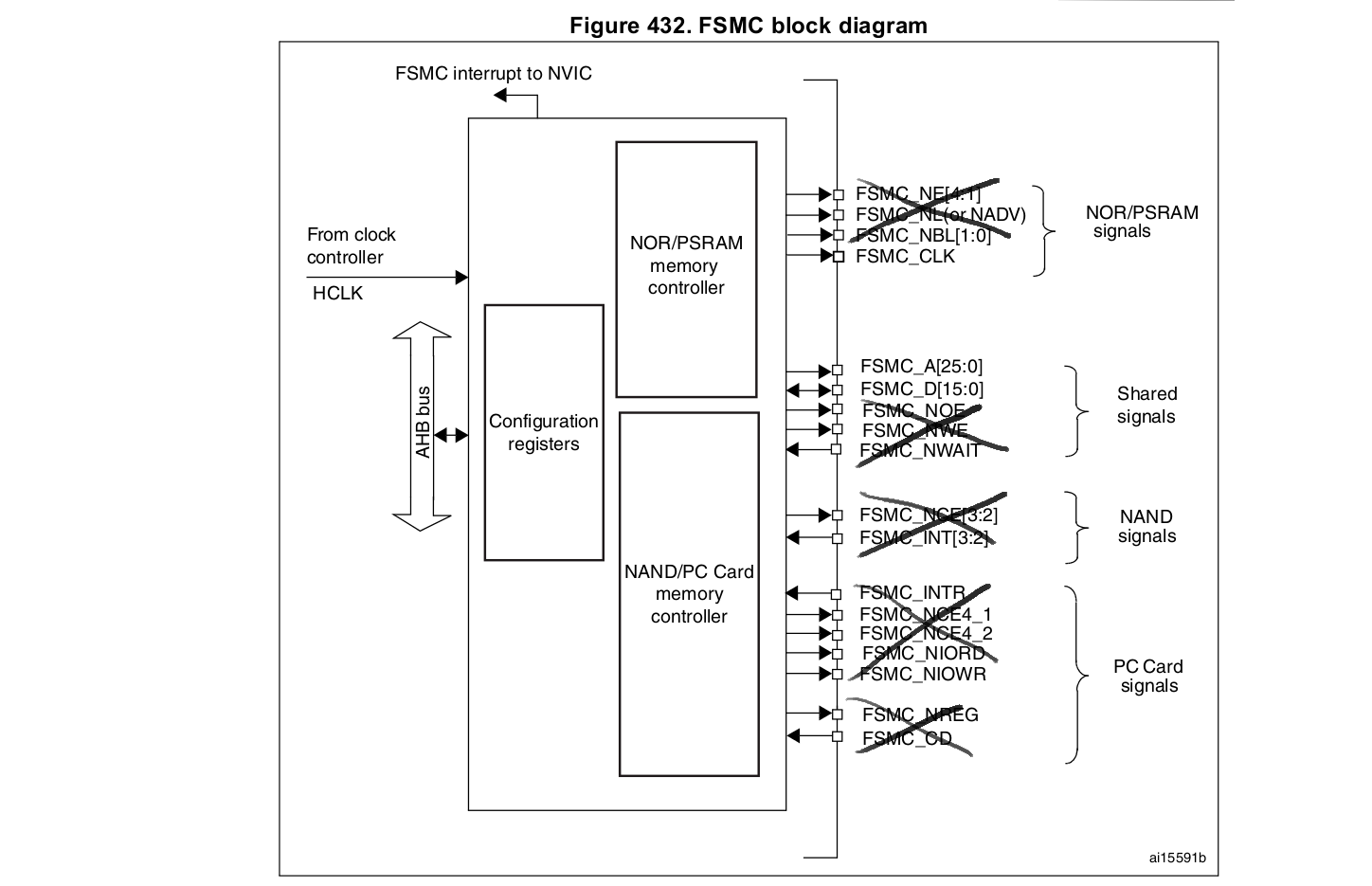
FSMC is alternate function 12 according to the datasheet (See "Table 9. Alternate function mapping" in [2]).
/* PD: 0, 1, 3, 8, 9, 10, 14, 15 -> alternate function (0b10) */

GPIOD->MODER = 0xA56A559A;

GPIOD->AFR[] = 0xCCCCCCCC; /* FSMC = AF12 (0xC) */

GPIOD->AFR[] = 0xCCCCCCCC;

/* PE: 7, 8, 9, 10, 11, 12, 13, 14, 15 -> alternate function (0b10) */

GPIOE->MODER = 0xAAAA9555;

GPIOE->AFR[] = 0xCCCCCCCC;

GPIOE->AFR[] = 0xCCCCCCCC;
FSMC setup/init (1st attempt)
Be careful of the the wicked register map documentation of the FSMC block:
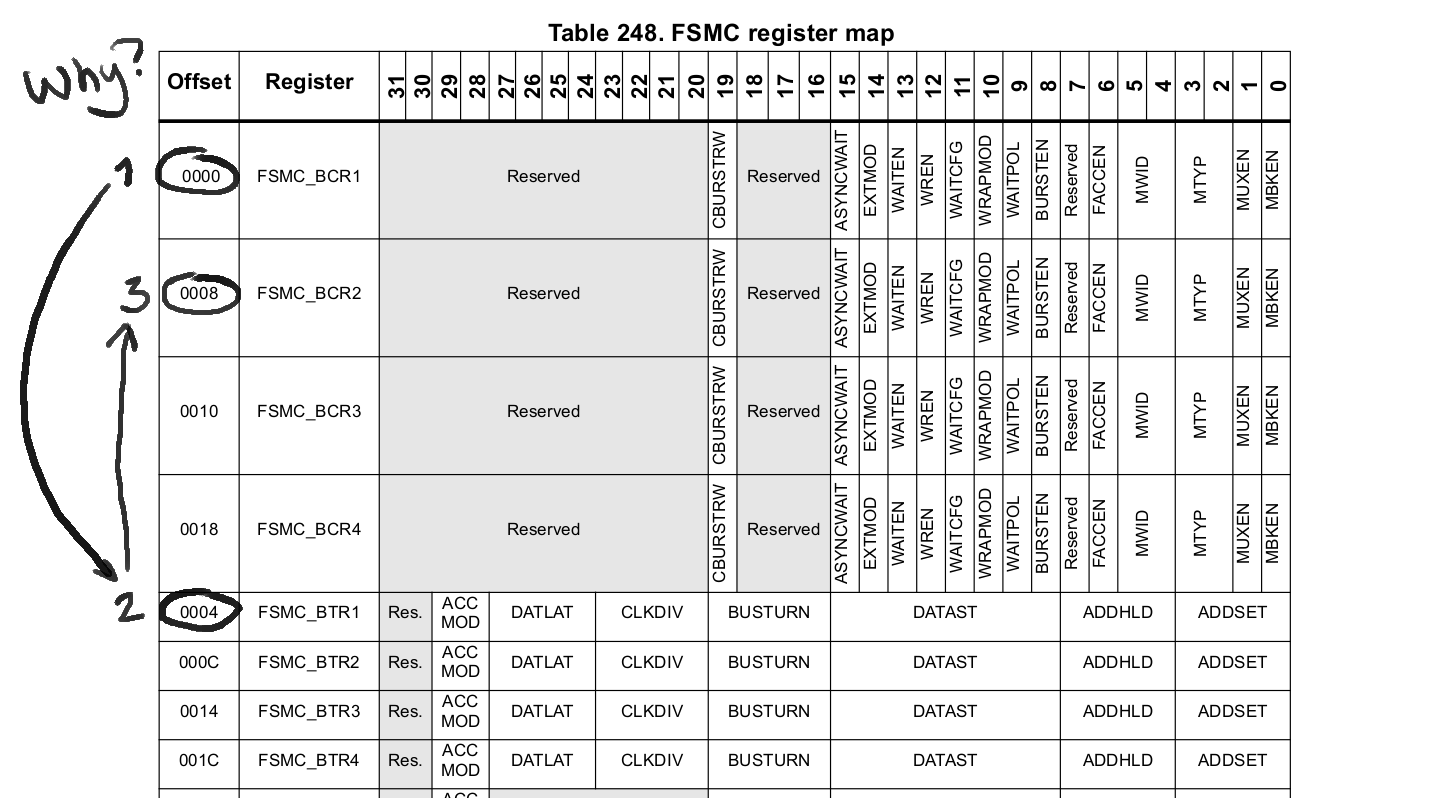
This is very misleading, since all other table are ordered as found in memory, but not here.
/* PSRAM, synchronous (burst), non-multiplexed */

/* control register */

FSMC_Bank1->BTCR[] = FSMC_BCR1_CBURSTRW | FSMC_BCR1_WAITPOL | FSMC_BCR1_BURSTEN | FSMC_BCR1_MWID_0 | FSMC_BCR1_WREN | FSMC_BCR1_MTYP_0 /* PSRAM */ | FSMC_BCR1_MBKEN;

/* timing register */

FSMC_Bank1->BTCR[] = FSMC_BTR1_CLKDIV_1 /* div 3 */ ;
It is noticable that the timing are all set to 0, except the clock.
Result (1st attempt)
The code writing to the FSMC is using an array and simulate a sequencial memory request, in order to take advantage of the burst mode.
volatile uint16_t* fsmc = (uint16_t*)0x60000000;

for(uint32_t i=; i<(sizeof(bitstream_bin)/); i++) {

        uint16_t w = ((uint16_t*)bitstream_bin)[i];

        fsmc[i] = w;

}
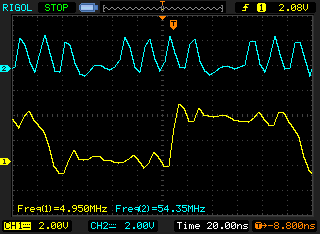
The clock is ~54MHz, but the maximum clock is HCLK/2 = 168/2=84MHz. Unfortunately, my oscilloscope is too slow for this.
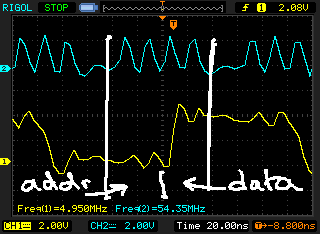
At least, 4 clock cycles are required to write one data. Data latency (DATLAT lowest value is 2). There is one cyle to give the address, two cyle of latency, one cyle for give the data.
At max FSMC speed (~84MHz), after dividing the clock by 4, the 16-bit parallel transmission would only be ~20MHz.

Bursts are possible up to 32 bits (two 16-bit data words). When using this feature, two data words are send for each address, hence more data is sent, but the clock is hard to use: 3 ticks for the (empty) address, 1 tick for the first data, 1 tick for the second data (5 cycles for 2 data, ~30MHz max).
Set pins (2nd attempt)
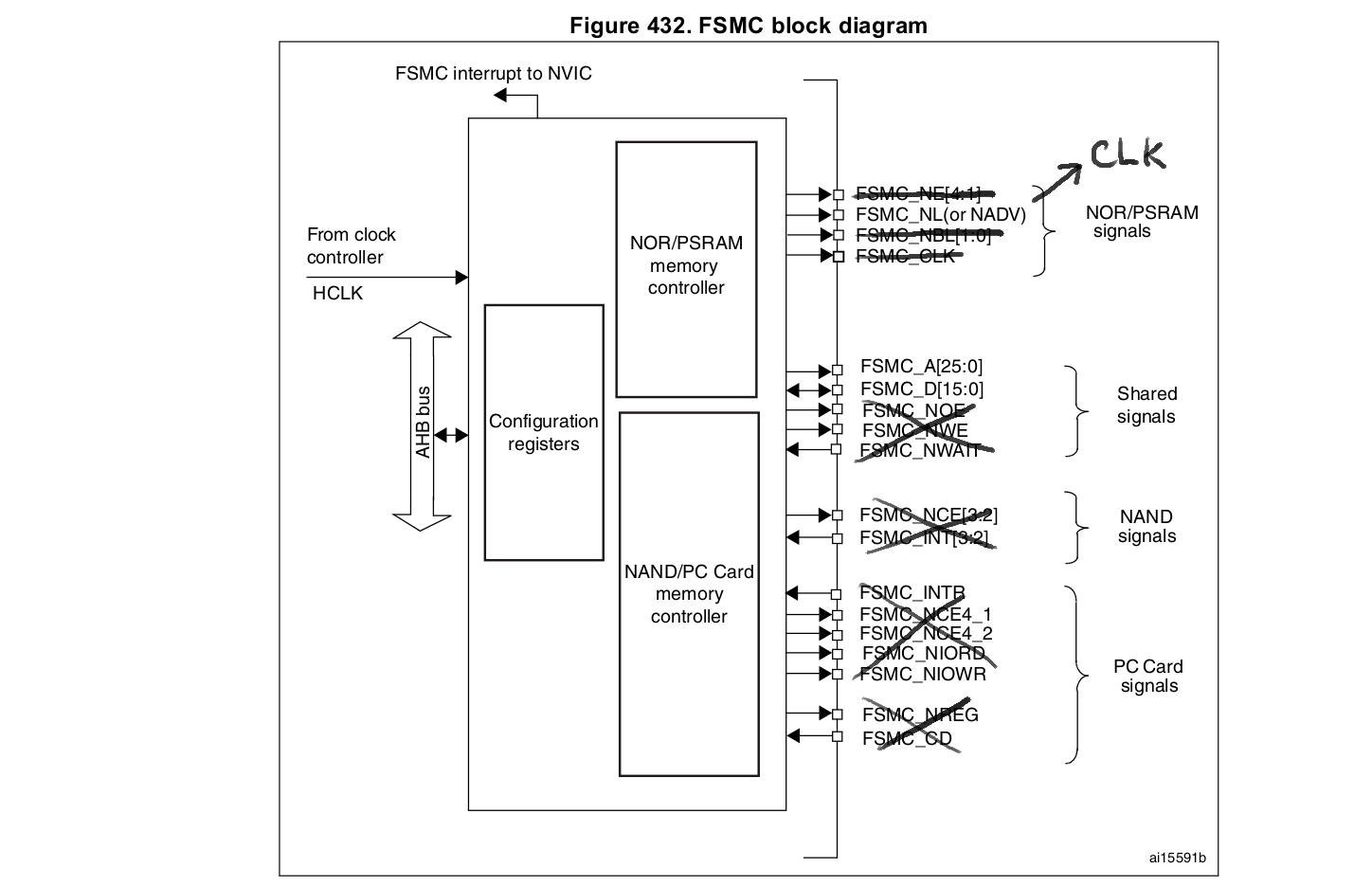
/* PD: 0, 1, 8, 9, 10, 14, 15 -> alternate function (0b10) */

GPIOD->MODER = 0xA56A555A;

GPIOD->AFR[] = 0xCCCCCCCC; /* FSMC = AF12 (0xC) */

GPIOD->AFR[] = 0xCCCCCCCC;

/* PE: 7, 8, 9, 10, 11, 12, 13, 14, 15 -> alternate function (0b10) */

GPIOE->MODER = 0xAAAA9555;

GPIOE->AFR[] = 0xCCCCCCCC;

GPIOE->AFR[] = 0xCCCCCCCC;

/* PB: 7 -> AF */

GPIOB->MODER = 0x55551555;

GPIOB->AFR[] = 0xCCCCCCCC;

GPIOB->AFR[] = 0xCCCCCCCC;
FSMC setup/init (2nd attempt)
/* NOR flash, asynchronous, multiplexed */

/* control register */

FSMC_Bank1->BTCR[] = FSMC_BCR1_WREN | FSMC_BCR1_FACCEN | FSMC_BCR1_MWID_0 /* 16-bit */ | FSMC_BCR1_MTYP_1 /* NOR flash */ | FSMC_BCR1_MUXEN | FSMC_BCR1_MBKEN;

/* timing register */

FSMC_Bank1->BTCR[] = FSMC_BTR1_CLKDIV_0 | FSMC_BTR1_DATAST_0 | FSMC_BTR1_ADDHLD_0 | FSMC_BTR1_ADDSET_1;
Result (2nd attempt)
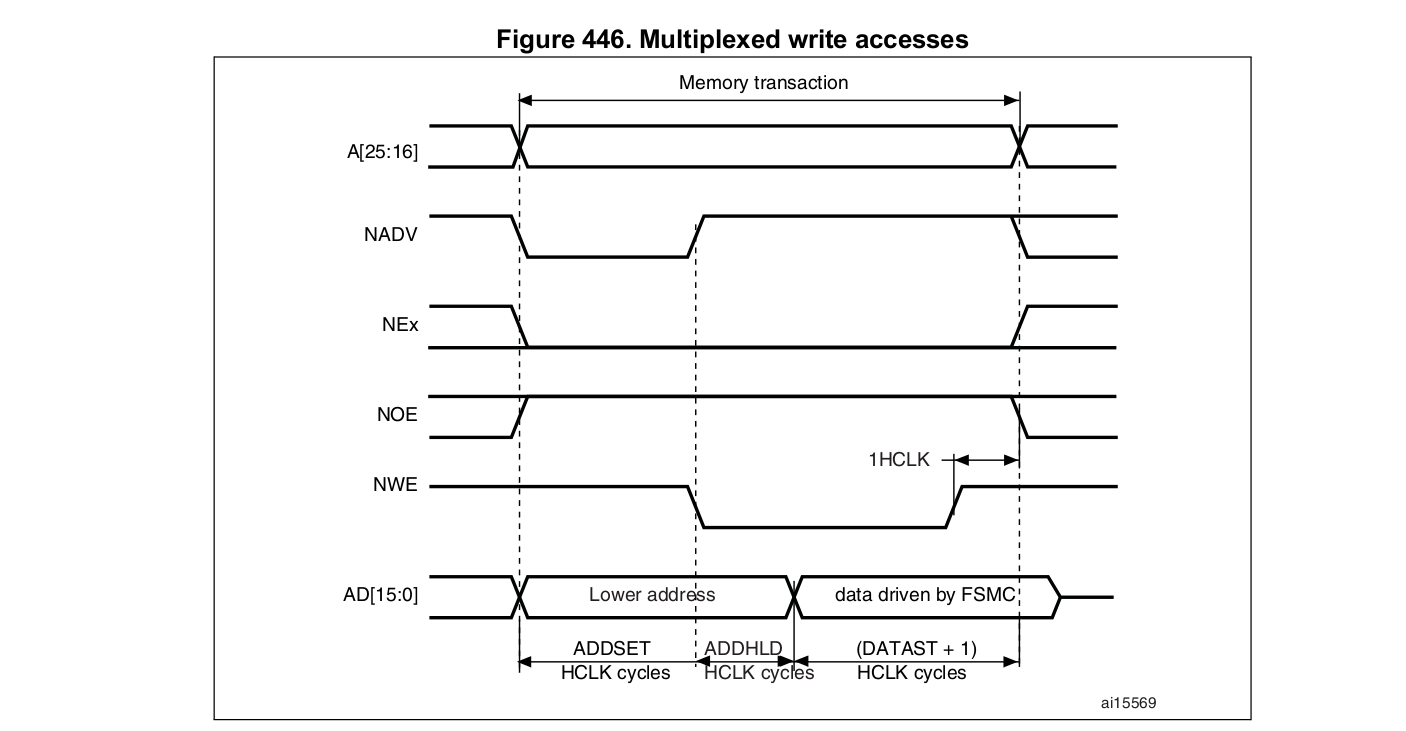
We want to use the NADV signal as a new clock CLK.
volatile uint16_t* fsmc = (uint16_t*)0x60000000;

uint16_t w[] = {

        0xFFFF, 0x0000, 0xFFFF, 0x0000,

        0xFFFF, 0x0000, 0xFFFF, 0x0000};

for(uint32_t i=;i<;i++) {

        fsmc[] = w[i];

}
We write to the same address in order to force a new memory transaction and cycle NADV.
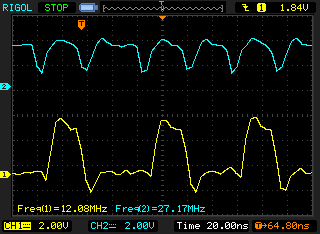
The problem is that the data bus is updated after the positive edge of the NADV "clock". This issue can be overcome by multiplexing the address and data bus and put the data value as address. The ADDSET value is also increased in order to have a more balanced clock (ADDSET=3).
for(uint32_t i=;i<;i++) {

        uint16_t v = w[i];

        fsmc[v] = v;

}
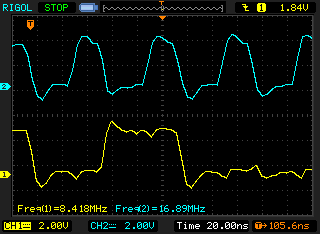
Unfortately, the overall clock speed decreased because the address "trick".
Conclusion
A "nice looking" 16-bit parallel signal with clock can be generated at approx. 16MHz using the memory controller (FSMC) in asynchronous NOR Flash mode. 20MHz can be achieved with an external clock divider (div 4) in synchronous PSRAM mode. If the clock edge can be aligned with the data edge, 27MHz is possible from SRAM.
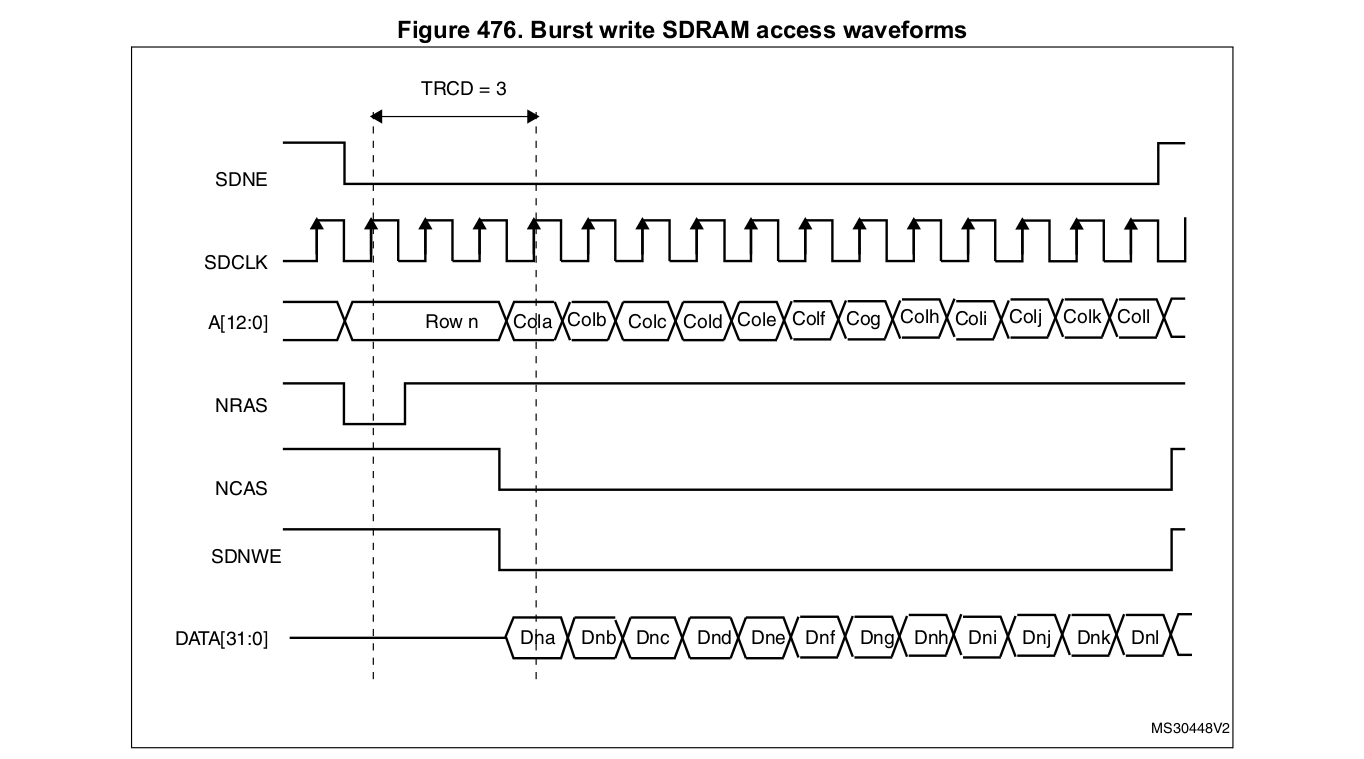
Note: the FMC (Flexible Memory Controller, also supporting SDRAM) in SDRAM mode can generate a synchronous burst of one data per clock. In this case, 84MHz is possible in theory. I haven't the hardware to test it.
STM32F4: Generating parallel signals with the FSMC的更多相关文章
- STM32F4: GENERATING A SINE WAVE
http://amarkham.com/?p=49
- Flexible implementation of a system management mode (SMM) in a processor
A system management mode (SMM) of operating a processor includes only a basic set of hardwired hooks ...
- PMP用语集
AC actual cost 实际成本 ACWP actual cost of work performed 已完工作实际成本 BAC budget at completion 完工预算 BCWP b ...
- 论文翻译:2021_DeepFilterNet: A Low Complexity Speech Enhancement Framework for Full-Band Audio based on Deep Filtering
论文地址:DeepFilterNet:基于深度滤波的全频带音频低复杂度语音增强框架 论文代码:https://github.com/ Rikorose/DeepFilterNet 引用:Schröte ...
- STM32F4—fsmc的配置步骤
0:开启GPIO时钟和FSMC时钟 1:配置GPIO 2:配置片选控制寄存器 3:配置片选时序寄存器 4:配置写入时序寄存器 GPIO_InitTypeDef GPIO_InitStructure;/ ...
- STM32F4 SPI with DMA
STM32F4 SPI with DMA A few people have requested code, so I thought I’d post the code showing how I’ ...
- Generating Complex Procedural Terrains Using GPU
前言:感慨于居然不用tesselation也可以产生这么复杂的地形,当然致命的那个关于不能有洞的缺陷还是没有办法,但是这个赶脚生成的已经足够好了,再加上其它模型估 计效果还是比较震撼的.总之好文共分享 ...
- GNU Parallel Tutorial
GNU Parallel Tutorial Prerequisites Input sources A single input source Multiple input sources Linki ...
- Massively parallel supercomputer
A novel massively parallel supercomputer of hundreds of teraOPS-scale includes node architectures ba ...
随机推荐
- Linux - ssh 连接问题
SSH 连接方式 ssh -p 22 user@192.168.1.209 # 从linux ssh登录另一台linux ssh -p 22 root@192.168.1.209 CMD # 利用ss ...
- Dream Spark ------spark on yarn ,yarn的配置
<?xml version="1.0"?> <!-- Licensed under the Apache License, Version 2.0 (the &q ...
- mybatis动态sql——(六)
0 什么是动态sql mybatis核心 对sql语句进行灵活操作,通过表达式进行判断,对sql进行灵活拼接.组装. 通过mybatis提供的各种标签方法实现动态拼接sql.
- ubuntu16.04系统搜狗输入法的安装
参考博客:https://www.cnblogs.com/lrj567/p/6307329.html 本来不想写的,但是最近老是重装系统,每次百度特别浪费时间,特此记录一下 先去官网下载搜狗输入法li ...
- Redis常见操作命令
1.库相关 select 索引 => 选择库 dbsize => 查询当前库中Key的数量 flushdb => 清空当前库 flushall => 清空所有库(建议不要用,除 ...
- 关于USBHID协议以及鼠标键盘描述符的解释【转】
转自:https://blog.csdn.net/jiujiujiuqiuqiuqiu/article/details/47277685 一.HID设备识别 前面有提到关于SCSI协议的USB设备实现 ...
- linux 如何删除文件夹下面的文件和文件夹,只保留两个文件
# 删除目录下那两个文件之外的所有文件 find dir/ -type f ! -name file1 -a ! -name file2 | xargs rm -f # 删除所有空目录(非空目录不 ...
- python3 str.format()的使用
基本格式 {字段名!转换字段:格式说明符} 字段名:省略:数字:变量名 'name is {}, age is {}'.format('peter',25) 'name is {1}, age is ...
- pathon 基础学习-集合(set),单双队列,深浅copy,内置函数
一.collections系列: collections其实是python的标准库,也就是python的一个内置模块,因此使用之前导入一下collections模块即可,collections在pyt ...
- Java编程的逻辑 (14) - 类的组合
本系列文章经补充和完善,已修订整理成书<Java编程的逻辑>,由机械工业出版社华章分社出版,于2018年1月上市热销,读者好评如潮!各大网店和书店有售,欢迎购买,京东自营链接:http: ...