
POJ---3463 Sightseeing 记录最短路和次短路的条数
| Time Limit: 2000MS | Memory Limit: 65536K | |
| Total Submissions: 9247 | Accepted: 3242 |
Description
Tour operator Your Personal Holiday organises guided bus trips across the Benelux. Every day the bus moves from one city S to another city F. On this way, the tourists in the bus can see the sights alongside the route travelled. Moreover, the bus makes a number of stops (zero or more) at some beautiful cities, where the tourists get out to see the local sights.
Different groups of tourists may have different preferences for the sights they want to see, and thus for the route to be taken from S to F. Therefore, Your Personal Holiday wants to offer its clients a choice from many different routes. As hotels have been booked in advance, the starting city S and the final city F, though, are fixed. Two routes from S to F are considered different if there is at least one road from a city A to a city B which is part of one route, but not of the other route.
There is a restriction on the routes that the tourists may choose from. To leave enough time for the sightseeing at the stops (and to avoid using too much fuel), the bus has to take a short route from S to F. It has to be either a route with minimal distance, or a route which is one distance unit longer than the minimal distance. Indeed, by allowing routes that are one distance unit longer, the tourists may have more choice than by restricting them to exactly the minimal routes. This enhances the impression of a personal holiday.
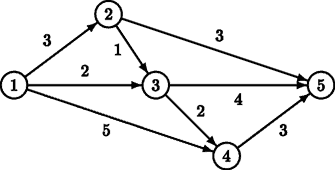
For example, for the above road map, there are two minimal routes from S = 1 to F = 5: 1 → 2 → 5 and 1 → 3 → 5, both of length 6. There is one route that is one distance unit longer: 1 → 3 → 4 → 5, of length 7.
Now, given a (partial) road map of the Benelux and two cities S and F, tour operator Your Personal Holiday likes to know how many different routes it can offer to its clients, under the above restriction on the route length.
Input
The first line of the input file contains a single number: the number of test cases to follow. Each test case has the following format:
One line with two integers N and M, separated by a single space, with 2 ≤ N ≤ 1,000 and 1 ≤ M ≤ 10, 000: the number of cities and the number of roads in the road map.
M lines, each with three integers A, B and L, separated by single spaces, with 1 ≤ A, B ≤ N, A ≠ B and 1 ≤ L ≤ 1,000, describing a road from city A to city B with length L.
The roads are unidirectional. Hence, if there is a road from A to B, then there is not necessarily also a road from B to A. There may be different roads from a city A to a city B.
One line with two integers S and F, separated by a single space, with 1 ≤ S, F ≤ N and S ≠ F: the starting city and the final city of the route.
There will be at least one route from S to F.
Output
For every test case in the input file, the output should contain a single number, on a single line: the number of routes of minimal length or one distance unit longer. Test cases are such, that this number is at most 109 = 1,000,000,000.
Sample Input
2

5 8

1 2 3

1 3 2

1 4 5

2 3 1

2 5 3

3 4 2

3 5 4

4 5 3

1 5

5 6

2 3 1

3 2 1

3 1 10

4 5 2

5 2 7

5 2 7

4 1
Sample Output
3

2
Hint
The first test case above corresponds to the picture in the problem description.
这题好像用spfa写起来特别的复杂 还是用dijkstra吧
以后还是多用dijkstar 他们都说这个快一些
spfa 以后判断环再写这个
题意:t组数据,每组输入点n和边m个数,
输入m条边,再输入起点ST和终点EN,
求从ST到EN最短路和比最短路长1的路的总条数。
这题改变松弛条件就行了
写起来繁琐一点
- if(x<最小)更新最短路和次短路
- if(x==最小)更新最短路数量
- if(x<次小)更新次短路
- if(x==次小)更新次短路数量
#include <cstdio>

#include <cstring>

#include <algorithm>

#include <queue>

#include <stack>

using namespace std;

typedef long long LL;

const int maxn = 1e5 + ;

const int mod = 1e9 + ;

const int INF = 2e9 + ;

int n, m, t, u, v, w, f, s, tot;

int head[], d[][], cnt[][], vis[][];

struct node {

    int v, w, next;

} edge[maxn];

void init() {

    tot = ;

    memset(head, -, sizeof(head));

}

void add(int u, int v, int w) {

    edge[tot].v = v;

    edge[tot].w = w;

    edge[tot].next = head[u];

    head[u] = tot;

    tot++;

}

struct node1 {

    int u, d, p;

    node1(int u, int d, int p): u(u), d(d), p(p) {}

    bool operator < (const node1 & a)const {

        return d > a.d;

    }

};

void dijkstra(int s) {

      priority_queue<node1>q;

      memset(vis, , sizeof(vis));

      memset(cnt, , sizeof(cnt));

      for (int i =  ; i <= n ; i++) d[i][] = d[i][] = INF;

      q.push(node1(s, , ));

      d[s][] = , cnt[s][] = ;

    while(!q.empty()) {

        node1 now = q.top();

        q.pop();

        int u = now.u, p = now.p;

        if (vis[u][p]) continue;

        vis[u][p] = ;

        for (int i = head[u] ; ~i ; i = edge[i].next ) {

            int v = edge[i].v, w = edge[i].w;

            if (d[v][] > d[u][p] + w) {

                d[v][] = d[v][];

                cnt[v][] = cnt[v][];

                d[v][] = d[u][p] + w;

                cnt[v][] = cnt[u][p];

                q.push(node1(v, d[v][], ));

                q.push(node1(v, d[v][], ));

            } else if (d[v][] == d[u][p] + w) cnt[v][] += cnt[u][p];

            else if (d[v][] > d[u][p] + w) {

                d[v][] = d[u][p] + w;

                cnt[v][] = cnt[u][p];

                q.push(node1(v, d[v][], ));

            } else if (d[v][] == d[u][p] + w) cnt[v][] += cnt[u][p];

        }

    }

}

int main() {

    scanf("%d", &t);

    while(t--) {

        init();

        scanf("%d%d", &n, &m);

        for (int i =  ; i < m ; i++) {

            scanf("%d%d%d", &u, &v, &w);

            add(u, v, w);

        }

        scanf("%d%d", &s, &f);

        dijkstra(s);

        if (d[f][] +  == d[f][]) printf("%d\n", cnt[f][] + cnt[f][]);

        else printf("%d\n", cnt[f][]);

    }

    return ;

}
POJ---3463 Sightseeing 记录最短路和次短路的条数的更多相关文章
- POJ - 3463 Sightseeing 最短路计数+次短路计数
F - Sightseeing 传送门: POJ - 3463 分析 一句话题意:给你一个有向图,可能有重边,让你求从s到t最短路的条数,如果次短路的长度比最短路的长度多1,那么在加上次短路的条数. ...
- poj 3463 Sightseeing( 最短路与次短路)
http://poj.org/problem?id=3463 Sightseeing Time Limit: 2000MS Memory Limit: 65536K Total Submissio ...
- poj 3463 Sightseeing——次短路计数
题目:http://poj.org/problem?id=3463 当然要给一个点记最短路和次短路的长度和方案. 但往优先队列里放的结构体和vis竟然也要区分0/1,就像把一个点拆成两个点了一样. 不 ...
- POJ 3463 Sightseeing (次短路经数)
Sightseeing Time Limit: 2000MS Memory Limit: 65536K Total Submissions:10005 Accepted: 3523 Descr ...
- POJ 3463 Sightseeing (次短路)
题意:求两点之间最短路的数目加上比最短路长度大1的路径数目 分析:可以转化为求最短路和次短路的问题,如果次短路比最短路大1,那么结果就是最短路数目加上次短路数目,否则就不加. 求解次短路的过程也是基于 ...
- POJ 3463 Sightseeing 【最短路与次短路】
题目 Tour operator Your Personal Holiday organises guided bus trips across the Benelux. Every day the ...
- poj 3463 Sightseeing(次短路+条数统计)
/* 对dij的再一次理解 每个点依旧永久标记 只不过这里多搞一维 0 1 表示最短路还是次短路 然后更新次数相当于原来的两倍 更新的时候搞一下就好了 */ #include<iostream& ...
- POJ 3463 Sightseeing 题解
题目 Tour operator Your Personal Holiday organises guided bus trips across the Benelux. Every day the ...
- POJ 3463 Sightseeing
最短路+次短路(Dijkstra+priority_queue) 题意是要求你找出最短路的条数+与最短路仅仅差1的次短路的条数. 開始仅仅会算最短路的条数,和次短路的长度.真是给次短路条数跪了.ORZ ...
- Sightseeing(poj 3463)
题意:给出n个点m条单向边,求最短路的道路条数和比最短路大1的道路条数的和. /* 用Dijkstra更新2*n次,来更新出所有点的最短路和次短路,顺便更新方案数. */ #include<cs ...
随机推荐
- javascript常用对象方法
concat:连接产生一个新数组 [1,2].concat([3,4]) >> [1, 2, 3, 4] filter:返回符合条件的一个新数组 [1,2,3,4,5].filte ...
- vue-router爬坑记
简介 因为我们用Vue开发的页面是单页面应用,就相当于只有一个主的index.html,这时候我们就不能使用a标签来进行页面的切换了,所以这时候我们今天的主角Vue-Router就闪亮的登场了 Vue ...
- Nodejs Express笔记
Express做服务器,主要考虑到可能存在的高并发,js写起来也并不麻烦,环境搭建也异常简单.开车~ 由于主要目的就是用于生产环境,所以肯定不能用高版本的Nodejs,选LTS,没错的. 一.安装 这 ...
- 二:HDFS 命令指南
命令具体选项请参考: http://hadoop.apache.org/docs/r2.6.3/hadoop-project-dist/hadoop-hdfs/HDFSCommands.html ...
- Alpha发布文案+美工
文案: Alpha发布文稿 我们是Hello World!团队,下面由我来简要介绍一下我们组的作品,我们组做的是一个飞机射击类游戏,名字叫做空天猎.这个游戏是基于JAVA平台创建的,那么接下来让我给大 ...
- Daily Scrum 10
今天我们小组开会内容分为以下部分: part 1: 经过反复思考,对于上次组会确定的在系统中加入娱乐版块进行了更进一步的商讨; part 2:继续探讨算法实现: part 3:进行明日的任务分配; ◆ ...
- mysql 复杂查询
1.同一个表下多次查询: sql语句: select b.* ,(select name from exh_common.medicine_type a where b.p_id = a.id) as ...
- CWnd类虚函数的调用时机、缺省实现
MFC(VC6.0)的CWnd及其子类中,有如下三个函数: class CWnd : public CCmdTarget{ public: virtual BOOL PreCrea ...
- iOS- 网络访问两种常用方式【GET & POST】实现的几个主要步骤
1.前言 上次,在博客里谈谈了[GET & POST]的区别,这次准备主要是分享一下自己对[GET & POST]的理解和实现的主要步骤. 在这就不多废话了,直接进主题,有什么不足的欢 ...
- css深入理解之 border
一 border-width不支持百分比值 1 不符合客观逻辑 2 w3成都一种约定吧 3 边框本身就像是一个包裹内容的界限 类似的还有outline,box-shadow text-shadow均不 ...