
poj3087 Shuffle'm Up
Description
A common pastime for poker players at a poker table is to shuffle stacks of chips. Shuffling chips is performed by starting with two stacks of poker chips, S1 and S2, each stack containing C chips.
Each stack may contain chips of several different colors.
The actual shuffle operation is performed by interleaving a chip from S1 with a chip from S2 as shown below for C = 5:
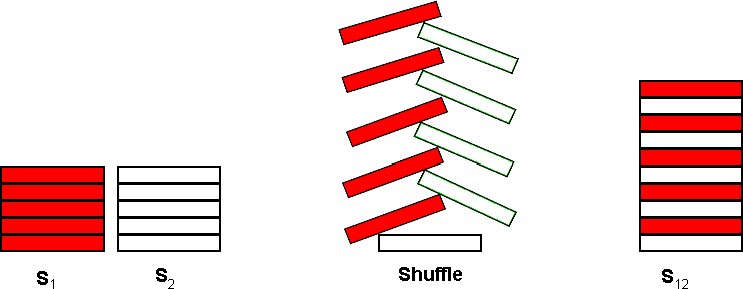
The single resultant stack, S12, contains 2 * C chips. The bottommost chip of S12 is the bottommost chip from S2. On top of that chip, is the bottommost
chip from S1. The interleaving process continues taking the 2nd chip from the bottom of S2 and placing that on S12, followed by the 2nd chip from the
bottom of S1 and so on until the topmost chip from S1 is placed on top of S12.
After the shuffle operation, S12 is split into 2 new stacks by taking the bottommost C chips from S12 to form a new S1 and the topmost C chips
from S12 to form a new S2. The shuffle operation may then be repeated to form a new S12.
For this problem, you will write a program to determine if a particular resultant stack S12 can be formed by shuffling two stacks some number of times.
Input
The first line of input contains a single integer N, (1 ≤ N ≤ 1000) which is the number of datasets that follow.
Each dataset consists of four lines of input. The first line of a dataset specifies an integer C, (1 ≤ C ≤ 100) which is the number of chips in each initial stack (S1 and S2).
The second line of each dataset specifies the colors of each of the C chips in stack S1, starting with the bottommost chip. The third line of each dataset specifies the colors of each of the C chips
in stack S2 starting with the bottommost chip. Colors are expressed as a single uppercase letter (A through H). There are no blanks or separators between the chip colors. The fourth line of each
dataset contains 2 * C uppercase letters (A through H), representing the colors of the desired result of the shuffling of S1 and S2 zero or
more times. The bottommost chip’s color is specified first.
Output
Output for each dataset consists of a single line that displays the dataset number (1 though N), a space, and an integer value which is the minimum number of shuffle operations required to get the desired resultant stack. If the
desired result can not be reached using the input for the dataset, display the value negative 1 (−1) for the number of shuffle operations.
Sample Input
2

4

AHAH

HAHA

HHAAAAHH

3

CDE

CDE

EEDDCC
Sample Output
1 2

2 -1
这道题是模拟题,给你两个字符串s1,s2,然后使它们合成一个字符串,合成的规则是s2的最前一个字符作为新字符串的开头字母,再是s1的最前一个字符,这样一次夹着排列,组合成新的字符串,如果和目标字符串一致,就输出要变化的次数,否则新字符串的前n个字符变成s1,后n个变成s2,再合成。
#include<stdio.h>

#include<string.h>

char s[400],s1[400],s2[400],str[400],str1[400];

int main()

{

	int T,n,m,i,j,h,num;

	scanf("%d",&T);

	for(h=1;h<=T;h++)

	{

		scanf("%d",&n);

		scanf("%s%s%s",s1,s2,s);

		strcpy(str1,s1);

		num=0;

		memset(str,0,sizeof(str));

		for(j=1;j<=100000;j++)

		{

			for(i=0;i<n;i++){

				str[i*2]=s2[i];str[i*2+1]=s1[i];

			}

			str[2*n]='\0';

			num++;

			if(strcmp(str,s)==0){

				break;

			}

			for(i=0;i<n;i++){

				s1[i]=str[i];

			}

			for(i=n;i<2*n;i++){

				s2[i-n]=str[i];

			}

		}

		if(num>=99999)printf("%d %d\n",h,-1);

	        else	printf("%d %d\n",h,num);

	}

	return 0;

}
poj3087 Shuffle'm Up的更多相关文章
- poj3087 Shuffle'm Up(模拟)
Shuffle'm Up Time Limit: 1000MS Memory Limit: 65536K Total Submissions: 10766 Accepted: 4976 Des ...
- POJ3087:Shuffle'm Up(模拟)
http://poj.org/problem?id=3087 Description A common pastime for poker players at a poker table is to ...
- POJ-3087 Shuffle'm Up (模拟)
Description A common pastime for poker players at a poker table is to shuffle stacks of chips. Shuff ...
- POJ3087 Shuffle'm Up —— 打表找规律 / map判重
题目链接:http://poj.org/problem?id=3087 Shuffle'm Up Time Limit: 1000MS Memory Limit: 65536K Total Sub ...
- POJ3087 Shuffle'm Up 简单模拟
题意:就是给你两副扑克,然后一张盖一张洗牌,不断重复这个过程,看能不能达到目标的扑克顺序 分析:然后就模拟下,-1的情况就是有循环节 #include<cstdio> #include&l ...
- POJ3087 Shuffle'm Up(模拟)
题目链接. AC代码如下; #include <iostream> #include <cstdio> #include <cstring> #include &l ...
- poj3087 Shuffle'm Up(bfs)
http://poj.org/problem?id=3087 注意复制字符串的时候,要在末尾加上'\0',否则导致strcmp出错. 还有就是开数组大小的时候看清楚一点,别开错了debug了好久. # ...
- POJ3087 Shuffle'm Up
题目: 现有字符串s1.s2.s12,其中s1.s2的长度为len,s12的长度为2*len. 是否可以通过一些操作使s1和s2转换合并成s12? 变换的操作规则如下: 假设s1=11111,s2=0 ...
- poj分类解题报告索引
图论 图论解题报告索引 DFS poj1321 - 棋盘问题 poj1416 - Shredding Company poj2676 - Sudoku poj2488 - A Knight's Jou ...
随机推荐
- 基于 MPI 的快速排序算法的实现
完整代码: #include <iostream> #include <cstdlib> #include <ctime> #include <algorit ...
- 【Oracle】归档日志的删除操作
[root@sha3 oracle]# rman target / Recovery Manager: Release 10.2.0.4.0 - Production on Tue Jan 20 01 ...
- kubernets之服务重定向
一 服务的强大功能之处的其他表现 前面介绍的所有有关服务的说明,都是将集群内部的pod应用暴露出来提供外部客户端或者内部的客户端进行访问,但是服务的强大之处远远不止于此 服务甚至可以将集群外部的应用 ...
- LR参数
一.LR函数 : lr_start_transaction: 为性能分析标记事务的开始 lr_end_transaction: 为性能分析标记事务的结束:事务名称与事务开始时保持一致 lr_ren ...
- awk中引用shell变量的方法
1.通过命令行参数定义变量时引用: awk -v awk变量名= shell变量名 #!/bin/bash var4bash=test awk -v var4awk="$var4bash&q ...
- Java高并发与多线程(三)-----线程的基本属性和主要方法
今天,我们开始Java高并发与多线程的第三篇,线程的基本属性和主要方法. [属性] 编号(ID) 类型long 用于标识不同的线程,编号唯一,只存在java虚拟机的一次运行 名称(Name) 类型St ...
- 面向对象的延伸与Java内部定义类的应用
识别类 传统的过程化程序设计,必须从顶部的main函数开始编写程序,在面向对象程序设计时没有所谓的"顶部".首先从设计类开始,然后再往每个类中添加方法. 识别类的规则是在分析问题的 ...
- JS复习笔记一:冒泡排序和二叉树列
在这里逐步整理一些JS开发的知识,分享给大家: 一:冒泡排序 使用场景:数组中根据某个值得大小来对这个数组进行整体排序 难度:简单 原理:先进行循环,循环获取第一至倒数第二的范围内所有值,对当前值与下 ...
- 错误捕捉过滤器 .NetCore版
前言 继承ExceptionFilterAttribute后,重写OnException函数. 统一捕捉所有报错,格式化返回前端. 代码实现 基类控制器 在基类控制器上添加[ErrorCatch]特性 ...
- dotnet cli 5.0 新特性——dotnet tool search
dotnet cli 5.0 新特性--dotnet tool search Intro .NET 5.0 SDK 的发布,给 dotnet cli 引入了一个新的特性,dotnet tool sea ...