
POJ 3155 Hard Life(最大密度子图+改进算法)
| Time Limit: 8000MS | Memory Limit: 65536K | |
| Total Submissions: 9012 | Accepted: 2614 | |
| Case Time Limit: 2000MS | Special Judge |
Description
John is a Chief Executive Officer at a privately owned medium size company. The owner of the company has decided to make his son Scott a manager in the company. John fears that the owner will ultimately give CEO position to Scott if he does well on his new manager position, so he decided to make Scott’s life as hard as possible by carefully selecting the team he is going to manage in the company.
John knows which pairs of his people work poorly in the same team. John introduced a hardness factor of a team — it is a number of pairs of people from this team who work poorly in the same team divided by the total number of people in the team. The larger is the hardness factor, the harder is this team to manage. John wants to find a group of people in the company that are hardest to manage and make it Scott’s team. Please, help him.
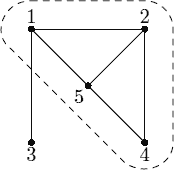
In the example on the picture the hardest team consists of people 1, 2, 4, and 5. Among 4 of them 5 pairs work poorly in the same team, thus hardness factor is equal to 5⁄4. If we add person number 3 to the team then hardness factor decreases to 6⁄5.
Input
The first line of the input file contains two integer numbers n and m (1 ≤ n ≤ 100, 0 ≤ m ≤ 1000). Here n is a total number of people in the company (people are numbered from 1 to n), and m is the number of pairs of people who work poorly in the same team. Next m lines describe those pairs with two integer numbers ai and bi (1 ≤ ai, bi ≤ n, ai ≠ bi) on a line. The order of people in a pair is arbitrary and no pair is listed twice.
Output
Write to the output file an integer number k (1 ≤ k ≤ n) — the number of people in the hardest team, followed by k lines listing people from this team in ascending order. If there are multiple teams with the same hardness factor then write any one.
Sample Input
sample input #1

5 6

1 5

5 4

4 2

2 5

1 2

3 1

sample input #2

4 0
Sample Output
sample output #1

4

1

2

4

5

sample output #2

1

1
Hint
Note, that in the last example any team has hardness factor of zero, and any non-empty list of people is a valid answer.
题目链接:POJ 3155
官方解说在胡伯涛Amber的最小割模型在信息学竞赛中的应用论文中最大密度子图是什么意思呢?就是选出一个子图,使得其子图的${边数 \over 顶点数}$最大,即${|E'| \over |V'|}$最大,后者是不是非常的熟悉,跟01规划非常像,就是使得该比值最大,那么按照01规划的思路,设这个比值为$g$,那么二分出一个$g$的最大值使得$|E'|-g*|V'|>0$,但是我怎么知道$E'$和$V'$怎么取啊?再看式子里面的$E'$和$V'$,可以发现若一条边$e_i$在边集$E'$中,那么$e_i$的两个端点$u_i$与$v_i$必定在顶点集$V'$中,也就是说$e_i$存在的必要条件是$u_i$,$v_i$两点的存在,然后再次观察这个式子,又可以发现可以把边看成新的虚拟点,点还是原来的点,虚拟点的点权为正数1,原来点的点权为负数-g,那么只要在这个新图里求一个最大权闭合图的最大权值就是这个$|E'|-g*|V'|$的最大值即这个式子的最优情况,然后根据其与0(或者叫eps…)的关系进行二分即可,码农题……
代码:
#include <stdio.h>

#include <iostream>

#include <algorithm>

#include <cstdlib>

#include <sstream>

#include <numeric>

#include <cstring>

#include <bitset>

#include <string>

#include <deque>

#include <stack>

#include <cmath>

#include <queue>

#include <set>

#include <map>

using namespace std;

#define INF 0x3f3f3f3f

#define LC(x) (x<<1)

#define RC(x) ((x<<1)+1)

#define MID(x,y) ((x+y)>>1)

#define CLR(arr,val) memset(arr,val,sizeof(arr))

#define FAST_IO ios::sync_with_stdio(false);cin.tie(0);

typedef pair<int, int> pii;

typedef long long LL;

const double PI = acos(-1.0);

const int N = 110;

const int M = 1010;

const double eps = 1e-8;

struct edge

{

    int to, nxt;

    double cap;

    edge() {}

    edge(int _to, int _nxt, double _cap): to(_to), nxt(_nxt), cap(_cap) {}

};

struct info

{

    int u, v;

};

info e[M];

edge E[(N + 3 * M) << 1];

int head[N + M], tot;

int d[N + M];

void init()

{

    CLR(head, -1);

    tot = 0;

}

inline void add(int s, int t, double cap)

{

    E[tot] = edge(t, head[s], cap);

    head[s] = tot++;

    E[tot] = edge(s, head[t], 0);

    head[t] = tot++;

}

int bfs(int s, int t)

{

    queue<int>Q;

    CLR(d, -1);

    d[s] = 0;

    Q.push(s);

    while (!Q.empty())

    {

        int u = Q.front();

        Q.pop();

        for (int i = head[u]; ~i; i = E[i].nxt)

        {

            int v = E[i].to;

            if (d[v] == -1 && E[i].cap > 0)

            {

                d[v] = d[u] + 1;

                if (v == t)

                    return 1;

                Q.push(v);

            }

        }

    }

    return ~d[t];

}

double dfs(int s, int t, double f)

{

    if (s == t || f == 0)

        return f;

    double ret = 0;

    for (int i = head[s]; ~i; i = E[i].nxt)

    {

        int v = E[i].to;

        if (d[v] == d[s] + 1 && E[i].cap > 0)

        {

            double df = dfs(v, t, min(f, E[i].cap));

            if (df > 0)

            {

                E[i].cap -= df;

                E[i ^ 1].cap += df;

                ret += df;

                f -= df;

                if (f == 0)

                    break;

            }

        }

    }

    if (ret == 0)

        d[s] = -1;

    return ret;

}

double dinic(int s, int t)

{

    double ret = 0;

    while (bfs(s, t))

        ret += dfs(s, t, 1e9);

    return ret;

}

double Maxweight(int n, int m, double g)

{

    init();

    int S = 0, T = n + m + 1;

    int i;

    for (i = 1; i <= n; ++i) //负权点连到汇点T

        add(i, T, g);

    for (i = 1; i <= m; ++i) //m个正权点从S连出

    {

        add(S, n + i, 1.0);

        add(n + i, e[i].u, 1e9); //原有边保留

        add(n + i, e[i].v, 1e9);

    }

    return m * 1.0 - dinic(S, T); //正权点-最大流得到最大权

}

int main(void)

{

    int n, m, i;

    while (~scanf("%d%d", &n, &m))

    {

        for (i = 1; i <= m; ++i)

            scanf("%d%d", &e[i].u, &e[i].v);

        if (!m)

        {

            puts("1");

            puts("1");

        }

        else

        {

            double L = 1.0 / n, R = m;

            double ans = 1;

            double dx = 1.0 / n / n;

            while (fabs(R - L) >= dx)

            {

                double mid = (L + R) / 2.0;

                if (fabs(Maxweight(n, m, mid)) >= eps)

                {

                    L = mid;

                    ans = mid;

                }

                else

                    R = mid;

            }

            Maxweight(n, m, ans);

            vector<int>pos;

            for (i = 1; i <= n; ++i)

                if (~d[i])

                    pos.push_back(i);

            int sz = pos.size();

            sort(pos.begin(), pos.end());

            printf("%d\n", sz);

            for (i = 0; i < sz; ++i)

                printf("%d\n", pos[i]);

        }

    }

    return 0;

}
改进算法:由论文可得$h(g)={{U*n-c[S, T]} \over 2}$,其中可以令$U=m$,然后新的建图方式为
改进后从600ms到200ms,效果还是不错的
代码:
#include <stdio.h>

#include <iostream>

#include <algorithm>

#include <cstdlib>

#include <sstream>

#include <numeric>

#include <cstring>

#include <bitset>

#include <string>

#include <deque>

#include <stack>

#include <cmath>

#include <queue>

#include <set>

#include <map>

using namespace std;

#define INF 0x3f3f3f3f

#define LC(x) (x<<1)

#define RC(x) ((x<<1)+1)

#define MID(x,y) ((x+y)>>1)

#define CLR(arr,val) memset(arr,val,sizeof(arr))

#define FAST_IO ios::sync_with_stdio(false);cin.tie(0);

typedef pair<int, int> pii;

typedef long long LL;

const double PI = acos(-1.0);

const int N = 110;

const int M = 1010;

const double eps = 1e-8;

struct edge

{

    int to, nxt;

    double cap;

    edge() {}

    edge(int _to, int _nxt, double _cap): to(_to), nxt(_nxt), cap(_cap) {}

};

struct info

{

    int u, v;

};

info e[M];

edge E[(N + M) << 2];

int head[N], tot;

int d[N], deg[N];

void init()

{

    CLR(head, -1);

    tot = 0;

}

inline void add(int s, int t, double cap)

{

    E[tot] = edge(t, head[s], cap);

    head[s] = tot++;

    E[tot] = edge(s, head[t], 0);

    head[t] = tot++;

}

int bfs(int s, int t)

{

    queue<int>Q;

    CLR(d, -1);

    d[s] = 0;

    Q.push(s);

    while (!Q.empty())

    {

        int u = Q.front();

        Q.pop();

        for (int i = head[u]; ~i; i = E[i].nxt)

        {

            int v = E[i].to;

            if (d[v] == -1 && E[i].cap > 0)

            {

                d[v] = d[u] + 1;

                if (v == t)

                    return 1;

                Q.push(v);

            }

        }

    }

    return ~d[t];

}

double dfs(int s, int t, double f)

{

    if (s == t || f == 0)

        return f;

    double ret = 0;

    for (int i = head[s]; ~i; i = E[i].nxt)

    {

        int v = E[i].to;

        if (d[v] == d[s] + 1 && E[i].cap > 0)

        {

            double df = dfs(v, t, min(f, E[i].cap));

            if (df > 0)

            {

                E[i].cap -= df;

                E[i ^ 1].cap += df;

                ret += df;

                f -= df;

                if (f == 0)

                    break;

            }

        }

    }

    if (ret == 0)

        d[s] = -1;

    return ret;

}

double dinic(int s, int t)

{

    double ret = 0;

    while (bfs(s, t))

        ret += dfs(s, t, 1e9);

    return ret;

}

double CST(int n, int m, double g)

{

    init();

    double U = m;

    int S = 0, T = n + 1;

    int i;

    for (i = 1; i <= n; ++i) //<S,v,U>与<v,T,U+2g-dv>

    {

        add(S, i, U);

        add(i, T, U + 2 * g - 1.0 * deg[i]);

    }

    for (i = 1; i <= m; ++i)//(u,v,1)

    {

        add(e[i].u, e[i].v, 1.0);

        add(e[i].v, e[i].u, 1.0);

    }

    return dinic(S, T); //直接计算最小割值(最大流值)

}

int main(void)

{

    int n, m, i;

    while (~scanf("%d%d", &n, &m))

    {

        CLR(deg, 0);

        for (i = 1; i <= m; ++i)

        {

            scanf("%d%d", &e[i].u, &e[i].v);

            ++deg[e[i].u];

            ++deg[e[i].v];

        }

        if (!m)

        {

            puts("1");

            puts("1");

        }

        else

        {

            double L = 1.0 / n, R = m;

            double ans = 1;

            double dx = 1.0 / n / n;

            while (fabs(R - L) >= dx)

            {

                double mid = (L + R) / 2.0;

                double hg = (m * n * 1.0 - CST(n, m, mid)) / 2;

                if (hg >= eps)

                {

                    L = mid;

                    ans = mid;

                }

                else

                    R = mid;

            }

            CST(n, m, ans);

            vector<int>pos;

            for (i = 1; i <= n; ++i)

                if (~d[i])

                    pos.push_back(i);

            int sz = pos.size();

            sort(pos.begin(), pos.end());

            printf("%d\n", sz);

            for (i = 0; i < sz; ++i)

                printf("%d\n", pos[i]);

        }

    }

    return 0;

}
POJ 3155 Hard Life(最大密度子图+改进算法)的更多相关文章
- POJ 3155 Hard Life 最大密度子图 最大权闭合图 网络流 二分
http://poj.org/problem?id=3155 最大密度子图和最大权闭合图性质很相近(大概可以这么说吧),一个是取最多的边一个是取最多有正贡献的点,而且都是有选一种必须选另一种的限制,一 ...
- POJ 3155 Hard Life(最大密度子图)
裸题.输入一个无向图,输出最大密度子图(输出子图结点数和升序编号). 看了<最小割模型在信息学竞赛中的应用——胡伯涛>的一部分,感觉01分数规划问题又是个大坑.暂时还看不懂. 参考http ...
- poj 3155 最大密度子图
思路: 这个还是看的胡伯涛的论文<最小割在信息学竞赛中的应用>.是将最大密度子图问题转化为了01分数规划和最小割问题. 直接上代码: #include <iostream> # ...
- POJ 3155:Hard Life(最大密度子图)
题目链接 题意 给出n个人,和m对有冲突的人.要裁掉一些人,使得冲突率最高,冲突率为存在的冲突数/人数. 思路 题意可以转化为,求出一些边,使得|E|/|V|最大,这种分数规划叫做最大密度子图. 学习 ...
- 静态频繁子图挖掘算法用于动态网络——gSpan算法研究
摘要 随着信息技术的不断发展,人类可以很容易地收集和储存大量的数据,然而,如何在海量的数据中提取对用户有用的信息逐渐地成为巨大挑战.为了应对这种挑战,数据挖掘技术应运而生,成为了最近一段时期数据科学的 ...
- POJ 3155 Hard Life
Hard Life Time Limit: 8000ms Memory Limit: 65536KB This problem will be judged on PKU. Original ID: ...
- 排序系列 之 简单选择排序及其改进算法 —— Java实现
简单选择排序算法: 基本思想: 在待排序数据中,选出最小的一个数与第一个位置的数交换:然后在剩下的数中选出最小的数与第二个数交换:依次类推,直至循环到只剩下两个数进行比较为止. 实例: 0.初始状态 ...
- POJ3155 Hard Life [最大密度子图]
题意:最大密度子图 #include<iostream> #include<cstdio> #include<cstring> #include<algo ...
- KMP及其改进算法
本文主要讲述KMP已经KMP的一种改进方法.若发现不正确的地方,欢迎交流指出,谢谢! KMP算法的基本思想: KMP的算法流程: 每当一趟匹配过程中出现字符比较不等时,不需回溯 i 指针,而是利用已经 ...
随机推荐
- 二叉搜索树(BST)学习笔记
简介 二叉搜索树(\(Binary\ Search\ Tree\)),简称\(BST\),用于在一个集合中查找元素. 性质 若它的左子树不为空,则左子树上所有节点的值都小于根节点的值 若它的右子树不为 ...
- Linux运维必会的实战编程笔试题(19题)
以下Linux运维笔试面试编程题,汇总整理自老男孩.马哥等培训机构,由运维派根据实战需求,略有调整: 企业面试题1:(生产实战案例):监控MySQL主从同步是否异常,如果异常,则发送短信或者邮件给管理 ...
- fread, fwrite - 二进制流的输入/输出
总览 (SYNOPSIS) #include <stdio.h> size_t fread(void *ptr, size_t size, size_t nmemb, FILE *stre ...
- 解决linux系统CentOS下调整home和根分区大小《转》
转自http://www.php114.net/2013/1019/637.html 目标:将VolGroup-lv_home缩小到20G,并将剩余的空间添加给VolGroup-lv_root 1 ...
- shiro学习记录(二)
1 在项目中应用shiro框架进行认证 第一步:引入shiro框架相关的jar <!-- 引入shiro框架的依赖 --> <dependency> <groupId&g ...
- ubuntu安装R时候增加软件源到sources.list,sudo apt-get update不能更新
http://forum.ubuntu.org.cn/viewtopic.php?t=401717 ubuntu安装R时候增加软件源到sources.list,sudo apt-get update不 ...
- IPV6验证正则表达式
验证ipv6的正则表达式: 例:fe80::ec61:c1d1:9827:82be%13 \s*((([0-9A-Fa-f]{1,4}:){7}([0-9A-Fa-f]{1,4}|:))|(([0-9 ...
- SpringBoot之HelloWorld仔细分析
程序中的pom.xml文件: 一.父级标签 <parent> <groupId>org.springframework.boot</groupId> <art ...
- python实现批量修改文件名
import os def dele(): # 设置一个计数器 n=0 st = input('请输入你要删除的字符:') for i in f: b = f[n] if st in b: oldna ...
- php 获取 今天、昨天、这周、上周、这月、上月、近30天
<?php //今天 $today = date("Y-m-d"); //昨天 $yesterday = date("Y-m-d", strtotime( ...