
V4L2学习(五)VIVI虚拟摄像头驱动
概述
前面简单分析了内核中虚拟摄像头驱动 vivi 的框架与实现,本文参考 vivi 来写一个虚拟摄像头驱动,查询、设置视频格式相对简单,难点在于 vb2_buf 的处理过程。
数据采集流程分析
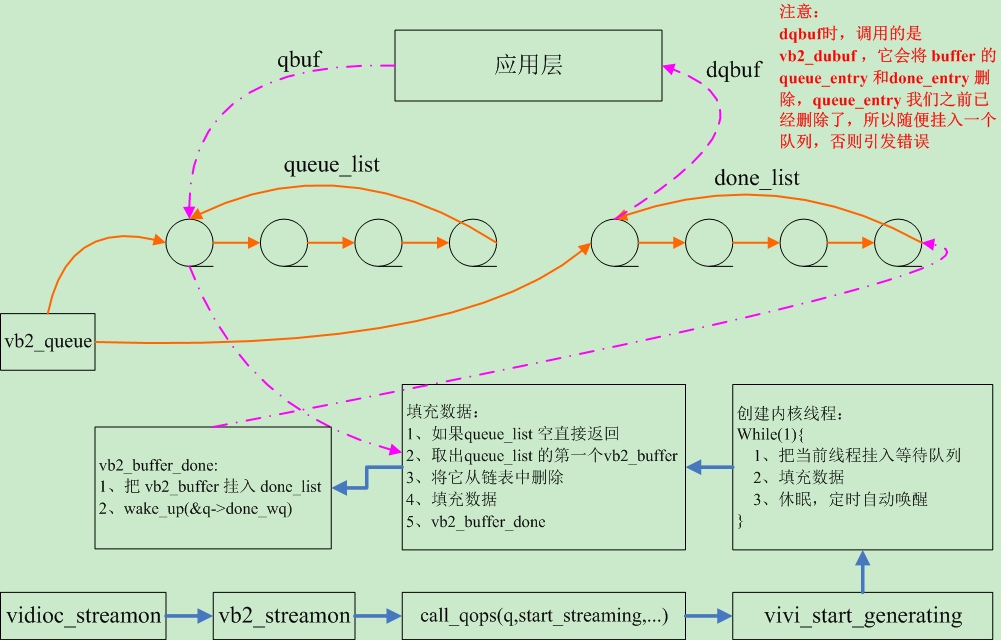
在我的程序中,大概的数据采集流程如上图所示,启动视频采集之后,创建了一个内核线程,内核线程每30ms 唤醒一次,每一次唤醒都会尝试用 queue_list 中取出一个 buffer 填充数据之后挂入 done_list ,挂入 done_list 之后就会唤醒应用程序(poll 中休眠),应用程序唤醒之后就会 dqbuf 获取数据,处理完数据再 qbuf 把 buffer 挂入 queue_list 的头部,一直循环。
代码
#include <linux/module.h>

#include <linux/errno.h>

#include <linux/kernel.h>

#include <linux/init.h>

#include <linux/sched.h>

#include <linux/slab.h>

#include <linux/font.h>

#include <linux/mutex.h>

#include <linux/videodev2.h>

#include <linux/kthread.h>

#include <linux/freezer.h>

#include <media/videobuf2-vmalloc.h>

#include <media/v4l2-device.h>

#include <media/v4l2-ioctl.h>

#include <media/v4l2-ctrls.h>

#include <media/v4l2-fh.h>

#include <media/v4l2-event.h>

#include <media/v4l2-common.h>

#define VFL_TYPE_GRABBER    0

#define MAX_WIDTH 1920

#define MAX_HEIGHT 1200

static unsigned int vid_limit = ;

static struct video_device *video_dev;      // video_device 结构,用来描述一个 video 设备

static struct vb2_queue vivi_queue;         // vivi_queue 用来存放缓冲区信息,缓冲区链表等

struct task_struct         *kthread;        // 内核线程,用来向缓冲区中填充数据

DECLARE_WAIT_QUEUE_HEAD(wait_queue_head);   // 等待队列头

struct list_head        my_list;            // 链表头

// 用来存放应用程序设置的视频格式

static struct mformat {

    __u32           width;

    __u32           height;

    __u32           pixelsize;

    __u32           field;

    __u32           fourcc;

    __u32           depth;

}mformat;

static void mvideo_device_release(struct video_device *vdev)

{

}

static long mvideo_ioctl(struct file *file, unsigned int cmd, void *arg)

{

    int ret = ;

    struct v4l2_fh *fh = NULL;

    switch (cmd) {

        case VIDIOC_QUERYCAP:

        {

            struct v4l2_capability *cap = (struct v4l2_capability *)arg;

            cap->version = LINUX_VERSION_CODE;

            ret = video_dev->ioctl_ops->vidioc_querycap(file, NULL, cap);

            break;

        }

        case VIDIOC_ENUM_FMT:

        {

            struct v4l2_fmtdesc *f = arg;

            if (f->type == V4L2_BUF_TYPE_VIDEO_CAPTURE) {

                ret = video_dev->ioctl_ops->vidioc_enum_fmt_vid_cap(file, fh, f);

            }else{

                printk("V4L2_BUF_TYPE_VIDEO_CAPTURE error\n");

            }

            break;

        }

        case VIDIOC_G_FMT:

        {

            struct v4l2_format *f = (struct v4l2_format *)arg;

            if (f->type == V4L2_BUF_TYPE_VIDEO_CAPTURE) {

                ret = video_dev->ioctl_ops->vidioc_g_fmt_vid_cap(file, fh, f);

            }else{

                printk("V4L2_BUF_TYPE_VIDEO_CAPTURE error\n");

            }

            break;

        }

        case VIDIOC_TRY_FMT:

        {

            struct v4l2_format *f = (struct v4l2_format *)arg;

            if (f->type == V4L2_BUF_TYPE_VIDEO_CAPTURE) {

                ret = video_dev->ioctl_ops->vidioc_try_fmt_vid_cap(file, fh, f);

            }else{

                printk("V4L2_BUF_TYPE_VIDEO_CAPTURE error\n");

            }

            break;

        }

        case VIDIOC_S_FMT:

        {

            struct v4l2_format *f = (struct v4l2_format *)arg;

            if (f->type == V4L2_BUF_TYPE_VIDEO_CAPTURE) {

                video_dev->ioctl_ops->vidioc_s_fmt_vid_cap(file, fh, f);

            }else{

                printk("V4L2_BUF_TYPE_VIDEO_CAPTURE error\n");

            }

            break;

        }

        case VIDIOC_REQBUFS:

        {

            struct v4l2_requestbuffers *p = arg;

            ret = video_dev->ioctl_ops->vidioc_reqbufs(file, fh, p);

            break;

        }

        case VIDIOC_QUERYBUF:

        {

            struct v4l2_buffer *p = arg;

            ret = video_dev->ioctl_ops->vidioc_querybuf(file, fh, p);

            break;

        }

        case VIDIOC_QBUF:

        {

            struct v4l2_buffer *p = arg;

            ret = video_dev->ioctl_ops->vidioc_qbuf(file, fh, p);

            break;

        }

        case VIDIOC_DQBUF:

        {

            struct v4l2_buffer *p = arg;

            ret = video_dev->ioctl_ops->vidioc_dqbuf(file, fh, p);

            break;

        }

        case VIDIOC_STREAMON:

        {

            enum v4l2_buf_type i = *(int *)arg;

            ret = video_dev->ioctl_ops->vidioc_streamon(file, fh, i);

            break;

        }

        case VIDIOC_STREAMOFF:

        {

            enum v4l2_buf_type i = *(int *)arg;

            ret = video_dev->ioctl_ops->vidioc_streamoff(file, fh, i);

            break;

        }

    }

    return ret;

}

static int vivi_mmap(struct file *file, struct vm_area_struct *vma)

{

    int ret;

    printk("enter mmap\n");

    ret = vb2_mmap(&vivi_queue, vma);

    if(ret == ){

        printk("mmap ok\n");

    }else{

        printk("mmap error\n");

    }

    return ret;

}

// 查询设备能力

static int mvidioc_querycap(struct file *file, void  *priv, struct v4l2_capability *cap)

{

    strcpy(cap->driver, "vivi");

    strcpy(cap->card, "vivi");

    strcpy(cap->bus_info, "mvivi");

    cap->device_caps = V4L2_CAP_VIDEO_CAPTURE;

    cap->capabilities = cap->device_caps | V4L2_CAP_DEVICE_CAPS | V4L2_CAP_STREAMING;

    printk("mvidioc_querycap  \n");

    return ;

}

// 枚举视频支持的格式

static int vidioc_enum_fmt_vid_cap(struct file *file, void  *priv, struct v4l2_fmtdesc *f)

{

    printk("vidioc_enum_fmt_vid_cap  \n");

    if (f->index >= )

        return -EINVAL;

    strcpy(f->description, "mvivi");

    f->pixelformat = mformat.fourcc;

    printk("vidioc_enum_fmt_vid_cap  \n");

    return ;

}

// 修正应用层传入的视频格式

static int vidioc_try_fmt_vid_cap(struct file *file, void *priv, struct v4l2_format *f)

{

    printk("vidioc_try_fmt_vid_cap\n");

    if (f->fmt.pix.pixelformat != V4L2_PIX_FMT_YUYV) {

        return -EINVAL;

    }

    f->fmt.pix.field = V4L2_FIELD_INTERLACED;

    v4l_bound_align_image(&f->fmt.pix.width, , MAX_WIDTH, ,

                  &f->fmt.pix.height, , MAX_HEIGHT, , );

    f->fmt.pix.bytesperline = (f->fmt.pix.width * mformat.depth) / ;

    f->fmt.pix.sizeimage    = f->fmt.pix.height * f->fmt.pix.bytesperline;

    if (mformat.fourcc == V4L2_PIX_FMT_YUYV)

        f->fmt.pix.colorspace = V4L2_COLORSPACE_SMPTE170M;

    else

        f->fmt.pix.colorspace = V4L2_COLORSPACE_SRGB;

    return ;

}

// 获取支持的格式

static int vidioc_g_fmt_vid_cap(struct file *file, void *priv, struct v4l2_format *f)

{

    // 将参数写回用户空间

    f->fmt.pix.width        = mformat.width;

    f->fmt.pix.height       = mformat.height;

    f->fmt.pix.field        = mformat.field;

    f->fmt.pix.pixelformat  = mformat.fourcc;

    f->fmt.pix.bytesperline = (f->fmt.pix.width * mformat.depth) / ;

    f->fmt.pix.sizeimage    = f->fmt.pix.height * f->fmt.pix.bytesperline;

    if (mformat.fourcc == V4L2_PIX_FMT_YUYV)

        f->fmt.pix.colorspace = V4L2_COLORSPACE_SMPTE170M;

    else

        f->fmt.pix.colorspace = V4L2_COLORSPACE_SRGB;

    printk("vidioc_g_fmt_vid_cap  \n");

    return ;

}

// 设置视频格式

static int vidioc_s_fmt_vid_cap(struct file *file, void *priv, struct v4l2_format *f)

{

    int ret = vidioc_try_fmt_vid_cap(file, priv, f);

    if (ret < )

        return ret;

        // 存储用户空间传入的参数设置

    mformat.fourcc      =  V4L2_PIX_FMT_YUYV;

    mformat.pixelsize   =  mformat.depth / ;

    mformat.width       =  f->fmt.pix.width;

    mformat.height      =  f->fmt.pix.height;

    mformat.field       =  f->fmt.pix.field;

    printk("vidioc_s_fmt_vid_capp  \n");

    return ;

}

// vb2 核心层 vb2_reqbufs 中调用它,确定申请缓冲区的大小

static int queue_setup(struct vb2_queue *vq, const struct v4l2_format *fmt,

                unsigned int *nbuffers, unsigned int *nplanes,

                unsigned int sizes[], void *alloc_ctxs[])

{

    unsigned long size;

    printk("mformat.width %d \n",mformat.width);

    printk("mformat.height %d \n",mformat.height);

    printk("mformat.pixelsize %d \n",mformat.pixelsize);

    size = mformat.width * mformat.height * mformat.pixelsize;

    if ( == *nbuffers)

        *nbuffers = ;

    while (size * *nbuffers > vid_limit *  * )

        (*nbuffers)--;

    *nplanes = ;

    sizes[] = size;

    return ;

}

static int buffer_init(struct vb2_buffer *vb)

{

    return ;

}

static int buffer_finish(struct vb2_buffer *vb)

{

    return ;

}

static int buffer_prepare(struct vb2_buffer *vb)

{

    unsigned long size;

    size = mformat.width * mformat.height * mformat.pixelsize;

    vb2_plane_size(vb, );

    //vb2_set_plane_payload(&buf->vb, 0, size);

    return ;

}

static void buffer_queue(struct vb2_buffer *vb)

{

}

// 内核线程中填充数据,效果是一个逐渐放大的圆形,视频大小为 640 * 480

static void vivi_fillbuff(struct vb2_buffer *vb)

{

    void *vbuf = NULL;

    unsigned char (*p)[mformat.width][mformat.pixelsize];

    unsigned int i,j;

    vbuf = vb2_plane_vaddr(vb, );

    static unsigned int t = ;

    p = vbuf;

    for(j = ; j < mformat.height; j++)

        for(i = ; i < mformat.width; i++){

            if((j - )*(j - ) + (i - )*(i - ) < (t * t)){

                *(*(*(p+j)+i)+) = (unsigned char)0xff;

                *(*(*(p+j)+i)+) = (unsigned char)0xff;

            }else{

                *(*(*(p+j)+i)+) = (unsigned char);

                *(*(*(p+j)+i)+) = (unsigned char);

            }

        }

    t++;

    printk("%d\n",t);

    if( t >= mformat.height/) t = ;

}

// 内核线程每一次唤醒调用它

static void vivi_thread_tick(void)

{

    struct vb2_buffer *buf = NULL;

        struct list_head *list;

        struct vb2_buffer *task;

    unsigned long flags;

    if (list_empty(&vivi_queue.queued_list)) {

        //printk("No active queue to serve\n");

        return;

    }

    // 注意我们这里取出之后就删除了,剩的重复工作,但是在 dqbuf 时,vb2_dqbuf 还会删除一次,我做的处理是在dqbuf之前将buf随便挂入一个链表

    buf = list_entry(vivi_queue.queued_list.next, struct vb2_buffer, queued_entry);

    list_del(&buf->queued_entry);

    /* 填充数据 */

    vivi_fillbuff(buf);

    printk("filled buffer %p\n", buf->planes[].mem_priv);

    // 它干两个工作,把buffer 挂入done_list 另一个唤醒应用层序,让它dqbuf

    vb2_buffer_done(buf, VB2_BUF_STATE_DONE);

}

#define WAKE_NUMERATOR 30

#define WAKE_DENOMINATOR 1001

#define BUFFER_TIMEOUT     msecs_to_jiffies(500)  /* 0.5 seconds */

#define frames_to_ms(frames)                    \

    ((frames * WAKE_NUMERATOR * ) / WAKE_DENOMINATOR)

static void vivi_sleep(void)

{

    int timeout;

    DECLARE_WAITQUEUE(wait, current);

    add_wait_queue(&wait_queue_head, &wait);

    if (kthread_should_stop())

        goto stop_task;

    /* Calculate time to wake up */

    timeout = msecs_to_jiffies(frames_to_ms());

    vivi_thread_tick();

    schedule_timeout_interruptible(timeout);

stop_task:

    remove_wait_queue(&wait_queue_head, &wait);

    try_to_freeze();

}

static int vivi_thread(void *data)

{

    set_freezable();

    for (;;) {

        vivi_sleep();

        if (kthread_should_stop())

            break;

    }

    printk("thread: exit\n");

    return ;

}

static int vivi_start_generating(void)

{

    kthread = kthread_run(vivi_thread, video_dev, video_dev->name);

    if (IS_ERR(kthread)) {

        printk("kthread_run error\n");

        return PTR_ERR(kthread);

    }

    /* Wakes thread */

    wake_up_interruptible(&wait_queue_head);

    return ;

}

static int start_streaming(struct vb2_queue *vq, unsigned int count)

{

    vivi_start_generating();

    return ;

}

static int stop_streaming(struct vb2_queue *vq)

{

    if (kthread) {

        kthread_stop(kthread);

        kthread = NULL;

    }

/*

    while (!list_empty(&vivi_queue.queued_list)) {

        struct vb2_buffer *buf;

        buf = list_entry(vivi_queue.queued_list.next, struct vb2_buffer, queued_entry);

        list_del(&buf->queued_entry);

        vb2_buffer_done(buf, VB2_BUF_STATE_ERROR);

    }

*/

    return ;

}

static struct vb2_ops vivi_video_qops = {

    .queue_setup        = queue_setup,

    .buf_init       = buffer_init,

    .buf_finish     = buffer_finish,

    .buf_prepare        = buffer_prepare,

    .buf_queue      = buffer_queue,

    .start_streaming    = start_streaming,

    .stop_streaming     = stop_streaming,

};

static int mvivi_open(struct file *filp)

{

    vivi_queue.type = V4L2_BUF_TYPE_VIDEO_CAPTURE;

    vivi_queue.io_modes = VB2_MMAP;

    vivi_queue.drv_priv = video_dev;

    //vivi_queue.buf_struct_size = sizeof(struct vivi_buffer);

    vivi_queue.ops      = &vivi_video_qops;

    vivi_queue.mem_ops  = &vb2_vmalloc_memops;

    vivi_queue.name = "vb2";

    vivi_queue.buf_struct_size = sizeof(struct vb2_buffer);

    INIT_LIST_HEAD(&vivi_queue.queued_list);

    INIT_LIST_HEAD(&vivi_queue.done_list);

    spin_lock_init(&vivi_queue.done_lock);

    init_waitqueue_head(&vivi_queue.done_wq);

    mformat.fourcc = V4L2_PIX_FMT_YUYV;

    mformat.depth  = ;

    INIT_LIST_HEAD(&my_list);

    return ;

}

static int vidioc_reqbufs(struct file *file, void *priv, struct v4l2_requestbuffers *p)

{

    printk("vidioc_reqbufs  \n");

    printk("count %d\n",p->count);

    printk("memory %d\n",p->memory);

    return vb2_reqbufs(&vivi_queue, p);

}

static int vidioc_querybuf(struct file *file, void *priv, struct v4l2_buffer *p)

{

    printk("vidioc_querybuf  \n");

    return vb2_querybuf(&vivi_queue, p);

}

static int vidioc_qbuf(struct file *file, void *priv, struct v4l2_buffer *p)

{

    printk("vidioc_qbuf buffer  \n");

    return vb2_qbuf(&vivi_queue, p);

}

static int vidioc_dqbuf(struct file *file, void *priv, struct v4l2_buffer *p)

{

    printk("vidioc_dqbuf buffer  \n");

    struct vb2_buffer *vb;

    vb = list_first_entry(&vivi_queue.done_list, struct vb2_buffer, done_entry);

    list_add_tail(&vb->queued_entry, &my_list);

    return vb2_dqbuf(&vivi_queue, p, file->f_flags & O_NONBLOCK);

}

static int vidioc_streamon(struct file *file, void *priv, enum v4l2_buf_type i)

{

    printk("vidioc_streamon  \n");

    return vb2_streamon(&vivi_queue, i);

}

static int vidioc_streamoff(struct file *file, void *priv, enum v4l2_buf_type i)

{

    printk("vidioc_streamoff  \n");

    return vb2_streamoff(&vivi_queue, i);

}

static struct v4l2_ioctl_ops mvivi_ioctl_ops = {

    .vidioc_querycap            = mvidioc_querycap,

    .vidioc_enum_fmt_vid_cap    = vidioc_enum_fmt_vid_cap,

    .vidioc_g_fmt_vid_cap       = vidioc_g_fmt_vid_cap,

    .vidioc_try_fmt_vid_cap     = vidioc_try_fmt_vid_cap,

    .vidioc_s_fmt_vid_cap       = vidioc_s_fmt_vid_cap,

    .vidioc_reqbufs             = vidioc_reqbufs,

    .vidioc_querybuf            = vidioc_querybuf,

    .vidioc_qbuf                = vidioc_qbuf,

    .vidioc_dqbuf               = vidioc_dqbuf,

    .vidioc_streamon            = vidioc_streamon,

    .vidioc_streamoff           = vidioc_streamoff,

};

static unsigned int mvivi_poll(struct file *file, struct poll_table_struct *wait)

{

    struct vb2_buffer *vb = NULL;

    int res = ;

    printk("enter the poll \n");

    poll_wait(file, &vivi_queue.done_wq, wait);

    if (!list_empty(&vivi_queue.done_list))

        vb = list_first_entry(&vivi_queue.done_list, struct vb2_buffer, done_entry);

    if (vb && (vb->state == VB2_BUF_STATE_DONE || vb->state == VB2_BUF_STATE_ERROR)) {

        return (V4L2_TYPE_IS_OUTPUT(vivi_queue.type)) ?

                res | POLLOUT | POLLWRNORM :

                res | POLLIN | POLLRDNORM;

    }

    return ;

}

long video_ioctl2(struct file *file, unsigned int cmd, unsigned long arg)

{

    return video_usercopy(file, cmd, arg, mvideo_ioctl);

}

static struct v4l2_file_operations mvivi_fops = {

    .owner          = THIS_MODULE,

    .open           = mvivi_open,

    .unlocked_ioctl = video_ioctl2,

    //.release        = mvivi_close,

    .poll           = mvivi_poll,

    .mmap           = vivi_mmap,

};

static struct video_device vivi_template = {

    .name       = "mvivi",

    .fops       = &mvivi_fops,

    .ioctl_ops  = &mvivi_ioctl_ops,

    .release    = mvideo_device_release,

};

static int  mvivi_init(void)

{

    int ret;

    video_dev   = video_device_alloc();

    *video_dev  = vivi_template;

    ret = video_register_device(video_dev, VFL_TYPE_GRABBER, -);

    if(ret != ){

        printk(" video_register_device error\n");

    }else{

        printk(" video_register_device ok\n");

    }

    return ret;

}

static void  mvivi_exit(void)

{

    video_unregister_device(video_dev);

}

module_init(mvivi_init);

module_exit(mvivi_exit);

MODULE_LICENSE("GPL");
V4L2学习(五)VIVI虚拟摄像头驱动的更多相关文章
- V4L2(二)虚拟摄像头驱动vivi深入分析【转】
转自:http://www.cnblogs.com/tureno/articles/6694463.html 转载于: http://blog.csdn.net/lizuobin2/article/d ...
- vivi虚拟摄像头驱动程序
一.vivi虚拟摄像头驱动 基于V4L2(video for linux 2)摄像头驱动程序,我们减去不需要的ioctl_fops的函数,只增加ioctl函数增加的必要的摄像头流查询等函数: #inc ...
- 二十四、V4L2框架主要结构体分析和虚拟摄像头驱动编写
一.V4L2框架主要结构体分析 V4L2(video for linux version 2),是内核中视频设备的驱动框架,为上层访问视频设备提供统一接口. V4L2整体框架如下图: 图中主要包括两层 ...
- 通过虚拟驱动vivi分析摄像头驱动
Linux摄像头驱动学习之:(二)通过虚拟驱动vivi分析摄像头驱动 一.通过指令 "strace -o xawtv.log xawtv" 得到以下调用信息: // 1~7都是在v ...
- 2.2 vivi虚拟视频驱动测试
学习目标:在linux终端安装xawtv,并测试vivi.ko驱动程序. 一.安装xawtv 1)ubuntu能上网情况下,使用命令:# sudo apt-get install xawtv 2)如果 ...
- Linux摄像头驱动学习之:(二)通过虚拟驱动vivi分析摄像头驱动
一.通过指令 "strace -o xawtv.log xawtv" 得到以下调用信息:// 1~7都是在v4l2_open里调用1. open2. ioctl(4, VIDIOC ...
- (一)V4L2学习流程
title: V4L2学习流程 date: 2019/4/23 18:00:00 toc: true --- V4L2学习流程 参考资料 关键资料,插图让人一下子就理解了 Linux摄像头驱动1--v ...
- V4l2初识(七)-----------浅析app获取虚拟摄像头数据的过程
继续分析数据的获取过程: 1.请求分配的缓冲区: ioctl(4,VIDIOC_REQBUFS) vidioc_reqbufs 2.查询和映射缓冲区 ioctl(4,VIDIOC_QUERYBUF ...
- 2.3 摄像头驱动_vivi驱动程序分析
学习目标:熟悉vivi的调用过程,分析vivi程序源码的ioctl函数: 一.vivi虚拟视频驱动测试方法 当我们接上usb摄像头设备时,系统会自动给我们安装对应的usb设备驱动程序.如果下次直接测试 ...
随机推荐
- C 碎片三 运算符与表达式
一.算术运算符 算术运算符:+. -. *. /. %等 加:+ 减: - 乘: * 除: / 除数不能为0 模:% 参与模运算的数据不能为小数 二.赋值运算符 赋值运算符:= 作用: ...
- iOS开发ReactiveCocoa学习笔记(四)
ReactiveCocoa常见操作方法介绍: demo地址:https://github.com/SummerHH/ReactiveCocoa.git 1.1 ReactiveCocoa操作须知 所有 ...
- iOS 收藏的笔记
目录 UI 资料类 网络篇 图表 动画 菜单栏 数据存储和数据库 第三方库 社交分享 刷新 视频音频 其他 阅读 JS 导航 系统 支付 书籍 工具类 完整项目收集 DEMO UI http://ww ...
- jQuery动态添加元素,并提交json格式数据到后台
参考:https://www.cnblogs.com/shj-com/p/7878727.html 下载 下载该插件的地址是:http://www.bootcdn.cn/jquery.serializ ...
- MySQL 返回指定长度的字符串
今天在做 iblog 项目时,有一个需求是,从 MySQL 返回某个字段的值要时要指定长度,上网搜到的方法是使用 MySQL 的字符串处理函数,如 left(str, length),right(st ...
- angularjs嵌套路由
index.html <!DOCTYPE html> <html lang="en"> <head> <meta charset=&quo ...
- spring mvc 的理解
1.Spring MVC是什么? Spring Web MVC是一种基于Java的实现了Web MVC设计模式的请求驱动类型的轻量级Web框架,即使用了MVC架构模式的思想,将web层进行职责解耦,基 ...
- LeetCode Unique Binary Search Trees (DP)
题意: 一棵BST有n个节点,每个节点的key刚好为1-n.问此树有多少种不同形态? 思路: 提示是动态规划. 考虑一颗有n个节点的BST和有n-1个节点的BST.从n-1到n只是增加了一个点n,那么 ...
- C++ vector常用法
在c++中,vector是一个十分有用的容器,下面对这个容器做一下总结. 1 基本操作 (1)头文件#include<vector>. (2)创建vector对象,vector<in ...
- pat乙级1052
输出“\”字符: cout << "\\"; 因为‘\’是转义字符,例如“\n”代表换行. 同理,printf输出“%”: printf("%%") ...