
[Scikit-learn] 2.1 Clustering - Gaussian mixture models & EM
原理请观良心视频:机器学习课程 Expectation Maximisation

Expectation-maximization is a well-founded statistical algorithm to get around this problem by an iterative process.
- First one assumes random components (randomly centered on data points, learned from k-means, or even just normally distributed around the origin) and computes for each point a probability of being generated by each component of the model.
- Then, one tweaks the parameters to maximize the likelihood of the data given those assignments. Repeating this process is guaranteed to always converge to a local optimum.
实战:
X_train

Out[79]:

array([[ 4.3,  3. ,  1.1,  0.1],

       [ 5.8,  4. ,  1.2,  0.2],

       [ 5.7,  4.4,  1.5,  0.4],

       ...,

       [ 6.5,  3. ,  5.2,  2. ],

       [ 6.2,  3.4,  5.4,  2.3],

       [ 5.9,  3. ,  5.1,  1.8]])

X_train.size

Out[80]: 444

classifier.means_

Out[81]:

array([[ 5.04594595,  3.45135126,  1.46486501,  0.25675684],    # 1st 4d Gaussian

       [ 5.92023012,  2.75827264,  4.42168189,  1.43882194],    # 2nd 4d Gaussian

       [ 6.8519452 ,  3.09214071,  5.71373857,  2.0934678 ]])   # 3rd 4d Gaussian


classifier.covars_

Out[82]:

array([[ 0.08532076,  0.08532076,  0.08532076,  0.08532076],

       [ 0.14443088,  0.14443088,  0.14443088,  0.14443088],

       [ 0.1758563 ,  0.1758563 ,  0.1758563 ,  0.1758563 ]])
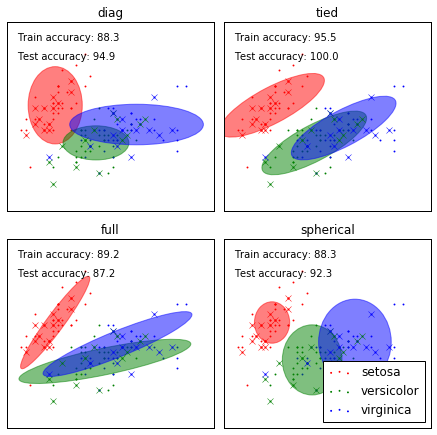
本有四个变量,如何画在平面图上的呢?以上只取了前两维数据做图。
"""

==================

GMM classification

==================

Demonstration of Gaussian mixture models for classification.

See :ref:`gmm` for more information on the estimator.

Plots predicted labels on both training and held out test data using a

variety of GMM classifiers on the iris dataset.

Compares GMMs with spherical, diagonal, full, and tied covariance

matrices in increasing order of performance.  Although one would

expect full covariance to perform best in general, it is prone to

overfitting on small datasets and does not generalize well to held out

test data.

On the plots, train data is shown as dots, while test data is shown as

crosses. The iris dataset is four-dimensional. Only the first two

dimensions are shown here, and thus some points are separated in other

dimensions.

"""

print(__doc__)

# Author: Ron Weiss <ronweiss@gmail.com>, Gael Varoquaux

# License: BSD 3 clause

# $Id$

import matplotlib.pyplot as plt

import matplotlib as mpl

import numpy as np

from sklearn import datasets

from sklearn.cross_validation import StratifiedKFold

from sklearn.externals.six.moves import xrange

from sklearn.mixture import GMM

def make_ellipses(gmm, ax):

    for n, color in enumerate('rgb'):

        v, w = np.linalg.eigh(gmm._get_covars()[n][:2, :2])

        u = w[0] / np.linalg.norm(w[0])

        angle = np.arctan2(u[1], u[0])

        angle = 180 * angle / np.pi  # convert to degrees

        v *= 9

        ell = mpl.patches.Ellipse(gmm.means_[n, :2], v[0], v[1], 180 + angle, color=color)

        ell.set_clip_box(ax.bbox)

        ell.set_alpha(0.5)

        ax.add_artist(ell)


iris = datasets.load_iris()

#数据预处理

# Break up the dataset into non-overlapping training (75%) and testing

# (25%) sets.
# 分层交叉验证,使得交叉验证抽到的样本符合原始样本的比例。
skf = StratifiedKFold(iris.target, n_folds=4)

# Only take the first fold.

train_index, test_index = next(iter(skf))

# next(iter())逐个遍历skf的elem, len(skf) = 4
# 随机获取了四组中的一组数据

X_train = iris.data  [train_index]

y_train = iris.target[train_index]

X_test  = iris.data  [test_index]

y_test  = iris.target[test_index]


#GMM初始化

n_classes = len(np.unique(y_train))
# y_train就三种值,代表有仨个Gaussian

# Try GMMs using different types of covariances.
# 四种不同的type做GMM,然后存放在dict中

classifiers = dict((covar_type,
                    GMM(n_components=n_classes, covariance_type=covar_type, init_params='wc', n_iter=20)
                    )

                    for covar_type in ['spherical', 'diag', 'tied', 'full']
                   )

# NB:covar_type的表现往往体现在高斯分布图像的旋转

n_classifiers = len(classifiers)

plt.figure(figsize=(3 * n_classifiers / 2, 6))

plt.subplots_adjust(bottom=.01, top=0.95, hspace=.15, wspace=.05,

                    left=.01, right=.99)

for index, (name, classifier) in enumerate(classifiers.items()):
"""
dict_items([('diag', GMM(covariance_type='diag', init_params='wc', min_covar=0.001, n_components=5, n_init=1, n_iter=20, params='wmc', random_state=None, tol=0.001, verbose=0)),
('tied', GMM(covariance_type='tied', init_params='wc', min_covar=0.001, n_components=5, n_init=1, n_iter=20, params='wmc', random_state=None, tol=0.001, verbose=0)),
('full', GMM(covariance_type='full', init_params='wc', min_covar=0.001, n_components=5, n_init=1, n_iter=20, params='wmc', random_state=None, tol=0.001, verbose=0)),
('spherical', GMM(covariance_type='spherical', init_params='wc', min_covar=0.001, n_components=5, n_init=1, n_iter=20, params='wmc', random_state=None, tol=0.001, verbose=0))])
"""
# 数据训练
    # Since we have class labels for the training data, we can

    # initialize the GMM parameters in a supervised manner.

    classifier.means_ = np.array([X_train[y_train == i].mean(axis=0) for i in xrange(n_classes)])

    # axis=0 沿着Matrix的‘行’求统计量,NB:每个向量的第一元素求mean,第二个元素求mean ...

    # Train the other parameters using the EM algorithm.

    classifier.fit(X_train)


# 数据表现

    h = plt.subplot(2, n_classifiers / 2, index + 1)

    make_ellipses(classifier, h)

for n, color in enumerate('rgb'):

        data = iris.data[iris.target == n]

       plt.scatter(data[:, 0], data[:, 1], 0.8, color=color,

                    label=iris.target_names[n])

    # Plot the test data with crosses

    for n, color in enumerate('rgb'):

        data = X_test[y_test == n]

        plt.plot(data[:, 0], data[:, 1], 'x', color=color)

    y_train_pred = classifier.predict(X_train)

    train_accuracy = np.mean(y_train_pred.ravel() == y_train.ravel()) * 100

    plt.text(0.05, 0.9, 'Train accuracy: %.1f' % train_accuracy,

             transform=h.transAxes)

    test_accuracy = np.mean(y_test_pred.ravel() == y_test.ravel()) * 100

    plt.text(0.05, 0.8, 'Test accuracy: %.1f' % test_accuracy,

             transform=h.transAxes)

    plt.xticks(())

    plt.yticks(())

    plt.title(name)

plt.legend(loc='lower right', prop=dict(size=12))

plt.show()
New api: mixture.GMM
"""

=============================================

Density Estimation for a mixture of Gaussians

=============================================

Plot the density estimation of a mixture of two Gaussians. Data is

generated from two Gaussians with different centers and covariance

matrices.

"""

import numpy as np

import matplotlib.pyplot as plt

from matplotlib.colors import LogNorm

from sklearn import mixture

n_samples = 300

# generate random sample, two components

np.random.seed(0)

# generate spherical data centered on (20, 20)

shifted_gaussian = np.random.randn(n_samples, 2) + np.array([20, 20])

# generate zero centered stretched Gaussian data

C = np.array([[0., -0.7], [3.5, .7]])

stretched_gaussian = np.dot(np.random.randn(n_samples, 2), C)

# concatenate the two datasets into the final training set

X_train = np.vstack([shifted_gaussian, stretched_gaussian])

# fit a Gaussian Mixture Model with two components

clf = mixture.GMM(n_components=2, covariance_type='full')

clf.fit(X_train)

# display predicted scores by the model as a contour plot

x = np.linspace(-20.0, 30.0)

y = np.linspace(-20.0, 40.0)

X, Y = np.meshgrid(x, y)

XX = np.array([X.ravel(), Y.ravel()]).T

Z = -clf.score_samples(XX)[0]

Z = Z.reshape(X.shape)

CS = plt.contour(X, Y, Z, norm=LogNorm(vmin=1.0, vmax=1000.0),

                 levels=np.logspace(0, 3, 10))

CB = plt.colorbar(CS, shrink=0.8, extend='both')

plt.scatter(X_train[:, 0], X_train[:, 1], .8)

plt.title('Negative log-likelihood predicted by a GMM')

plt.axis('tight')

plt.show()
如何判定模型中有几个Gaussian,Selecting the number of components in a classical GMM
The BIC criterion can be used to select the number of components in a GMM in an efficient way. In theory, it recovers the true number of components only in the asymptotic regime (i.e. if much data is available).
Note that using a DPGMM avoids the specification of the number of components for a Gaussian mixture model.
(NOTE:DPGMM会放在Dirichlet Process章节中学习)
哪个模型更加的好呢?目前常用有如下方法:
AIC = -2 ln(L) + 2k Akaike information criterion
BIC = -2 ln(L) + ln(n)*k Bayesian information criterion
HQ = -2 ln(L) + ln(ln(n))*k Hannan-quinn criterion
其中L是在该模型下的最大似然,n是数据数量,k是模型的变量个数。
注意这些规则只是刻画了用某个模型之后相对“真实模型”的信息损失【因为不知道真正的模型是什么样子,所以训练得到的所有模型都只是真实模型的一个近似模型】,所以用这些规则不能说明某个模型的精确度,即三个模型A, B, C,在通过这些规则计算后,我们知道B模型是三个模型中最好的,但是不能保证B这个模型就能够很好地刻画数据,因为很有可能这三个模型都是非常糟糕的,B只是烂苹果中的相对好的苹果而已。
这些规则理论上是比较漂亮的,但是实际在模型选择中应用起来还是有些困难的,例如上面我们说了5个变量就有32个变量组合,如果是10个变量呢?2的10次方,我们不可能对所有这些模型进行一一验证AIC, BIC,HQ规则来选择模型,工作量太大。
"""

=================================

Gaussian Mixture Model Selection

=================================

This example shows that model selection can be performed with

Gaussian Mixture Models using information-theoretic criteria (BIC).

Model selection concerns both the covariance type

and the number of components in the model.

In that case, AIC also provides the right result (not shown to save time),

but BIC is better suited if the problem is to identify the right model.

Unlike Bayesian procedures, such inferences are prior-free.

In that case, the model with 2 components and full covariance

(which corresponds to the true generative model) is selected.

"""

print(__doc__)

import itertools

import numpy as np

from scipy import linalg

import matplotlib.pyplot as plt

import matplotlib as mpl

from sklearn import mixture

# Number of samples per component

n_samples = 500

# Generate random sample, two components

np.random.seed(0)

C = np.array([[0., -0.1], [1.7, .4]])

X = np.r_[np.dot(np.random.randn(n_samples, 2), C),

          .7 * np.random.randn(n_samples, 2) + np.array([-6, 3])]

lowest_bic = np.infty

bic = []

n_components_range = range(1, 7)

cv_types = ['spherical', 'tied', 'diag', 'full']

for cv_type in cv_types:

    for n_components in n_components_range:

        # Fit a mixture of Gaussians with EM

        gmm = mixture.GMM(n_components=n_components, covariance_type=cv_type)

        gmm.fit(X)

        bic.append(gmm.bic(X))

        if bic[-1] < lowest_bic:

            lowest_bic = bic[-1]

            best_gmm   = gmm

# 这里不需要 test set

bic = np.array(bic)

color_iter = itertools.cycle(['k', 'r', 'g', 'b', 'c', 'm', 'y'])

clf = best_gmm

bars = []

# Plot the BIC scores

spl = plt.subplot(2, 1, 1)

for i, (cv_type, color) in enumerate(zip(cv_types, color_iter)):

    xpos = np.array(n_components_range) + .2 * (i - 2)

    bars.append(plt.bar(xpos, bic[i * len(n_components_range):

                                  (i + 1) * len(n_components_range)],

                        width=.2, color=color))

plt.xticks(n_components_range)

plt.ylim([bic.min() * 1.01 - .01 * bic.max(), bic.max()])

plt.title('BIC score per model')

xpos = np.mod(bic.argmin(), len(n_components_range)) + .65 +\

    .2 * np.floor(bic.argmin() / len(n_components_range))

plt.text(xpos, bic.min() * 0.97 + .03 * bic.max(), '*', fontsize=14)

spl.set_xlabel('Number of components')

spl.legend([b[0] for b in bars], cv_types)

# Plot the winner

splot = plt.subplot(2, 1, 2)

Y_ = clf.predict(X)

for i, (mean, covar, color) in enumerate(zip(clf.means_, clf.covars_,

                                             color_iter)):

    v, w = linalg.eigh(covar)

    if not np.any(Y_ == i):

        continue

    plt.scatter(X[Y_ == i, 0], X[Y_ == i, 1], .8, color=color)

    # Plot an ellipse to show the Gaussian component

    angle = np.arctan2(w[0][1], w[0][0])

    angle = 180 * angle / np.pi  # convert to degrees

    v *= 4

    ell = mpl.patches.Ellipse(mean, v[0], v[1], 180 + angle, color=color)

    ell.set_clip_box(splot.bbox)

    ell.set_alpha(.5)

    splot.add_artist(ell)

plt.xlim(-10, 10)

plt.ylim(-3, 6)

plt.xticks(())

plt.yticks(())

plt.title('Selected GMM: full model, 2 components')

plt.subplots_adjust(hspace=.35, bottom=.02)

plt.show()
[Scikit-learn] 2.1 Clustering - Gaussian mixture models & EM的更多相关文章
- [OpenCV] Samples 15: Background Subtraction and Gaussian mixture models
不错的草稿.但进一步处理是必然的,也是难点所在. Extended: 固定摄像头,采用Gaussian mixture models对背景建模. OpenCV 中实现了两个版本的高斯混合背景/前景分割 ...
- Gaussian Mixture Models and the EM algorithm汇总
Gaussian Mixture Models and the EM algorithm汇总 作者:凯鲁嘎吉 - 博客园 http://www.cnblogs.com/kailugaji/ 1. 漫谈 ...
- [Scikit-learn] 2.1 Clustering - Variational Bayesian Gaussian Mixture
最重要的一点是:Bayesian GMM为什么拟合的更好? PRML 这段文字做了解释: Ref: http://freemind.pluskid.org/machine-learning/decid ...
- 漫谈 Clustering (3): Gaussian Mixture Model
上一次我们谈到了用 k-means 进行聚类的方法,这次我们来说一下另一个很流行的算法:Gaussian Mixture Model (GMM).事实上,GMM 和 k-means 很像,不过 GMM ...
- 基于图嵌入的高斯混合变分自编码器的深度聚类(Deep Clustering by Gaussian Mixture Variational Autoencoders with Graph Embedding, DGG)
基于图嵌入的高斯混合变分自编码器的深度聚类 Deep Clustering by Gaussian Mixture Variational Autoencoders with Graph Embedd ...
- [zz] 混合高斯模型 Gaussian Mixture Model
聚类(1)——混合高斯模型 Gaussian Mixture Model http://blog.csdn.net/jwh_bupt/article/details/7663885 聚类系列: 聚类( ...
- Fisher Vector Encoding and Gaussian Mixture Model
一.背景知识 1. Discriminant Learning Algorithms(判别式方法) and Generative Learning Algorithms(生成式方法) 现在常见的模式 ...
- (原创)(三)机器学习笔记之Scikit Learn的线性回归模型初探
一.Scikit Learn中使用estimator三部曲 1. 构造estimator 2. 训练模型:fit 3. 利用模型进行预测:predict 二.模型评价 模型训练好后,度量模型拟合效果的 ...
- 聚类之高斯混合模型(Gaussian Mixture Model)【转】
k-means应该是原来级别的聚类方法了,这整理下一个使用后验概率准确评测其精度的方法—高斯混合模型. 我们谈到了用 k-means 进行聚类的方法,这次我们来说一下另一个很流行的算法:Gaussia ...
随机推荐
- go包管理之glide
go语言的包是没有中央库来统一管理的,通过使用go get命令从远程代码库(github.com,goolge code 等)拉取,直接跳过中央版本库的约束,让代码的拉取直接基于源代码版本控制库,开发 ...
- CAS (7) —— Mac下配置CAS 4.x的JPATicketRegistry(服务端)
CAS (7) -- Mac下配置CAS 4.x集群及JPATicketRegistry(服务端) tomcat版本: tomcat-8.0.29 jdk版本: jdk1.8.0_65 cas版本: ...
- [转]C# RichTextBox不用滚动条
转自:http://blog.csdn.net/happy09li/article/details/7444912 第一种思路: richTextBox1.ScrollBars = RichTextB ...
- WebRTC 源码分析(四):VideoCRE 与内存抖动优化
WebRTC 是个宝,初窥这部分代码时就被它的 Capturer 类的设计惊艳到了,仔细品鉴后越发佩服起来,里面简直填了太多坑了,如此宝贝,如不能为我所用,岂非一大憾事!而前三篇的解读,正是为了今天能 ...
- javascript常用功能收藏
引用:http://www.css88.com/archives/5180 收集了一些比较常用的javascript函数. 字符串长度截取 function cutstr(str, len) { va ...
- javascript小技巧[转]
总的来说,如果你要找js 的东西,而不看这两篇的话,肯定要多花好多时间!!哈哈!! 如果你找的javascript的东西的话,建议你 ctrl+F 直接在这个页上找,因为这里80%有你要找的,但是要 ...
- SSH-简单登陆业务详解,从环境部署到代码编写
一直都是半解半知的情况下动手去实现某些功能,但是竟然也可以成功, 而我发现你花2小时听视频看所谓的理论,不如花2小时直接做个功能出来, 更加深了对此框架的理解,中间遇到问题后,可以上网再查详细的知识点 ...
- (笔记)Linux常用命令大全
系统信息 arch 显示机器的处理器架构(1) uname -m 显示机器的处理器架构(2) uname -r 显示正在使用的内核版本 dmidecode -q 显示硬件系统部件 - (SMBIOS ...
- 第11章:sed进阶操作
第11章:sed进阶操作 sed是一个很好的文件处理工具,本身是一个管道命令,主要是以行为单位进行处理,可以将数据行进行替换.删除.新增.选取等特定工作,下面先了解一下sed的用法 sed命令行格式为 ...
- Linux入门基础教程之Linux下软件安装
Linux入门基础教程之Linux下软件安装 一.在线安装: sudo apt-get install 即可安装 如果在安装完后无法用Tab键补全命令,可以执行: source ~/.zshrc AP ...