
poj 1486 Sorting Slides
| Time Limit: 1000MS | Memory Limit: 10000K | |
| Total Submissions: 4469 | Accepted: 1766 |
Description
The situation is like this. The slides all have numbers written on them according to their order in the talk. Since the slides lie on each other and are transparent, one cannot see on which slide each number is written. 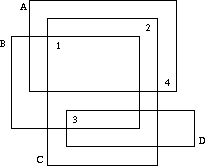
Well, one cannot see on which slide a number is written, but one may deduce which numbers are written on which slides. If we label the slides which characters A, B, C, ... as in the figure above, it is obvious that D has number 3, B has number 1, C number 2 and A number 4.
Your task, should you choose to accept it, is to write a program that automates this process.
Input
This is followed by n lines containing two integers each, the x- and y-coordinates of the n numbers printed on the slides. The first coordinate pair will be for number 1, the next pair for 2, etc. No number will lie on a slide boundary.
The input is terminated by a heap description starting with n = 0, which should not be processed.
Output
If no matchings can be determined from the input, just print the word none on a line by itself.
Output a blank line after each test case.
Sample Input
4

6 22 10 20

4 18 6 16

8 20 2 18

10 24 4 8

9 15

19 17

11 7

21 11

2

0 2 0 2

0 2 0 2

1 1

1 1

0
Sample Output
Heap 1

(A,4) (B,1) (C,2) (D,3)

Heap 2

none

题意:有n张幻灯片重叠在了一起,并且每张幻灯片上都标记了一个数字,只是重叠之后不知道相应的数字是哪张幻灯片上的,你需要判断那几张幻灯片可以确定出它们上面标记的数字。
思路:每张幻灯片抽象为一个结点,每个数字也抽象为一个结点,并且每个数字出现在了某张幻灯片的内部,幻灯片就向该数字连一条边,这样建立了匹配图,之后就是二分匹配问题。先求一次该图最大匹配,求得的匹配数设为N;
要确定出每张幻灯片a是不是对应了某个数字b,可以先把a,b对应的边从图中删除,删除后再求该图最大匹配,若最大匹配变为了N-1,说明这条边是必须边,即确定了a,b的对应关系;反之,这条边删除后,a还可以和其他的数字对应,b还可和其他幻灯片对应,那么关系就不唯一了,无法确定。操作完成,把这条边再加进图中
把所有边都删除一次,即可确定哪些边是必须的。
AC代码:
#define _CRT_SECURE_NO_DEPRECATE

#include<iostream>

#include<algorithm>

#include<queue>

#include<set>

#include<vector>

#include<cstring>

#include<string>

using namespace std;

#define INF 0x3f3f3f3f

const int N_MAX =;

int V;//点的个数

vector<int>G[N_MAX];

int match[N_MAX];

bool used[N_MAX];

void add_edge(int u, int v) {

    G[u].push_back(v);

    G[v].push_back(u);

}

bool dfs(int v) {

    used[v] = true;

    for (int i = ; i < G[v].size(); i++) {

        int u = G[v][i], w = match[u];

        if (w <  || !used[w] && dfs(w)) {

            match[v] = u;

            match[u] = v;

            return true;

        }

    }

    return false;

}

int bipartite_matching() {

    int res = ;

    memset(match, -, sizeof(match));

    for (int v = ; v < V; v++) {

        if (match[v] < ) {

            memset(used, , sizeof(used));

            if (dfs(v))

                res++;

        }

    }

    return res;

}

struct Area {

    int x_min, x_max, y_min, y_max;

}area[N_MAX];

struct Cor {

    int x, y;

}cor[N_MAX];

int n,s,t,COr[N_MAX];

char ARea[N_MAX];

int main() {

    int Case = ;

    while (scanf("%d",&n)&&n) {

        Case++;

        //0~n-1:区域

        //n~2n-1:记号

        V =  * n;

        for (int i = ; i < n; i++)

            scanf("%d%d%d%d",&area[i].x_min,&area[i].x_max,&area[i].y_min,&area[i].y_max);

        for (int i = ; i < n;i++) {

            scanf("%d%d",&cor[i].x,&cor[i].y);

            for (int j = ; j < n;j++) {

                if (area[j].x_min<cor[i].x&&area[j].x_max>cor[i].x&&area[j].y_min<cor[i].y&&area[j].y_max>cor[i].y)

                add_edge(j, i + n);

            }

        }

        int N = bipartite_matching();//一开始匹配数

        int num = ;

        for (int i = ; i < n;i++) {//对于每一块区域

            for (int j = ; j < n;j++) {//对于每一个坐标点

                if (area[i].x_min<cor[j].x&&area[i].x_max>cor[j].x&&area[i].y_min<cor[j].y&&area[i].y_max>cor[j].y) {

                    vector<int>::iterator it1 = find(G[i].begin(),G[i].end(),j+n);

                    vector<int>::iterator it2 = find(G[j + n].begin(), G[j + n].end(), i);

                    G[i].erase(it1);

                    G[j + n].erase(it2);

                    if (bipartite_matching() < N) {//说明是必须边

                        ARea[num] = i+;

                        COr[num] = j+;

                            num++;

                    }

                    add_edge(i, j + n);//复原

                }

            }

        }

        if (!num)printf("Heap %d\nnone\n",Case);

        else {

            printf("Heap %d\n", Case);

            for (int i = ; i < num;i++) {

                printf("(%c,%d) ",ARea[i],COr[i]);

            }

            puts("");

        }

        puts("");

    for (int i = ; i < V;i++) {

            G[i].clear();

        }

    }

    return ;

}
poj 1486 Sorting Slides的更多相关文章
- POJ 1486 Sorting Slides (KM)
Sorting Slides Time Limit: 1000MS Memory Limit: 10000K Total Submissions: 2831 Accepted: 1076 De ...
- POJ 1486 Sorting Slides(二分图匹配)
[题目链接] http://poj.org/problem?id=1486 [题目大意] 给出每张幻灯片的上下左右坐标,每张幻灯片的页码一定标在这张幻灯片上, 现在问你有没有办法唯一鉴别出一些幻灯片 ...
- poj 1486 Sorting Slides(二分图匹配的查找应用)
Description Professor Clumsey is going to give an important talk this afternoon. Unfortunately, he i ...
- POJ 1486 Sorting Slides(寻找必须边)
题意:找出幻灯片与编号唯一对应的情况 思路: 1:求最大匹配,若小于n,则答案为none,否则转2 (不过我代码没有事先判断一开始的最大匹配数是否<n,但这样也过了,估计给的数据最大匹配数一定为 ...
- POJ 1486 Sorting Slides (二分图关键匹配边)
题意 给你n个幻灯片,每个幻灯片有个数字编号1~n,现在给每个幻灯片用A~Z进行编号,在该幻灯片范围内的数字都可能是该幻灯片的数字编号.问有多少个幻灯片的数字和字母确定的. 思路 确定幻灯片的数字就是 ...
- POJ 1486 Sorting Slides(二分图完全匹配必须边)题解
题意:给你n张照片的范围,n个点的坐标,问你能唯一确定那几个点属于那几张照片,例如样例中4唯一属于A,2唯一属于C,1唯一属于B,3唯一属于C 思路:进行二分图完全匹配,怎么判断唯一属于?匹配完之后删 ...
- POJ 1486 Sorting Slides【二分图匹配】
题目大意:有n张幻灯片和n个数字,幻灯片放置有重叠,每个数字隶属于一个幻灯片,现在问你能够确定多少数字一定属于某个幻灯片 思路:上次刷过二分图的必须点后这题思路就显然了 做一次二分匹配后将当前匹配的边 ...
- 【POJ】1486:Sorting Slides【二分图关键边判定】
Sorting Slides Time Limit: 1000MS Memory Limit: 10000K Total Submissions: 5390 Accepted: 2095 De ...
- ACM: poj 1094 Sorting It All Out - 拓扑排序
poj 1094 Sorting It All Out Time Limit:1000MS Memory Limit:10000KB 64bit IO Format:%lld & ...
随机推荐
- 强化学习_PolicyGradient(策略梯度)_代码解析
使用策略梯度解决离散action space问题. 一.导入包,定义hyper parameter import gym import tensorflow as tf import numpy as ...
- 在Solr中配置中文分词IKAnalyzer
李克华 云计算高级群: 292870151 交流:Hadoop.NoSQL.分布式.lucene.solr.nutch 在Solr中配置中文分词IKAnalyzer 1.在配置文件schema.xml ...
- 关键字: on
关键字: on 数据库在通过连接两张或多张表来返回记录时,都会生成一张中间的临时表,然后再将这张临时表返回给用户. 在使用left jion时,on和where条件的区别如下: 1. on条件是在生成 ...
- 一个制作Xcode5插件的模板
原Github地址:https://github.com/kattrali/Xcode5-Plugin-Template 安装将 本工成复制到~/Library/Developer/Xcode/Tem ...
- MIPS程序设计实例
第一题:用系统功能调用实现简单输入输出 题目要求 利用系统功能调用从键盘输入,转换后在屏幕上显示,具体要求如下: 1.如果输入的是字母(A~Z,区分大小写)或数字(0~9),则将其转换成对应的英文单词 ...
- Java中集合类
一.Collection Collection 接口用于表示任何对象或元素组.想要尽可能以常规方式处理一组元素时,就使用这一接口.Collection 在前面的大图也可以看出,它是List 和 Set ...
- Luogu P1782 旅行商的背包
题目传送门 卡常背包果然名不虚传 算法主体就是两种背包分开跑,先跑多重背包,再跑奇货 不知道为什么,这题二进制拆分好像要比单调队列优化快一些 然后这题毒瘤的地方就出来了: 如果一件物品的体积\(\ti ...
- postgresql+pgadmin3安装
检查5432端口是否被占用,如果占用则释放 1.运行postgresql-9.3.1.xxx.run 安装好postgresql和pgadmin III 2.创建数据库目录和日志目录 [roo ...
- 【Java_多线程并发编程】JUC原子类——AtomicLong原子类
1. AtomicLong是基本原子类中的一种 AtomicLong是对长整形进行原子操作. 1.1 AtomicLong类的函数列表 // 构造函数 AtomicLong() // 创建值为init ...
- 【Java_多线程并发编程】JUC原子类——4种原子类
根据修改的数据类型,可以将JUC包中的原子操作类可以分为4种,分别是: 1. 基本类型: AtomicInteger, AtomicLong, AtomicBoolean ;2. 数组类型: Atom ...