
快速模式第三包:quick_inR1_outI2()
快速模式第三包:quick_inR1_outI2()
文章目录
1. 序言
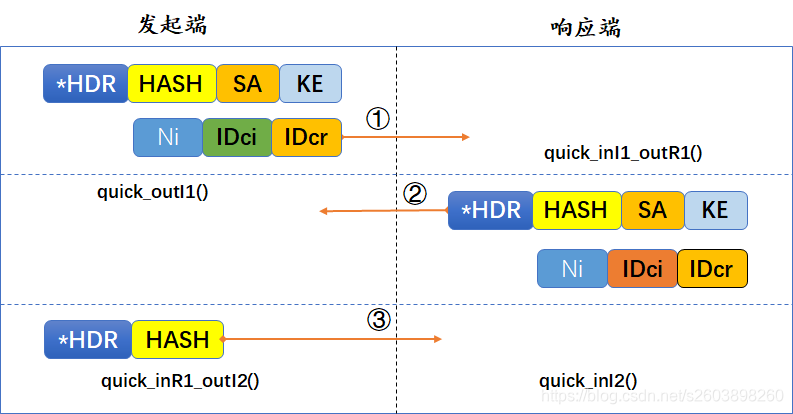
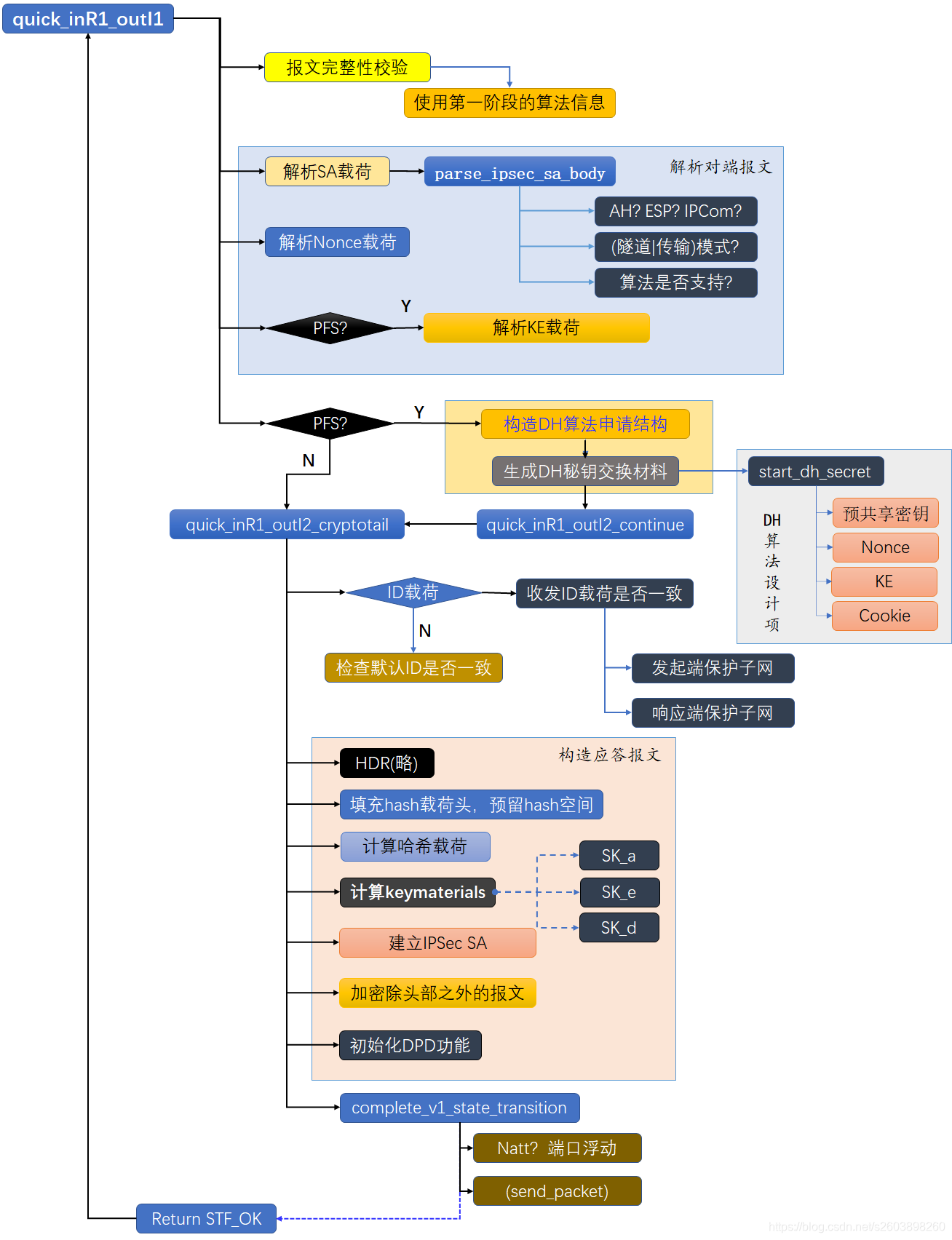
在上一篇中博客中长话短说了第二包的处理流程,前两个报文的交互是快速模式的关键交互,用来协商会话参数(加解密算法、会话秘钥等),而第三包则是对前两个报文的认证,流程上简单了很多 。quick_inR1_outI2()处理流程实现的功能如下:
- 解析SA载荷(对端选择的加解密算法信息)、KE载荷(pfs)、Nonce载荷。
- 构造第三个报文
- 生成密钥生成材料keymats
- 建立完整的IPsec SA
- 发起端建立的为完整IPSec SA,包括入SA和出SA,响应端有所不同。
- 启动DPD检测
2. quick_inR1_outI2()的处理流程
第三个报文的完整处理流程如下:
3. 快速模式第③包报文格式
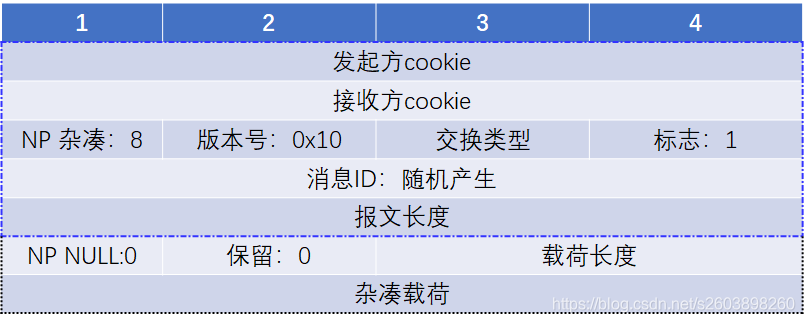
该报文中的杂凑载荷是对前面交换的认证。第③包仅有ISAKMP头部和杂凑载荷构成,杂凑载荷的消息摘要是以一个0字节的MsgID、去掉载荷头的发起者Nonce以及去掉了载荷头的响应者Nonce为输入参数生成的,计算公式如下:
H
A
S
H
(
3
)
=
P
R
F
(
S
K
E
Y
−
a
,
0
∣
M
s
g
I
D
∣
N
i
b
∣
N
r
b
)
HASH(3) = PRF(SKEY-a, 0|MsgID|Ni_b|Nr_b)
HASH(3)=PRF(SKEY−a,0∣MsgID∣Nib∣Nrb)
4. quick_inR1_outI2()源码分析
接口quick_inR1_outI2()的主要功能如下:
- 验证报文的完整性
- 解析响应端选择的SA载荷
- 加解密算法(ESP协议、AH协议,…)
- 认证算法
- 封装模式(隧道模式 ?传输模式)
- 解析Nonce载荷
- 如果启用PFS
- 解析KE载荷
- 再次计算DH交换值
stf_status

quick_inR1_outI2(struct msg_digest *md)

{

    struct state *const st = md->st;

    /* HASH(2) in *//*验证报文的哈希载荷*/

    CHECK_QUICK_HASH(md

	, quick_mode_hash12(hash_val, hash_pbs->roof, md->message_pbs.roof

	    , st, &st->st_msgid, TRUE)

	, "HASH(2)", "Quick R1");

    /* SA in */

    {

	struct payload_digest *const sa_pd = md->chain[ISAKMP_NEXT_SA];

	/*解析对端选择的SA载荷*/

	RETURN_STF_FAILURE(parse_ipsec_sa_body(&sa_pd->pbs

	    , &sa_pd->payload.sa, NULL, TRUE, st));

    }

    /* Nr in *//*解析对端Nonce载荷*/

    RETURN_STF_FAILURE(accept_v1_nonce(md, &st->st_nr, "Nr"));

    /* [ KE ] in (for PFS) *//*根据配置策略解析对端KE载荷*/

    RETURN_STF_FAILURE(accept_PFS_KE(md, &st->st_gr, "Gr", "Quick Mode R1"));

    if(st->st_pfs_group) {/*如果支持PFS功能,则需要进行DH算法计算*/

		struct dh_continuation *dh = alloc_thing(struct dh_continuation

							 , "quick outI2 DH");

		/* set up DH calculation */

		dh->md = md;

		passert(st != NULL);

		set_suspended(st, md);

		pcrc_init(&dh->dh_pcrc);

		dh->dh_pcrc.pcrc_func = quick_inR1_outI2_continue;

		return start_dh_secret(&dh->dh_pcrc, st

				       , st->st_import

				       , INITIATOR

				       , st->st_pfs_group->group);

    } else {

		/* just call the tail function */

		struct dh_continuation dh;

		dh.md=md;

		return quick_inR1_outI2_cryptotail(&dh, NULL);

    }

}
4. quick_inR1_outI2_cryptotail()源码分析
接口quick_inR1_outI2_cryptotail()的主要功能如下:
检验ID载荷收发是否一致
这里是通过ID载荷来协商IPSec隧道的保护子网信息
NAT-T相关处理
构造应答报文
计算keymats值
建立IPSecSA
初始化本隧道的DPD定时器
stf_status

quick_inR1_outI2_cryptotail(struct dh_continuation *dh

			    , struct pluto_crypto_req *r)

{

    struct msg_digest *md = dh->md;

    struct state *st = md->st;

    struct connection *c = st->st_connection;

    if (st->st_pfs_group != NULL && r!=NULL) {

	finish_dh_secret(st, r);/*获取密钥信息*/

        if(!r->pcr_success) {

            return STF_FAIL + INVALID_KEY_INFORMATION;

        }

    }

#ifdef NAT_TRAVERSAL

    ... ...

#endif

    /* [ IDci, IDcr ] in; these must match what we sent */

    {

	struct payload_digest *const IDci = md->chain[ISAKMP_NEXT_ID];

	struct payload_digest *IDcr;

	if (IDci != NULL)/*应答报文中包含ID载荷*/

	{

	    /* ??? we are assuming IPSEC_DOI */

	    /* IDci (we are initiator) *//*确定收发ID载荷是否一致*/

	    if (!check_net_id(&IDci->payload.ipsec_id, &IDci->pbs

			      , &st->st_myuserprotoid, &st->st_myuserport

			      , &st->st_connection->spd.this

                              , &st->st_localaddr

			      , "our client"))

		return STF_FAIL + INVALID_ID_INFORMATION;

	    /* we checked elsewhere that we got two of them */

	    IDcr = IDci->next;/*响应端ID载荷是否匹配*/

	    passert(IDcr != NULL);

	    /* IDcr (responder is peer) */

	    if (!check_net_id(&IDcr->payload.ipsec_id, &IDcr->pbs

			      , &st->st_peeruserprotoid, &st->st_peeruserport

			      , &st->st_connection->spd.that

                              , &st->st_remoteaddr

			      , "peer client"))

		return STF_FAIL + INVALID_ID_INFORMATION;

	    /*

	     * if there is a NATOA payload, then use it as

	     *    &st->st_connection->spd.that.client, if the type

	     * of the ID was FQDN

	     */

#ifdef NAT_TRAVERSAL

	... ...

#endif

	}

	else

	{

	    /* no IDci, IDcr: we must check that the defaults match our proposal */

	    if (!subnetisaddr(&c->spd.this.client, &c->spd.this.host_addr)/*两个地址一样即可*/

		|| !subnetisaddr(&c->spd.that.client, &c->spd.that.host_addr))

	    {

		loglog(RC_LOG_SERIOUS, "IDci, IDcr payloads missing in message"

		    " but default does not match proposal");

		return STF_FAIL + INVALID_ID_INFORMATION;

	    }

	}

    }

    /**************** build reply packet HDR*, HASH(3) ****************/

    /* HDR* out done ISAKMP头部已经填充完毕*/

    /* HASH(3) out -- sometimes, we add more content */

    {

	u_char	/* set by START_HASH_PAYLOAD: */

	    *r_hashval,	/* where in reply to jam hash value */

	    *r_hash_start;      /* start of what is to be hashed */

	/*填充hash载荷*/

	START_HASH_PAYLOAD(md->rbody, ISAKMP_NEXT_NONE);

	/*计算哈希载荷值,用于对端检测报文的完整性*/

	(void)quick_mode_hash3(r_hashval, st);

        r_hash_start = r_hash_start;   /* otherwise complaint about never used */

    }

   /* Derive new keying material *//*计算密钥生成材料*/

    compute_keymats(st);

    /* Tell the kernel to establish the inbound, outbound, and routing part

     * of the new SA (unless the commit bit is set -- which we don't support).

     * We do this before any state updating so that

     * failure won't look like success.

     */

    if (!install_ipsec_sa(md->pst, st, TRUE))/*建立IPsecSA*/

	return STF_INTERNAL_ERROR;

    /* encrypt message, except for fixed part of header */

	/*加密*/

    if (!encrypt_message(&md->rbody, st))

    {

        delete_ipsec_sa(st, FALSE);

        return STF_INTERNAL_ERROR;	/* ??? we may be partly committed */

    }

    st->st_connection->newest_ipsec_sa = st->st_serialno;

    /* note (presumed) success */

    if (c->gw_info != NULL)

	c->gw_info->key->last_worked_time = now();

    /* If we have dpd delay and dpdtimeout set, then we are doing DPD

	on this conn, so initialize it */

    if (st->st_connection->dpd_delay && st->st_connection->dpd_timeout) {

        if(dpd_init(st) != STF_OK) {/*启动DPD定时器*/

            delete_ipsec_sa(st, FALSE);

            return STF_FAIL;

        }

    }

    return STF_OK;

}
4. compute_keymats()源码分析
compute_keymats()是一个很重的函数,功能是第二阶段计算生成密钥材料,它的计算方式如下:
- 如果启用PFS功能:
K
E
Y
M
A
T
S
=
P
R
F
(
S
K
E
Y
S
T
R
−
d
,
g
x
y
∣
p
r
o
t
o
c
o
l
∣
S
P
I
∣
N
i
−
b
∣
N
r
−
b
)
KEYMATS = PRF(SKEYSTR-d, g^{xy} | protocol | SPI | Ni-b |Nr-b )
KEYMATS=PRF(SKEYSTR−d,gxy∣protocol∣SPI∣Ni−b∣Nr−b)
- 未用PFS功能:
K
E
Y
M
A
T
S
=
P
R
F
(
S
K
E
Y
S
T
R
−
d
,
p
r
o
t
o
c
o
l
∣
S
P
I
∣
N
i
−
b
∣
N
r
−
b
)
KEYMATS = PRF(SKEYSTR-d, protocol | SPI | Ni-b |Nr-b )
KEYMATS=PRF(SKEYSTR−d,protocol∣SPI∣Ni−b∣Nr−b)
需要注意的是:
- g
x
y
g^{xy}
gxy是第二阶段通过额外的DH交换计算得到的(DH计算出的共享秘钥),存储在
st->st_shared中。此变量虽然在第一阶段时也有生成,但是第二阶段使用了第一阶段复制的state状态,并未使用第一阶段中的st_shared的值,因此第二阶段的st->st_shared只有在进行额外的DH交换后才会生成,且不会使用第一阶段的共享密钥的值。
static void

compute_keymats(struct state *st)

{

    if (st->st_ah.present)

	compute_proto_keymat(st, PROTO_IPSEC_AH, &st->st_ah, "AH");

    if (st->st_esp.present)

	compute_proto_keymat(st, PROTO_IPSEC_ESP, &st->st_esp, "ESP");

}

/*

 * Produce the new key material of Quick Mode.

 * RFC 2409 "IKE" section 5.5

 * specifies how this is to be done.

 *###############################################

 *	compute_proto_keymat非常重要的密钥协商函数

 *###############################################

 */

static void

compute_proto_keymat(struct state *st

		     , u_int8_t protoid

		     , struct ipsec_proto_info *pi

		     , const char *satypename)

{

    size_t needed_len = 0; /* bytes of keying material needed */

    /* Add up the requirements for keying material

     * (It probably doesn't matter if we produce too much!)

     */

    switch (protoid)

    {

    case PROTO_IPSEC_ESP:

	    switch (pi->attrs.transattrs.encrypt)/*加密算法*/

	    {

	    	    case ESP_NULL:

			needed_len = 0;

			break;

		    case ESP_DES:

			needed_len = DES_CBC_BLOCK_SIZE;

			break;

		    case ESP_3DES:

			needed_len = DES_CBC_BLOCK_SIZE * 3;

			break;

		    case ESP_AES:

			needed_len = AES_CBC_BLOCK_SIZE;

			/* if an attribute is set, then use that! */

			if(st->st_esp.attrs.transattrs.enckeylen) {/*如果属性载荷设置了此参数,则使用此参数的值*/

			    needed_len = st->st_esp.attrs.transattrs.enckeylen/8;

			}

			break;

		    default:

#ifdef KERNEL_ALG

			if((needed_len=kernel_alg_esp_enc_keylen(pi->attrs.transattrs.encrypt))>0) {

				/* XXX: check key_len "coupling with kernel.c's */

				if (pi->attrs.transattrs.enckeylen) {

					needed_len=pi->attrs.transattrs.enckeylen/8;

					DBG(DBG_PARSING, DBG_log("compute_proto_keymat:"

							"key_len=%d from peer",

							(int)needed_len));

				}

				break;

			}

#endif

			bad_case(pi->attrs.transattrs.encrypt);

	    }

	    DBG(DBG_PARSING, DBG_log("compute_proto_keymat:"

				     "needed_len (after ESP enc)=%d",

				     (int)needed_len));

	    switch (pi->attrs.transattrs.integ_hash)/*哈希算法*/

	    {

		    case AUTH_ALGORITHM_NONE:

			break;

		    case AUTH_ALGORITHM_HMAC_MD5:

			needed_len += HMAC_MD5_KEY_LEN;

			break;

		    case AUTH_ALGORITHM_HMAC_SHA1:

			needed_len += HMAC_SHA1_KEY_LEN;

			break;

		    default:

#ifdef KERNEL_ALG

		      if (kernel_alg_esp_auth_ok(pi->attrs.transattrs.integ_hash, NULL) == NULL) {

			  needed_len += kernel_alg_esp_auth_keylen(pi->attrs.transattrs.integ_hash);

			  break;

		      }

#endif

		    case AUTH_ALGORITHM_DES_MAC:

			bad_case(pi->attrs.transattrs.integ_hash);

			break;

	    }

	    DBG(DBG_PARSING, DBG_log("compute_proto_keymat:"

				    "needed_len (after ESP auth)=%d",

				    (int)needed_len));

	    break;

    case PROTO_IPSEC_AH:

	    switch (pi->attrs.transattrs.encrypt)

	    {

		    case AH_MD5:

			needed_len = HMAC_MD5_KEY_LEN;

			break;

		    case AH_SHA:

			needed_len = HMAC_SHA1_KEY_LEN;

			break;

		    default:

#ifdef KERNEL_ALG

			if (kernel_alg_ah_auth_ok(pi->attrs.transattrs.integ_hash, NULL)) {

			    needed_len += kernel_alg_ah_auth_keylen(pi->attrs.transattrs.integ_hash);

			    break;

			}

#endif

			bad_case(pi->attrs.transattrs.encrypt);

	    }

	    break;

    default:

	bad_case(protoid);

    }

/*将所有算法需要的密钥长度全部相加,从而生成所需长度的密钥材料*/

    pi->keymat_len = needed_len;

    /* Allocate space for the keying material.

     * Although only needed_len bytes are desired, we

     * must round up to a multiple of ctx.hmac_digest_len

     * so that our buffer isn't overrun.

     */

    {

	struct hmac_ctx ctx_me, ctx_peer;

	size_t needed_space;	/* space needed for keying material (rounded up) */

	size_t i;

	hmac_init_chunk(&ctx_me, st->st_oakley.prf_hasher, st->st_skeyid_d);

	ctx_peer = ctx_me;	/* duplicate initial conditions */

	needed_space = needed_len + pad_up(needed_len, ctx_me.hmac_digest_len);

	replace(pi->our_keymat, alloc_bytes(needed_space, "keymat in compute_keymat()"));

	replace(pi->peer_keymat, alloc_bytes(needed_space, "peer_keymat in quick_inI1_outR1()"));

/*

* 准备计算秘钥所需的所有材料

*	1. DH交换生成的共享秘钥

*	2. 协议protocol

*	3. SPI

*	4. Ni_b

*	5. Nr_b

*/

	for (i = 0;; )

	{

        /*1. DH交换生成的共享秘钥*/

	    if (st->st_shared.ptr != NULL)

	    {

            /* PFS: include the g^xy */

            hmac_update_chunk(&ctx_me, st->st_shared);

            hmac_update_chunk(&ctx_peer, st->st_shared);

	    }

        /*2. 协议protocol*/

	    hmac_update(&ctx_me, &protoid, sizeof(protoid));

	    hmac_update(&ctx_peer, &protoid, sizeof(protoid));

		/*3. SPI*/

	    hmac_update(&ctx_me, (u_char *)&pi->our_spi, sizeof(pi->our_spi));

	    hmac_update(&ctx_peer, (u_char *)&pi->attrs.spi, sizeof(pi->attrs.spi));

		/*4. Ni_b*/

	    hmac_update_chunk(&ctx_me, st->st_ni);

	    hmac_update_chunk(&ctx_peer, st->st_ni);

		/*5. Nr_b*/

	    hmac_update_chunk(&ctx_me, st->st_nr);

	    hmac_update_chunk(&ctx_peer, st->st_nr);

	    hmac_final(pi->our_keymat + i, &ctx_me);

	    hmac_final(pi->peer_keymat + i, &ctx_peer);

	    i += ctx_me.hmac_digest_len;

	    if (i >= needed_space)

		break;

	    /* more keying material needed: prepare to go around again */

	    hmac_reinit(&ctx_me);

	    hmac_reinit(&ctx_peer);

	    hmac_update(&ctx_me, pi->our_keymat + i - ctx_me.hmac_digest_len, ctx_me.hmac_digest_len);

	    hmac_update(&ctx_peer, pi->peer_keymat + i - ctx_peer.hmac_digest_len, ctx_peer.hmac_digest_len);

	}

    }

/*双方能计算出对端的密钥材料信息???*/

    DBG(DBG_CRYPT,

	DBG_log("%s KEYMAT\n",satypename);

	DBG_dump("  KEYMAT computed:\n", pi->our_keymat, pi->keymat_len);

	DBG_dump("  Peer KEYMAT computed:\n", pi->peer_keymat, pi->keymat_len));

}
5. dpd_init()源码分析
DPD功能对应有两个事件:
EVENT_DPD_TIMEOUT
第一阶段的定时器,在第二阶段已经断开的情况下,用来检测第一阶段是否超时
DPD_EVENT
第二阶段的定时器,长时间未通讯时断开连接,并启动第一阶段的定时器
这个定时器机制实际使用时会复杂一点。可以参考注释说明。
/**

 * Initialize RFC 3706 Dead Peer Detection

 *

 * @param st An initialized state structure

 * @return void

 *

 * How DPD works.

 *

 * There are two kinds of events that can be scheduled.

 * At most one of them is schedule at any given time.

 *

 * The EVENT_DPD_TIMEOUT event, if it ever goes off, means that

 * neither the ISAKMP SA nor the IPsec SA has *RECEIVED* any DPD

 * events lately.

 *

 * 0) So, every time we receive a DPD (R_U_THERE or R_U_ACK), then

 *    we delete any DPD event (EVENT_DPD or EVENT_DPD_TIMEOUT), and

 *    we schedule a new DPD_EVENT (sending) for "delay" in the future.

 *

 * 1) When the DPD_EVENT goes off, we check the phase 2 (if there is one)

 *    SA to see if there was incoming traffic. If there was, then we are happy,

 *    we set a new DPD_EVENT, and we are done.

 *

 * 2) If there was no phase 2 activity, we check if there was a recent enough

 *    DPD activity (st->st_last_dpd). If so, we just reschedule, and do

 *    nothing.

 *

 * 3) Otherwise, we send a DPD R_U_THERE message, and set the

 *    EVENT_DPD_TIMEOUT on the phase 1.

 *

 * One thing to realize when looking at "ipsec whack --listevents" output,

 * is there there will only be DPD_EVENT_TIMEOUT events if there are

 * outstanding R_U_THERE messages.

 *

 * The above is the basic idea, but things are a bit more complicated because

 * multiple phase 2s can share the same phase 1 ISAKMP SA. Each phase 2 state

 * has its own DPD_EVENT. Further, we start a DPD_EVENT for phase 1 when it

 * gets established. This is because the phase 2 may never actually succeed

 * (usually due to authorization issues, which may be DNS or otherwise related)

 * and if the responding end dies (gets restarted, or the conn gets reloaded

 * with the right policy), then we may have a bum phase 1 SA, and we can not

 * re-negotiate. (This happens WAY too often)

 *

 * The phase 2 dpd_init() will attempt to kill the phase 1 DPD_EVENT, if it

 * can, to reduce the amount of work.

 *

 * The st_last_dpd member which is used is always the one from the phase 1.

 * So, if there are multiple phase 2s, then if any of them receive DPD data

 * they will update the st_last_dpd, so the test in #2 will avoid the traffic

 * for all by one phase 2.

 *

 * Note that the EVENT_DPD are attached to phase 2s (typically), while the

 * EVENT_DPD_TIMEOUT are attached to phase 1s only.

 *

 * Finally, if the connection is using NAT-T, then we ignore the phase 2

 * activity check, because in the case of a unidirectional stream (VoIP for

 * a conference call, for instance), we may not send enough traffic to keep

 * the NAT port mapping valid.

 *

 */

stf_status

dpd_init(struct state *st)

{

    /**

     * Used to store the 1st state

     */

#ifdef HAVE_LABELED_IPSEC

	if(st->st_connection->loopback) {

            openswan_log("dpd is not required for ipsec connections over loopback");

            return STF_OK;

	}

#endif

    struct state *p1st;

    /* find the related Phase 1 state */

    p1st = find_state_ikev1(st->st_icookie, st->st_rcookie,

		      &st->st_connection->spd.that.host_addr, 0);/*第一阶段的msgid为0*/

    if (p1st == NULL) {

        loglog(RC_LOG_SERIOUS, "could not find phase 1 state for DPD");

	/*

	 * if the phase 1 state has gone away, it really should have

	 * deleted all of its children.

	 * Why would this happen? because a quick mode SA can take

	 * some time to create (DNS lookups for instance), and the phase 1

	 * might have been taken down for some reason in the meantime.

	 * We really can not do anything here --- attempting to invoke

	 * the DPD action would be a good idea, but we really should

	 * do that outside this function.

	 */

	return STF_FAIL;

    }

    /* if it was enabled, and we haven't turned it on already */

    if (p1st->hidden_variables.st_dpd) {

	time_t n = now();

	openswan_log("Dead Peer Detection (RFC 3706): enabled");

	if(st->st_dpd_event == NULL || (st->st_connection->dpd_delay + n) < st->st_dpd_event->ev_time) {

	    delete_dpd_event(st);

	    event_schedule(EVENT_DPD, st->st_connection->dpd_delay, st);

	}

    } else {

      openswan_log("Dead Peer Detection (RFC 3706): not enabled because peer did not advertise it");

    }

    if(p1st != st) {/*第一阶段的DPD_EVENT事件已经没有必要,可以进行删除了,第二阶段会有自己的DPD_EVENT*/

	/* st was not a phase 1 SA, so kill the DPD_EVENT on the phase 1 */

	if(p1st->st_dpd_event != NULL

	   && p1st->st_dpd_event->ev_type == EVENT_DPD) {

	    delete_dpd_event(p1st);

	}

    }

    return STF_OK;

}
6. install_ipsec_sa()源码分析

快速模式第三包:quick_inR1_outI2()的更多相关文章
- 快速模式第三包收尾之quick_inI2()
快速模式第三包收尾之quick_inI2() 文章目录 快速模式第三包收尾之quick_inI2() 1. 序言 2. quick_inI2()处理流程图 3. 报文格式 4. quick_inI2( ...
- openswan中ISAKMP交互过程关键函数接口
1. ISAKMP交互过程中关键函数接口 下面分别说明不同的阶段和模式下的函数接口以及对应的报文. 2. 第一阶段(Phase I)主模式函数接口 发送端 响应端 main_outI1 主模式第一包 ...
- IPsec 9个包分析(主模式+快速模式)
第一阶段:ISAKMP协商阶段 1.1 第一包 包1:发起端协商SA,使用的是UDP协议,端口号是500,上层协议是ISAKMP,该协议提供的是一个框架,里面的负载Next payload类似模块,可 ...
- iPhone 6 被盗记录二【写在315前夕:苹果售后福州直信创邺在没有三包的情况下帮小偷翻新、助力小偷换机销赃!无视王法。让人震惊,痛心,憎恨!消费者很受伤很无奈】
投诉公司: 北京直信创邺数码科技有限公司 标题: 写在315前夕:苹果售后在没有三包的情况下帮小偷翻新.助力小偷换机销赃!无视王法.让人震惊,痛心,憎恨!消费者很受伤很无奈 期望: 还我手机,或者赔 ...
- python能够执行,但编译第三包遇到 python.h no such file or directory
python能够执行,但编译第三包遇到 python.h no such file or directory 这个问题是由于没有安装python-devel, 安装此包就能够解决次问题,在Linux下 ...
- 数据结构20:KMP算法(快速模式匹配算法)详解
通过上一节的介绍,学习了串的普通模式匹配算法,大体思路是:模式串从主串的第一个字符开始匹配,每匹配失败,主串中记录匹配进度的指针 i 都要进行 i-j+1 的回退操作(这个过程称为“指针回溯”),同时 ...
- java普通项目打包成可执行jar文件时如何添加第三包
在java的web项目中,引用第三方包的时候非常简单.因为在web项目上中,默认有一个web-inf文件夹.web-inf文件夹下有一个lib文件夹,如果有用到第三方包,直接丢进去就行了.但是对于普通 ...
- 快速模式第二包: quick_inI1_ouR1()
文章目录 1. 序言 2. quick_inI1_outR1()流程图 3. 快速模式消息②数据包格式 4. 源码分析 4.1 quick_inI1_outR1() 4.2 quick_inI1_ou ...
- 快速模式第一包: quick_outI1()
文章目录 1. 序言 2. quick_outI1()流程图 3. quick_outI1()源码分析 4. quick_outI1_continue()源码分析 5. quick_outI1_tai ...
随机推荐
- 一键设置WPS_Office_2019专业版的定时自动备份的批处理文件
一键设置WPS_Office_2019专业版的定时自动备份的批处理文件 rem ================================================ rem 一键设置WPS ...
- kivy中文编程指南
Kivy中文编程指南,由网友翻译后,我整理目录及页面形式,便了浏览查阅. 点击下载
- Centos8 Tomcat 开机自启配置
第一步:修改catalina.sh文件 # vim 编辑 Tomcat bin/catalina.sh 文件.增加如下内容 CATALINA_PID="$CATALINA_BASE/bin/ ...
- 解决:无法从 Windows 应用商店下载。请检查网络连接
今天在安装wsl的时候,装了几次一直中断,一直提示正在从Windows 应用商店下载,网络无法连接... 每次都是加载到2%就断了.网上搜了一圈,找到以下2种解决办法: 修改DNS把DNS修改为微软的 ...
- Python从零开始编写控制程序(一)
Python之从零开始编写控制程序(一) 在此声明:本博客仅供学习参考,任何产生相关违法犯罪行为与本人无关. 另外如果有师傅有好的思路和想法,可以和我一起沟通交流. 最近在一直尝试做Powershel ...
- 跟Waf斗智斗勇的一天
差点心态爆炸 幸亏整出来了... 最近快放寒假了..临近高考不到最后一星期绝对不学习.. 挖下SRC 这家自带的waf头疼死我了 想几次Fuzz全都撞壁了 然后发现了这家waf的规则 信息搜集不说了 ...
- 关于stm32 HardFault_Handler 异常的处理 死机
在系统开发的时候,出现了HardFault_Handler硬件异常,也就是死机,尤其是对于调用了os的一系统,程序量大,检测堆栈溢出,以及数组溢出等,找了半天发现什么都没有的情况下,估计想死的心都有了 ...
- spring boot中连接数据库报错500(mybatis)
spring boot中连接数据库报错500(mybatis) pom.xml中的依赖 <!-- 集成mybatis--> <dependency> <groupId&g ...
- JmoVxia
关于我 网名:季末微夏 英文:JmoVxia 签名:路漫漫其修远兮,吾将上下而求索 标签:iOS开发(ma)工程师(nong).技术爱好者 联系我 邮箱:JmoVxia@gmail.com Githu ...
- 题解 party?
传送门 挺遗憾的一个题 考场上想到的思路是题解的退化版,可以有71pts(赛时以为只有20pts),但因为这一场的策略原因没有打-- 首先发现颜色种类数很少,可以直接bitset上树剖维护,炸不了空间 ...