
强化学习实战 | 表格型Q-Learning玩井子棋(三)优化,优化
在 强化学习实战 | 表格型Q-Learning玩井字棋(二)开始训练!中,我们让agent“简陋地”训练了起来,经过了耗费时间的10万局游戏过后,却效果平平,尤其是初始状态的数值表现和预期相差不小。我想主要原因就是没有采用等价局面同步更新的方法,导致数据利用率较低。等价局面有7个,分别是:旋转90°,旋转180°,旋转270°,水平翻转,垂直翻转,旋转90°+水平翻转,旋转90°+垂直翻转,如下图所示。另外,在生成等价局面的同时,也要生成等价的动作,这样才能实现完整的Q值更新。
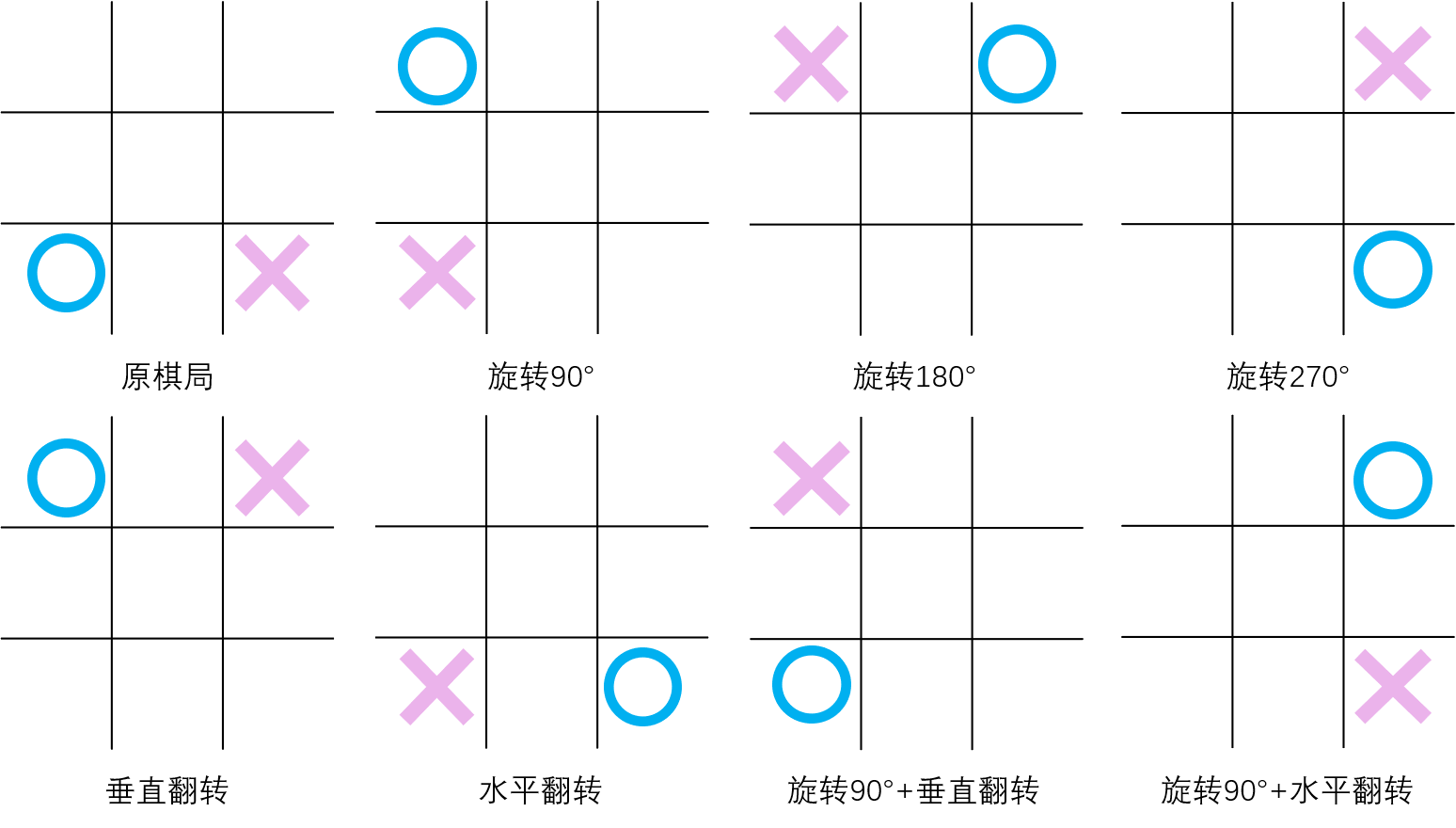
步骤1:写旋转和翻转函数
def rotate(array): # Input: np.array [[1,2,3],[4,5,6],[7,8,9]]

    list_ = list(array)

    list_[:] = map(list,zip(*list_[::-1]))

    return np.array(list_) # Output: np.array [[7,4,1],[8,5,2],[9,6,3]]

def flip(array_, direction): # Input: np.array [[1,2,3],[4,5,6],[7,8,9]]

    array = array_.copy()

    n = int(np.floor(len(array)/2))

    if direction == 'vertical': # Output: np.array [[7,8,9],[4,5,6],[1,2,3]]

        for i in range(n):

            temp = array[i].copy()

            array[i] = array[-i-1].copy()

            array[-i-1] = temp

    elif direction == 'horizon': # Output: np.array [[3,2,1],[6,5,4],[9,8,7]]

        for i in range(n):

            temp = array[:,i].copy()

            array[:,i] = array[:,-i-1]

            array[:,-i-1] = temp

    return array
步骤2:写生成等价局面及等价动作的函数
函数名为 genEqualStateAndAction(state, action),定义在 Agent() 类中。
def genEqualStateAndAction(self, state_, action_): # Input: np.array, tuple(x,y)

        state, action = state_.copy(), action_

        equalStates, equalActions = [], []

        # 原局面

        equalStates.append(state)

        equalActions.append(action)

        # 水平翻转

        state_tf = state.copy()

        action_state_tf = np.zeros(state.shape)

        action_state_tf[action] = 1

        state_tf = flip(state_tf, 'horizon')

        action_state_tf = flip(action_state_tf, 'horizon')

        index = np.where(action_state_tf == 1)

        action_tf = (int(index[0]), int(index[1]))

        equalStates.append(state_tf)

        equalActions.append(action_tf)

        # 垂直翻转

        state_tf = state.copy()

        action_state_tf = np.zeros(state.shape)

        action_state_tf[action] = 1

        state_tf = flip(state_tf, 'vertical')

        action_state_tf = flip(action_state_tf, 'vertical')

        index = np.where(action_state_tf == 1)

        action_tf = (int(index[0]), int(index[1]))

        equalStates.append(state_tf)

        equalActions.append(action_tf)

        # 旋转90°

        state_tf = state.copy()

        action_state_tf = np.zeros(state.shape)

        action_state_tf[action] = 1

        for i in range(1):

            state_tf = rotate(state_tf)

            action_state_tf = rotate(action_state_tf)

        index = np.where(action_state_tf == 1)

        action_tf = (int(index[0]), int(index[1]))

        equalStates.append(state_tf)

        equalActions.append(action_tf)

        # 旋转180°

        state_tf = state.copy()

        action_state_tf = np.zeros(state.shape)

        action_state_tf[action] = 1

        for i in range(2):

            state_tf = rotate(state_tf)

            action_state_tf = rotate(action_state_tf)

        index = np.where(action_state_tf == 1)

        action_tf = (int(index[0]), int(index[1]))

        equalStates.append(state_tf)

        equalActions.append(action_tf)

        # 旋转270°

        state_tf = state.copy()

        action_state_tf = np.zeros(state.shape)

        action_state_tf[action] = 1

        for i in range(3):

            state_tf = rotate(state_tf)

            action_state_tf = rotate(action_state_tf)

        index = np.where(action_state_tf == 1)

        action_tf = (int(index[0]), int(index[1]))

        equalStates.append(state_tf)

        equalActions.append(action_tf)

        # 旋转90° + 水平翻转

        state_tf = state.copy()

        action_state_tf = np.zeros(state.shape)

        action_state_tf[action] = 1

        for i in range(1):

            state_tf = rotate(state_tf)

            action_state_tf = rotate(action_state_tf)

        state_tf = flip(state_tf, 'horizon')

        action_state_tf = flip(action_state_tf, 'horizon')

        index = np.where(action_state_tf == 1)

        action_tf = (int(index[0]), int(index[1]))

        equalStates.append(state_tf)

        equalActions.append(action_tf)

        # 旋转90° + 垂直翻转

        state_tf = state.copy()

        action_state_tf = np.zeros(state.shape)

        action_state_tf[action] = 1

        for i in range(1):

            state_tf = rotate(state_tf)

            action_state_tf = rotate(action_state_tf)

        state_tf = flip(state_tf, 'vertical')

        action_state_tf = flip(action_state_tf, 'vertical')

        index = np.where(action_state_tf == 1)

        action_tf = (int(index[0]), int(index[1]))

        equalStates.append(state_tf)

        equalActions.append(action_tf)

        return equalStates, equalActions
细心的读者可能会发问了:你这生成等价局面不去重的么?是的,不去重了。原因之一是如果要去重,那么要比对大量的np.array,实现起来较麻烦,可能会增加很多代码时间;原因之二是对重复的局面多次更新,只是不符合逻辑,但应该没有副作用:毕竟只要数据够多,最后Q表中的值都会收敛到一个值,而重复出现次数多的局面只是收敛得更快罢了。
步骤3:修改Agent()中的相关代码
需要修改方法 addNewState(self, env_, currentMove) 和方法 updateQtable(self, env_, currentMove, done_),整体代码如下:


import gym

import random

import time

import numpy as np

# 查看所有已注册的环境

# from gym import envs

# print(envs.registry.all())

def str2tuple(string): # Input: '(1,1)'

    string2list = list(string)

    return ( int(string2list[1]), int(string2list[4]) ) # Output: (1,1)

def rotate(array): # Input: np.array [[1,2,3],[4,5,6],[7,8,9]]

    list_ = list(array)

    list_[:] = map(list,zip(*list_[::-1]))

    return np.array(list_) # Output: np.array [[7,4,1],[8,5,2],[9,6,3]]

def flip(array_, direction): # Input: np.array [[1,2,3],[4,5,6],[7,8,9]]

    array = array_.copy()

    n = int(np.floor(len(array)/2))

    if direction == 'vertical': # Output: np.array [[7,8,9],[4,5,6],[1,2,3]]

        for i in range(n):

            temp = array[i].copy()

            array[i] = array[-i-1].copy()

            array[-i-1] = temp

    elif direction == 'horizon': # Output: np.array [[3,2,1],[6,5,4],[9,8,7]]

        for i in range(n):

            temp = array[:,i].copy()

            array[:,i] = array[:,-i-1]

            array[:,-i-1] = temp

    return array

class Game():

    def __init__(self, env):

        self.INTERVAL = 0 # 行动间隔

        self.RENDER = False # 是否显示游戏过程

        self.first = 'blue' if random.random() > 0.5 else 'red' # 随机先后手

        self.currentMove = self.first

        self.env = env

        self.agent = Agent()

    def switchMove(self): # 切换行动玩家

        move = self.currentMove

        if move == 'blue': self.currentMove = 'red'

        elif move == 'red': self.currentMove = 'blue'

    def newGame(self): # 新建游戏

        self.first = 'blue' if random.random() > 0.5 else 'red'

        self.currentMove = self.first

        self.env.reset()

        self.agent.reset()

    def run(self): # 玩一局游戏

        self.env.reset() # 在第一次step前要先重置环境,不然会报错

        while True:

            print(f'--currentMove: {self.currentMove}--')

            self.agent.updateQtable(self.env, self.currentMove, False)

            if self.currentMove == 'blue':

                self.agent.lastState_blue = self.env.state.copy()

            elif self.currentMove == 'red':

                self.agent.lastState_red = self.agent.overTurn(self.env.state) # 红方视角需将状态翻转

            action = self.agent.epsilon_greedy(self.env, self.currentMove)

            if self.currentMove == 'blue':

                self.agent.lastAction_blue = action['pos']

            elif self.currentMove == 'red':

                self.agent.lastAction_red = action['pos']

            state, reward, done, info = self.env.step(action)

            if done:

                self.agent.lastReward_blue = reward

                self.agent.lastReward_red = -1 * reward

                self.agent.updateQtable(self.env, self.currentMove, True)

            else:

                if self.currentMove == 'blue':

                    self.agent.lastReward_blue = reward

                elif self.currentMove == 'red':

                    self.agent.lastReward_red = -1 * reward

            if self.RENDER: self.env.render()

            self.switchMove()

            time.sleep(self.INTERVAL)

            if done:

                self.newGame()

                if self.RENDER: self.env.render()

                time.sleep(self.INTERVAL)

                break

class Agent():

    def __init__(self):

        self.Q_table = {}

        self.EPSILON = 0.05

        self.ALPHA = 0.5

        self.GAMMA = 1 # 折扣因子

        self.lastState_blue = None

        self.lastAction_blue = None

        self.lastReward_blue = None

        self.lastState_red = None

        self.lastAction_red = None

        self.lastReward_red = None

    def reset(self):

        self.lastState_blue = None

        self.lastAction_blue = None

        self.lastReward_blue = None

        self.lastState_red = None

        self.lastAction_red = None

        self.lastReward_red = None

    def getEmptyPos(self, state): # 返回空位的坐标

        action_space = []

        for i, row in enumerate(state):

            for j, one in enumerate(row):

                if one == 0: action_space.append((i,j))

        return action_space

    def randomAction(self, env_, mark): # 随机选择空格动作

        actions = self.getEmptyPos(env_)

        action_pos = random.choice(actions)

        action = {'mark':mark, 'pos':action_pos}

        return action

    def overTurn(self, state): # 翻转状态

        state_ = state.copy()

        for i, row in enumerate(state_):

            for j, one in enumerate(row):

                if one != 0: state_[i][j] *= -1

        return state_

    def genEqualStateAndAction(self, state_, action_): # Input: np.array, tuple(x,y)

        state, action = state_.copy(), action_

        equalStates, equalActions = [], []

        # 原局面

        equalStates.append(state)

        equalActions.append(action)

        # 水平翻转

        state_tf = state.copy()

        action_state_tf = np.zeros(state.shape)

        action_state_tf[action] = 1

        state_tf = flip(state_tf, 'horizon')

        action_state_tf = flip(action_state_tf, 'horizon')

        index = np.where(action_state_tf == 1)

        action_tf = (int(index[0]), int(index[1]))

        equalStates.append(state_tf)

        equalActions.append(action_tf)

        # 垂直翻转

        state_tf = state.copy()

        action_state_tf = np.zeros(state.shape)

        action_state_tf[action] = 1

        state_tf = flip(state_tf, 'vertical')

        action_state_tf = flip(action_state_tf, 'vertical')

        index = np.where(action_state_tf == 1)

        action_tf = (int(index[0]), int(index[1]))

        equalStates.append(state_tf)

        equalActions.append(action_tf)

        # 旋转90°

        state_tf = state.copy()

        action_state_tf = np.zeros(state.shape)

        action_state_tf[action] = 1

        for i in range(1):

            state_tf = rotate(state_tf)

            action_state_tf = rotate(action_state_tf)

        index = np.where(action_state_tf == 1)

        action_tf = (int(index[0]), int(index[1]))

        equalStates.append(state_tf)

        equalActions.append(action_tf)

        # 旋转180°

        state_tf = state.copy()

        action_state_tf = np.zeros(state.shape)

        action_state_tf[action] = 1

        for i in range(2):

            state_tf = rotate(state_tf)

            action_state_tf = rotate(action_state_tf)

        index = np.where(action_state_tf == 1)

        action_tf = (int(index[0]), int(index[1]))

        equalStates.append(state_tf)

        equalActions.append(action_tf)

        # 旋转270°

        state_tf = state.copy()

        action_state_tf = np.zeros(state.shape)

        action_state_tf[action] = 1

        for i in range(3):

            state_tf = rotate(state_tf)

            action_state_tf = rotate(action_state_tf)

        index = np.where(action_state_tf == 1)

        action_tf = (int(index[0]), int(index[1]))

        equalStates.append(state_tf)

        equalActions.append(action_tf)

        # 旋转90° + 水平翻转

        state_tf = state.copy()

        action_state_tf = np.zeros(state.shape)

        action_state_tf[action] = 1

        for i in range(1):

            state_tf = rotate(state_tf)

            action_state_tf = rotate(action_state_tf)

        state_tf = flip(state_tf, 'horizon')

        action_state_tf = flip(action_state_tf, 'horizon')

        index = np.where(action_state_tf == 1)

        action_tf = (int(index[0]), int(index[1]))

        equalStates.append(state_tf)

        equalActions.append(action_tf)

        # 旋转90° + 垂直翻转

        state_tf = state.copy()

        action_state_tf = np.zeros(state.shape)

        action_state_tf[action] = 1

        for i in range(1):

            state_tf = rotate(state_tf)

            action_state_tf = rotate(action_state_tf)

        state_tf = flip(state_tf, 'vertical')

        action_state_tf = flip(action_state_tf, 'vertical')

        index = np.where(action_state_tf == 1)

        action_tf = (int(index[0]), int(index[1]))

        equalStates.append(state_tf)

        equalActions.append(action_tf)

        return equalStates, equalActions

    def addNewState(self, env_, currentMove): # 若当前状态不在Q表中,则新增状态

         state = env_.state if currentMove == 'blue' else self.overTurn(env_.state) # 如果是红方行动则翻转状态

         eqStates, eqActions = self.genEqualStateAndAction(state, (0,0))

         for one in eqStates:

             if str(one) not in self.Q_table:

                 self.Q_table[str(one)] = {}

                 actions = self.getEmptyPos(one)

                 for action in actions:

                     self.Q_table[str(one)][str(action)] = 0

    def epsilon_greedy(self, env_, currentMove): # ε-贪心策略

        state = env_.state if currentMove == 'blue' else self.overTurn(env_.state) # 如果是红方行动则翻转状态

        Q_Sa = self.Q_table[str(state)]

        maxAction, maxValue, otherAction = [], -100, []

        for one in Q_Sa:

            if Q_Sa[one] > maxValue:

                maxValue = Q_Sa[one]

        for one in Q_Sa:

            if Q_Sa[one] == maxValue:

                maxAction.append(str2tuple(one))

            else:

                otherAction.append(str2tuple(one))

        try:

            action_pos = random.choice(maxAction) if random.random() > self.EPSILON else random.choice(otherAction)

        except: # 处理从空的otherAction中取值的情况

            action_pos = random.choice(maxAction)

        action = {'mark':currentMove, 'pos':action_pos}

        return action

    def updateQtable(self, env_, currentMove, done_):

        judge = (currentMove == 'blue' and self.lastState_blue is None) or \

                (currentMove == 'red' and self.lastState_red is None)

        if judge: # 边界情况1:若agent无上一状态,说明是游戏中首次动作,那么只需要新增状态就好,无需更新Q值

            self.addNewState(env_, currentMove)

            return

        if done_: # 边界情况2:若当前状态S_是终止状态,则无需把S_添加至Q表格中,直接令maxQ_S_a = 0,并同时更新双方Q值

            for one in ['blue', 'red']:

                S = self.lastState_blue  if one == 'blue' else self.lastState_red

                a = self.lastAction_blue if one == 'blue' else self.lastAction_red

                eqStates, eqActions = self.genEqualStateAndAction(S, a)

                R = self.lastReward_blue if one == 'blue' else self.lastReward_red

                # print('lastState S:\n', S)

                # print('lastAction a: ', a)

                # print('lastReward R: ', R)

                # print('\n')

                maxQ_S_a = 0

                for S, a in zip(eqStates, eqActions):

                    self.Q_table[str(S)][str(a)] = (1 - self.ALPHA) * self.Q_table[str(S)][str(a)] \

                                                    + self.ALPHA * (R + self.GAMMA * maxQ_S_a)

            return

        # 其他情况下:Q表无当前状态则新增状态,否则直接更新Q值

        self.addNewState(env_, currentMove)

        S_ = env_.state if currentMove == 'blue' else self.overTurn(env_.state)

        S = self.lastState_blue  if currentMove == 'blue' else self.lastState_red

        a = self.lastAction_blue if currentMove == 'blue' else self.lastAction_red

        eqStates, eqActions = self.genEqualStateAndAction(S, a)

        R = self.lastReward_blue if currentMove == 'blue' else self.lastReward_red

        # print('lastState S:\n', S)

        # print('State S_:\n', S_)

        # print('lastAction a: ', a)

        # print('lastReward R: ', R)

        # print('\n')

        Q_S_a = self.Q_table[str(S_)]

        maxQ_S_a = -100

        for one in Q_S_a:

            if Q_S_a[one] > maxQ_S_a:

                maxQ_S_a = Q_S_a[one]

        for S, a in zip(eqStates, eqActions):

            self.Q_table[str(S)][str(a)] = (1 - self.ALPHA) * self.Q_table[str(S)][str(a)] \

                                            + self.ALPHA * (R + self.GAMMA * maxQ_S_a)

env = gym.make('TicTacToeEnv-v0')

game = Game(env)

for i in range(10000):

    print('episode', i)

    game.run()

Q_table = game.agent.Q_table
测试
经过了上述优化,agent能够在一轮对局中更新16个Q值,比起上一节 强化学习实战 | 表格型Q-Learning玩井字棋(二)开始训练! 中的更新2个Q值要多8倍,不妨就玩1万局游戏,看看是否能玩出之前玩8万局游戏的效果。
项目1:查看Q表格的状态数

一般般,仍然有状态没有覆盖到。
项目2:查看初始状态
先手开局:
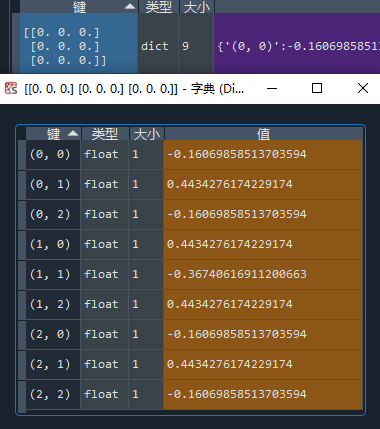
这效果也太好了吧!不但有完美的对称,还有泾渭分明的胜负判断: 第一步走四边就稳了,走四角和走中间都是输面大。看来优化之后,Q值的整体方差这一块表现得非常好了。
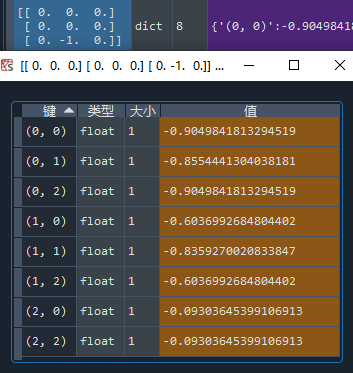
再贴一个后手开局的情况:
项目3:测试代码时间
引入了更复杂的trick,确实是完美地争取到了一些收益,但玩一局游戏的时间一定是增加了,增加了多少呢?我们用上一节的老算法和本节的算法分别跑2000局游戏,记录一下时间(本人使用的CPU是:Intel(R) Core(TM) i7-9750H)。
双向更新+等价局面同步更新:

双向更新:

增加了不到两倍的时间,换来了大约8倍的更新量提高,还降低了方差,看来这优化是赚的。
小结
拿着优化好的算法,心里也有了些底气,可以放心大胆地增加训练时间了。下一节,我们将用训练完全Q表,用pygame做一个拥有人机对阵,机机对战,作弊功能的井字棋游戏。还可以做一些对战的数据分析,比如AI内战的胜率多高?AI对阵随机策略的胜率多高?下节见!
强化学习实战 | 表格型Q-Learning玩井子棋(三)优化,优化的更多相关文章
- 强化学习实战 | 表格型Q-Learning玩井字棋(二)
在 强化学习实战 | 表格型Q-Learning玩井字棋(一)中,我们构建了以Game() 和 Agent() 类为基础的框架,本篇我们要让agent不断对弈,维护Q表格,提升棋力.那么我们先来盘算一 ...
- 强化学习实战 | 表格型Q-Learning玩井字棋(四)游戏时间
在 强化学习实战 | 表格型Q-Learning玩井字棋(三)优化,优化 中,我们经过优化和训练,得到了一个还不错的Q表格,这一节我们将用pygame实现一个有人机对战,机机对战和作弊功能的井字棋游戏 ...
- 强化学习实战 | 表格型Q-Learning玩井字棋(一)
在 强化学习实战 | 自定义Gym环境之井子棋 中,我们构建了一个井字棋环境,并进行了测试.接下来我们可以使用各种强化学习方法训练agent出棋,其中比较简单的是Q学习,Q即Q(S, a),是状态动作 ...
- 强化学习系列之:Deep Q Network (DQN)
文章目录 [隐藏] 1. 强化学习和深度学习结合 2. Deep Q Network (DQN) 算法 3. 后续发展 3.1 Double DQN 3.2 Prioritized Replay 3. ...
- 强化学习实战 | 自定义Gym环境之井字棋
在文章 强化学习实战 | 自定义Gym环境 中 ,我们了解了一个简单的环境应该如何定义,并使用 print 简单地呈现了环境.在本文中,我们将学习自定义一个稍微复杂一点的环境--井字棋.回想一下井字棋 ...
- 强化学习实战 | 自定义Gym环境之扫雷
开始之前 先考虑几个问题: Q1:如何展开无雷区? Q2:如何计算格子的提示数? Q3:如何表示扫雷游戏的状态? A1:可以使用递归函数,或是堆栈. A2:一般的做法是,需要打开某格子时,再去统计周围 ...
- 强化学习实战 | 自定义Gym环境
新手的第一个强化学习示例一般都从Open Gym开始.在这些示例中,我们不断地向环境施加动作,并得到观测和奖励,这也是Gym Env的基本用法: state, reward, done, info = ...
- 强化学习实战 | 自定义gym环境之显示字符串
如果想用强化学习去实现扫雷.2048这种带有数字提示信息的游戏,自然是希望自定义 gym 环境时能把字符显示出来.上网查了很久,没有找到gym自带的图形工具Viewer可以显示字符串的信息,反而是通过 ...
- 深度强化学习:入门(Deep Reinforcement Learning: Scratching the surface)
RL的方案 两个主要对象:Agent和Environment Agent观察Environment,做出Action,这个Action会对Environment造成一定影响和改变,继而Agent会从新 ...
随机推荐
- 快速排序平均时间复杂度O(nlogn)的推导
快速排序作为随机算法的一种,不能通过常规方法来计算时间复杂度 wiki上有三种快排平均时间复杂度的分析,本文记录了一种推导方法. 先放快速排序的伪代码,便于回顾.参考 quicksort(int L, ...
- Go语言核心36讲(Go语言实战与应用四)--学习笔记
26 | sync.Mutex与sync.RWMutex 从本篇文章开始,我们将一起探讨 Go 语言自带标准库中一些比较核心的代码包.这会涉及这些代码包的标准用法.使用禁忌.背后原理以及周边的知识. ...
- Typora常用命令
目录 Typora编辑器所用语法--Markdown 简介 1.Markdown --标题 2. Markdown --列表(子标题) 3. Markdown --列表嵌套 4. Markdown - ...
- OPA-Gatekeeper实验:对特定用户的更新时间窗口做限制
实验目的 OPA-Gatekeeper可以在Kubernetes 中,通过策略来实现一些额外的管理.安全方面的限制,例如:限制特定用户在 Namespace 中的行为权限 本次实验将在test命名空间 ...
- [bzoj1042]硬币购物
先预处理出没有上限的方案数,然后容斥,然后将所有东西的范围都变为[0,+oo),即可用预处理出的dp数组计算 1 #include<bits/stdc++.h> 2 using names ...
- Geotools核心特点以及支持数据的格式和标准
Geotools是一个java类库,它提供了很多的标准类和方法来处理空间数据,同时这个类库是构建在OGC标准之上的,是OGC思想的一种实现.而OGC是国际标准,所以geotools将来必定会成为开源空 ...
- Codeforces 1188B - Count Pairs(思维题)
Codeforces 题面传送门 & 洛谷题面传送门 虽说是一个 D1B,但还是想了我足足 20min,所以还是写篇题解罢( 首先注意到这个式子里涉及两个参数,如果我们选择固定一个并动态维护另 ...
- sar 系统活动情况报告
sar(System Activity Reporter系统活动情况报告)是目前 Linux 上最为全面的系统性能分析工具之一,可以从多方面对系统的活动进行报告, 包括:文件的读写情况.系统调用的使用 ...
- [云原生]Docker - 安装&卸载
目录 系统要求 卸载旧版本 安装Docker 方法一:通过repo安装 设置Repository 安装Docker Engine 升级Docker Engine 方法二:通过package安装 方法三 ...
- day9 图书设计项目
总路由层url from django.conf.urls import url from django.contrib import admin from app01 import views ur ...