
Spark源码执行逻辑分析【基于案例SparkPi】

一.案例SparkPi代码
 package scala

 import org.apache.spark.sql.SparkSession

 import scala.math.random

 /** Computes an approximation to pi */

 object SparkPi {

   def main(args: Array[String]) {

     val spark = SparkSession

       .builder

       .appName("Spark Pi")

       .master("local[2]")

       .getOrCreate()

     val slices = if (args.length > 0) args(0).toInt else 2

     val n = math.min(100000L * slices, Int.MaxValue).toInt // avoid overflow

     val count = spark.sparkContext.parallelize(1 until n, slices).map { i =>

       val x = random * 2 - 1

       val y = random * 2 - 1

       if (x*x + y*y <= 1) 1 else 0

     }.reduce(_ + _)

     println(s"Pi is roughly ${4.0 * count / (n - 1)}")

     spark.stop()

   }

 }
二.执行结果
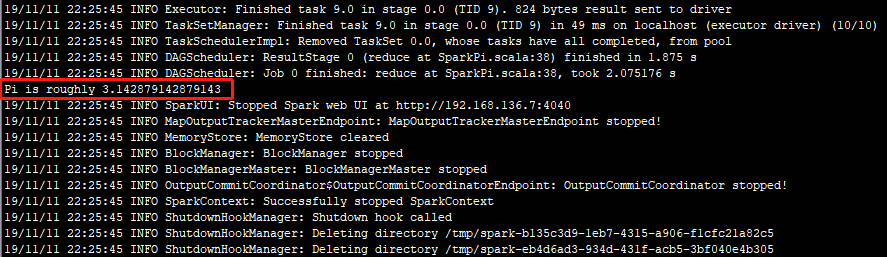
三.日志分析
1.在使用提交命令./run-example SparkPi 10执行案例SparkPi时,根据警告信息可知,因为是local【本地模式】,Spark会先检查本地IP。

2.其次,Spark会检测是否配置本地Hadoop及相关log4j等配置,配置会优先加载用户指定的Hadoop,无配置则使用自带的默认Hadoop.

3.基本信息检查完之后,开始启动Spark任务,向服务器注册该任务,启动可视化组件acls,开启服务sparkDriver
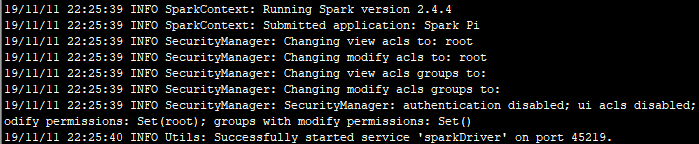
4.Spark开始注册任务调度器和资源管理器

5.创建本地临时目录,根据缓存模式缓存数据

6.SparkUI开启成功

7.开启Spark自带的netty web服务器

8.执行计算
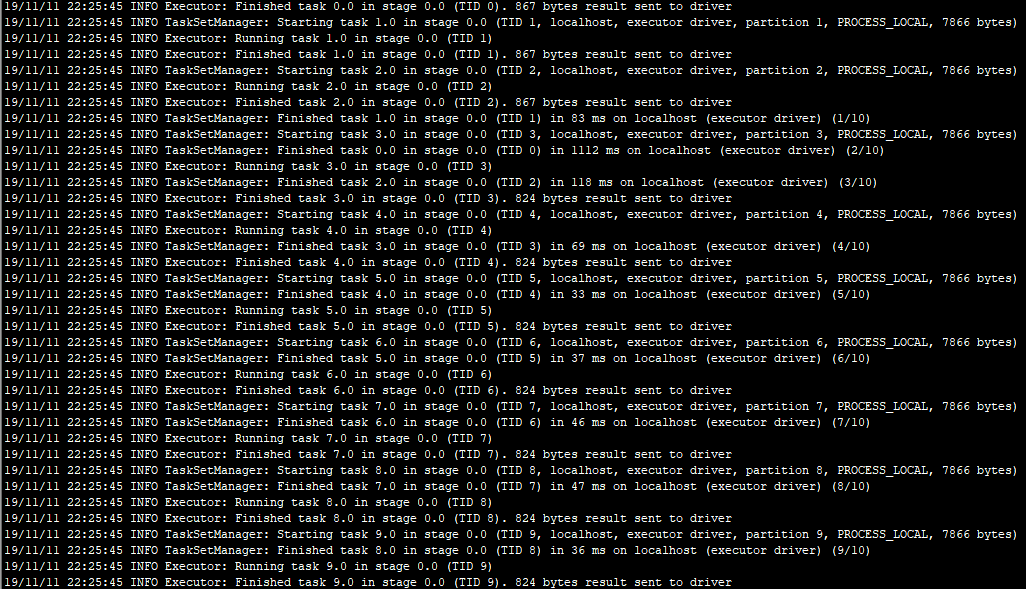
9.执行成功,关闭SparkUI、任务调度器、资源管理器
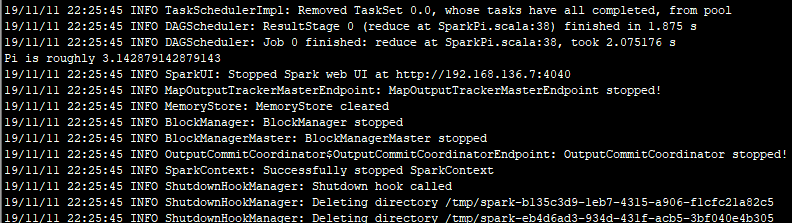
四.源码分析
1.创建SparkSession程序执行入口
val spark = SparkSession.builder.appName("Spark Pi").master("local[2]").getOrCreate()
该程序首先调用对象SparkSession,指定应用的名称,运行方式【集群or单机】以及一些类如使用内存大小,核数等配置。在这个过程中会检测IP【仅限单机模式】和Hadoop配置。对应日志中的1、2、3。
源码如下:
 object SparkSession extends Logging {

   /**

    * Builder for [[SparkSession]].

    */

   @InterfaceStability.Stable

   class Builder extends Logging {

     private[this] val options = new scala.collection.mutable.HashMap[String, String]

     private[this] val extensions = new SparkSessionExtensions

     private[this] var userSuppliedContext: Option[SparkContext] = None

     private[spark] def sparkContext(sparkContext: SparkContext): Builder = synchronized {

       userSuppliedContext = Option(sparkContext)

       this

     }

     /**

      * Sets a name for the application, which will be shown in the Spark web UI.

      * If no application name is set, a randomly generated name will be used.

      *

      * @since 2.0.0

      */

     def appName(name: String): Builder = config("spark.app.name", name)

     /**

      * Sets a config option. Options set using this method are automatically propagated to

      * both `SparkConf` and SparkSession's own configuration.

      *

      * @since 2.0.0

      */

     def config(key: String, value: String): Builder = synchronized {

       options += key -> value

       this

     }

     /**

      * Sets the Spark master URL to connect to, such as "local" to run locally, "local[4]" to

      * run locally with 4 cores, or "spark://master:7077" to run on a Spark standalone cluster.

      *

      * @since 2.0.0

      */

     def master(master: String): Builder = config("spark.master", master)

     /**

      * Enables Hive support, including connectivity to a persistent Hive metastore, support for

      * Hive serdes, and Hive user-defined functions.

      *

      * @since 2.0.0

      */

     def enableHiveSupport(): Builder = synchronized {

       if (hiveClassesArePresent) {

         config(CATALOG_IMPLEMENTATION.key, "hive")

       } else {

         throw new IllegalArgumentException(

           "Unable to instantiate SparkSession with Hive support because " +

             "Hive classes are not found.")

       }

     }

     /**

      * Gets an existing [[SparkSession]] or, if there is no existing one, creates a new

      * one based on the options set in this builder.

      *

      * This method first checks whether there is a valid thread-local SparkSession,

      * and if yes, return that one. It then checks whether there is a valid global

      * default SparkSession, and if yes, return that one. If no valid global default

      * SparkSession exists, the method creates a new SparkSession and assigns the

      * newly created SparkSession as the global default.

      *

      * In case an existing SparkSession is returned, the config options specified in

      * this builder will be applied to the existing SparkSession.

      *

      * @since 2.0.0

      */

     def getOrCreate(): SparkSession = synchronized {

       assertOnDriver()

       // Get the session from current thread's active session.

       var session = activeThreadSession.get()

       if ((session ne null) && !session.sparkContext.isStopped) {

         options.foreach { case (k, v) => session.sessionState.conf.setConfString(k, v) }

         if (options.nonEmpty) {

           logWarning("Using an existing SparkSession; some configuration may not take effect.")

         }

         return session

       }

       // Global synchronization so we will only set the default session once.

       SparkSession.synchronized {

         // If the current thread does not have an active session, get it from the global session.

         session = defaultSession.get()

         if ((session ne null) && !session.sparkContext.isStopped) {

           options.foreach { case (k, v) => session.sessionState.conf.setConfString(k, v) }

           if (options.nonEmpty) {

             logWarning("Using an existing SparkSession; some configuration may not take effect.")

           }

           return session

         }

         // No active nor global default session. Create a new one.

         val sparkContext = userSuppliedContext.getOrElse {

           val sparkConf = new SparkConf()

           options.foreach { case (k, v) => sparkConf.set(k, v) }

           // set a random app name if not given.

           if (!sparkConf.contains("spark.app.name")) {

             sparkConf.setAppName(java.util.UUID.randomUUID().toString)

           }

           SparkContext.getOrCreate(sparkConf)

           // Do not update `SparkConf` for existing `SparkContext`, as it's shared by all sessions.

         }

         // Initialize extensions if the user has defined a configurator class.

         val extensionConfOption = sparkContext.conf.get(StaticSQLConf.SPARK_SESSION_EXTENSIONS)

         if (extensionConfOption.isDefined) {

           val extensionConfClassName = extensionConfOption.get

           try {

             val extensionConfClass = Utils.classForName(extensionConfClassName)

             val extensionConf = extensionConfClass.newInstance()

               .asInstanceOf[SparkSessionExtensions => Unit]

             extensionConf(extensions)

           } catch {

             // Ignore the error if we cannot find the class or when the class has the wrong type.

             case e @ (_: ClassCastException |

                       _: ClassNotFoundException |

                       _: NoClassDefFoundError) =>

               logWarning(s"Cannot use $extensionConfClassName to configure session extensions.", e)

           }

         }

         session = new SparkSession(sparkContext, None, None, extensions)

         options.foreach { case (k, v) => session.initialSessionOptions.put(k, v) }

         setDefaultSession(session)

         setActiveSession(session)

         // Register a successfully instantiated context to the singleton. This should be at the

         // end of the class definition so that the singleton is updated only if there is no

         // exception in the construction of the instance.

         sparkContext.addSparkListener(new SparkListener {

           override def onApplicationEnd(applicationEnd: SparkListenerApplicationEnd): Unit = {

             defaultSession.set(null)

           }

         })

       }

       return session

     }

   }

 }
2.程序计算逻辑执行
  val count = spark.sparkContext.parallelize(1 until n, slices).map { i =>
    val x = random * 2 - 1
    val y = random * 2 - 1
    if (x*x + y*y <= 1) 1 else 0
  }.reduce(_ + _)
 首先,程序调用SparkContext对象的parallelize函数,把数据转换为RDD并执行计算。对应日志中的步骤8。
 源码如下:
  /** Distribute a local Scala collection to form an RDD.

    *

    * @note Parallelize acts lazily. If `seq` is a mutable collection and is altered after the call

    * to parallelize and before the first action on the RDD, the resultant RDD will reflect the

    * modified collection. Pass a copy of the argument to avoid this.

    * @note avoid using `parallelize(Seq())` to create an empty `RDD`. Consider `emptyRDD` for an

    * RDD with no partitions, or `parallelize(Seq[T]())` for an RDD of `T` with empty partitions.

    * @param seq Scala collection to distribute

    * @param numSlices number of partitions to divide the collection into

    * @return RDD representing distributed collection

    */

   def parallelize[T: ClassTag](

       seq: Seq[T],

       numSlices: Int = defaultParallelism): RDD[T] = withScope {

     assertNotStopped()

     new ParallelCollectionRDD[T](this, seq, numSlices, Map[Int, Seq[String]]())

   }
其中,比较重要的调用是withScope,该函数可以实现执行传入的函数体,以使在该主体中创建的所有RDD具有相同的作用域。
源码如下:
  /**

    * Execute the given body such that all RDDs created in this body will have the same scope.

    * The name of the scope will be the first method name in the stack trace that is not the

    * same as this method's.

    *

    * Note: Return statements are NOT allowed in body.

    */

   private[spark] def withScope[T](

       sc: SparkContext,

       allowNesting: Boolean = false)(body: => T): T = {

     val ourMethodName = "withScope"

     val callerMethodName = Thread.currentThread.getStackTrace()

       .dropWhile(_.getMethodName != ourMethodName)

       .find(_.getMethodName != ourMethodName)

       .map(_.getMethodName)

       .getOrElse {

         // Log a warning just in case, but this should almost certainly never happen

         logWarning("No valid method name for this RDD operation scope!")

         "N/A"

       }

     withScope[T](sc, callerMethodName, allowNesting, ignoreParent = false)(body)

   }

   /**

    * Execute the given body such that all RDDs created in this body will have the same scope.

    *

    * If nesting is allowed, any subsequent calls to this method in the given body will instantiate

    * child scopes that are nested within our scope. Otherwise, these calls will take no effect.

    *

    * Additionally, the caller of this method may optionally ignore the configurations and scopes

    * set by the higher level caller. In this case, this method will ignore the parent caller's

    * intention to disallow nesting, and the new scope instantiated will not have a parent. This

    * is useful for scoping physical operations in Spark SQL, for instance.

    *

    * Note: Return statements are NOT allowed in body.

    */

   private[spark] def withScope[T](

       sc: SparkContext,

       name: String,

       allowNesting: Boolean,

       ignoreParent: Boolean)(body: => T): T = {

     // Save the old scope to restore it later

     val scopeKey = SparkContext.RDD_SCOPE_KEY

     val noOverrideKey = SparkContext.RDD_SCOPE_NO_OVERRIDE_KEY

     val oldScopeJson = sc.getLocalProperty(scopeKey)

     val oldScope = Option(oldScopeJson).map(RDDOperationScope.fromJson)

     val oldNoOverride = sc.getLocalProperty(noOverrideKey)

     try {

       if (ignoreParent) {

         // Ignore all parent settings and scopes and start afresh with our own root scope

         sc.setLocalProperty(scopeKey, new RDDOperationScope(name).toJson)

       } else if (sc.getLocalProperty(noOverrideKey) == null) {

         // Otherwise, set the scope only if the higher level caller allows us to do so

         sc.setLocalProperty(scopeKey, new RDDOperationScope(name, oldScope).toJson)

       }

       // Optionally disallow the child body to override our scope

       if (!allowNesting) {

         sc.setLocalProperty(noOverrideKey, "true")

       }

       body

     } finally {

       // Remember to restore any state that was modified before exiting

       sc.setLocalProperty(scopeKey, oldScopeJson)

       sc.setLocalProperty(noOverrideKey, oldNoOverride)

     }

   }
Spark源码执行逻辑分析【基于案例SparkPi】的更多相关文章
- Spark源码剖析 - SparkContext的初始化(二)_创建执行环境SparkEnv
2. 创建执行环境SparkEnv SparkEnv是Spark的执行环境对象,其中包括众多与Executor执行相关的对象.由于在local模式下Driver会创建Executor,local-cl ...
- Spark 源码分析 -- task实际执行过程
Spark源码分析 – SparkContext 中的例子, 只分析到sc.runJob 那么最终是怎么执行的? 通过DAGScheduler切分成Stage, 封装成taskset, 提交给Task ...
- spark 源码分析之二十一 -- Task的执行流程
引言 在上两篇文章 spark 源码分析之十九 -- DAG的生成和Stage的划分 和 spark 源码分析之二十 -- Stage的提交 中剖析了Spark的DAG的生成,Stage的划分以及St ...
- spark源码分析以及优化
第一章.spark源码分析之RDD四种依赖关系 一.RDD四种依赖关系 RDD四种依赖关系,分别是 ShuffleDependency.PrunDependency.RangeDependency和O ...
- Apache Spark源码剖析
Apache Spark源码剖析(全面系统介绍Spark源码,提供分析源码的实用技巧和合理的阅读顺序,充分了解Spark的设计思想和运行机理) 许鹏 著 ISBN 978-7-121-25420- ...
- Spark源码的编译过程详细解读(各版本)
说在前面的话 重新试多几次.编译过程中会出现下载某个包的时间太久,这是由于连接网站的过程中会出现假死,按ctrl+c,重新运行编译命令. 如果出现缺少了某个文件的情况,则要先清理maven(使用命 ...
- 《Apache Spark源码剖析》
Spark Contributor,Databricks工程师连城,华为大数据平台开发部部长陈亮,网易杭州研究院副院长汪源,TalkingData首席数据科学家张夏天联袂力荐1.本书全面.系统地介绍了 ...
- Spark源码的编译过程详细解读(各版本)(博主推荐)
不多说,直接上干货! 说在前面的话 重新试多几次.编译过程中会出现下载某个包的时间太久,这是由于连接网站的过程中会出现假死,按ctrl+c,重新运行编译命令. 如果出现缺少了某个文件的情况,则要 ...
- Spark 源码解析:TaskScheduler的任务提交和task最佳位置算法
上篇文章< Spark 源码解析 : DAGScheduler中的DAG划分与提交 >介绍了DAGScheduler的Stage划分算法. 本文继续分析Stage被封装成TaskSet, ...
随机推荐
- Appium+python自动化(三)- SDK Manager(超详解)
简介 本来宏哥一开始打算用真机做的,所以在前边搭建环境时候就没有下载SDK,但是由于许多小伙伴通过博客发短消息给宏哥留言说是没有真机,所以顺应民意整理一下模拟器,毕竟“得民心者,得天下”.SDK顾名思 ...
- zz扔掉anchor!真正的CenterNet——Objects as Points论文解读
首发于深度学习那些事 已关注写文章 扔掉anchor!真正的CenterNet——Objects as Points论文解读 OLDPAN 不明觉厉的人工智障程序员 关注他 JustDoIT 等 ...
- NOIP 2005 采药
洛谷 P1048 采药 洛谷传送门 JDOJ 1277: [NOIP2005]采药 T3 JDOJ传送门 Description 辰辰是个天资聪颖的孩子,他的梦想是成为世界上最伟大的医师.为此,他 ...
- Linux学习笔记-第7天 - 编程还是要多写多练
编程思路很重要,多写是要熟悉命令用法,多练不只是要熟悉语句常用在什么环境,更要在其基础上,尝试更多的写法.
- 分布式共识算法 (三) Raft算法
系列目录 分布式共识算法 (一) 背景 分布式共识算法 (二) Paxos算法 分布式共识算法 (三) Raft算法 分布式共识算法 (四) BTF算法 一.引子 1.1 介绍 Raft 是一种为了管 ...
- VIPKID:笔试题(数组中和为0的一对数的数量,十进制转二进制中1的个数)
1. 求数组中的和为0 的一对数的数量 注意,需要用到set import java.util.Scanner; public class Main{ public static void main( ...
- html5手机web页面底部菜单
一.效果图 二.HTML代码 <header class="text-center">TOP</header> <div id="conte ...
- c# 多线程解决死锁问题
可使用:Monitor.TryEnter()方法.虽然这种方法可以解决死锁问题,但是最好还是不要出现死锁这种情况.如果出现死锁这种情况,就说明代码有问题啊.还是在else里面加个日志记录下吧,然后再解 ...
- VUE引入jq bootstrap 之终极解决方案(测试)
初入VUE遇见的一些问题,在网上找了些方法,再根据自己的实际项目解决的问题写得此文,,希望对你有所帮助. vue-cli快速构建项目以及引入boostrap.jq各种插件配置 vue-cli脚手架工具 ...
- Python【每日一问】38
问: 基础题: 设计一个经营杠杆系数函数DOL,它包含三个参数,S为营业收入,C为变动成本总额,F为固定成本的总额. 已知2018年的S为20,C为11,F为3,求2019年的经营杠杆系数. 提高题: ...