
Robot Motion
Description
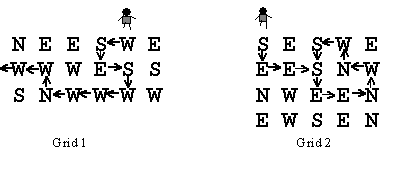
A robot has been programmed to follow the instructions in its path. Instructions for the next direction the robot is to move are laid down in a grid. The possible instructions are
N north (up the page)
S south (down the page)
E east (to the right on the page)
W west (to the left on the page)
For example, suppose the robot starts on the north (top) side of Grid 1 and starts south (down). The path the robot follows is shown. The robot goes through 10 instructions in the grid before leaving the grid.
Compare what happens in Grid 2: the robot goes through 3 instructions only once, and then starts a loop through 8 instructions, and never exits.
You are to write a program that determines how long it takes a robot to get out of the grid or how the robot loops around.
Input
Output
Sample Input
3 6 5

NEESWE

WWWESS

SNWWWW

4 5 1

SESWE

EESNW

NWEEN

EWSEN

0 0 0
Sample Output
10 step(s) to exit

3 step(s) before a loop of 8 step(s)
 #include<stdio.h>

 #include<string.h>

 #include<stdlib.h>

 int main()

 {

     char s[][];

     int i,j,m,n,a,p[][];

     while(scanf("%d %d %d%*c",&m,&n,&a)&&m&&n&&a)

     {

         memset(p,,sizeof(p));

         for(i=; i<m; i++)

         {

             for(j=; j<n; j++)

                 scanf("%c",&s[i][j]);

             getchar();

         }

         j=a-;

         i=;

         p[i][j]=;

         while()

         {

             if(s[i][j]=='N')

             {

                 if(i-<)

                 {

                     printf("%d step(s) to exit\n",p[i][j]);

                     break;

                 }

                 else if(p[i-][j])

                 {

                     printf("%d step(s) before a loop of %d step(s)\n",p[i-][j]-,p[i][j]+-p[i-][j]);

                     break;

                 }

                 else

                 {

                     p[i-][j]=p[i][j]+;

                     i--;

                     continue;

                 }

             }

             else if(s[i][j]=='S')

             {

                 if(i+==m)

                 {

                     printf("%d step(s) to exit\n",p[i][j]);

                     break;

                 }

                 else if(p[i+][j])

                 {

                     printf("%d step(s) before a loop of %d step(s)\n",p[i+][j]-,p[i][j]+-p[i+][j]);

                     break;

                 }

                 else

                 {

                     p[i+][j]=p[i][j]+;

                     i++;

                     continue;

                 }

             }

             else if(s[i][j]=='W')

             {

                 if(j-<)

                 {

                     printf("%d step(s) to exit\n",p[i][j]);

                     break;

                 }

                 else if(p[i][j-])

                 {

                     printf("%d step(s) before a loop of %d step(s)\n",p[i][j-]-,p[i][j]+-p[i][j-]);

                     break;

                 }

                 else

                 {

                     p[i][j-]=p[i][j]+;

                     j--;

                     continue;

                 }

             }

             else if(s[i][j]=='E')

             {

                 if(j+==n)

                 {

                     printf("%d step(s) to exit\n",p[i][j]);

                     break;

                 }

                 else if(p[i][j+])

                 {

                     printf("%d step(s) before a loop of %d step(s)\n",p[i][j+]-,p[i][j]+-p[i][j+]);

                     break;

                 }

                 else

                 {

                     p[i][j+]=p[i][j]+;

                     j++;

                     continue;

                 }

             }

         }

     }

     return ;

 }
Robot Motion的更多相关文章
- poj1573 Robot Motion
Robot Motion Time Limit: 1000MS Memory Limit: 10000K Total Submissions: 12507 Accepted: 6070 Des ...
- Robot Motion(imitate)
Robot Motion Time Limit: 1000MS Memory Limit: 10000K Total Submissions: 11065 Accepted: 5378 Des ...
- 模拟 POJ 1573 Robot Motion
题目地址:http://poj.org/problem?id=1573 /* 题意:给定地图和起始位置,robot(上下左右)一步一步去走,问走出地图的步数 如果是死循环,输出走进死循环之前的步数和死 ...
- POJ 1573 Robot Motion(BFS)
Robot Motion Time Limit: 1000MS Memory Limit: 10000K Total Submissions: 12856 Accepted: 6240 Des ...
- Robot Motion 分类: POJ 2015-06-29 13:45 11人阅读 评论(0) 收藏
Robot Motion Time Limit: 1000MS Memory Limit: 10000K Total Submissions: 11262 Accepted: 5482 Descrip ...
- POJ 1573 Robot Motion
Robot Motion Time Limit: 1000MS Memory Limit: 10000K Total Submissions: 12978 Accepted: 6290 Des ...
- Poj OpenJudge 百练 1573 Robot Motion
1.Link: http://poj.org/problem?id=1573 http://bailian.openjudge.cn/practice/1573/ 2.Content: Robot M ...
- POJ1573——Robot Motion
Robot Motion Description A robot has been programmed to follow the instructions in its path. Instruc ...
- hdoj 1035 Robot Motion
Robot Motion Time Limit: 2000/1000 MS (Java/Others) Memory Limit: 65536/32768 K (Java/Others)Tota ...
- HDU-1035 Robot Motion
http://acm.hdu.edu.cn/showproblem.php?pid=1035 Robot Motion Time Limit: 2000/1000 MS (Java/Others) ...
随机推荐
- 基于Visual C++2012拆解世界五百强面试题--题3
请用C语言实现 输入N,打印N*N矩阵 比如 N = 3, 打印: 1 2 3 8 9 4 7 6 5 N = 4, 打印 1 2 3 4 12 13 14 5 11 16 ...
- android 01
安卓开源(就是免费),谷歌收购后推出,可以山寨(小米,三星都是安卓的山寨),ios不是开源(苹果应用要商用就要交钱).安卓3.0是平板,现在安卓至少是4.0以上,否则out了. 微软主要是系统和off ...
- 在LINUX中跟踪函数调用----http://stackoverflow.com/
http://stackoverflow.com/questions/311840/tool-to-trace-local-function-calls-in-linux I am looking f ...
- object C—类中函数的调用
Object C-类中函数的调用 创建,三个类.然后,在代码中调用相同名字的函数.观察他们的调用次序. @interface test : NSObject - (void)print; @end @ ...
- 一次优化web项目的经历记录(三)
一次优化web项目的经历记录 这段时间以来的总结与反思 前言:最近很长一段时间没有更新博客了,忙于一堆子项目的开发,严重拖慢了学习与思考的进程. 开水倒满了需要提早放下杯子,晚了就会烫手,这段时间以来 ...
- fedora虚拟机中的vsftp服务配置
最近在学习unix,但在使用ftp链接虚拟机时总是总是各种报错,查了很多资料,试了很多方法,都有一定的问题,最后也算是久病成医,这里给其他跟我一样小白提供一个比较好的解决方案希望能有所帮助. Fedo ...
- 从ActionFilterAttribute向view传送数据
[原文转载]http://www.cnblogs.com/QLeelulu/archive/2008/08/17/1269599.html 原文地址:ASP.NET MVC Tip #31 – Pas ...
- oracle中获取特定时间的前一天
select to_char(to_date('@rq','YYYY-MM-DD')-1,'YYYY-MM-DD') FROM DUAL 把@rq换成你要的时间就行了
- CSRF 攻击的应对之道
转载自imb文库 CSRF(Cross Site Request Forgery, 跨站域请求伪造)是一种网络的攻击方式,该攻击可以在受害者毫不知情的情况下以受害者名义伪造请求发送给受攻击站点,从而在 ...
- javaScript 删除数组中指定元素
Array.prototype.indexOf = function(val) { for (var i = 0; i < this.length; i++) { if (this[i] == ...