
POJ1573——Robot Motion
Robot Motion
Description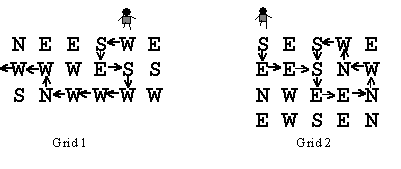
A robot has been programmed to follow the instructions in its path. Instructions for the next direction the robot is to move are laid down in a grid. The possible instructions are
N north (up the page)
S south (down the page)
E east (to the right on the page)
W west (to the left on the page)
For example, suppose the robot starts on the north (top) side of Grid 1 and starts south (down). The path the robot follows is shown. The robot goes through 10 instructions in the grid before leaving the grid.
Compare what happens in Grid 2: the robot goes through 3 instructions only once, and then starts a loop through 8 instructions, and never exits.
You are to write a program that determines how long it takes a robot to get out of the grid or how the robot loops around.
Input
There will be one or more grids for robots to navigate. The data for each is in the following form. On the first line are three integers separated by blanks: the number of rows in the grid, the number of columns in the grid, and the number of the column in which the robot enters from the north. The possible entry columns are numbered starting with one at the left. Then come the rows of the direction instructions. Each grid will have at least one and at most 10 rows and columns of instructions. The lines of instructions contain only the characters N, S, E, or W with no blanks. The end of input is indicated by a row containing 0 0 0.
Output
For each grid in the input there is one line of output. Either the robot follows a certain number of instructions and exits the grid on any one the four sides or else the robot follows the instructions on a certain number of locations once, and then the instructions on some number of locations repeatedly. The sample input below corresponds to the two grids above and illustrates the two forms of output. The word "step" is always immediately followed by "(s)" whether or not the number before it is 1.
Sample Input
3 6 5
NEESWE
WWWESS
SNWWWW
4 5 1
SESWE
EESNW
NWEEN
EWSEN
0 0 0
Sample Output
10 step(s) to exit
3 step(s) before a loop of 8 step(s)
题目大意:看图+样例基本就懂了。
解题思路:模拟
Code:
 #include<string>

 #include<iostream>

 #include<cstdio>

 #include<cstring>

 using namespace std;

 int a,b,first,px,py,date1,date2;

 struct Point

 {

     char dir;

     int vis,step;

 } P[];

 int move(int cnt)

 {

     int tmp=(py-)*a+px;

     if (P[tmp].dir=='N') py--;

     if (P[tmp].dir=='E') px++;

     if (P[tmp].dir=='S') py++;

     if (P[tmp].dir=='W') px--;

     if (px>=a+||px<=||py>=b+||py<=)

         return ;

     tmp=(py-)*a+px;

     if (P[tmp].vis)

     {

         date1=P[tmp].step-;

         date2=cnt-date1-;

         return -;

     }

     else P[tmp].vis=,P[tmp].step=cnt;

     return ;

 }

 int main()

 {

     while (cin>>b>>a>>first)

     {

         int k=;

         if (!a&&!b&&!first) break;

         for (int i=; i<=b; i++)

             for (int j=; j<=a; j++)

             {

                 cin>>P[k].dir;

                 P[k++].vis=;

             }

         px=first,py=;

         P[first].step=,P[first].vis=;

         int cnt=,ok;

         while ()

         {

             ok=move(cnt);

             if (ok) break;

             cnt++;

         }

         if (ok==) printf("%d step(s) to exit\n",cnt-);

         else printf("%d step(s) before a loop of %d step(s)\n",date1,date2);

     }

     return ;

 }
POJ1573——Robot Motion的更多相关文章
- poj1573 Robot Motion
Robot Motion Time Limit: 1000MS Memory Limit: 10000K Total Submissions: 12507 Accepted: 6070 Des ...
- POJ-1573 Robot Motion模拟
题目链接: https://vjudge.net/problem/POJ-1573 题目大意: 有一个N*M的区域,机器人从第一行的第几列进入,该区域全部由'N' , 'S' , 'W' , 'E' ...
- poj1573 Robot Motion(DFS)
题目链接 http://poj.org/problem?id=1573 题意 一个机器人在给定的迷宫中行走,在迷宫中的特定位置只能按照特定的方向行走,有两种情况:①机器人按照方向序列走出迷宫,这时输出 ...
- POJ1573(Robot Motion)--简单模拟+简单dfs
题目在这里 题意 : 问你按照图中所给的提示走,多少步能走出来??? 其实只要根据这个提示走下去就行了.模拟每一步就OK,因为下一步的操作和上一步一样,所以简单dfs.如果出现loop状态,只要记忆每 ...
- POJ1573 Robot Motion(模拟)
题目链接. 分析: 很简单的一道题, #include <iostream> #include <cstring> #include <cstdio> #inclu ...
- 【POJ - 1573】Robot Motion
-->Robot Motion 直接中文 Descriptions: 样例1 样例2 有一个N*M的区域,机器人从第一行的第几列进入,该区域全部由'N' , 'S' , 'W' , 'E' ,走 ...
- Robot Motion(imitate)
Robot Motion Time Limit: 1000MS Memory Limit: 10000K Total Submissions: 11065 Accepted: 5378 Des ...
- 模拟 POJ 1573 Robot Motion
题目地址:http://poj.org/problem?id=1573 /* 题意:给定地图和起始位置,robot(上下左右)一步一步去走,问走出地图的步数 如果是死循环,输出走进死循环之前的步数和死 ...
- POJ 1573 Robot Motion(BFS)
Robot Motion Time Limit: 1000MS Memory Limit: 10000K Total Submissions: 12856 Accepted: 6240 Des ...
随机推荐
- Java多线程(五) Lock接口,ReentranctLock,ReentrantReadWriteLock
在JDK5里面,提供了一个Lock接口.该接口通过底层框架的形式为设计更面向对象.可更加细粒度控制线程代码.更灵活控制线程通信提供了基础.实现Lock接口且使用得比较多的是可重入锁(Reentrant ...
- CSS3 弹性盒布局模型(转)
简介 引入弹性盒布局模型的目的是提供一种更加有效的方式来对一个容器中的条目进行排列. 对齐和分配空白空间.即便容器中条目的尺寸未知或是动态变化的,弹性盒布局模型也能正常的工作.在该布局模型中,容器会根 ...
- 连接Oracle数据库的OracleHelper.cs
using System; using System.Configuration; using System.Data; using System.Data.OracleClient; using S ...
- 离线文档(DocSet)下载地址汇总
我分享的百度网盘地址,官网下载慢:http://pan.baidu.com/s/1uOBYQ 名称 下载地址 更新时间 IOS 9.2 031-43202-A.dmg 20151209 OS X 10 ...
- 纯CSS3代码实现简单的图片轮播
以4张图片为例:1.基本布局:将4张图片左浮动横向并排放入一个div容器内,图片设置统一尺寸,div宽度设置4个图片的总尺寸,然后放入相框容器div,相框设置1个图片的大小并设置溢出隐藏,以保证正确显 ...
- JS中的!=、== 、!==、===的用法和区别。
1 2 3 4 5 6 7 8 9 10 11 12 13 14 15 16 17 18 19 20 var num = 1; var str = '1'; var test = 1; t ...
- 从零学起PHP
数据库连接conn.php <?php //第一步:链接数据库 $conn=@mysql_connect("localhost:3306","root", ...
- 数据可视化(一)-Matplotlib简易入门
本节的内容来源:https://www.dataquest.io/mission/10/plotting-basics 本节的数据来源:https://archive.ics.uci.edu/ml/d ...
- 生产场景NFS共享存储优化及实战
生产场景NFS共享存储优化: 1.硬件:sas/ssd磁盘,买多块,raid0/raid10,网卡好 2.NFS服务器端优化加all_squash,async /backup/NFS 192.168. ...
- Python学习_从文件读取数据和保存数据
运用Python中的内置函数open()与文件进行交互 在HeadFirstPython网站中下载所有文件,解压后以chapter 3中的“sketch.txt”为例: 新建IDLE会话,首先导入os ...