
EM and GMM(Code)
In EM and GMM(Theory), I have introduced the theory of em algorithm for gmm. Now lets practice it in matlab!
1. Generate 1000 pieces of random 2-dimention data which obey 5 gaussian distribution.
function X = GenerateData

    Sigma = [1, 0; 0, 1];

    mu1 = [1, -1];

    x1 = mvnrnd(mu1, Sigma, 200);

    mu2 = [5.5, -4.5];

    x2 = mvnrnd(mu2, Sigma, 200);

    mu3 = [1, 4];

    x3 = mvnrnd(mu3, Sigma, 200);

    mu4 = [6, 4.5];

    x4 = mvnrnd(mu4, Sigma, 200);

    mu5 = [9, 0.0];

    x5 = mvnrnd(mu5, Sigma, 200);

    % obtain the 1000 data points to be clustered

    X = [x1; x2; x3; x4; x5];

end
2. Complete em algorithm.
function [Mu, Sigma, Pi, r_nk] = EmForGmm(Data, classNum, initVal)

    % Data : Matrix(n * d), n is the quantity of the data and d is the data

    %        dimention

    % classNum : Scale

    % initVal : Cell(3 * 1), initial value for Mu, Sigma and Pi

    %           cell 1: Mu

    %           cell 2: Sigma

    %           cell 3: Pi

    [sampleNum, sampleDim] = size(Data);

    indexPoint = zeros(sampleNum, 1);

    while(1)

        for n = 1 : sampleNum

            x = Data(n, :);

            px_nk_sumk = 0;

            for k = 1 : classNum

                Sigma_k = initVal{2}(:,:,k);

                Mu_k = initVal{1}(k,:);

                Pi_k = initVal{3}(k);

                px(n,k) = (1/(2*pi^(sampleDim/2)*det(Sigma_k)^(0.5))) ...

                    * exp(-0.5 * (x - Mu_k)*inv(Sigma_k)*(x - Mu_k)');

                px_nk_sumk = px_nk_sumk + Pi_k * px(n, k);

            end

            for k = 1 : classNum

                Sigma_k = initVal{2}(:,:,k);

                Mu_k = initVal{1}(k,:);

                Pi_k = initVal{3}(k);

                r(n, k) = Pi_k * px(n, k) / px_nk_sumk;

            end

        end

        Nk = sum(r)';

        newMuK = r' * Data;

        Nkk = repmat(Nk,1,2);

        newMuK = newMuK ./ Nkk;

        for i = 1 : classNum

            nk = Nk(i);

            MuT = repmat(newMuK(i,:),sampleNum,1);

            xT = Data - MuT;

            rT = r(:,i);

            rT = repmat(rT,1,2);

            newSigma(:,:,i) = xT' * (xT .* rT) / nk;

        end

        newPiK = Nk / sampleNum;

        indexPointT = indexPoint;

        [aa,indexPoint] = max(r,[],2);

        j1 = sum(sum(abs(newMuK - initVal{1}))) < 1e-6;

        j2 = sum(sum(sum(abs(newSigma - initVal{2})))) < 1e-6;

        j3 = sum(abs(newPiK - initVal{3})) < 1e-6;

        clf;

        if (j1 && j2 && j3)

            for i = 1:sampleNum

                if (indexPoint(i)==1)

                    plot(Data(i,1), Data(i,2), 'r.')

                end

                if (indexPoint(i)==2)

                    plot(Data(i,1), Data(i,2), 'b.')

                end

                if (indexPoint(i)==3)

                    plot(Data(i,1), Data(i,2), 'k.')

                end

                if (indexPoint(i)==4)

                    plot(Data(i,1), Data(i,2), 'g.')

                end

                if (indexPoint(i)==5)

                    plot(Data(i,1), Data(i,2), 'm.')

                end

                hold on;

            end

            break;

        else

            initVal{1} = newMuK;

            initVal{2} = newSigma;

            initVal{3} = newPiK;

        end

    end

    Mu = newMuK;

    Sigma = newSigma;

    Pi = newPiK;

    r_nk = r;

end
3. Complete main function.
clear,clc,clf

Data = GenerateData;

classNum = 5;

[sampleNum, sampleDia] = size(Data);

%% Initial value

% indexNum = floor(1 + (sampleNum - 1) * rand(1,classNum));

indexNum = [50,300,500,700,900];

initMu = Data(indexNum,:);

initSigmaT = [1 0.2;0.2 1];

initSigma = zeros(2,2,classNum);

for i = 1 : classNum

    initSigma(:,:,i) = initSigmaT;

    initPi(i,1) = 1 / classNum;

end

initVal = cell(3,1);

initVal{1} = initMu;

initVal{2} = initSigma;

initVal{3} = initPi;

%% EM algorithm

[Mu, Sigma, Pi, r_nk] = EmForGmm(Data, classNum, initVal);
4. Result.
The cluster result can be show as figure 3.
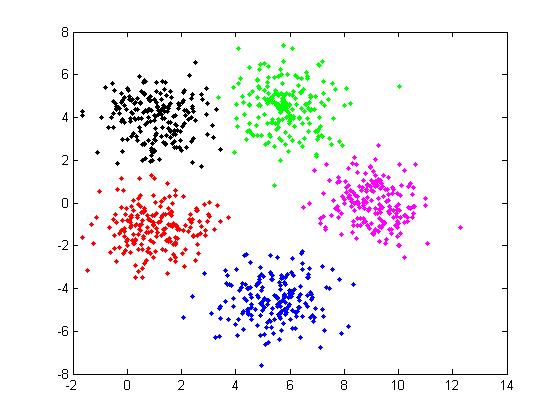
Figure 3
The probality distribution function can be writen as:
\[ p(\mathbf{x}) = \sum_{k=1}^{K}\pi_kp(\mathbf{x}|\mu_k\Sigma_k) \]
where,
$\mu_1 = (1.028, -1.158) $, $\mu_2 = (5.423, -4.538) $, $\mu_3 = (1.036, 3.975) $, $\mu_4 = (5.835, 4.474) $, $\mu_5 = (9.074, -0.063) $
Notice that, when generate the data:
$\mu_1 = (1, -1) $, $\mu_2 = (5.5, -4.5) $, $\mu_3 = (1, 4) $, $\mu_4 = (6, 4.5) $, $\mu_5 = (9, 0) $)
\[
\Sigma_1 = \left(
\begin{array}{cc}
1.0873& 0.0376\\
0.0376& 0.8850
\end{array}
\right),
\Sigma_2 = \left(
\begin{array}{cc}
1.1426& 0.0509\\
0.0509& 0.9192
\end{array}
\right),
\Sigma_3 = \left(
\begin{array}{cc}
0.9752& -0.0712\\
-0.0712& 0.9871
\end{array}
\right),
\Sigma_4 = \left(
\begin{array}{cc}
1.0111& -0.0782\\
-0.0782& 1.2034
\end{array}
\right),
\Sigma_5 = \left(
\begin{array}{cc}
0.8665& -0.1527\\
-0.1527& 0.9352
\end{array}
\right)
\]
Notice that, when generate the data:
\[\Sigma = \left(
\begin{array}{cc}
1& 0\\
0& 1
\end{array}
\right)
\]
$\pi_1 = 0.1986$, $\pi_2 = 0.2004 $, $\pi_3 = 0.1992$, $\pi_4 = 0.2015 $, $\pi_5 = 0.2002$
Notice that, when generate the data: each guassian components occupy 20% of all data. (1000 data point, 200 for each guassian components)
EM and GMM(Code)的更多相关文章
- EM and GMM(Theory)
Part 1: Theory 目录: What's GMM? How to solve GMM? What's EM? Explanation of the result What's GMM? GM ...
- 微信小程序API登录凭证(code),获得的用户登录态拥有一定的时效性
调用接口获取登录凭证(code)进而换取用户登录态信息,包括用户的唯一标识(openid) 及本次登录的 会话密钥(session_key).用户数据的加解密通讯需要依赖会话密钥完成. OBJECT参 ...
- 三维卷积:全景图像Spherical CNNs(Code)
卷积神经网络(CNN)可以很好的处理二维平面图像的问题.然而,对球面图像进行处理需求日益增加.例如,对无人机.机器人.自动驾驶汽车.分子回归问题.全球天气和气候模型的全方位视觉处理问题. 将球形信号的 ...
- css里px em rem特点(转)
1.px特点: 1.IE无法调整px作为单位的字体大小: 2.Firefox能够调整px.em和rem. px是像素,是相对长度单位,是相对于显示器屏幕分辨率而言的. 2.em特点: 1.em的值并不 ...
- PCL:描述三维离散点的ROPS特征(Code)
前言: 三维点云为三维欧式空间点的集合.对点云的形状描述若使用局部特征,则可分为两种:固定世界坐标系的局部描述和寻找局部主方向的局部描述,ROPS特征为寻找局部主方向的特征描述. 1.寻找主方向(对X ...
- Python:Matplotlib 画曲线和柱状图(Code)
原文链接:http://blog.csdn.net/ikerpeng/article/details/20523679 参考资料:http://matplotlib.org/gallery.html ...
- Qt:&OpenCV—Q图像处理基本操作(Code)
原文链接:http://www.cnblogs.com/emouse/archive/2013/03/31/2991333.html 作者写作一系列:http://www.cnblogs.com/em ...
- 编码(Code)
很遗憾,直接搜索Code或者编码是很难得找到这本书的,我也是无意中才接触到本书. 第一次读本书,对各方面的知识都不算很懂,觉得很多地方都写的太多浅显,好像本该就是这样子,一个编码系统说的那么麻烦干嘛, ...
- px和em的区别(转)
在国内网站中,包括三大门户,以及“引领”中国网站设计潮流的蓝色理想,ChinaUI等都是使用了px作为字体单位.只有百度好歹做了个可调的表率.而 在大洋彼岸,几乎所有的主流站点都使用em作为字体单位, ...
随机推荐
- javascript--study
1.函数传参:按值传递 对于数字.字符串等是将它们的值传递给了函数参数,函数参数的改变不会影响函数外部的变量. 对于数组和对象等是将对象(数组)的变量的值传递给了函数参数,这个变量保存的指向对象(数组 ...
- IOS开发中各种型号的分辨率及软件图标的制作
IOS中各手机的分辨率为: 5.5寸: 1242*2208;4.7寸: 750*1334;4.0寸: 640*1136;3.5寸: 640*960; 软件的图标有以下需求(注意选中右侧红色框中这一条) ...
- UVa 11631 - Dark roads
题目大意:政府为了减小开支决定关闭一些路灯,同时保证照亮的路能连接所有路口. 又是一个MST问题,Kruskal算法,不过数据规模比较大,又Submission Error了...扔这吧... #in ...
- 安卓selector
定义styles.xml <?xml version="1.0" encoding="utf-8"?> <resources> < ...
- JS内存泄漏排查方法——Chrome Profiles
一.概述 Google Chrome浏览器提供了非常强大的JS调试工具,Heap Profiling便是其中一个.Heap Profiling可以记录当前的堆内存(heap)快照,并生成对象的描述文件 ...
- Aptana插件安装、配置
本文讲解在线安装的方式: 1.eclipse->help->Install New SoftWare... 在弹出的对话框Work with中填入[http://download.apta ...
- docker tag
docker tag 命令以及其中的一些概念--之我见 1. 重要的本质的东西是 image - docker 最有用的东西是image,这个应该可以被大部分人接受 - 查看官网的 tag 命令,一 ...
- BNU Online Judge-34777-Magical GCD
题目链接 http://www.bnuoj.com/bnuoj/problem_show.php?pid=34777 题意 如样例 输入 1530 60 20 20 20 输出 80 如 30 和 ...
- 上传预览 easyui部分控件获取focuse 表单验证
js: $(document).ready(function () { //$('#creater').combobox({ // url: '/VMS.UI/BindData/ScheamData? ...
- 创建第一个Android应用程序 HelloWorld
按照博客的进程,今天应该进行程序编写啦,下面让我们开写一个简单的HelloWorld程序. 提示:这里对于如何使用Eclipse创建一个Android程序就不多讲啦,不会的同学可以去查阅相关文档. 程 ...