
【Paper Reading】Deep Supervised Hashing for fast Image Retrieval
what has been done:
This paper proposed a novel Deep Supervised Hashing method to learn a compact similarity-presevering binary code for the huge body of image data.
Data sets:
CIFAR-10: 60,000 32*32 belonging to 10 mutually exclusively categories(6000 images per category)
NUS-WIDE: 269,648 from Flickr, warpped to 64*64
content based image retrieval: visually similar or semantically similar.
Traditional method: calculate the distance between the query image and the database images.
Problem: time and memory
Solution: hashing methods(map image to compact binary codes that approximately preserve the data structure in the original space)
Problem: performace depends on the features used, more suitable for dealing with the visiual similarity search rather than the sematically similarity search.
Solution: CNNs, the CNNs successful applications of CNNs in various tasks imply that the feature learned by CNNs can well capture the underlying sematic structure of images in spite of significant appearance variations.
Related works:
Locality Sensitive Hashing(LSH):use random projections to produce hashing bits
cons: requires long codes to achieve satisfactory performance.(large memory)
data-dependent hashing methods: unsupervised vs supervised
unsupervised methods: only make use of unlabelled training data to lean hash functions
- spectral hashing(SH): minimizes the weighted hamming distance of image pairs
- Iterative Quantization(ITQ): minimize the quantization error on projected image descriptors so as to allievate the information loss
supervised methods: take advantage of label inforamtion thus can preserve semantic similarity
- CCA-ITQ: an extension of iterative quantization
- predictable discriminative binary code: looks for hypeplanes that seperate categories with large margin as hash function.
- Minimal Loss Hashing(MLH): optimize upper bound of a hinge-like loss to learn the hash functions
problem: the above methods use linear projection as hash functions and can only deal with linearly seperable data.
solution: supervised hashing with kernels(KSH) and Binary Reconstructive Embedding(BRE).
Deep hashing: exploits a non-linear deep networks to produce binary code.
Problem : most hash methods relax the binary codes to real-values in optimizations and quantize the model outputs to produce binary codes. However there is no guarantee that the optimal real-valued codes are still optimal after quantization .
Solution: DIscrete Graph Hashing(DGH) and Supervided Discrete Hashing(DSH) are proposed to directly optimize the binary codes.
Problem : Use hand crafted feature and cannot capture the semantic information.
Solution: CNNs base hashing method
Our goal: similar images should be encoded to similar binary codes and the binary codes should be computed efficiently.
Loss function:
Relaxation:
Implementation details:
Network structure:
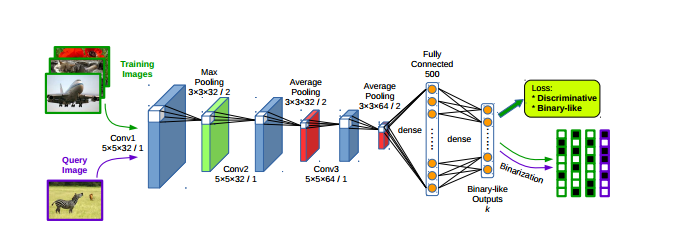
3*卷积层:
3*池化层:
2*全连接层:
Training methodology:
- generate images pairs online by exploiting all the image pairs in each mini-batch. Allivate the need to store the whole pair-wise similarity matrix, thus being scalable to large-scale data-sets.
- Fine-tune vs Train from scratch
Experiment:
CIFAR-10
GIST descriptors for conventional hashing methods
NUS-WIDE
225-D normalized block-wise color moment features
Evalutaion Metrics
mAP: mean Average Precision
precision-recall curves(48-bit)
mean precision within Hamming radius 2 for different code lengths
Network ensembles?
Comparison with state-of-the-art method
CNNH: trainin the model to fit pre-computed discriminative binary code. binary code generation and the network learning are isolated
CLBHC: train the model with a binary-line hidden layer as features for classification, encoding dissimilar images to similar binary code would not be punished.
DNNH: used triplet-based constraints to describe more complex semantic relations, training its networks become more diffucult due to the sigmoid non-linearlity and the parameterized piece-wise threshold function used in the output layer.
Combine binary code generation with network learning
Comparision of Encoding Time
【Paper Reading】Deep Supervised Hashing for fast Image Retrieval的更多相关文章
- 【Paper Reading】Learning while Reading
Learning while Reading 不限于具体的书,只限于知识的宽度 这个系列集合了一周所学所看的精华,它们往往来自不只一本书 我们之所以将自然界分类,组织成各种概念,并按其分类,主要是因为 ...
- 【Paper Reading】Object Recognition from Scale-Invariant Features
Paper: Object Recognition from Scale-Invariant Features Sorce: http://www.cs.ubc.ca/~lowe/papers/icc ...
- 【Paper Reading】Bayesian Face Sketch Synthesis
Contribution: 1) Systematic interpretation to existing face sketch synthesis methods. 2) Bayesian fa ...
- 【Paper Reading】Improved Textured Networks: Maximizing quality and diversity in Feed-Forward Stylization and Texture Synthesis
Improved Textured Networks: Maximizing quality and diversity in Feed-Forward Stylization and Texture ...
- 【资料总结】| Deep Reinforcement Learning 深度强化学习
在机器学习中,我们经常会分类为有监督学习和无监督学习,但是尝尝会忽略一个重要的分支,强化学习.有监督学习和无监督学习非常好去区分,学习的目标,有无标签等都是区分标准.如果说监督学习的目标是预测,那么强 ...
- 【文献阅读】Deep Residual Learning for Image Recognition--CVPR--2016
最近准备用Resnet来解决问题,于是重读Resnet的paper <Deep Residual Learning for Image Recognition>, 这是何恺明在2016-C ...
- 【文献阅读】Augmenting Supervised Neural Networks with Unsupervised Objectives-ICML-2016
一.Abstract 从近期对unsupervised learning 的研究得到启发,在large-scale setting 上,本文把unsupervised learning 与superv ...
- 【CS-4476-project 6】Deep Learning
AlexNet / VGG-F network visualized by mNeuron. Project 6: Deep LearningIntroduction to Computer Visi ...
- 【论文阅读】Deep Mixture of Diverse Experts for Large-Scale Visual Recognition
导读: 本文为论文<Deep Mixture of Diverse Experts for Large-Scale Visual Recognition>的阅读总结.目的是做大规模图像分类 ...
随机推荐
- WEBGL学习【十一】光照模型
<!DOCTYPE HTML> <html lang="en"> <head> <title>Listing 7-3 and 7-4 ...
- webpack使用中遇到的相关问题
问题一:使用webpack打包jquery后,在页面使用错误信息:$ is not defined new webpack.ProvidePlugin({ "$": "j ...
- [luogu2052 NOI2011] 道路修建 (树形dp)
传送门 Description 在 W 星球上有 n 个国家.为了各自国家的经济发展,他们决定在各个国家 之间建设双向道路使得国家之间连通.但是每个国家的国王都很吝啬,他们只愿 意修建恰好 n – 1 ...
- [noip2011]计算系数+二项式定理证明
大水题,二项式定理即可(忘得差不多了) 对于一个二项式,\((a+b)^n\)的结果为 \(\sum_{k=0}^{k<=n}C_{n}^{k}a^{n-k}b^k\) 证明: 由数学归纳法,当 ...
- centos7把编译安装的服务通过systemctl管理
nginx编译安装的目录是/usr/local/nginx nginx配置文件是/usr/local/nginx/conf/nginx.conf systemctl管理的服务文件在/usr/lib/s ...
- gpio_request 原形代码
http://blog.csdn.net/maopig/article/details/7428561 其原型为 int gpio_request(unsigned gpio, const char ...
- 【 ACM-ICPC 2018 沈阳赛区网络预赛 D】Made In Heaven
[链接] 我是链接,点我呀:) [题意] 在这里输入题意 [题解] 点可以重复走的k短路. [代码] #include <bits/stdc++.h> #define LL long lo ...
- BA-siemens-symaro传感器简介
1 传感器的原理 传感器.控制器.执行机构是构成控制系统 3 个要素,传感器的作 用一般用来测量工艺参数,提供给控制器或显示仪表,实现工艺过程的 监测或控制.传感器的类型是按测量参数不同分类的,主要分 ...
- centos7.0 安装日志--图文具体解释-python开发环境配置
centos7.0公布之后,就下载了everthing的DVD镜像.今天有时间,所以决定在vbox底下体验一番--- 上图: watermark/2/text/aHR0cDovL2Jsb2cuY3Nk ...
- socket编程之二:两种链接类型tcp和udp
前面一篇文章说到了一些计算机网络的基础知识.引入了socket.从这节開始,就进入正题了. 一 概述 TCP:Transimission Control Protocol传输控制协议. UPD:Use ...