
poj 1330(初探LCA)
| Time Limit: 1000MS | Memory Limit: 10000K | |
| Total Submissions: 23795 | Accepted: 12386 |
Description
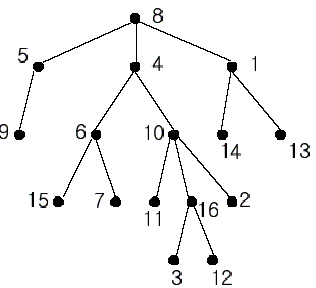
In the figure, each node is labeled with an integer from {1,
2,...,16}. Node 8 is the root of the tree. Node x is an ancestor of node
y if node x is in the path between the root and node y. For example,
node 4 is an ancestor of node 16. Node 10 is also an ancestor of node
16. As a matter of fact, nodes 8, 4, 10, and 16 are the ancestors of
node 16. Remember that a node is an ancestor of itself. Nodes 8, 4, 6,
and 7 are the ancestors of node 7. A node x is called a common ancestor
of two different nodes y and z if node x is an ancestor of node y and an
ancestor of node z. Thus, nodes 8 and 4 are the common ancestors of
nodes 16 and 7. A node x is called the nearest common ancestor of nodes y
and z if x is a common ancestor of y and z and nearest to y and z among
their common ancestors. Hence, the nearest common ancestor of nodes 16
and 7 is node 4. Node 4 is nearer to nodes 16 and 7 than node 8 is.
For other examples, the nearest common ancestor of nodes 2 and 3 is
node 10, the nearest common ancestor of nodes 6 and 13 is node 8, and
the nearest common ancestor of nodes 4 and 12 is node 4. In the last
example, if y is an ancestor of z, then the nearest common ancestor of y
and z is y.
Write a program that finds the nearest common ancestor of two distinct nodes in a tree.
Input
input consists of T test cases. The number of test cases (T) is given in
the first line of the input file. Each test case starts with a line
containing an integer N , the number of nodes in a tree,
2<=N<=10,000. The nodes are labeled with integers 1, 2,..., N.
Each of the next N -1 lines contains a pair of integers that represent
an edge --the first integer is the parent node of the second integer.
Note that a tree with N nodes has exactly N - 1 edges. The last line of
each test case contains two distinct integers whose nearest common
ancestor is to be computed.
Output
Sample Input
2

16

1 14

8 5

10 16

5 9

4 6

8 4

4 10

1 13

6 15

10 11

6 7

10 2

16 3

8 1

16 12

16 7

5

2 3

3 4

3 1

1 5

3 5
Sample Output
4

3
Source
下面这段模板代码引自某位大神的博客 http://www.cppblog.com/menjitianya/archive/2015/12/10/212447.html
void LCA_Tarjan(int u) {
//题意:t组测试用例,输入n,接下来输入n-1条边 组成一棵树,第n组数据代表询问a b之间最近公共祖先

#include <stdio.h>

#include <algorithm>

#include <string.h>

#include <vector>

using namespace std;

const int MAX = ;

vector<int> mp[MAX];

int father[MAX];

int indegree[MAX];  ///入度为0的就是根节点

int _rank[MAX];  ///利用启发式合并防止树成链

int vis[MAX];

int ances[MAX];

int A,B;

void init(int n){

    for(int i=;i<=n;i++){

        ances[i]=;

        vis[i]=;

        _rank[i] = ;

        indegree[i]=;

        father[i] = i;

        mp[i].clear();

    }

}

int _find(int x){

    if(x==father[x]) return x;

    return father[x] = _find(father[x]);

}

void _union(int a,int b){

    int x = _find(a);

    int y = _find(b);

    father[x]=y;

}

 int Tarjan(int u)

 {

     for (int i=;i<mp[u].size();i++)

     {

         Tarjan(mp[u][i]);

         _union(u,mp[u][i]);

         ances[_find(u)]=u;

     }

     vis[u]=;

    if (A==u && vis[B]) printf("%d\n",ances[_find(B)]);

     else if (B==u && vis[A]) printf("%d\n",ances[_find(A)]);

     return ;

 }

int main()

{

    int tcase;

    scanf("%d",&tcase);

    while(tcase--){

        int n;

        scanf("%d",&n);

        init(n);

        int a,b;

        for(int i=;i<n;i++){

            scanf("%d%d",&a,&b);

            mp[a].push_back(b);

            indegree[b]++;

        }

        scanf("%d%d",&A,&B);

        for(int i=;i<=n;i++){

            if(indegree[i]==){

               Tarjan(i);

                break;

            }

        }

    }

    return ;

}
poj 1330(初探LCA)的更多相关文章
- POJ 1330 (LCA)
http://poj.org/problem?id=1330 题意:给出一个图,求两个点的最近公共祖先. sl :水题,贴个模板试试代码.本来是再敲HDU4757的中间发现要用LCA, 操蛋只好用这 ...
- POJ 1330(LCA/倍增法模板)
链接:http://poj.org/problem?id=1330 题意:q次询问求两个点u,v的LCA 思路:LCA模板题,首先找一下树的根,然后dfs预处理求LCA(u,v) AC代码: #inc ...
- poj 1330(RMQ&LCA入门题)
传送门:Problem 1330 https://www.cnblogs.com/violet-acmer/p/9686774.html 参考资料: http://dongxicheng.org/st ...
- Nearest Common Ancestors POJ - 1330 (LCA)
Nearest Common Ancestors Time Limit: 1000MS Memory Limit: 10000K Total Submissions: 34657 Accept ...
- POJ 1330 Tarjan LCA、ST表(其实可以数组模拟)
题意:给你一棵树,求两个点的最近公共祖先. 思路:因为只有一组询问,直接数组模拟好了. (写得比较乱) 原题请戳这里 #include <cstdio> #include <bits ...
- POJ - 1330 Nearest Common Ancestors(基础LCA)
POJ - 1330 Nearest Common Ancestors Time Limit: 1000MS Memory Limit: 10000KB 64bit IO Format: %l ...
- POJ 1330 Nearest Common Ancestors / UVALive 2525 Nearest Common Ancestors (最近公共祖先LCA)
POJ 1330 Nearest Common Ancestors / UVALive 2525 Nearest Common Ancestors (最近公共祖先LCA) Description A ...
- POJ.1330 Nearest Common Ancestors (LCA 倍增)
POJ.1330 Nearest Common Ancestors (LCA 倍增) 题意分析 给出一棵树,树上有n个点(n-1)条边,n-1个父子的边的关系a-b.接下来给出xy,求出xy的lca节 ...
- POJ 1330 Nearest Common Ancestors (LCA,倍增算法,在线算法)
/* *********************************************** Author :kuangbin Created Time :2013-9-5 9:45:17 F ...
随机推荐
- 四道JavaScript面试题检测你的js基本功
下面有四道简短的JavaScript小脚本,如果你能顺利预测脚本的运行结果,那么你的JavaScript基本功还是可以的.如果答错了,可以相应地去补一下缺漏的知识.反正也很简单,答错了只是说明你没了解 ...
- Magic FZU - 2280 无脑HASH暴力
Kim is a magician, he can use n kinds of magic, number from 1 to n. We use string Si to describe mag ...
- DOM学习控件定位和案例
Dom中有多种定位属性,下面是一个简单案例 <html><!--制作一个会跟着鼠标走的图像,还有控件定位的案例--> <head> <title>doc ...
- android极光推送初步了解
推送可以及时,主动的与用户发起交互 (1)继承jar包,照示例AndroidManifest.xml添加. (2)自定义MyApp继承自Application,在onCreate方法中调用JPushI ...
- 快速排序Quick sort
快速排序Quick sort 原理,通过一趟扫描将要排序的数据分割成独立的两部分,其中一部分的所有数据都比另外一部分的所有数据都要小,然后再按此方法对这两部分数据分别进行快速排序,整个排序过程可以递归 ...
- WP8.1 Windows Phone 8.1开发:何如定义Pivot头部样式、定义Pivot头部颜色
Windows Phone 8.1 ,如何自定义Pivot头部样式?用Pivot控件完成这样的效果. 网上找了好久,只找到了windows phone 8的解决方案. 终于一个大神给支了招,我觉得我有 ...
- SQL语句中的单引号处理以及模糊查询
为了防止程序SQL语句错误以及SQL注入,单引号必须经过处理.有2种办法: 1.使用参数,比如SELECT * FROM yourTable WHERE name = @name; 在C#中使用Sql ...
- python数据处理课程笔记(一)
一.numpy 1.numpy中所有元素必须是相同的类型 a=[1,2,3,4,'t'] #列表中有str类型,转换为ndarray时所有元素都转换为str类型 arr1=np.array(a) pr ...
- js中三种定义变量 const, var, let 的区别
js中三种定义变量的方式const, var, let的区别 1.const定义的变量不可以修改,而且必须初始化. 1 const b = 2;//正确 2 // const b;//错误,必须初始化 ...
- oracle 的number数据类型
NUMBER类型细讲:Oracle number datatype 语法:NUMBER[(precision [, scale])]简称:precision --> p scale ...