
angular 学习理解笔记
原文:https://github.com/eoinkelly/notes/blob/master/angular/book-building-web-apps-w-angular/angular.md
---------------------------------------------------------------------------------
Modules
You can create and retrieve modules with the angular.module() function
var modInstance = angular.module('someName', []); // create 'someName' module

var myNameMod = angular.module('someName'); // retrieve a reference to an existing model
- A module acts as a container for other managed objects
- The
ng-appdirective is given the name of a module. - Modules can contain any kind of object, not just angular specific ones
In angular you can declarativly express dependencies between modules
- Pros
- you can swap collaborators as you need them
- you are not responsible for creating or destroying (managing life cycle) of collaborators - angular does it for you - this means less code but also less control I guess
- if you object doesn't create or destroy any of its collaborators, it has less jobs
- it makes all the collaborators swappable (hence easier to change)
- it lets you unit test much easier. The ability to swap collaborators is very important for testability
To take advantage of angular DI system, you need to tell it about your code by registering your code in modules.
Angular modules do not store instances of the objects your code needs - they store factories/recipes/constructors that can create these instances
- The $provide service allows us to register our recipes
- The recipes are then interpreted by the $injector service (which creates and wires up their dependencies too)
- objects created from a recipe are called services
NB Angular will only interpret a given recipe once during the applications life cycle - there will only every be one instance of each service object!!!
Consequences
- there is only one of each controller, filter, directive, service that you register
- if I want to use Angular DI/modules for my own code, I need to remember that the constructor function I provide will only be run one time during the lifetime of the app.
- Angular services are singletons!!!
- ? does this imply that services are not useful for models?
7 ways of registering an object with Angular DI system
moduleInstance.value('name', func)
- registered by value() cannot have dependencies
- func must be a constructor
moduleInstance.service()
- not used very often apparently
- lets you make services
- the function you provide must be a constructor (decorates
this, no explicit return)
moduleInstance.factory('name', )
- allows to register any arbitrary object-creating code i.e. the function does not have to be a constructor - it can return anything
- the function you pass can be used as the module pattern (it can have "private" variables, and return it's public interface)
- factory is the most common way of registing code with the DI system
moduleInstance.constant('name', value)
- lets you register a constant that can be declared as a dependency by other modules
- You could put constants within the function you pass to factory but this is better because
- they can be swapped out for tests
- you can re-use the service across many applications
- con: they don't have default values - the client app has to specify every constant
moduleInstance.provider('name', function)
- all of the other registration methods are sugar for this one
- it must return an object that contains a
$getproperty which is a factory function - a provider is an object that embeds factory function in it's $get property
- it can also expose other functions as properties and have hidden data so you can have a default configuration that gets overridden by the functions it exposes.
- it is the most verbose but most flexibly way of registering
moduleInstance.config(func(fooProvider))
- note there is no name parameter, only a function
- allows you to call functions on the provider object before it's $get property is invoked to create the service
- these functions get run during the config phase (they can change the recipe)
- gets passed in an instance of a provider (decided by the parameter name)
- Two ways of registering config functions for angular modules:
angular.module('my-foo-mod', [], function (myServiceProvider) {

  // I am **the** config function because I am the third argument (implicit - less obvious)

  // I am the only one - this is less flexible

  // the parameter passed in here is a reference to the **provider** that creates the service instances

  // angular uses its argument parsing magic to know find the provider for 'myService'

  myServiceProvider.setMaxLen(5);

});

// This form is prefered as it is more explicit and flexible

angular.module('my-foo-mod', [])

  .config(function () {

    // I am a config function

  })

  .config(function () {

    // so am I

  })
- within the config() function we are calling things in the public interface of the provider object (which contains the factory object in
$get). This is like changing the recipe, not creating the service using the original recipe and then tweaking it - Angular uses it's magic "parse the function text" trick to find the right provider using the naming convention fooProvider (the provider for foo)
moduleInstance.run(func(...))
- note there is no name parameter, only a function
- code that should be invoked at the run phase of the module
Function objects registered as modules get an $inject attribute which points to an array of strings representing their dependencies - this is what all the sugar ways of declaring dependencies does.
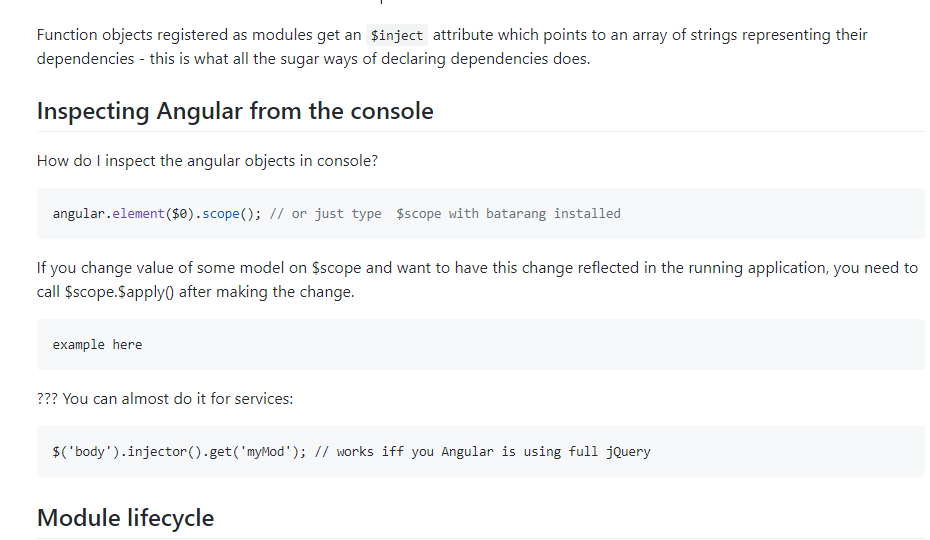
Inspecting Angular from the console
How do I inspect the angular objects in console?
angular.element($0).scope(); // or just type $scope with batarang installed
If you change value of some model on $scope and want to have this change reflected in the running application, you need to call $scope.$apply() after making the change.
example here
??? You can almost do it for services:
$('body').injector().get('myMod'); // works iff you Angular is using full jQuery
Module lifecycle
Angular module has two phases
- configuration phase
- all recipes are collected & configured
- providers can be configured (using modInstance.config()) here
- config() callbacks are run here
- run phase
- any post-instantiation logic is run here
- the equivalent of a main method in other languages
- a module can have multiple run blocks
- run() callbacks are run here
- you can use run callbacks to add variables to the $rootScope
Angular modules can be combined into other modules
- groups of related services can be combined into re-usable modules
- the top level (application) module can just declare its dependencies on what it needs
Angular has both a services namespace and a module heirarchy. All services are global singletons so the modules (a heirarchy of service creation recipes) eventually creates a flat services namespace.
- services can declare dependencies on other services, values, constants (they don't care what modules these are in however)
- modules (each of which can contain multiple services) can declare dependencies on each other
Service visiblity
- All services are combined into a global namespace so they can all depend on each other no matter what module they are defined in.
- This means that the module heirarchy is flattened out
- The module herirarchy is still worthwhile because it helps for organisating code and testing
- You can override services by defining ones with the same name that are "closer" to the service that needs them.
- Services defined in modules that are closer to the root of the module heirarchy will override those in child modules
- There is currently no way of having a service that is private to a module
- There is currently no way of restricting the visibility of a service
- This means that the module heirarchy is flattened out
angular 学习理解笔记的更多相关文章
- batch normalization学习理解笔记
batch normalization学习理解笔记 最近在Andrew Ng课程中学到了Batch Normalization相关内容,通过查阅资料和原始paper,基本上弄懂了一些算法的细节部分,现 ...
- ASCII, Unicode, UTF-8, 8进制, 16进制等各种编码学习理解笔记
字符编码的发展历史 Unicode和UTF-8有何区别? 在这个问题下的于洋的最高票回答中,比较完整地介绍了字符编码的发展历史,为了便于记忆,再次简要概括一番. 一个字节:最初一个字节的标准是混乱的, ...
- angular学习笔记(三十一)-$location(2)
之前已经介绍了$location服务的基本用法:angular学习笔记(三十一)-$location(1). 这篇是上一篇的进阶,介绍$location的配置,兼容各版本浏览器,等. *注意,这里介绍 ...
- angular学习笔记(三十)-指令(7)-compile和link(2)
继续上一篇:angular学习笔记(三十)-指令(7)-compile和link(1) 上一篇讲了compile函数的基本概念,接下来详细讲解compile和link的执行顺序. 看一段三个指令嵌套的 ...
- angular学习笔记(三十)-指令(6)-transclude()方法(又称linker()方法)-模拟ng-repeat指令
在angular学习笔记(三十)-指令(4)-transclude文章的末尾提到了,如果在指令中需要反复使用被嵌套的那一坨,需要使用transclude()方法. 在angular学习笔记(三十)-指 ...
- angular学习笔记(三十一)-$location(1)
本篇介绍angular中的$location服务的基本用法,下一篇介绍它的复杂的用法. $location服务的主要作用是用于获取当前url以及改变当前的url,并且存入历史记录. 一. 获取url的 ...
- angular学习笔记(三十)-指令(10)-require和controller
本篇介绍指令的最后两个属性,require和controller 当一个指令需要和父元素指令进行通信的时候,它们就会用到这两个属性,什么意思还是要看栗子: html: <outer‐direct ...
- angular学习笔记(三十)-指令(7)-compile和link(1)
这篇主要讲解指令中的compile,以及它和link的微妙的关系. link函数在之前已经讲过了,而compile函数,它和link函数是不能共存的,如果定义了compile属性又定义link属性,那 ...
- angular学习笔记(三十)-指令(5)-link
这篇主要介绍angular指令中的link属性: link:function(scope,iEle,iAttrs,ctrl,linker){ .... } link属性值为一个函数,这个函数有五个参数 ...
随机推荐
- vue—你必须知道的
更多总结 猛戳这里 属性与方法 不要在实例属性或者回调函数中(例如,vm.$watch('a', newVal => this.myMethod())使用箭头函数.因为箭头函数会绑定父级上下文, ...
- k8s的故障切换(failover)
当前3个节点的状态都为ready 当前node1有两个pod node2有1个pod 现在将node1关机会有怎样的现象 ping 分布在node1节点的pod地址已经ping不通. 在node1节 ...
- poj 1584(综合性强的计算几何,好题)
A Round Peg in a Ground Hole Time Limit: 1000MS Memory Limit: 10000K Total Submissions: 6238 Acc ...
- nginx反向代理部署nodejs配置
将域名abc.com反向代理到127.0.0.1:8888 upstream nodejs { server 127.0.0.1:8888; keepalive 64; } server { list ...
- Go语言map映射的基本操作
对比python, java都有对应的字典类型及哈希类型. package main import ( "fmt" ) //main is the entry of the pro ...
- EF中使用Linq时First、FirstOrDefault、Single、SingleOrDefault几个方法的区别
在使用EntityFramework开发时,.NET的System.Linq.Enumerable类为我们提供了许多Linq方法. 给大家分享一下关于First.FirstOrDefault.Sing ...
- [libGDX游戏开发教程]使用Libgdx进行游戏开发(5)-关卡加载
在上一章我们介绍了如何管理和利用素材,但是我们注意到,这些素材都是零散的,比如岩石的左部等,这一章,我们将利用这些零件拼合成完整的游戏对象. 回顾最开始的设计类图,注意Level类和所有Level中的 ...
- 计蒜客 30996.Lpl and Energy-saving Lamps-线段树(区间满足条件最靠左的值) (ACM-ICPC 2018 南京赛区网络预赛 G)
G. Lpl and Energy-saving Lamps 42.07% 1000ms 65536K During tea-drinking, princess, amongst other t ...
- hscan扫描工具
在网上发现一篇关于hscan工具的介绍 文章来源: http://book.51cto.com/art/200810/94967.htm 2.4.3 使用HScan获取信息案例 HScan是一款优秀 ...
- Codeforces #430 Div2 C
#430 Div2 C 题意 给出一棵带点权的树,每一个节点的答案为从当前节点到根节点路径上所有节点权值的最大公因子(在求最大共因子的时候可以选择把这条路径上的任意一点的权值置为0).对于每一个节点单 ...