
自己动手实现STL 01:内存配置器的实现(stl_alloc.h)
一、前言
在STL中,容器是其中的重中之重,基本的STL中的算法,仿函数等都是围绕着容器实现的功能。而,内存配置器,是容器的实现的基础。所以,我第一次要去编写便是内存配置器的实现。在STL中,内存配置器的实现是在stl_alloc.h中。
二、配置器原理简要介绍
在SGI STL中配置分为两级,第一级配置器和第二级配置器。两者关系如下:
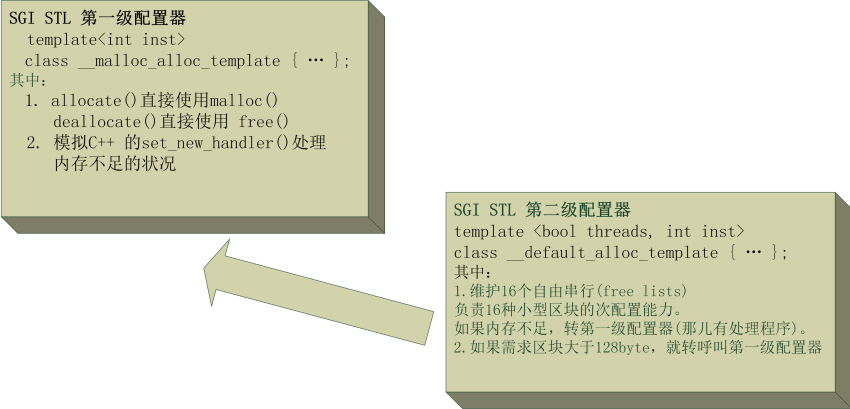
图1:第一级配置器和第二级配置器
在SGI STL中内存的配置器分为两级,第一级配置器和第二级配置器。第一级配置器就是,直接调用系统的malloc分配内存。对于小于128byte的内存分配请求,我们使用第二级内存配置器。第二级内存配置器是一个内存池,其中共有16个已分配好的区块形成的链表。这16个链表的中区块的大小依次是8,16,24....128byte,都8的倍数。每次请求小于等于128byte时,把请求的大小上调到最接近的8的倍数,比如,7就上调为8,30就上调为32,然后找到对应大小区块的链表,从中取下一个区块返回给请求。
第二级配置器使用内存池的好处就是,可以避免太多小额区块造成的内存破碎。同时,每次分配内存都需要调用malloc去分配,malloc调用的消耗的时间等资源是一定的,对于大区块的分配这样的消耗的时间等资源,是没有什么的。但是对于小额区块的,它的消耗就显得太不值的了。我们可以采用一次预分配一块连续的大区块,把它串成一个定额大小的区块链表,(8的倍数字节),下次使用的时候,从对应预分配的区块链表中找一个能够满足大小的,最接近的区块直接返回给请求,这样就可以避免对于小区块的malloc调用。同时对于小区块的释放,可以直接把它加入到内存池中对应大小的链表中即可。

图2:把连续大区块串成小额区块
在第二级配置器中维持一个free_list[16]数组,其中存储着8-128byte各种大小区块的链表的头节点地址。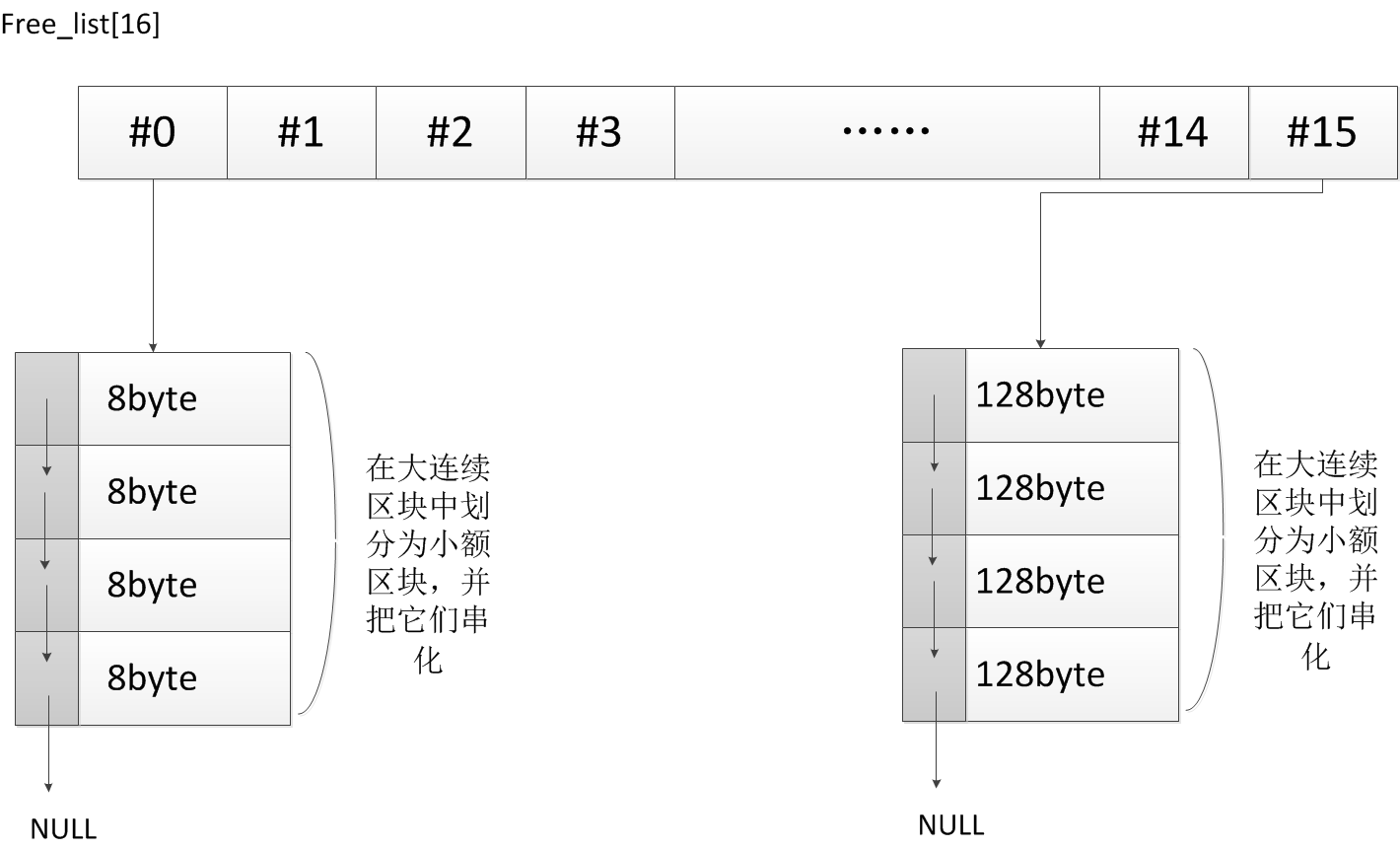
图3:free_list[16]结构
每次分配只要从适当大小的链表中取出第一个节点,返回给请求,让free_list对应的位置的保存链表的下一个节点地址。释放的时候,对于小于等于128byte的区块,只要把它插入对应大小区块链表的头,然后调整保存的链表头结点的地址就可以了。当需求大小区块的使用完了的时候,可以利用malloc一次分配适当大小的大区块,然后把它分割为对应大小的小区块,在把它们串联起来形成链表,把第一个节点地址存入对应的free_list的位置中。
三、实现源代码
上面只是配置器的简介,在源码中有详细的注释。源码如下:
 /*************************************************************************

     > File Name: stl_alloc_wjzh.h

     > Author: wjzh

     > Mail: wangjzh_1@163.com

     > Created Time: 2014年10月31日 星期五 16时06分23秒

  ************************************************************************/

 #ifndef __SGI_STL_INTERNAL_ALLOC_WJZH_H

 #define __SGI_STL_INTERNAL_ALLOC_WJZH_H

 #ifdef __SUNPRO_CC

 #    define __PRIVATE public

 #else

 #    define __PRIVATE private

 #endif

 #ifdef __STL_STATIC_TEMPLATE_MEMBER_BUG

 #    define __USE_MALLOC

 #endif

 #if 0

 #    include <new>

 #    define __THROW_BAD_ALLOC throw bad_alloc

 #elif !defined(__THROW_BAD_ALLOC)

 //#    include <iostream.h>

 #include <iostream>

 #    define __THROW_BAD_ALLOC std::cerr << "out of memory" << std::endl; exit()

 #endif

 #ifndef __ALLOC

 #    define __ALLOC alloc

 #endif

 #ifdef __STL_WIN32THREADS

 #    include <windows.h>

 #endif

 #include <stddef.h>

 #include <stdlib.h>

 #include <string.h>

 #include <assert.h>

 #ifndef __RESTRICT

 #    define __RESTRICT

 #endif

 #if !defined(__STL_PTHREADS) && !defined(_NOTHREADS) \

  && !defined(__STL_SGI_THREADS) && !defined(__STL_WIN32THREADS)

 #    define _NOTHREADS

 #endif

 #ifdef __STL_PTHREADS

 #    include <pthread.h>

 #    define __NODE_ALLOCATOR_LOCK \

         if (threads) pthread_mutex_lock(&__node_allocator_lock)

 #    define __NODE_ALLOCATOR_UNLOCK \

         if (threads) pthread_mutex_unlock(&__node_allocator_lock)

 #    define __NODE_ALLOCATOR_THREADS true

 #    define __VOLATILE volatile

 # endif

 # ifdef __STL_WIN32THREADS

 #    define __NODE_ALLOCATOR_LOCK \

         EnterCriticalSection(&__node_allocator_lock)

 #    define __NODE_ALLOCATOR_UNLOCK \

         LeaveCriticalSection(&__node_allocator_lock)

 #    define __NODE_ALLOCATOR_THREADS true

 #    define __VOLATILE volatile

 # endif

 # ifdef __STL_SGI_THREADS

     extern "C" {

         extern int __us_rsthread_malloc;

     }

 #    define __NODE_ALLOCATOR_LOCK if (threads && __us_rsthread_malloc) \

 { __lock(&__node_allocator_lock);    }

 #    define __NODE_ALLOCATOR_UNLOCK if(threads && __us_rsthread_malloc) \

 { __unlcok(&__node_allocator_lock);    }

 #    define __NODE_ALLOCATOR_THREADS true

 #    define __VOLATILE volatile

 # endif

 # ifdef _NOTHREADS

 #    define __NODE_ALLOCATOR_LOCK

 #    define __NODE_ALLOCATOR_UNLOCK

 #    define __NODE_ALLOCATOR_THREADS false

 #    define __VOLATILE

 # endif

 __STL_BEGIN_NAMESPACE

 #if defined(__sgi) && !defined(__GNUC__) && (_MIPS_SIM != _MIPS_SIM_ABI32)

 #pragma set woff 1174

 #endif

 #ifdef __STL_STATIC_TEMPLATE_MEMBER_BUG

 #    ifdef __DECLARE_GLOBALS_HERE

         void (* __malloc_alloc_oom_handler)() = ;

 #else

         extern void (* __malloc_alloc_oom_handler)();

 # endif

 #endif

 template <int inst>

 class __malloc_alloc_template {

     private:

         static void *oom_malloc(size_t);

         static void *oom_realloc(void *, size_t);

 #ifndef __STL_STATIC_TEMPLATE_MEMBER_BUG

         static void (* __malloc_alloc_oom_handler)();

 #endif

     public:

         static void* allocate(size_t n)

         {

             void *result = malloc(n);

             if ( == result) result = oom_malloc(n);

             return result;

         }

         static void deallocate(void *p, size_t)

         {

             free(p);

         }

         static void * reallocate(void *p, size_t , size_t new_sz)

         {

             void *result = realloc(p, new_sz);

             if ( == result) result = oom_realloc(p, new_sz);

             return result;

         }

         static void (* set_malloc_handler(void (*f)()))()

         {

             void (* old)() = __malloc_alloc_oom_handler;

             __malloc_alloc_oom_handler = f;

             return(old);

         }

 };

 // malloc_alloc out-of-memory handling

 // 分配内存时,没有内存时的处理

 #ifndef __STL_STATIC_TEMPLATE_MEMBER_BUG

 template <int inst>

 void (* __malloc_alloc_template<inst>::__malloc_alloc_oom_handler)() = ;

 #endif

 template <int inst>

 void * __malloc_alloc_template<inst>::oom_malloc(size_t n)

 {

     void (* my_malloc_handler)();

     void *result;

     for (;;)

     {

         my_malloc_handler = __malloc_alloc_oom_handler;

         if ( == my_malloc_handler) { __THROW_BAD_ALLOC; }

         (*my_malloc_handler)();

         result = malloc(n);

         if (result) return (result);

     }

 }

 template <int inst>

 void * __malloc_alloc_template<inst>::oom_realloc(void *p, size_t n)

 {

     void (* my_malloc_handler)();

     void *result;

     for (;;)

     {

         my_malloc_handler = __malloc_alloc_oom_handler;

         if ( == my_malloc_handler) { __THROW_BAD_ALLOC; }

         (*my_malloc_handler)();

         result = realloc(p, n);

         if (result) return (result);

     }

 }

 typedef __malloc_alloc_template<> malloc_alloc;

 template<class T, class Alloc>

 class simple_alloc

 {

     public:

         static T *allocate(size_t n)

         {

             return  == n ?  : (T*) Alloc::allocate(n * sizeof(T));

         }

         static T *allocate(void)

         {

             return (T*) Alloc::allocate(sizeof(T));

         }

         static void deallocate(T *p, size_t n)

         {

             if ( != n) Alloc::deallocate(p, n * sizeof(T));

         }

         static void deallocate(T *p)

         {

             Alloc::deallocate(p, sizeof(T));

         }

 };

 // Allocator adaptor to check size arguments for debugging.

 template <class Alloc>

 class debug_alloc

 {

     private:

         enum { extra = };    // Size of space used to store size. Note

                     // that this must be large enough to preserve

                     // alignment.

     public:

         static void * allocate(size_t n)

         {

             char *result = (char *)Alloc::allocate(n + extra);

             *(size_t *)result = n;    //前size_t大小用来记录result的大小,实际预分配了extra个字节,用来存储大小,

                         //但是只用size_t字节,因为不同系统size_t大小不同,8个字节足够满足所有系统了

             return result + extra;

         }

         static void deallocate(void *p, size_t n)

         {

             char * real_p = (char *)p - extra;

             assert(*(size_t *)real_p == n);

             Alloc::deallocate(real_p, n + extra);

         }

         static void * reallocate(void *p, size_t old_sz, size_t new_sz)

         {

             char * real_p = (char *)p - extra;

             assert(*(size_t *)real_p == old_sz);

             char * result = (char *)

                             Alloc::reallocate(real_p, old_sz + extra, new_sz+ extra);

             *(size_t *)result = new_sz;

             return result + extra;

         }

 };

 #ifdef __USE_MALLOC

 typedef malloc_alloc alloc;

 typedef malloc_alloc single_client_alloc;

 #else

 //下面是第二级配置器

 //主要是维护一个内存池,用来小于128byte的小型区块内存的分配

 //其中,有多个链表,各链表中的node大小从8-128byte,都是8的倍数

 //分配时,不是8的倍数,上调至最近的8的倍数,

 //然后从相应链表中取下一个对应大小的node分配给请求

 #ifdef __SUNPRO_CC

     enum {__ALIGN = };  //小型区块的上调边界

     enum {__MAX_BYTES = };   //小型区块的上限

     enum {__NFREELISTS = __MAX_BYTES/__ALIGN};

 #endif

 //第二级配置器

 template <bool threads, int inst>

 class __default_alloc_template

 {

     private:

 # ifndef __SUNPRO_CC

     enum {__ALIGN = };  //小型区块的上调边界

     enum {__MAX_BYTES = };   //小型区块的上限

     enum {__NFREELISTS = __MAX_BYTES/__ALIGN};

 # endif

     //大小上调至8的倍数

     static size_t ROUND_UP(size_t bytes)

     {

         return (((bytes) + __ALIGN-) & ~(__ALIGN - ));

     }

 __PRIVATE:

     union obj

     {

         union obj * free_list_link;  //用于在链表中指向下一个节点

         char client_data[]; //用于存储实际区块的内存地址,由于这是一个union,很好的节约了这个数据的内存

     };

     private:

 # ifdef __SUNPRO_CC

     static obj * __VOLATILE free_list[];

 # else

     static obj * __VOLATILE free_list[__NFREELISTS];

 # endif

     static size_t FREELIST_INDEX(size_t bytes)

     {

         return (((bytes) + __ALIGN-)/__ALIGN - );

     }

     //返回大小为n的对象,并可能加入大小为n的其他区块到free list

     static void *refill(size_t n);

     //配置一块空间,可容纳nobjs个大小为"size"的区块

     //如果配置nobjs个区块有所不便,nobjs可能会降低

     static char *chunk_alloc(size_t size, int &nobjs);

     //chunk 分配、配置的状态

     static char *start_free; //内存池起始位置。只在chunk_alloc()中变化

     static char *end_free;   //内存池结束位置。只在chunk_alloc()中变化

     static size_t heap_size;

 /*

 # ifdef __STL_SGI_THREADS

     static volatile unsigned long __node_allocator_lock;

     static void __lock(volatile unsigned long *);

     static inline void __unlock(volatile unsigned long *);

 # endif

 */

 # ifdef __STL_PTHREADS

     static pthread_mutex_t __node_allocator_lock;

 # endif

 # ifdef __STL_WIN32THREADS

     static CRITICAL_SECTION __node_allocator_lock;

     static bool __node_allocator_lock_initialized;

     public:

         __default_alloc_template()

         {

             //假定第一个构造函数的调用在线程启动起

             if (!__node_allocator_lock_initialized)

             {

                 InitializedCriticalSection(&__node_allocator_lock);

                 __node_allocator_lock_initialized = true;

             }

         }

     private:

 # endif

         class lock

         {

             public:

                 lock() { __NODE_ALLOCATOR_LOCK; }

                 ~lock() { __NODE_ALLOCATOR_UNLOCK; }

         };

         friend class lock;

     public:

         //n必须大于0

         static void * allocate(size_t n)

         {

             obj * __VOLATILE * my_free_list;

             obj * __RESTRICT result;

             //需要分配的大小大于二级配置器的__MAX_BYTES,直接使用第一级配置器

             if (n > (size_t) __MAX_BYTES)

             {

                 return(malloc_alloc::allocate(n));

             }

             my_free_list = free_list + FREELIST_INDEX(n); //找到比需要分配的大小大,且最接近的大小块所在的链表所在free_list数组中的位置

             //如果支持线程,定义lock

 #        ifndef _NOTHREADS

             lock lock_instance;

 #        endif

             result = *my_free_list;  //取出找的对应链表的指向第一个节点的指针

             if (result == )    //对应的链表中没有剩余未分配的节点区块

             {

                 void *r = refill(ROUND_UP(n));    //再从内存池中分配一批,需求大小的区块(实际大小是请求大小上调至8的倍数后的数值),

                                 //然后,放入对应链表,待分配给请求

                 return r;

             }

             //如果对应大小区块的链表中不为空,还有待分配的区块,取出第一个节点

             *my_free_list = result -> free_list_link;

             return (result);

         };

         //p不可以是0

         static void deallocate(void *p, size_t n)

         {

             obj *q = (obj *)p;

             obj * __VOLATILE * my_free_list;

             //大于区块大小上限的,直接调用第一级配置器释放

             if (n > (size_t) __MAX_BYTES)

             {

                 malloc_alloc::deallocate(p, n);

                 return;

             }

             my_free_list = free_list + FREELIST_INDEX(n);

             //需要修改my_free_list,如果支持线程,那么需要加上互斥锁

 #            ifndef _NOTHREADS

             lock lock_instance;

 #            endif

             //头插法,插入对应大小的区块链表

             q -> free_list_link = *my_free_list;

             *my_free_list = q;

             //lock是静态对象,到此,将自动析构销毁,在其析构函数中,会释放锁

         }

         static void *reallocate(void *p, size_t old_sz, size_t new_sz);

 };

 typedef __default_alloc_template<__NODE_ALLOCATOR_THREADS, > alloc;

 typedef __default_alloc_template<false, > single_client_alloc;

 // 我们从大的chunks中分配内存,是为了避免使用malloc太频繁了

 // 假设size已经适当上调至8的倍数

 // 我持有allocation lock

 // 注意参数objs 是pass by reference

 template <bool threads, int inst>

 char *

 __default_alloc_template<threads, inst>::chunk_alloc(size_t size, int& nobjs)

 {

     char * result;

     size_t total_bytes = size * nobjs;

     size_t bytes_left = end_free - start_free;    //内存池剩余空间

     if (bytes_left >= total_bytes)

     {

         //内存池中剩余的空间足够满足需求量

         result = start_free;

         start_free += total_bytes;

         return(result);

     }

     else if (bytes_left >= size)

     {

         //内存池剩余空间不能完全满足需求量,但足够供应一个及以上的区块

         nobjs = bytes_left/size;

         total_bytes = size * nobjs;

         result = start_free;

         start_free += total_bytes;

         return (result);

     }

     else

     {

         //内存池连一个区块的大小都无法满足

         size_t bytes_to_get =  * total_bytes + ROUND_UP(heap_size >> );

         //以下试着让内存池中的残余零头还有利用价值

         if (bytes_left > )

         {

             //内存池中内还有一些零头,先配给适当的free list

             //首先寻找适当的free list

             obj * __VOLATILE * my_free_list =

                     free_list + FREELIST_INDEX(bytes_left);

             //调整free list,将内存池中残余的空间编入

             ((obj *)start_free) -> free_list_link = *my_free_list;

             *my_free_list = (obj *)start_free;

         }

         //配置heap空间,用来补充内存池

         start_free = (char *)malloc(bytes_to_get);

         if ( == start_free)

         {

             //如果heap空间不足,malloc()失败

             int i;

             obj * __VOLATILE *my_free_list, *p;

             //试着检视我们手上的东西。这不会造成伤害。我们不打算尝试配置

             //较小的区块,因为那在多线程机器上容易导致灾难

             //以下搜索适当的free list

             //所谓适当是指“尚有未用区块,且区块够大”之free list

             for (i = size; i <= __MAX_BYTES; i += __ALIGN)

             {

                 my_free_list = free_list + FREELIST_INDEX(i);

                 p = *my_free_list;

                 if ( != p)

                 {

                     //free list内尚有未用区块

                     //调整free list以释放出未用的区块到内存池

                     *my_free_list = p -> free_list_link;

                     start_free = (char *)p;

                     end_free = start_free + i;

                     // 此时内存池已经有内存了

                     // 递归调用自己,为了修正objs

                     return chunk_alloc(size, nobjs);

                     //注意,任何残余的零头终将被编入适当的free list中备用

                 }

             }

             end_free = ;  //如果出现意外(山穷水尽,到处都没有内存可用了)

             //调用第一级配置器,看看out-of-memory机制能否尽点力

             start_free = (char *)malloc_alloc::allocate(bytes_to_get);

             //这会导致抛出异常,或内存不足的情况获得改善

         }

         heap_size += bytes_to_get;

         end_free = start_free + bytes_to_get;

         //递归调用自己,为了修正objs

         return chunk_alloc(size, nobjs);

     }

 }

 // 返回一个大小为n的对象,并且有时候会为适当的free list 增加节点

 // 假设n已经适当上调至8的倍数

 // 我们持有allocation lock

 template <bool threads, int inst>

 void* __default_alloc_template<threads, inst>::refill(size_t n)

 {

     int nobjs = ;  //默认一次分配20个需求大小的区块

     char * chunk = chunk_alloc(n, nobjs); //chunk是分配的空间的开始地址,令其类型为char *,主要是因为一个char的大小正好是一个byte

     obj * __VOLATILE *my_free_list;

     obj * result;

     obj * current_obj, * next_obj;

     int i;

     //如果只获得一个区块,这个区块就分配给调用者,free list 无新节点

     if ( == nobjs) return chunk;

     //否则准备调整free list,纳入新节点

     my_free_list = free_list + FREELIST_INDEX(n);

     //以下在chunk空间内建立free list

     result = (obj *)chunk;  //这一块准备返回给客端

     // 以下导引free list 指向新配置的空间(取自内存池)

     //由于chunk是char*,所以加上n,就表示走过n个char,

     //一个char正好是一个byte,所以chunk+n现在指向第二个区块

     *my_free_list = next_obj = (obj *)(chunk + n);

     for (i = ; ; ++i)

     {

         // 从1开始,因为第0个将返回给客端

         current_obj = next_obj;

         // 每次移动n个char,正好是n个byte,所以正好指向下个区块

         next_obj = (obj *)((char *)next_obj + n);

         if (nobjs -  == i)

         {

             // 已经遍历完,此时next_obj指向的内存已经超出我们分配的大小了

             // 不属于我们的内存

             current_obj -> free_list_link = ;

             break;

         }

         else

         {

             current_obj -> free_list_link = next_obj;

         }

     }

     return result;

 }

 template<bool threads, int inst>

 void*

 __default_alloc_template<threads, inst>::reallocate(void *p,

                                                     size_t old_sz,

                                                     size_t new_sz)

 {

     void * result;

     size_t copy_sz;

     if (old_sz > (size_t) __MAX_BYTES && new_sz > (size_t) __MAX_BYTES)

     {

         return realloc(p, new_sz);

     }

     if (ROUND_UP(old_sz) == ROUND_UP(new_sz)) return p;

     result = allocate(new_sz);

     copy_sz = new_sz > old_sz ? old_sz : new_sz;

     memcpy(result, p, copy_sz);

     deallocate(p, old_sz);

     return result;

 }

 #ifdef __STL_PTHREADS

     template <bool threads,int inst>

     pthread_mutex_t

     __default_alloc_template<threads, inst>::__node_allocator_lock

         = PTHREAD_MUTEX_INITIALIZER;

 #endif

 #ifdef __STL_WIN32THREADS

         template <bool threads, int inst> CRITICAL_SECTION

         __default_alloc_template<threads, inst>::__node_allocator_lock;

         template <bool threads, int inst> bool

         __default_alloc_template<threads, inst>::__node_allocator_lock_initialized

             = false;

 #endif

 //省略了通用lock的实现(即不使用pthread,也没有win32thread)

 template <bool threads, int inst>

 char *__default_alloc_template<threads, inst>::start_free = ; //设置初始值

 template <bool threads, int inst>

 char *__default_alloc_template<threads, inst>::end_free = ; //设置初始值

 template <bool threads, int inst>

 size_t __default_alloc_template<threads, inst>::heap_size = ; //设置初始值

 //初始化16种大小的区块链表为空

 template <bool threads, int inst>

 typename __default_alloc_template<threads, inst>::obj * __VOLATILE

 __default_alloc_template<threads, inst>::free_list[

 # ifdef __SUNPRO_CC

     __NFREELISTS

 # else

     __default_alloc_template<threads, inst>::__NFREELISTS

 # endif

 ] = {, , , , , , , , , , , , , , , , };

 # ifdef __STL_WIN32THREADS

   // Create one to get critical section initialized.

   // We do this onece per file, but only the first constructor

   // does anything.

   static alloc __node_allocator_dummy_instance;

 # endif

 # endif /* ! __USE_MALLOC */

 #if defined(__sgi) && !defined(__GNUC__) && (_MIPS_SIM != _MIPS_SIM_ABI32)

 #pragma reset woff 1174

 #endif

 __STL_END_NAMESPACE

 #undef __PRIVATE

 #endif /* __SGI_STL_INTERNAL_ALLOC_WJZH_H */

 //End
自己动手实现STL 01:内存配置器的实现(stl_alloc.h)的更多相关文章
- SGI STL内存配置器存在内存泄漏吗?
阅读了SGI的源码后对STL很是膜拜,很高质量的源码,从中学到了很多.温故而知新!下文中所有STL如无特殊说明均指SGI版本实现. STL 内存配置器 STL对内存管理最核心部分我觉得是其将C++对象 ...
- STL内存配置器
一.STL内存配置器的总体设计结构 1.两级内存配置器:SGI-STL中设计了两级的内存配置器,主要用于不同大小的内存分配需求,当需要分配的内存大小大于128bytes时, 使用第一级配置器,否则使用 ...
- STL的空间配置器std_alloc 笔记
STL的空间配置器std_alloc 笔记 C++的内存分配基本操作是 ::operator new(),内存释放是 ::operator delete(),这里个全局函数相当于C的malloc和fr ...
- 带你深入理解STL之空间配置器(思维导图+源码)
前不久把STL细看了一遍,由于看得太"认真",忘了做笔记,归纳和总结这步漏掉了.于是为了加深印象,打算重看一遍,并记录下来里面的一些实现细节.方便以后能较好的复习它. 以前在项目中 ...
- STL之空间配置器allocator
摘要 C++STL的空间配置器将内存的分配.释放,对象的构造.析构都分开执行,内存分配由alloc::allocate()负责,内存的释放由alloc::deallocate()负责:对象的构造由:: ...
- STL库的内存配置器(allocator)
正在学习中,如果有错,还请多多指教,根据不断的理解,会进行更改,更改之前的样子都会保留下来,记录错误是最大的进步,嗯嗯! 具有次配置力的SGI空间配置器(SGI是STL的一种版本,也有其他的版本) 这 ...
- [STL]双层级配置器
考虑到过多“小型区块”可能造成的内存碎片问题,SGI设计了双层级配置器: 第一级配置器直接调用malloc()和free(): 第二级配置器分两种情况:当配置区块大于128字节时,调用第一级配置器:当 ...
- STL 之 空间配置器(allocator)
一.SGI 标准的空间配置器,std::allocator SGI也定义了一个符合部分标准,名为allocator的配置器,但是它自己不使用,也不建议我们使用,主要原因是效率不佳. 它只是把C++的操 ...
- STL之空间配置器
在前面很多随笔里都有提到new对象是先分配内存然后初始化对象,主要是对operator new和placement new的使用 在SGI STL中内存的分配和初始化是分开的,分配内存是使用类模板,模 ...
随机推荐
- 题解 P2863 【[USACO06JAN]牛的舞会The Cow Prom】
题目链接 赤裸裸的板子,就加一个特判就行.直接上代码 #include<stdio.h> #include<algorithm> #include<iostream> ...
- SDUT OJ 数据结构实验之链表二:逆序建立链表
数据结构实验之链表二:逆序建立链表 Time Limit: 1000 ms Memory Limit: 65536 KiB Submit Statistic Discuss Problem Descr ...
- Spark调优秘诀——超详细
版权声明:本文为博主原创文章,转载请注明出处. Spark调优秘诀 1.诊断内存的消耗 在Spark应用程序中,内存都消耗在哪了? 1.每个Java对象都有一个包含该对象元数据的对象头,其大小是16个 ...
- ML理论知识博文列表
一文弄懂神经网络中的反向传播法——BackPropagation:http://www.cnblogs.com/charlotte77/p/5629865.html 人脸识别图库:http://vis ...
- nuget服务器搭建
本文章主要介绍如何将本地dll打包成为一个Nuget包,并如何发布到自己的nuget服务器,示例代码下载.章节如下 1. 本地dll如何打包,以及版本的更新 2. 在linux上搭建nuget.ser ...
- python 连接数据库 pymysql模块的使用
一 Python3连接MySQL 本文介绍Python3连接MySQL的第三方库--PyMySQL的基本使用. 1 PyMySQL介绍 PyMySQL 是在 Python3.x 版本中用于连接 MyS ...
- 【转】IntelliJ IDEA下自动生成Hibernate映射文件以及实体类
1.构建项目并添加项目结构配置以及配置初始参数 1.1.如图将基本的架子搭建好 1.2.点击File,弹出的菜单中点击Project Structure: 1.3.点击左侧的Modul ...
- oracle数据库操纵语言DML
oracle数据库操纵语言:DML 添加数据: ()直接添加数据: insert into table_name(column_name1,column_name2,...) values(data1 ...
- JAVA 序列化_基础
JAVA序列化 实现 Serializable 接口的对象,可以序列化为本地文件 简单示例: //序列化类 public class Test implements Serializable { pr ...
- aoj0558
一.题意: 在H * W的地图上有N个奶酪工厂,分别生产硬度为1-N的奶酪.有一只吃货老鼠准备从老鼠洞出发吃遍每一个工厂的奶酪.老鼠有一个体力值,初始时为1,每吃一个工厂的奶酪体力值增加1(每个工厂只 ...