
【转】6 Reasons Why JavaScript’s Async/Await Blows Promises Away (Tutorial)
----------------------------------------------------------------------------------------------
6 Reasons Why JavaScript’s Async/Await Blows Promises Away (Tutorial)
In case you missed it, Node now supports async/await out of the box since version 7.6. If you haven’t tried it yet, here are a bunch of reasons with examples why you should adopt it immediately and never look back.
[UPDATE]: Node 8 LTS is out now with full Async/Await support.
[EDIT]: It seems that the embedded code on gist does not work on medium native app, but it works on mobile browsers. If you are reading this on the app, tap on the share icon and choose “open in browser” in order to see code snippets.
Async/await 101
For those who have never heard of this topic before, here’s a quick intro
- Async/await is a new way to write asynchronous code. Previous options for asynchronous code are callbacks and promises.
- Async/await is actually built on top of promises. It cannot be used with plain callbacks or node callbacks.
- Async/await is, like promises, non blocking.
- Async/await makes asynchronous code look and behave a little more like synchronous code. This is where all its power lies.
Syntax
Assuming a function getJSON that returns a promise, and that promise resolves with some JSON object. We just want to call it and log that JSON, then return "done".
This is how you would implement it using promises
const makeRequest = () =>

  getJSON()

    .then(data => {

      console.log(data)

      return "done"

    })

makeRequest()
And this is how it looks with async/await
const makeRequest = async () => {

  console.log(await getJSON())

  return "done"

}

makeRequest()
There are a few differences here
- Our function has the keyword
asyncbefore it. Theawaitkeyword can only be used inside functions defined withasync. Anyasyncfunction returns a promise implicitly, and the resolve value of the promise will be whatever youreturnfrom the function (which is the string"done"in our case). - The above point implies that we can’t use await in the top level of our code since that is not inside an
asyncfunction.
3. await getJSON() means that the console.log call will wait until getJSON() promise resolves and print it value.
Why Is It better?
1. Concise and clean
Look at how much code we didn’t write! Even in the contrived example above, it’s clear we saved a decent amount of code. We didn’t have to write .then, create an anonymous function to handle the response, or give a name data to a variable that we don’t need to use. We also avoided nesting our code. These small advantages add up quickly, which will become more obvious in the following code examples.
2. Error handling
Async/await makes it finally possible to handle both synchronous and asynchronous errors with the same construct, good old try/catch. In the example below with promises, the try/catch will not handle if JSON.parsefails because it’s happening inside a promise. We need to call .catch on the promise and duplicate our error handling code, which will (hopefully) be more sophisticated than console.log in your production ready code.
Now look at the same code with async/await. The catch block now will handle parsing errors.
3. Conditionals
Imagine something like the code below which fetches some data and decides whether it should return that or get more details based on some value in the data.
Just looking at this gives you a headache. It’s easy to get lost in all that nesting (6 levels), braces, and return statements that are only needed to propagate the final result up to the main promise.
This example becomes way more readable when rewritten with async/await.
4. Intermediate values
You have probably found yourself in a situation where you call a promise1and then use what it returns to call promise2, then use the results of both promises to call a promise3. Your code most likely looked like this
If promise3 didn’t require value1 it would be easy to flatten the promise nesting a bit. If you are the kind of person who couldn’t live with this, you could wrap both values 1 & 2 in a Promise.all and avoid deeper nesting, like this
This approach sacrifices semantics for the sake of readability. There is no reason for value1 & value2 to belong in an array together, except to avoid nesting promises.
This same logic becomes ridiculously simple and intuitive with async/await. It makes you wonder about all the things you could have done in the time that you spent struggling to make promises look less hideous.
5. Error stacks
Imagine a piece of code that calls multiple promises in a chain, and somewhere down the chain an error is thrown.
The error stack returned from a promise chain gives no clue of where the error happened. Even worse, it’s misleading; the only function name it contains is callAPromise which is totally innocent of this error (the file and line number are still useful though).
However, the error stack from async/await points to the function that contains the error
This is not a huge plus when you’re developing on your local environment and have the file open in an editor, but it’s quite useful when you’re trying to make sense of error logs coming from your production server. In such cases, knowing the error happened in makeRequest is better than knowing that the error came from a then after a then after a then …
6. Debugging
Last but not least, a killer advantage when using async/await is that it’s much easier to debug. Debugging promises has always been such a pain for 2 reasons
- You can’t set breakpoints in arrow functions that return expressions (no body).
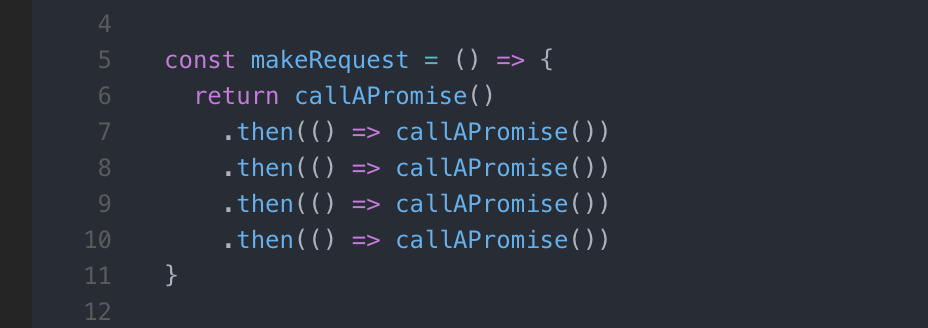
Try setting a breakpoint anywhere here
2. If you set a breakpoint inside a .then block and use debug shortcuts like step-over, the debugger will not move to the the following .then because it only “steps” through synchronous code.
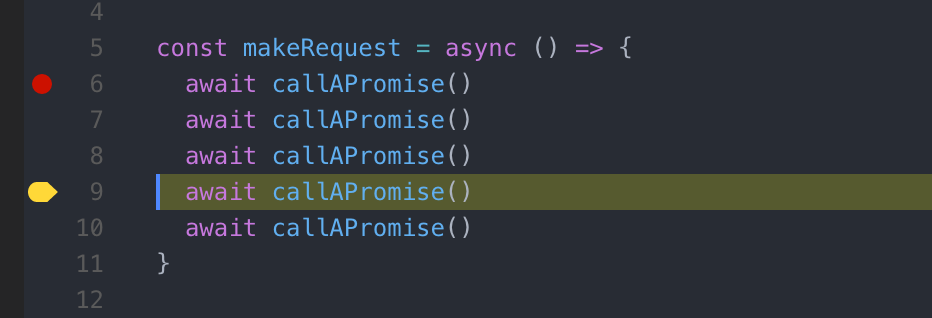
With async/await you don’t need arrow functions as much, and you can step through await calls exactly as if they were normal synchronous calls.
In Conclusion
Async/await is one of the most revolutionary features that have been added to JavaScript in the past few years. It makes you realize what a syntactical mess promises are, and provides an intuitive replacement.
Concerns
Some valid skepticism you might have about using this feature
- It makes asynchronous code less obvious: Our eyes learned to spot asynchronous code whenever we see a callback or a
.then, it will take a few weeks for your eyes to adjust to the new signs, but C# had this feature for years and people who are familiar with it know it’s worth this minor, temporary inconvenience. - Node 7 is not an LTS release: Yes, but node 8 is coming next month, and migrating you codebase to the new version will most likely take little to no effort. [UPDATE]: Node 8 LTS is now out.
【转】6 Reasons Why JavaScript’s Async/Await Blows Promises Away (Tutorial)的更多相关文章
- [转] 理解 JavaScript 的 async/await
[From] https://segmentfault.com/a/1190000007535316 边城 2016年11月19日发布 随着 Node 7 的发布,越来越多的人开始研究据说是 ...
- 【前端_js】理解 JavaScript 的 async/await
async 和 await 在干什么 任意一个名称都是有意义的,先从字面意思来理解.async 是“异步”的简写,而 await 可以认为是 async wait 的简写.所以应该很好理解 async ...
- 理解 JavaScript 的 async/await
随着 Node 7 的发布,越来越多的人开始研究据说是异步编程终级解决方案的 async/await.我第一次看到这组关键字并不是在 JavaScript 语言里,而是在 c# 5.0 的语法中.C# ...
- [转] Understanding JavaScript’s async await
PS:Promise的用处是异步调用,这个对象使用的时候,call then函数,传一个处理函数进去,处理异步调用后的结果 Promise<Action>这样的对象呢,异步调用后的结果是一 ...
- JavaScript 的 Async\/Await 完胜 Promise 的六
参考:http://www.10tiao.com/html/558/201705/2650964601/1.html Node 现在从版本 7.6 开始就支持 async/await 了. 简介: A ...
- 深入理解理解 JavaScript 的 async/await
原文地址:https://segmentfault.com/a/1190000007535316,首先感谢原文作者对该知识的总结与分享.本文是在自己理解的基础上略作修改所写,主要为了加深对该知识点的理 ...
- JavaScript 的 async/await
随着 Node 7 的发布,越来越多的人开始研究据说是异步编程终级解决方案的 async/await. 异步编程的最高境界,就是根本不用关心它是不是异步. async 函数就是隧道尽头的亮光,很多人认 ...
- JavaScript 利用 async await 实现 sleep 效果
const sleep = (timeountMS) => new Promise((resolve) => { setTimeout(resolve, timeountMS); }); ...
- Async/Await替代Promise的6个理由
译者按: Node.js的异步编程方式有效提高了应用性能:然而回调地狱却让人望而生畏,Promise让我们告别回调函数,写出更优雅的异步代码:在实践过程中,却发现Promise并不完美:技术进步是无止 ...
随机推荐
- 2017 计蒜之道 初赛 第五场 C. UCloud 的安全秘钥(中等)
暴力. $O(m*n)$的算法可以通过此题,每次询问$O(m)$扫$S$数组,统计不同数字的个数,每次移动最多只会变化两个数字,如果不同数字个数为$0$,那么答案加$1$. #include < ...
- CodeForces 803D Magazine Ad
二分. 首先把字符串处理成一个数组,二分答案,判断一下即可. #include <cstdio> #include <cmath> #include <set> # ...
- 前端使用express mock数据
项目中使用的是RESTFUL接口规范,项目框架用的是vue,项目开始时,调研了几个比较有名的mock数据的插件:比如webpack的中间件api-mock,json-server,mockjs,还有e ...
- MySQL 5.7 安装完成后,首次登陆的几个问题
Server:CentOS 7.0 MySQL : 5.7.20 MySQL Community Server (GPL) 1.首次登陆后修改密码: 根据安装时的选择不同,有mysqld_safe用m ...
- hdu 1158 dp Employment Planning
Employment Planning Time Limit:1000MS Memory Limit:32768KB 64bit IO Format:%I64d & %I64u ...
- Elasticsearch 删除索引下的所有数据
下面是head中操作的截图 #清空索引 POST quality_control/my_type/_delete_by_query?refresh&slices=5&pretty { ...
- java 继承 String类
韩梦飞沙 韩亚飞 313134555@qq.com yue31313 han_meng_fei_sha String 类 是 final修饰 , 是不能 继承的.
- 2017-2018-1 JAVA实验站 冲刺 day05
2017-2018-1 JAVA实验站 冲刺 day05 各个成员今日完成的任务 小组成员 今日工作 完成进度 张韵琪 进行工作总结 100% 齐力锋 找按钮音乐 100% 张浩林 写博客 100% ...
- 【BZOJ】1042: [HAOI2008]硬币购物
1042: [HAOI2008]硬币购物 Time Limit: 10 Sec Memory Limit: 162 MBSubmit: 3307 Solved: 2075[Submit][Stat ...
- bzoj1977 次小生成树
Description 小 C 最近学了很多最小生成树的算法,Prim 算法.Kurskal 算法.消圈算法等等. 正当小 C 洋洋得意之时,小 P 又来泼小 C 冷水了.小 P 说,让小 C 求出一 ...