
Stanford机器学习笔记-5.神经网络Neural Networks (part two)
5 Neural Networks (part two)
content:
5 Neural Networks (part two)
5.1 cost function
5.2 Back Propagation
5.3 神经网络总结
接上一篇4. Neural Networks (part one).本文将先定义神经网络的代价函数,然后介绍逆向传播(Back Propagation: BP)算法,它能有效求解代价函数对连接权重的偏导,最后对训练神经网络的过程进行总结。
5.1 cost function
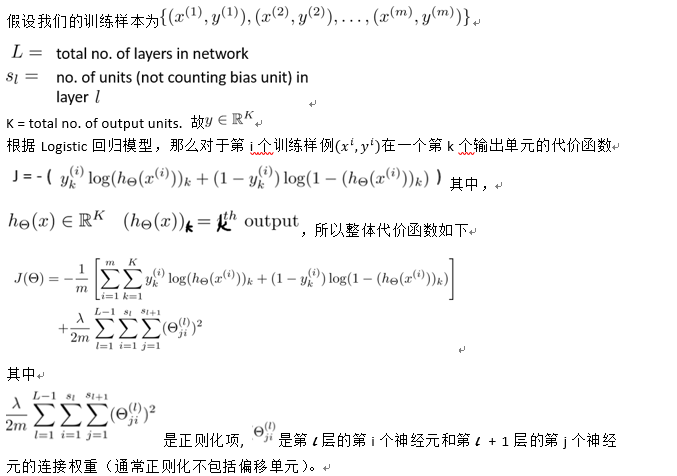
(注:正则化相关内容参见3.Bayesian statistics and Regularization)
5.2 Back Propagation
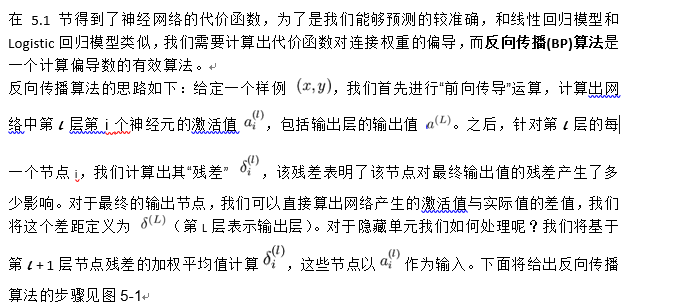
(详细推导过程参见反向传播算法,以及李宏毅的机器学习课程:youtube,B站)。

图5-1 BP算法步骤
在实现反向传播算法时,有如下几个需要注意的地方。
- 需要对所有的连接权重(包括偏移单元)初始化为接近0但不全等于0的随机数。如果所有参数都用相同的值作为初始值,那么所有隐藏层单元最终会得到与输入值有关的、相同的函数(也就是说,所有神经元的激活值都会取相同的值,对于任何输入x 都会有:
 )。随机初始化的目的是使对称失效。具体地,我们可以如图5-2一样随机初始化。(matlab实现见后文代码1)
 - 如果实现的BP算法计算出的梯度(偏导数)是错误的,那么用该模型来预测新的值肯定是不科学的。所以,我们应该在应用之前就判断BP算法是否正确。具体的,可以通过数值的方法(如图5-3所示的)计算出较精确的偏导,然后再和BP算法计算出来的进行比较,若两者相差在正常的误差范围内,则BP算法计算出的应该是比较正确的,否则说明算法实现有误。注意在检查完后,在真正训练模型时不应该再运行数值计算偏导的方法,否则将会运行很慢。(matlab实现见后文代码2)
- 用matlab实现时要注意matlab的函数参数不能为矩阵,而连接权重为矩阵,所以在传递初始化连接权重前先将其向量化,再用reshape函数恢复。(见后文代码3)
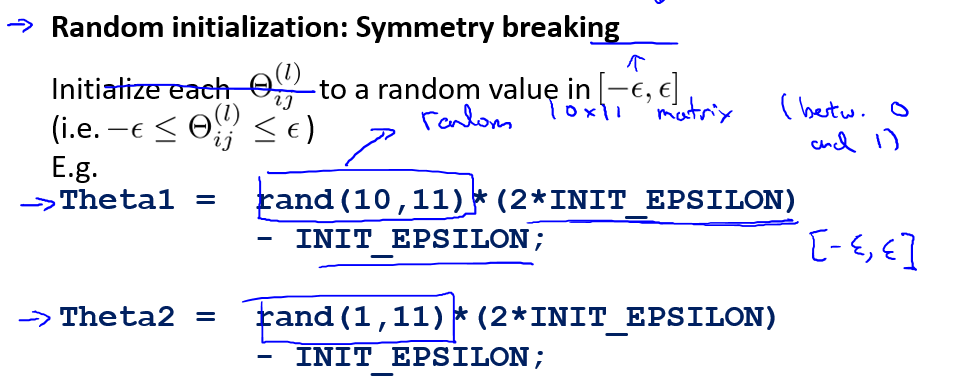
图5-2 随机初始化连接权重
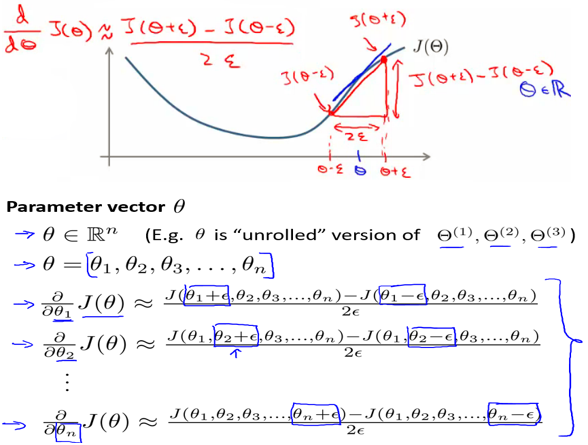
图5-3 数值方法求代价函数偏导的近似值
5.3 神经网络总结
第一步,设计神经网络结构。
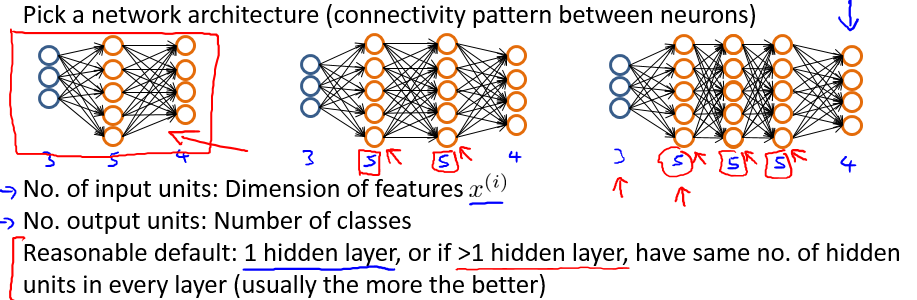
隐藏层单元个数通常都是不确定的。
一般选取神经网络隐藏层单元个数的几个经验公式如下:
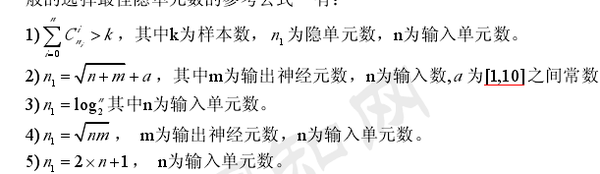
参考https://www.zhihu.com/question/46530834
此外,MNIST手写数字识别中给出了以不同的神经网络结构训练的结果,供参考
第二步,实现正向传播(FP)和反向传播算法,这一步包括如下的子步骤。

第三步,用数值方法检查求偏导的正确性

第四步,用梯度下降法或更先进的优化算法求使得代价函数最小的连接权重

在第四步中,由于代价函数是非凸(non-convex)函数,所以在优化过程中可能陷入局部最优值,但不一定比全局最优差很多(如图5-4),在实际应用中通常不是大问题。也会有一些启发式的算法(如模拟退火算法,遗传算法等)来帮助跳出局部最优。
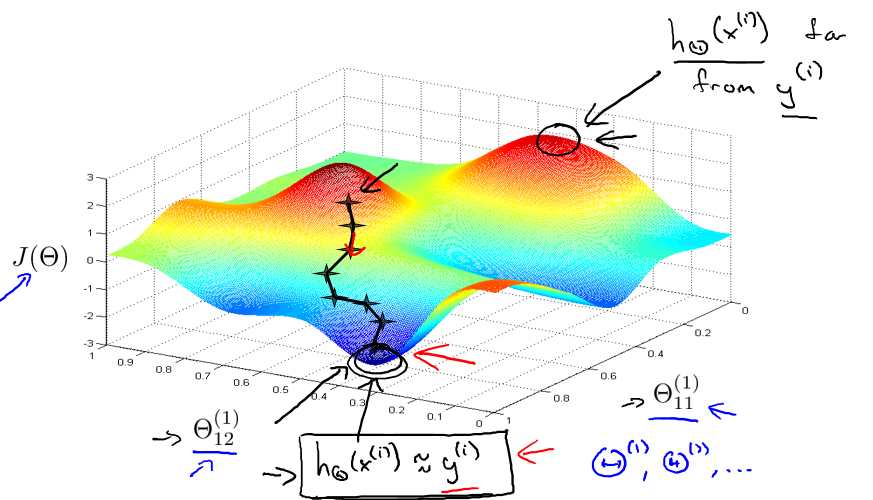
图5-4 陷入局部最优(不一定比全局最优差很多)
代码1:随机初始化连接权重
function W = randInitializeWeights(L_in, L_out)

%RANDINITIALIZEWEIGHTS Randomly initialize the weights of a layer with L_in

%incoming connections and L_out outgoing connections

%   W = RANDINITIALIZEWEIGHTS(L_in, L_out) randomly initializes the weights

%   of a layer with L_in incoming connections and L_out outgoing

%   connections.

%

%   Note that W should be set to a matrix of size(L_out,  + L_in) as

%   the column row of W handles the "bias" terms

%

W = zeros(L_out,  + L_in);

% Instructions: Initialize W randomly so that we break the symmetry while

%               training the neural network.

%

% Note: The first row of W corresponds to the parameters for the bias units

%

epsilon_init = sqrt() / (sqrt(L_out+L_in));

W = rand(L_out,  + L_in) *  * epsilon_init - epsilon_init;

end
代码2:用数值方法求代价函数对连接权重偏导的近似值
function numgrad = computeNumericalGradient(J, theta)

%COMPUTENUMERICALGRADIENT Computes the gradient using "finite differences"

%and gives us a numerical estimate of the gradient.

%   numgrad = COMPUTENUMERICALGRADIENT(J, theta) computes the numerical

%   gradient of the function J around theta. Calling y = J(theta) should

%   return the function value at theta.

% Notes: The following code implements numerical gradient checking, and

%        returns the numerical gradient.It sets numgrad(i) to (a numerical

%        approximation of) the partial derivative of J with respect to the

%        i-th input argument, evaluated at theta. (i.e., numgrad(i) should

%        be the (approximately) the partial derivative of J with respect

%        to theta(i).)

%

numgrad = zeros(size(theta));

perturb = zeros(size(theta));

e = 1e-4;

for p = 1:numel(theta)

    % Set perturbation vector

    perturb(p) = e;

    % Compute Numerical Gradient

    numgrad(p) = ( J(theta + perturb) - J(theta - perturb)) / (2*e);

    perturb(p) = 0;

end

end
代码3:应用FP和BP算法实现计算隐藏层为1层的神经网络的代价函数以及其对连接权重的偏导数
function [J grad] = nnCostFunction(nn_params, ...

                                   input_layer_size, ...

                                   hidden_layer_size, ...

                                   num_labels, ...

                                   X, y, lambda)

%NNCOSTFUNCTION Implements the neural network cost function for a two layer

%neural network which performs classification

%   [J grad] = NNCOSTFUNCTON(nn_params, hidden_layer_size, num_labels, ...

%   X, y, lambda) computes the cost and gradient of the neural network. The

%   parameters for the neural network are "unrolled" into the vector

%   nn_params and need to be converted back into the weight matrices.

%

%   The returned parameter grad should be a "unrolled" vector of the

%   partial derivatives of the neural network.

%

% Reshape nn_params back into the parameters Theta1 and Theta2, the weight matrices

% for our 2 layer neural network:Theta1: 1->2; Theta2: 2->3

Theta1 = reshape(nn_params(1:hidden_layer_size * (input_layer_size + 1)), ...

                 hidden_layer_size, (input_layer_size + 1));

Theta2 = reshape(nn_params((1 + (hidden_layer_size * (input_layer_size + 1))):end), ...

                 num_labels, (hidden_layer_size + 1));

% Setup some useful variables

m = size(X, 1);

J = 0;

Theta1_grad = zeros(size(Theta1));

Theta2_grad = zeros(size(Theta2));

%         Note: The vector y passed into the function is a vector of labels

%               containing values from 1..K. You need to map this vector into a

%               binary vector of 1's and 0's to be used with the neural network

%               cost function.

for i = 1:m

    % compute activation by Forward Propagation

    a1 = [1; X(i,:)'];

    z2 = Theta1 * a1;

    a2 = [1; sigmoid(z2)];

    z3 = Theta2 * a2;

    h = sigmoid(z3);

    yy = zeros(num_labels,1);

    yy(y(i)) = 1;              % 训练集的真实值yy

    J = J + sum(-yy .* log(h) - (1-yy) .* log(1-h));

    % Back Propagation

    delta3 = h - yy;

    delta2 = (Theta2(:,2:end)' * delta3) .* sigmoidGradient(z2); %注意要除去偏移单元的连接权重

    Theta2_grad = Theta2_grad + delta3 * a2';

    Theta1_grad = Theta1_grad + delta2 * a1';

end

J = J / m + lambda * (sum(sum(Theta1(:,2:end) .^ 2)) + sum(sum(Theta2(:,2:end) .^ 2))) / (2*m);

Theta2_grad = Theta2_grad / m;

Theta2_grad(:,2:end) = Theta2_grad(:,2:end) + lambda * Theta2(:,2:end) / m; % regularized nn

Theta1_grad = Theta1_grad / m;

Theta1_grad(:,2:end) = Theta1_grad(:,2:end) + lambda * Theta1(:,2:end) / m; % regularized nn

% Unroll gradients

grad = [Theta1_grad(:) ; Theta2_grad(:)];

end
Stanford机器学习笔记-5.神经网络Neural Networks (part two)的更多相关文章
- Stanford机器学习笔记-4. 神经网络Neural Networks (part one)
4. Neural Networks (part one) Content: 4. Neural Networks (part one) 4.1 Non-linear Classification. ...
- Stanford机器学习---第五讲. 神经网络的学习 Neural Networks learning
原文 http://blog.csdn.net/abcjennifer/article/details/7758797 本栏目(Machine learning)包括单参数的线性回归.多参数的线性回归 ...
- 论文笔记:Diffusion-Convolutional Neural Networks (传播-卷积神经网络)
Diffusion-Convolutional Neural Networks (传播-卷积神经网络)2018-04-09 21:59:02 1. Abstract: 我们提出传播-卷积神经网络(DC ...
- 【论文笔记】Progressive Neural Networks 渐进式神经网络
Progressive NN Progressive NN是第一篇我看到的deepmind做这个问题的.思路就是说我不能忘记第一个任务的网络,同时又能使用第一个任务的网络来做第二个任务. 为了不忘记之 ...
- 论文笔记(1)-Dropout-Improving neural networks by preventing co-adaptation of feature detectors
Improving neural networks by preventing co-adaptation of feature detectors 是Hinton在2012年6月份发表的,从这篇文章 ...
- 斯坦福机器学习视频笔记 Week4 & Week5 神经网络 Neural Networks
神经网络是一种受大脑工作原理启发的模式. 它在许多应用中广泛使用:当您的手机解释并理解您的语音命令时,很可能是神经网络正在帮助理解您的语音; 当您兑现支票时,自动读取数字的机器也使用神经网络. Non ...
- Coursera 机器学习 第5章 Neural Networks: Learning 学习笔记
5.1节 Cost Function神经网络的代价函数. 上图回顾神经网络中的一些概念: L 神经网络的总层数. sl 第l层的单元数量(不包括偏差单元). 2类分类问题:二元分类和多元分类. 上 ...
- 机器学习(六)--------神经网络(Neural Networks)
无论是线性回归还是逻辑回归都有这样一个缺点,即:当特征太多时, 计算的负荷会非常大. 比如识别图像,是否是一辆汽车,可能就需要判断太多像素. 这时候就需要神经网络. 神经网络是模拟人类大脑的神经网络, ...
- 【原】Coursera—Andrew Ng机器学习—Week 4 习题—Neural Networks 神经网络
[1] Answer:C [2] Answer:D 第二层要输出四个元素a1 a2 a3 a4.输入x有两个,加一个x0是三个.所以是4 * 3 [3] Answer:C [4] Answer:C [ ...
随机推荐
- Web 开发最有用的50款 jQuery 插件集锦——《图片特效篇》
<Web 开发最有用的50款 jQuery 插件集锦>系列文章向大家分享最具创新的50款 jQuery 插件,这些插件分成以下类别:网页布局插件,导航插件,表格插件,滑块和转盘插件,图表插 ...
- 唯美!分享8款响应式的 WordPress 餐厅主题
您是否拥有一个餐厅,酒吧,咖啡馆,小酒馆,比萨饼店?如果答案是肯定的,请确保您在网上也提供服务.为了使您的工作更轻松,我们选择了一些新的和独特的餐厅主题,覆盖了范围很广的食品企业.这些主题提供了很多很 ...
- jquery messagetip信息语提示控件
编写原因: 作为提示框,jquery有个messagebox的控件,也就是弹出的提示框.但这个控件如果不是用在需要确认的时候,单单警告提示.消息提示.失败提示时,用户还需要去点下确认,有时这操作还是挺 ...
- [Android]竖直滑动选择器WheelView的实现
以下内容为原创,转载请注明: 来自天天博客:http://www.cnblogs.com/tiantianbyconan/p/3819304.html 公司项目中有这么一个需求,所以需要自己实现下.效 ...
- 在GitHub上管理项目
在GitHub上管理项目 新建repository 本地目录下,在命令行里新建一个代码仓库(repository) 里面只有一个README.md 命令如下: touch README.md git ...
- 安卓开发_慕课网_Fragment实现Tab(App主界面)
学习内容来自“慕课网” 这里用Fragment来实现APP主界面 思路: 底部横向排列4个LinearLayout,每个LinearLayout包含一个图片按钮和一个文字 1.默认显示第一个功能(微信 ...
- 免费开发者证书真机调试App ID失效问题:"Unable to add App ID because the '10' App ID limit in '7' days has been exceeded."解决方案(5月5号)
免费开发者证书真机调试App ID失效问题:"Unable to add App ID because the '10' App ID limit in '7' days has been ...
- class&meta class
http://chun.tips 当我们发送一个消息给一个NSObject对象时,这条消息会在对象的类的方法列表里查找当我们发送一个消息给一个类时,这条消息会在类的Meta Class的方法列表里查找 ...
- nutz的json视图
2.3. json视图 返回json视图有两种方法: @Ok("json") 与@Ok(“raw:json”) 2.3.1. @Ok("json") (1) ...
- 面试问题4:C语言预处理包括哪些
问题描述:C语言 预处理包括哪些操作 C语言的三种预处理包括:宏定义(#define).文件包含(#include).条件编译(#if.#else.#endif). 对于宏定义的介绍: 宏定义必须写在 ...