
Tree - AdaBoost with sklearn source code
In the previous post we addressed some issue of decision tree, including instability, lack of smoothness, sensitivity to data, and etc.
One solution is Boosting Method. In simple words Boosting combines multiple weak learners to get a powerful prediction, where the weak learner are usually shallow tree.
Before we go to the popularly used boosting algorithm like GBM(GBRT) and xgBoost, let's start with one of the earliest Boosting Method - AdaBoost.
AdaBoost Evolution
Early AdaBoost focus on binary classification only. And then it extend to regression problem and multi-class classification. Let's go through them one by one.
Discrete AdaBoost (Freund & Schapire 1996)
A concise description of Discrete AdaBoost is that at each step a base binary classifier (\(f_m(x) \in \{-1,1 \}\)) is trained against a weighted training sample. The weight of misclassified sample will increase, and then another classifier will be trained with updated weight. The final result will be a weighted sum of all base classifiers.
- assign equal weight to all sample \(w_i = 1/N\)
- Repeat below m times
A. Fit classifier \(f_m(x) \in \{-1,1\}\), by minimizing a weighted loss function
B. Compute weighted misclassification rate \(e_m = E_w[I(y\ne f_m(x))] = \sum_i{w_i \cdot I(y\ne f_m(x)) }\)
C. Compute classifier weight \(c_m = log((1-e_m)/e_m)\)
D. Update sample weight \(w_i = w_i * exp(c_m \cdot I(y\ne f_m(x))\)
E. Normalize weight so that \(\sum_i{w_i} = 1\)
- Output the classifier \(sign[\sum_{i=1}^M c_m f_m(x)]\)
A few intuitive finding of the above algorithm:
- The bigger the error for the base learner, the lower weight it will have.
- If the weighted miscalssification rate is higher than 50%, which is worse then random guess, then this base learner will get negative weight.
- The smaller the error for the base learner, the weight of misclassified sample will increase more.
I guess most of people may be curious why the weight is updated in above way, and why a sequence of weak learner can be better than a single classifier. We will get to this magic later.
Real AdaBoost (Schapire & Singer 1998)
Above discrete AdaBoost is limited to binary classification. A more generalized AdaBoost called Real AdaBoost is developed later, where probability (\(P_m(x) \in [0,1])\)) is trained at each step, like logistics regression.
With some modification on discrete algo, we get below:
- Assign equal weight to all sample \(w_i = 1/N\)
- Repeat below m times
A. Fit classier \(p_m(x) \in [-1,1]\), by minimizing a weighted loss function
B. Compute \(f_m(x) = \frac{1}{2}log(p_m(x)/(1-p_m(x)) )\)
C. Update weight: \(w_i = w_i * exp(-y_if_m(x_i) )\)
D. Normalize weight so that \(\sum_i{w_i} = 1\)
- Output the classifier \(sign[\sum_{i=1}^M f_m(x)]\)
Discrete Multi-class AdaBoost (J. Zhu, et al 2009)
Later the AdaBoost algorithm is further extended to multi-class classification. This is also the algorithm currently used in sklearn. For a k-class classification problem, the algo is below
- assign equal weight to all sample \(w_i = 1/N\)
- Repeat below m times
A. Fit classifier \(f_m(x)\) by minimizing a weighted loss function
B. Compute weighted misclassification rate \(e_m = E_w[I(y\ne f_m(x))] = \sum_i{w_i \cdot I(y\ne f_m(x)) }\)
C. Compute classifier weight \(c_m = log((1-e_m)/e_m) + log(K-1)\)
D. Update sample weight \(w_i = w_i * exp(c_m \cdot I(y\ne f_m(x))\)
E. Normalize weight so that \(\sum_i{w_i} = 1\)
- Output the classifier \(argmax{\sum_{i=1}^M c_m \cdot I(f_m(x)=k)}\)
Here we can see when k=2, the multi-class AdaBoost will be the same as original AdaBoost. The biggest difference lies in weight calculation. For original AdaBoost, there is a stopping threshold that each weak classifier weight must be greater >0, meaning misclassification rate should be smaller than 50% (purely random).
However for multi-class, we allow misclassification rate to be bigger than 50%, in other words we tends to overweight misclassified sample more than 2-class AdaBoost.
Why AdaBoost work? (Friedman et al. 2000)
Noe let's try to solve your confusion:
- Why train weak learner additively?
- Why the sample weight is updated in this way?
- Why the final ensemble is done in this way?
Friedman reveals the mystery in 2000, where he shows AdaBoost is a forward stage-wise additive model, by minimizing exponential loss . 2 main assumptions here:
\(F(x) = \sum_{m=1}^Mc_m f_m(x)\) AdaBoost can be decomposed into a weighted additive function, where new basis function is sequentially added to the expansion without adjusting the existing term.
\(J(F) = E(e^{(-yF(x))})\) AdaBoost approximate the exponential loss iteratively.
Algorithm reproduction
Now let's work the magic and reproduce the discrete AdaBoost algorithm.
Based on current \(F(x)\) estimator for \(y \in \{-1,1\}\), we additively compute \(f(x) \in \{-1,1\}\) by minimizing \(J(F(x) + cf(x))\)
J(F(x) +cf(x)) &= E(exp{(-y(F(x) + cf(x)) }) \\
&= \sum_{i=1}^N{w_i *exp{-ycf(x)}}\\
&= \sum_{y=f(x)} w_i \cdot e^{-c} + \sum_{y \neq f(x)} w_i \cdot e^{c} \\
&= \sum_{i=1}^{N} w_i \cdot e^{-c} + \sum_{y \neq f(x)} w_i \cdot (e^{c} - e^{-c} ) \\
& = e^{-c} + \sum_{y \neq f(x)} w_i \cdot (e^{c} - e^{-c} )\\
& = e^{-c} + (e^{c} - e^{-c} ) \sum w_i \cdot I(y \neq f(x))
\end{align}
\]
Therefore
\]
So we minimize weighted misclassification rate to get base learner at each iteration, exactly the same as step 2(A) in AdaBoost, where sample weight is the current exponential error.
After solving misclassification rate \(e_m\), we further solve base learner coefficient c
& \text{min }{ e^{-c} + (e^{c} - e^{-c}) \cdot e_m }\\
& \text{where c} =\frac{1}{2} \log{\frac{1-e_m}{e_m} = \frac{1}{2} c_m }
\end{align}
\]
Constant 0.5 is same for all base learner. Ignoring it, we will get the same coefficient as step 2(C) in AdaBoost.
Last let's see how the weighted is update
w'_i & = e^{ -y(F(x)+cf(x) )} \\
& = w_i \cdot \exp{(2I(y \neq f(x)-1)\cdot c} \\
& = w_i \cdot \exp{(I(y \neq f(x)) \cdot c_m)} * constant
\end{align}
\]
Since the weight is always normalized, ignoring constant we will get the same weight updating formula as step 2(D) in AdaBoost.
Boom! So far we already proved that AdaBoost is approximating an exponential error with a forward additive model. Next let's dig even deeper, what exactly is exponential loss solving?
Algorithm Insight
Let's recall the loss function for classification problem that we discussed in previous tree model. We have misclassification rate, Gini Index and cross-entropy (negative log-likelihood ). Then what is exponential loss solving?
Idea 1. Exponential loss can be approximated via AdaBoost
Actually when AdaBoost is first invented, author didn't think in terms of exponential loss, which is proved by Freud 5 years later.
Therefore first usage of exponential loss is that it can be approximated by additive model. By iteratively training weak classifier and re-weighting sample with misclassification rate, we can approximate exponential loss.
Idea 2. Exponential loss solves for Logit function
Let's use the binary classification problem as an example to solve the loss function. Here \(y \in \{-1,1\}\) and \(sign(f(x))\) is the binary prediction.
E(\exp{-yf(x)} | X ) &= e^{-f(x)}E(I(y=1)|x) + e^{f(x)} E(y=-1|x)\\
& = e^{-f(x)}P(y=1|x) + e^{f(x)}P(y=-1|x)\\
\frac{\partial E(\exp{-yf(x)} | X )}{\partial f(x)} & = - e^{-f(x)}P(y=1|x) + e^{f(x)}(1-P) \\
f(x) &= \frac{1}{2}\log{\frac{p}{1-p}}
\end{align}
\]
Does \(f(x)\) looks familiar to you? Yes it is the half Logit function (log-odds)! In logistics regression we use above formula to map \(x \in R \to y \in \{0,1\}\)
Let's have a brief review of logistic regression.
when \(y \in \{0,1\}\)
P = P(y= 1|x) &= \frac{1}{1+e^{-f(x)}} \\
\text{ And }f(x) & = \log{\frac{p}{1-p}}
\end{align}
\]
when \(y \in \{-1,1\}\), modification is needed
P = P(y=1|x) &= \frac{1}{1+e^{-yf(x)}}
\end{align}
\]
The cross-entropy (negative log-likelihood) is defined below.
L(Y,p(x)) &= - E(I(y=1)\log{p(x)} +I(y=-1)\log{1-p(x)} )\\
&= E(\log{(1+ \exp{-yf(x)} )})
\end{align}
\]
Boom! Logistics Regression actually is optimizing a similar loss function, compared to exponential Loss.
Idea 3. Exponentional loss is a differentiable representation of misclassificaton error
In both exponential loss and negative log-likelihood, we can see loss is monotone decreasing of \(yf(x)\) (margin), which is similar to residual \(y-f(x)\) in regression problem. Decision boundary for \(yf(x)\) is 0, where \(yf(x)>0\) is correctly classified.
Compared to misclassifcation error \(I(yf(x)<0)\), the advantage of \(yf(x)\) is that even if misclassification rate is 0, the model training will keep pushing the sample to be more distinguishly separated, meaning f(x) may have bigger absolute value.
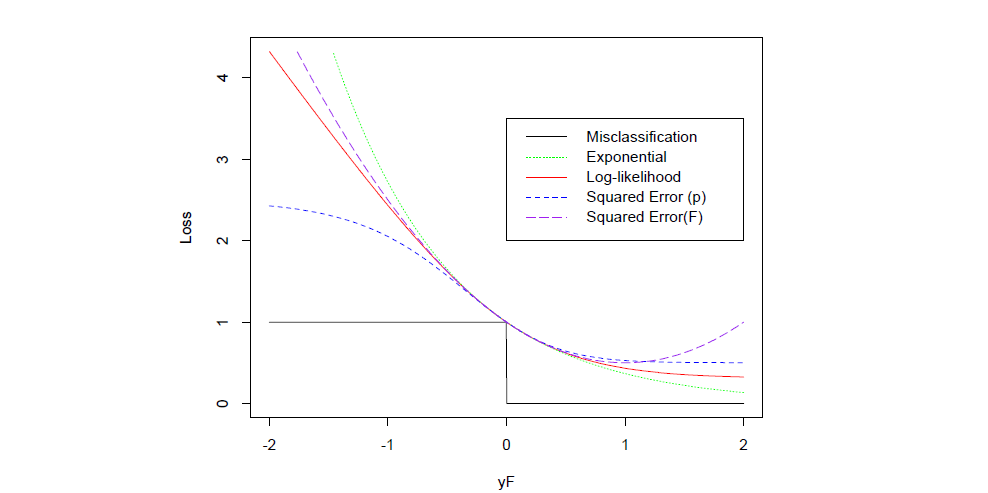
Above is a comparison between different loss function (scaled to cross(0,1)). A few take away here
- Compare with Squared Error (F), exponential loss is monotonically decreasing with \(yf(x)\), it doesn't penalize sample that are too correctly classified.
- Both exponential loss and log-likelihood penalize large negative margin \(yf(x)\) - very wrong prediction
- Exponential loss penalize negative margin even more, makes it sensitive to noise, such as mislabeled sample and outliers.
For more detailed discussion of better loss function, we will further discussion this in the following Gradient Boosting Machine, a more powerful boosting algorithm.
AdaBoost sklearn source code
Now let's go through sklearn source code and see how AdaBoost is implemented. Some modification is made to simplify the code here.
Boosting
n_estimators defines maximum of iteration. It is the maximum number of base learner in the additive model.
for iboost in range(self.n_estimators):

    # train base learner

    sample_weight, estimator_weight, estimator_error = self._boost(iboost,X, y, sample_weight, random_state)

    # store base learner error and coefficient

    self.estimator_weights_[iboost] = estimator_weight

    self.estimator_errors_[iboost] = estimator_error

    # weight normalization

    sample_weight_sum = np.sum(sample_weight)

    sample_weight /= sample_weight_sum
Base Learner
1. AdaBoostClassifier
By default AdaBoostClassifier will use DecisionTreeClassifier as base learner. For details of classification tree, you can go to my previous post - Tree - Overview of Decision Tree with sklearn source code
Sklearn support both multi-class real and discrete AdaBoost, where algorithm = 'SAMME.R' stands for real, and 'SAMME' is discrete. Here we take discrete one as example.
def _boost_discrete(self, iboost, X, y, sample_weight, random_state):

	estimator = self._make_estimator(random_state=random_state)

	estimator.fit(X, y, sample_weight=sample_weight)

	y_predict = estimator.predict(X)  # predict sample class

	incorrect = y_predict != y # get misclassified sample

	estimator_error = np.mean(np.average(incorrect, weights=sample_weight, axis=0)) # weighted misclassification rate

	estimator_weight = self.learning_rate * (

		np.log((1. - estimator_error) / estimator_error) +

		np.log(n_classes - 1.)) # coefficient of base learner in final ensemble

	sample_weight *= np.exp(estimator_weight * incorrect *

							((sample_weight > 0) |

							 (estimator_weight < 0))) # update sample weight

	return sample_weight, estimator_weight, estimator_error
2. AdaBoostRegressor
By default DecisionTreeRegressor is used as base learner for regression. Different loss functions are used: {'linear', 'square', 'exponential'}
In this post we mainly focus on classification problem. I will cover more details about regression in other ensemble algorithm.
def _boost(self, iboost, X, y, sample_weight, random_state):

	estimator = self._make_estimator(random_state=random_state)

	estimator.fit(X[bootstrap_idx], y[bootstrap_idx]) #bootstrap to create weighted sample

	y_predict = estimator.predict(X)

	error_vect = np.abs(y_predict - y)

	error_max = error_vect.max()

	if error_max != 0.:

		error_vect /= error_max # scale error by max absolute error

	if self.loss == 'square':

		error_vect **= 2

	elif self.loss == 'exponential':

		error_vect = 1. - np.exp(- error_vect)

	estimator_error = (sample_weight * error_vect).sum() # weighted average loss

    beta = estimator_error / (1. - estimator_error) #

	estimator_weight = self.learning_rate * np.log(1. / beta) # estimator coefficient

	sample_weight *= np.power(

		beta, (1. - error_vect) * self.learning_rate) # update sample with error

	return sample_weight, estimator_weight, estimator_error
Ensemble
When the model finish training, we ensemble all estimators to yield final prediction.
def decision_function(self, X):

	X = self._validate_X_predict(X)

	n_classes = self.n_classes_

	classes = self.classes_[:, np.newaxis]

	pred = None

	if self.algorithm == 'SAMME.R':

		pred = sum(_samme_proba(estimator, n_classes, X)

				   for estimator in self.estimators_) # Real doesn't coefficient

	else:

		pred = sum((estimator.predict(X) == classes).T * w

				   for estimator, w in zip(self.estimators_,

										   self.estimator_weights_)) # weighted class label

	pred /= self.estimator_weights_.sum() #normalize by weight

	if n_classes == 2:

		pred[:, 0] *= -1

		return pred.sum(axis=1)

	return pred
To be continued.
Reference
- Friedman, J., Hastie, T., and Tibshirani, R. (2000).
Special invited paper. additive logistic regression: A statistical
view of boosting - Freund, Y., Schapire, R. E., et al. (1996).
Experiments with a new boosting algorithm. - Freund, Y. and Schapire, R. E. (1997).
A decision-theoretic generalization of on-line learning and an
application to boosting. - Freund, Y. and Schapire, R. E. (1995). A desicion-theoretic generalization of online learning and an application to boosting, pages 23¨C37.
- T. Hastie, R. Tibshirani and J. Friedman. (2009). “Elements of Statistical Learning”, Springer.
- Bishop, Pattern Recognition and Machine Learning 2006
- scikit-learn tutorial http://scikit-learn.org/stable/modules/generated/sklearn.ensemble.AdaBoostClassifier.html
Tree - AdaBoost with sklearn source code的更多相关文章
- Tree - Decision Tree with sklearn source code
After talking about Information theory, now let's come to one of its application - Decision Tree! No ...
- Tree - Gradient Boosting Machine with sklearn source code
This is the second post in Boosting algorithm. In the previous post, we go through the earliest Boos ...
- 用source code编译安装Xdebug
1. Unpack the tarball: tar -xzf xdebug-2.2.x.tgz. Note that you do not need to unpack the tarball i ...
- XML.ObjTree -- XML source code from/to JavaScript object like E4X
转载于:http://www.kawa.net/works/js/xml/objtree-try-e.html // ========================================= ...
- How to Build MySQL from Source Code on Windows & compile MySQL on win7+vs2010
Not counting obtaining the source code, and once you have the prerequisites satisfied, [Windows] use ...
- Troubles in Building Android Source Code
Some Troubles or problems you may encounter while you setup the Android source code build environmen ...
- Tips for newbie to read source code
This post is first posted on my WeChat public account: GeekArtT Reading source code is always one bi ...
- 编程等宽字体Source Code Pro(转)
Source Code Pro - 最佳的免费编程字体之一!来自 Adobe 公司的开源等宽字体下载 每一位程序员都有一套自己喜爱的代码编辑器与编程字体,譬如我们之前就推荐过一款"神 ...
- How to build the Robotics Library from source code on Windows
The Robotics Library is an open source C++ library for robot kinematics, motion planning and control ...
随机推荐
- Android学习路线总结,绝对干货(转)
转自:https://www.cnblogs.com/yishaochu/p/5436094.html 一.前言 不知不觉自己已经做了几年开发了,由记得刚出来工作的时候感觉自己能牛逼,现在回想起来感觉 ...
- Hadoop学习之路(十五)MapReduce的多Job串联和全局计数器
MapReduce 多 Job 串联 需求 一个稍复杂点的处理逻辑往往需要多个 MapReduce 程序串联处理,多 job 的串联可以借助 MapReduce 框架的 JobControl 实现 实 ...
- linux 的常用命令---------第一阶段
ls -a 列出所有的文件,包括以 . 开头的隐藏文件 ls -d 列出目录本身,并不包含目录中的文件 ls -h 人类易读 ls -h 长输出 man 帮助使用手册 ...
- 集合之保持compareTo和equals同步
在Java中我们常使用Comparable接口来实现排序,其中compareTo是实现该接口方法.我们知道compareTo返回0表示两个对象相等,返回正数表示大于,返回负数表示小于.同时我们也知道e ...
- CentOS中配置VNC Server
环境:CentOS 6.4 1.安装tigervnc-server及相关软件 首先检查系统中是否安装tigervnc-server安装包 rpm -qa tigervnc-server 如果没有就直接 ...
- CSU 1547: Rectangle (思维题加一点01背包)
1547: Rectangle Submit Page Summary Time Limit: 1 Sec Memory Limit: 256 Mb Submitted: ...
- 安装framework 4.6.2的时报错 “无法建立到信任根颁发机构的证书链”
解决方案: 1.下载证书:MicrosoftRootCertificateAuthority2011.cer 2.开始→运行→MMC 3.文件→添加删除管理单元 (Ctrl+M) 4.证书→计算机账户 ...
- linux查看日志文件内容命令(面试被常问到的问题)
tail -f test.log 你会看到屏幕不断有内容被打印出来. 这时候中断第一个进程Ctrl-C, linux 如何显示一个文件的某几行(中间几行) 从第3000行开始,显示1000行.即显示3 ...
- 在Linux中连接android设备
1.用usb线连接电脑和android设备,在命令行中输入lsusb可查看采用usb连接到电脑的设备 找到设备的vendor ID. 如上图: "Bus 002 Device 007: ID ...
- PhpStorm 回到上次编辑位置的快捷键
回到上次编辑位置 Ctrl + Alt + <- (向后) Ctrl + Alt + -> (向前) 这个快捷键有时和电脑桌面快捷键冲突.解决办法: win + D 回到电脑桌面,右键-& ...