
Joinpoint继承体系-笔记
Joinpoint继承层次图:
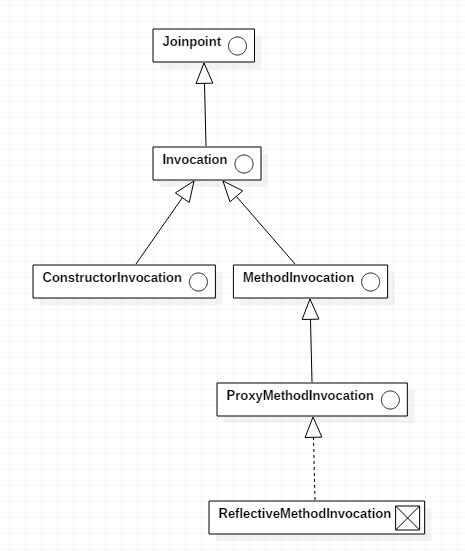
由上图可以知道的所有的接口的实现都在ReflectiveMethodInvocation这个类中。ConstructorInvocation接口只有一个方法,这个方法的实现好像是由ReflectMethodInvocation的getStaticPart()方法来实现的,具体请看源码。
现在把上面的接口和类的源码的看看,顺便做下笔记。
一、Joinpoint
这个接口表示一个一般的运行时连接点。一个运行时连接点是一个事件,这个事件发生在一个静态连接点(也就是在程序中的某一个位置)。例如:
接口的方法:
    /**

     * Proceed to the next interceptor in the chain.

     * <p>The implementation and the semantics of this method depends

     * on the actual joinpoint type (see the children interfaces).

     * @return see the children interfaces' proceed definition

     * @throws Throwable if the joinpoint throws an exception

     */

    Object proceed() throws Throwable;
开始拦截器链条中的下一个的拦截器。
    /**

     * Return the object that holds the current joinpoint's static part.

     * <p>For instance, the target object for an invocation.

     * @return the object (can be null if the accessible object is static)

     */

    Object getThis();
返回目标对象。
    /**

     * Return the static part of this joinpoint.

     * <p>The static part is an accessible object on which a chain of

     * interceptors are installed.

     */

    AccessibleObject getStaticPart();
返回连接点的静态部分,其实应该就是目标方法吧。(返回连接点的静态部分,静态部分就是的已经安装在拦截器链条上的可以访问的方法对象。)
二、Invocation
这个接口表示程序当中的一个调用。一个调用就是一个连接点而且可以被一个拦截器拦截。
这个接口只有一个方法:
/**

 * This interface represents an invocation in the program.

 *

 * <p>An invocation is a joinpoint and can be intercepted by an

 * interceptor.

 *

 * @author Rod Johnson

 */

public interface Invocation extends Joinpoint {

    /**

     * Get the arguments as an array object.

     * It is possible to change element values within this

     * array to change the arguments.

     * @return the argument of the invocation

     */

    Object[] getArguments();

}
方法返回的是目标方法的参数。如果目标方法是无参方法,那么会返回一个Object[] 类型的长度为0的数组。
三、MethodInvocation
/**

 * Description of an invocation to a method, given to an interceptor

 * upon method-call.

 *

 * <p>A method invocation is a joinpoint and can be intercepted by a

 * method interceptor.

 *

 * @author Rod Johnson

 * @see MethodInterceptor

 */

public interface MethodInvocation extends Invocation {

    /**

     * Get the method being called.

     * <p>This method is a frienly implementation of the

     * {@link Joinpoint#getStaticPart()} method (same result).

     * @return the method being called

     *///返回一个已经被调用的方法,其实是目标方法。

    Method getMethod();

}
getMethod()方法返回的是目标方法对应的Method对象。
四、ProxyMethodInvocation
这个接口扩展了MethodInvocation接口。
接口的方法:
    /**

     * Return the proxy that this method invocation was made through.

     * @return the original proxy object

     */

    Object getProxy();
返回原始的对象,也就是目标对象。
    /**

     * Create a clone of this object. If cloning is done before {@code proceed()}

     * is invoked on this object, {@code proceed()} can be invoked once per clone

     * to invoke the joinpoint (and the rest of the advice chain) more than once.

     * @return an invocable clone of this invocation.

     * {@code proceed()} can be called once per clone.

     */

    MethodInvocation invocableClone();
浅复制
    /**

     * Set the arguments to be used on subsequent invocations in the any advice

     * in this chain.

     * @param arguments the argument array

     */

    void setArguments(Object... arguments);
设置目标方法的参数值。
    /**

     * Add the specified user attribute with the given value to this invocation.

     * <p>Such attributes are not used within the AOP framework itself. They are

     * just kept as part of the invocation object, for use in special interceptors.

     * @param key the name of the attribute

     * @param value the value of the attribute, or {@code null} to reset it

     */

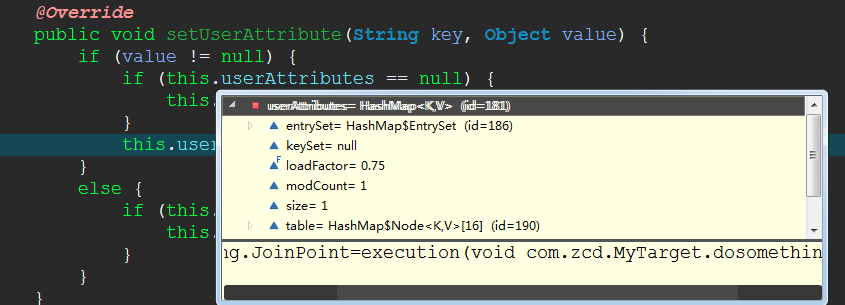
    void setUserAttribute(String key, Object value);
设置用户属性
五、ReflectiveMethodInvocation
使用反射类调用目标对象。子类可以覆盖invokeJoinpoint()方法。可以通过使用invocableClone()方法浅克隆一个调用(an invocation)来重复调用proceed()方法。而且还可以使用setUserAttribute(...)方法添加上自定义的属性到这个调用上。
这个类的属性:
    protected final Object proxy;//代理对象。

    protected final Object target;//目标对象。

    protected final Method method;//目标方法对应的Method对象。

    protected Object[] arguments;//目标方法参数。

    private final Class<?> targetClass;//目标对象的类型

    /**

     * Lazily initialized map of user-specific attributes for this invocation.

     */

    private Map<String, Object> userAttributes;

    /**

     * List of MethodInterceptor and InterceptorAndDynamicMethodMatcher

     * that need dynamic checks.

     */

    protected final List<?> interceptorsAndDynamicMethodMatchers;

    /**

     * Index from 0 of the current interceptor we're invoking.

     * -1 until we invoke: then the current interceptor.

     */

    private int currentInterceptorIndex = -1;
这个类的方法:
这个类方法也不少,挑重要的讲。
①、构造器。
    /**

     * Construct a new ReflectiveMethodInvocation with the given arguments.

     * @param proxy the proxy object that the invocation was made on

     * @param target the target object to invoke

     * @param method the method to invoke

     * @param arguments the arguments to invoke the method with

     * @param targetClass the target class, for MethodMatcher invocations

     * @param interceptorsAndDynamicMethodMatchers interceptors that should be applied,

     * along with any InterceptorAndDynamicMethodMatchers that need evaluation at runtime.

     * MethodMatchers included in this struct must already have been found to have matched

     * as far as was possibly statically. Passing an array might be about 10% faster,

     * but would complicate the code. And it would work only for static pointcuts.

     */

    protected ReflectiveMethodInvocation(

            Object proxy, Object target, Method method, Object[] arguments,

            Class<?> targetClass, List<Object> interceptorsAndDynamicMethodMatchers) {

        this.proxy = proxy;

        this.target = target;

        this.targetClass = targetClass;

        this.method = BridgeMethodResolver.findBridgedMethod(method);

        this.arguments = AopProxyUtils.adaptArgumentsIfNecessary(method, arguments);

        this.interceptorsAndDynamicMethodMatchers = interceptorsAndDynamicMethodMatchers;

    }
这个构造器在初始化对象时,设置了代理对象、目标对象、目标对象所属的类Calss对象、目标方法对应的Method对象、目标方法的参数、以及MethodInterceptor和InterceptorAndDynamicMethodMatcher组成的链条。
②、这是方法最重要。不管是通知方法还是目标方法,都是通过的这个方法来调用的。所以,连接点起到了一个调度的作用。
    @Override

    public Object proceed() throws Throwable {

        //    We start with an index of -1 and increment early.
        //currentInterceptorIndex的值等于拦截器链的长度的时候说明每个拦截器都被调用了。此时可以调用目标方法了。

        if (this.currentInterceptorIndex == this.interceptorsAndDynamicMethodMatchers.size() - 1) {

            return invokeJoinpoint();//调用目标方法,不知道这里的方法名为什么叫invokeJoinpoint,明明是调用的目标方法嘛,还没参透。

        }

        //currentInterceptorIndex的初始值为-1,所以它是从拦截器链条的第一个拦截器开始调用拦截器的。先++。
        Object interceptorOrInterceptionAdvice =

                this.interceptorsAndDynamicMethodMatchers.get(++this.currentInterceptorIndex);

        if (interceptorOrInterceptionAdvice instanceof InterceptorAndDynamicMethodMatcher) {

            // Evaluate dynamic method matcher here: static part will already have

            // been evaluated and found to match.

            InterceptorAndDynamicMethodMatcher dm =

                    (InterceptorAndDynamicMethodMatcher) interceptorOrInterceptionAdvice;

            if (dm.methodMatcher.matches(this.method, this.targetClass, this.arguments)) {

                return dm.interceptor.invoke(this);

            }

            else {

                // Dynamic matching failed.

                // Skip this interceptor and invoke the next in the chain.

                //跳过当前的拦截器并且调用链条中的下一个拦截器.
                return proceed();

            }

        }

        else {

            // It's an interceptor, so we just invoke it: The pointcut will have

            // been evaluated statically before this object was constructed.
            //调用拦截器。注意:这个对象把自己作为参数。这就是为什么拦截器中又可以调用这个proceed()方法的原因。
            return ((MethodInterceptor) interceptorOrInterceptionAdvice).invoke(this);

        }

    }
现在用一张图来解释上面的代码。
浅色小框表示连接点。深色大框表示拦截器(第一个深色框和最后一个深色框除外)。
箭头标表示程序的执行方向。我画的箭头的起始位置是非常严格的,比如后置通知的那个方框,箭头进来不是直接指向mi.proceed()那行代码的,意思是表示它之前可能还有代码。需要执行mi.proceed()那行代码之前的代码,然后才执行mi.proceed()这行,执行mi.proceed()的时候程序跳转到了连接点。在连接点中将取出下一个拦截器,调用它的invoke方法程序进入到下一个拦截器。当程序返回时,箭头并不是直接指向mi.proceed()这行代码的,说明这行代码已经执行完,现在执行mi.proceed()后面的代码。每个方法的底部都会有一个箭头指向上一个方框,箭头在方框的底部说明方法执行完毕并且return了。
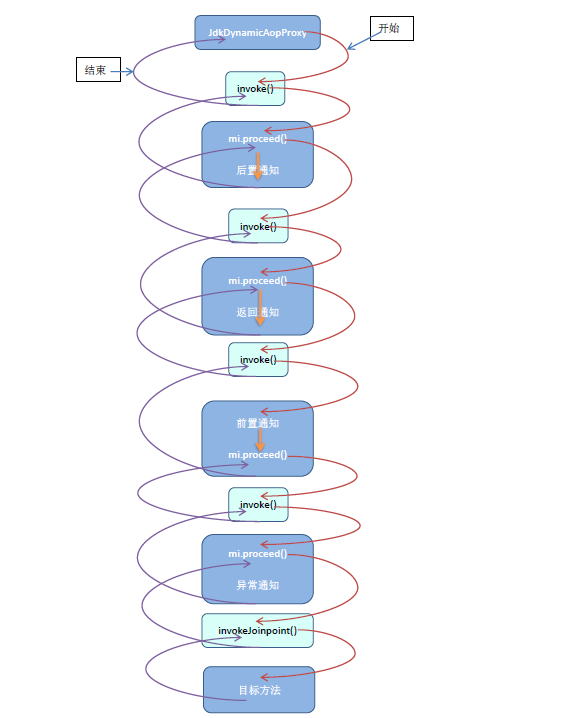
根据上面的图,可以看出无论拦截器链中各个拦截器的顺序是什么样的,前置通知总是能够在调用目标方法之前执行,因为前置通知总是在mi.proceed()之前执行。而后置通知总是在目标方法之后执行,因为后置通知总是在mi.proceed()之后。但是返回通知和后置通知谁先执行呢???这个就跟它们在链条的顺序有关了。如上图,应该是返回通知先执行然后才到后置通知。
Joinpoint继承体系-笔记的更多相关文章
- Java基础知识强化之集合框架笔记02:集合的继承体系图解
1. 集合的继承体系图解:
- 代码的坏味道(12)——平行继承体系(Parallel Inheritance Hierarchies)
坏味道--平行继承体系(Parallel Inheritance Hierarchies) 平行继承体系(Parallel Inheritance Hierarchies) 其实是 霰弹式修改(Sho ...
- 从基层容器类看万变不离其宗的JAVA继承体系
以容器类为例子,可以观一叶而知秋,看看以前的前辈们是如何处理各种面向对象思想下的继承体系的.读的源代码越多,就越要总结这个继承关系否则读的多也忘得快. 首先摆上一张图片: 看到这张图很多人就慌了,难道 ...
- 【09-23】js原型继承学习笔记
js原型继承学习笔记 function funcA(){ this.a="prototype a"; } var b=new funcA(); b.a="object a ...
- Scala 深入浅出实战经典 第41讲:List继承体系实现内幕和方法操作源码揭秘
Scala 深入浅出实战经典 第41讲:List继承体系实现内幕和方法操作源码揭秘 package com.parllay.scala.dataset /** * Created by richard ...
- 【转载】Javascript原型继承-学习笔记
阮一峰这篇文章写的很好 http://www.ruanyifeng.com/blog/2011/06/designing_ideas_of_inheritance_mechanism_in_javas ...
- 浅谈javascript继承体系
最近做web项目,接触了jquery等框架,虽然使用方便,但是还是想学习下Javascript,今天分享下最近对js原型继承的理解,不足之处欢迎指正. 一.构造器的原型属性与原型对象 刚接触js时通常 ...
- ASP.NET MVC:如何提供 Controller 继承体系使用的 ModelBinder?
背景 Mvc 提供了一种可扩展的模型绑定机制,具体来说就是:将客户端传递的参数按照一定的策略绑定到 action 的参数上,这带来的直接好处就是让 action 的参数支持强类型.一般来说我们有如下方 ...
- C++ 继承体系中的名称覆盖
首先一个简单的样例: int x; int f() { double x; cin >> x; return x; } 在上述代码中.函数f的局部变量x掩盖了全局变量x.这得从 " ...
随机推荐
- jquery源码学习笔记(一)jQuery的无new构建
本人是一名.net程序员..... 你一个.net coder 看什么jQuery 源码啊? 原因吗,很简单.技多不压身吗(麻蛋,前端工作好高...羡慕). 我一直都很喜欢JavaScript,废话不 ...
- 【JavaScript 从零开始】表达式和运算符(2)
in运算符 in运算符希望它的左操作数是一个字符串或可以转换为字符串,希望它的右操作数是一个对象. 如果右侧的对象拥有一个名为做操作数值的属性名,那么表达式返回true,例如: var point= ...
- [javaSE] 数组(获取最值)
数组的常见操作(获取最值) 1.获取最值需要进行比较,每一次比较都会有一个较大的值,因为该值不确定,通过一个变量进行存储 2.让数组中的每一个元素都和这个变量中的值进行比较,如果大于了变量中的值,就用 ...
- Linux root用户不能通过SSH连接的问题
http://jingyan.baidu.com/article/fd8044fad48fc95031137a85.html 最近在虚拟机安装Ubuntu之后,通过普通ssh远程连接的时候明明输入了正 ...
- Android Studio 1.1.0汉化初步出炉!
我找到去年12月国人汉化的版本,然后迁移上来的.实测支持Android window最新版(1.1.0) 项目分4部分:1压缩好的:2文本分析器:3原生的语言包:4原版语言包备份 现在一些新增的项目没 ...
- idea 版本升级至最新版
前言:当前最新版为官网上的2018.2.3版本 一.下载最新版 官网地址:http://www.jetbrains.com/idea/download/#section=windows 百度网盘地址: ...
- Spring Boot 表单验证、AOP统一处理请求日志、单元测试
一.使用@Valid表单验证 于实体类中添加@Min等注解 @Entity public class Girl { @Id @GeneratedValue private Integer id; pr ...
- html打造动画【系列2】- 可爱的蛙蛙表情
先感受一下全部表情包: 在开始之前先安利一个知识点:Flex弹性布局 我们一般做水平三列布局都是用的float方法,将每一块浮动显示在同一行.这种方法会导致元素没有原来的高度属性,要用清除浮动来解决空 ...
- github|webstorm
分享本地项目到github 从github上迁出项目到本地
- nvflash 报错解决
0.首先给出nvflash官网下载地址: https://www.techpowerup.com/download/nvidia-nvflash/ 刷入命令 nvflash xxx.rom 多显卡刷入 ...