
leetcode 307 Range Sum Query
问题描述:给定一序列,求任意区间(i, j)的元素和;修改任意一元素,实现快速更新
树状数组
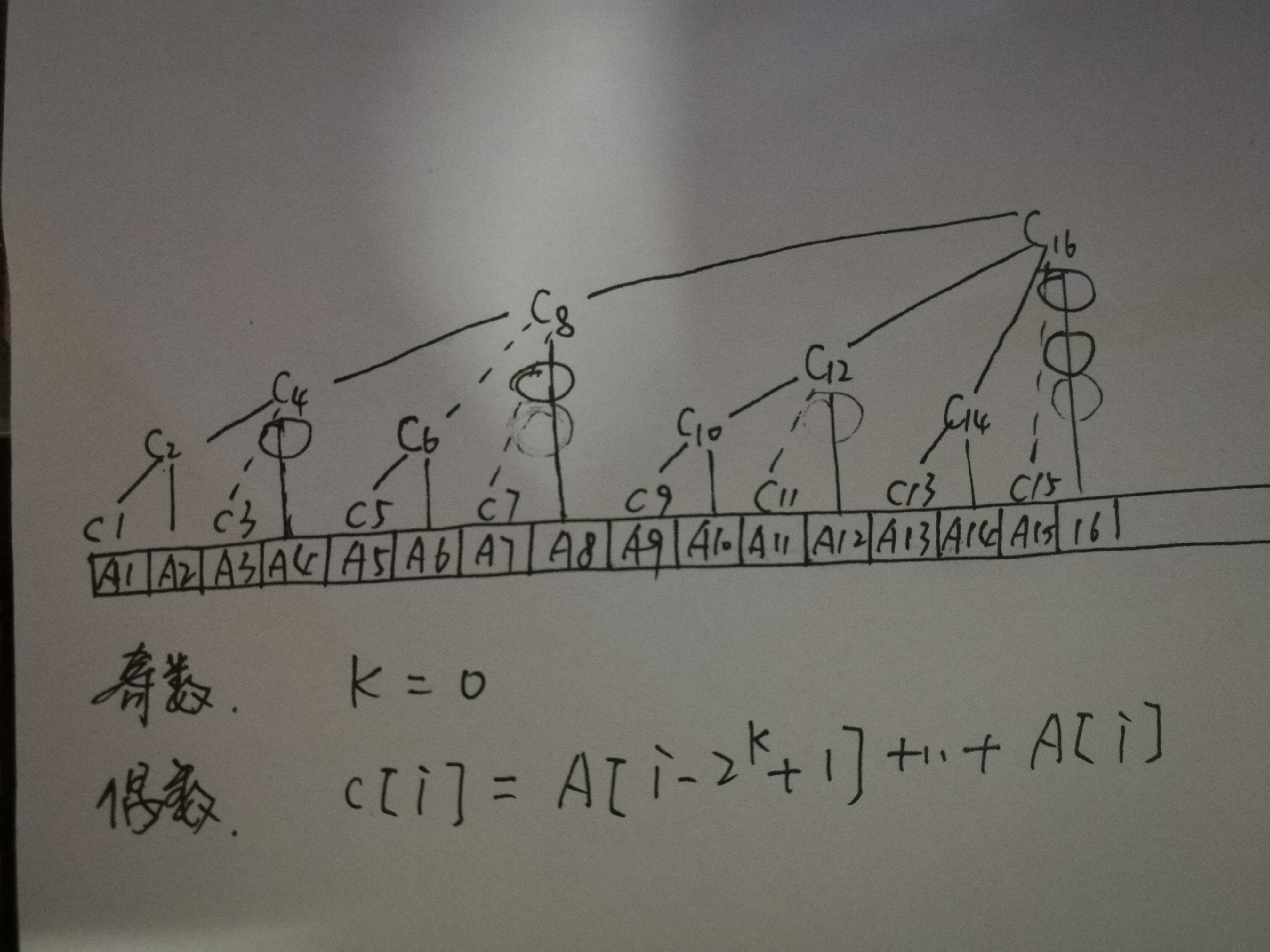
树状数组的主要特点是生成一棵树,树的高度为logN。每一层的高度为k,分布在这一层的序列元素索引的二进制表达有个共同的特点,就是最低二次幂为k。
子树间有很强的联系,即,给定一序列元素索引i,可以推知该元素所在节点C[i]的父节点C[p],p=i+2^k,其中k=i & (i ^ (i-1)),以及该元素所在子树的前一子树的根节点p=i-2^k。
子树间的联系可以很方便地用于求前n个元素的和,即找到所有子树即可;为实现更新,也只需要logN步操作,实现C[i]值的更新和序列元素的更新。
# leetcode 307
# 树状数组
# 树状数组的本质还是二分树,从而达到O(logN)的算法复杂度
# 树状数组最有趣的地方在于最底层高度为0,序列的第i项的高度为k,k代表i的二进制中从右数0的位数,即2次幂的最低次
# 从二进制的角度来看,很快可以得出结论 2^k = i & (i ^ (i - 1))
# 给出一节点i,可以快速找到它的父节点(i + 2^k)和该节点前的最近一棵子树的根结点(i - 2^k)
# 问题形式:
# 1. 给定一固定序列,求索引n前所有项和:相当于求所有子树的根节点值之和
# 2. 对固定序列任意修改一元素,实现快速更新:相当于更新包含该结点的所有子树的根节点的值
# 最纠结的地方还是求根节点数组C,没想到是通过update求。
class NumArray(object):
    def __init__(self, nums):
        """
        :type nums: List[int]
        """
        self.nums = [0 for _ in nums]
        self.n = len(nums)
        self.c = [0 for _ in nums]
        for i, num in enumerate(nums):
            self.update(i, num)

    def lowBit(self, x):
        ## return x & (-x)
        return x & (x ^ (x - 1))

    def update(self, i, val):
        """
        :type i: int
        :type val: int
        :rtype: void
        """
        difference = val - self.nums[i]
        self.nums[i] = val
        while i < self.n:
            self.c[i] += difference
            i += self.lowBit(i + 1)

    def getSum(self, n):
        sum = 0
        while n >= 0:
            sum += self.c[n]
            n -= self.lowBit(n + 1)
        return sum

    def sumRange(self, i, j):
        """
        :type i: int
        :type j: int
        :rtype: int
        """
        return self.getSum(j) - self.getSum(i) + self.nums[i]

        # Your NumArray object will be instantiated and called as such:
        # obj = NumArray(nums)
        # obj.update(i,val)
        # param_2 = obj.sumRange(i,j)

nums = [1, 3, 5]
X = NumArray(nums)
# X.update(0, 1)
print(X.sumRange(0, 2))
# print(X.getSum(0))
线段树
线段树是一种满二分树,即每个节点的度为0或2.
线段树的主要特点是不断平分区间[s, e]为[s, mid]和[mid + 1, e],其中mid = s + int((e - s) / 2)。称度为0的结点为叶节点,即只包含一个数,不再平分。
线段树的构造是通过构造结点,由其平分性质可知,若给定序列长度为N,则叶节点数目为N,非叶节点为N - 1,即一共2N - 1个结点。
定义根节点的索引为0,其左子树的结点为1, 右子树的结点为2。通用地说,若当前结点为i,则其左结点为(2 * i + 1),右结点为(2 * i + 2),因此,构造结点数目时,索引长度不是N-1。(具体为多少我也还不知道,有博文说是2 * 2 ^(ceil(logN))) - 1,但数据量一大leetcode上就死活通不过)
同样地,线段树可以用于求和和更新。非常巧妙!线段树的操作基本都是基于递归函数,先给一个总区间(也就是根节点对应的区间),然后不断平分,求 getSbSumUntil(ss, mid, qs, qe, (2 * si) + 1) +
getSbSumUntil(mid + 1, se, qs, qe, (2 * si) + 2)
此外,线段树还可以用于求区间和最大和区间替换,下次说。
# leetcode 307
# 线段树
import math
class NumArray(object):
    def __init__(self, nums):
        """
        :type nums: List[int]
        """
        self.nums = nums
        self.n = len(nums)
        self.st = [0 for _ in range(2 * 2 ^ int(math.log2(self.n)))]
        self.constructSTUntil(0, self.n - 1, 0)

    def getMid(self, s, e):
        return int(s + (e - s) / 2)

    def constructSTUntil(self, ss, se, si):
        if ss == se:
            self.st[si] = self.nums[ss]
            return self.st[si]
        mid = self.getMid(ss, se)
        self.st[si] = self.constructSTUntil(ss, mid, (2 * si) + 1) + \
                      self.constructSTUntil(mid + 1, se, (2 * si) + 2)
        return self.st[si]

    def updataUntil(self, ss, se, i, si, difference):
        if i < ss or i > se:
            return
        self.st[si] += difference
        if ss != se:
            mid = self.getMid(ss, se)
            self.updataUntil(ss, mid, i, (2 * si + 1), difference)
            self.updataUntil(mid + 1, se, i, (2 * si + 2), difference)

    def update(self, i, val):
        """
        :type i: int
        :type val: int
        :rtype: void
        """
        difference = val - self.nums[i]
        self.nums[i] = val
        self.updataUntil(0, self.n - 1, i, 0, difference)

    def getSbSumUntil(self, ss, se, qs, qe, si):
        if qs == qe:
            return self.nums[qs]
        if (qs <= ss) and (qe >= se):
            return self.st[si]
        if (qs > se) or (qe < ss):
            return 0
        mid = self.getMid(ss, se)
        return self.getSbSumUntil(ss, mid, qs, qe, (2 * si) + 1) + \
               self.getSbSumUntil(mid + 1, se, qs, qe, (2 * si) + 2)

    def sumRange(self, i, j):
        """
        :type i: int
        :type j: int
        :rtype: int
        """
        return self.getSbSumUntil(0, self.n - 1, i, j, 0)

        # Your NumArray object will be instantiated and called as such:
        # obj = NumArray(nums)
        # obj.update(i,val)
        # param_2 = obj.sumRange(i,j)

nums = [-1]
X = NumArray(nums)
X.update(0, 1)
print(X.sumRange(0, 0))
参考文献:
http://bookshadow.com/weblog/search/?pattern=%E7%BA%BF%E6%AE%B5%E6%A0%91&submit=
http://www.cnblogs.com/newpanderking/articles/2775168.html
leetcode 307 Range Sum Query的更多相关文章
- [LeetCode] 307. Range Sum Query - Mutable 区域和检索 - 可变
Given an integer array nums, find the sum of the elements between indices i and j (i ≤ j), inclusive ...
- leetcode@ [307] Range Sum Query - Mutable / 线段树模板
Given an integer array nums, find the sum of the elements between indices i and j (i ≤ j), inclusive ...
- [LeetCode] 307. Range Sum Query - Mutable 解题思路
Given an integer array nums, find the sum of the elements between indices i and j (i ≤ j), inclusive ...
- LeetCode - 307. Range Sum Query - Mutable
Given an integer array nums, find the sum of the elements between indices i and j (i ≤ j), inclusive ...
- leetcode 307. Range Sum Query - Mutable(树状数组)
Given an integer array nums, find the sum of the elements between indices i and j (i ≤ j), inclusive ...
- [LeetCode] 303. Range Sum Query - Immutable 区域和检索 - 不可变
Given an integer array nums, find the sum of the elements between indices i and j (i ≤ j), inclusive ...
- [LeetCode] 304. Range Sum Query 2D - Immutable 二维区域和检索 - 不可变
Given a 2D matrix matrix, find the sum of the elements inside the rectangle defined by its upper lef ...
- 【刷题-LeetCode】307. Range Sum Query - Mutable
Range Sum Query - Mutable Given an integer array nums, find the sum of the elements between indices ...
- [Leetcode Week16]Range Sum Query - Mutable
Range Sum Query - Mutable 题解 原创文章,拒绝转载 题目来源:https://leetcode.com/problems/range-sum-query-mutable/de ...
随机推荐
- saltstack returners
大意就是将saltstack 执行的结果,不在终端显示,写到文件或者数据库,功能类似于ansible的callback 参考 https://github.com/saltstack/salt/tre ...
- webserver nginx / https / upstream
s nginx server_name 配置 https://segmentfault.com/q/1010000008426747?_ea=1647456 问题:我的host还没有域名,server ...
- 【C#】使用bat文件安装卸载Window服务
1.安装服务 @echo off @title 安装windows服务path %SystemRoot%\Microsoft.NET\Framework\v4.0.30319echo========= ...
- Oracle 数据库分页查询与排序分页查询
一.分页查询 原始查询语句 SELECT * FROM NASLE_WFSHH 修改为分页查询语句,加上 ROWNUM 列.此处为查询第 1 页,每页 9 条数据 SELECT * FROM ( SE ...
- Linux记录-配置无密码登录
1.互信的机器都执行 ssh-keygen -t rsa cat ~/.ssh/id_rsa.pub >> /home/hdfs/.ssh/authorized_keys chmod 60 ...
- System.Web.Optimization 合并压缩技术的使用
捆绑和压缩原理是:将多个css文件动态合并和压缩为一个css文件.多个js文件动态合并和压缩为一个js文件,如此达到减少浏览器对服务器资源文件的请求数量.缩小资源文件的尺寸来提高页面反应速度的目的.A ...
- jQuery使用(八):运动方法
show().hide().toggle() 参数:null或(duration,easing,callblack) fadeIn().fadeout().fadeToggle().fadeTo() ...
- mysql:insert插入数据过慢如何解决,设置innodb_flush_log_at_trx_commit为0就能解决
问题: 最近在做性能测试,造数据,发现insert好慢,只有几十条每秒,很奇怪,最后再网上找到了原因. 网文如下: MY SQL insert 速度过慢 最近在用MySQL做存储,测试中发现插入数据太 ...
- bzoj千题计划311:bzoj5017: [Snoi2017]炸弹(线段树优化tarjan构图)
https://www.lydsy.com/JudgeOnline/problem.php?id=5017 暴力: 对于每一个炸弹,枚举所有的炸弹,看它爆炸能不能引爆那个炸弹 如果能,由这个炸弹向引爆 ...
- Java笔记——泛型擦除
1. 泛型擦除 package cn.Douzi.T_Demo; import java.util.ArrayList; /** * @Auther: Douzi * @Date: 2019/3/8 ...