
poj 1330 Nearest Common Ancestors 题解
Nearest Common Ancestors
| Time Limit: 1000MS | Memory Limit: 10000K | |
| Total Submissions: 24618 | Accepted: 12792 |
Description
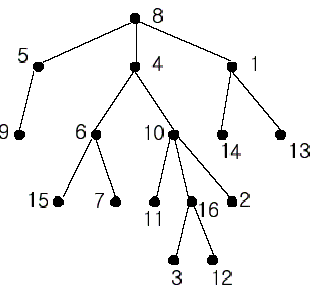
In the figure, each node is labeled with an integer from {1,
2,...,16}. Node 8 is the root of the tree. Node x is an ancestor of node
y if node x is in the path between the root and node y. For example,
node 4 is an ancestor of node 16. Node 10 is also an ancestor of node
16. As a matter of fact, nodes 8, 4, 10, and 16 are the ancestors of
node 16. Remember that a node is an ancestor of itself. Nodes 8, 4, 6,
and 7 are the ancestors of node 7. A node x is called a common ancestor
of two different nodes y and z if node x is an ancestor of node y and an
ancestor of node z. Thus, nodes 8 and 4 are the common ancestors of
nodes 16 and 7. A node x is called the nearest common ancestor of nodes y
and z if x is a common ancestor of y and z and nearest to y and z among
their common ancestors. Hence, the nearest common ancestor of nodes 16
and 7 is node 4. Node 4 is nearer to nodes 16 and 7 than node 8 is.
For other examples, the nearest common ancestor of nodes 2 and 3 is
node 10, the nearest common ancestor of nodes 6 and 13 is node 8, and
the nearest common ancestor of nodes 4 and 12 is node 4. In the last
example, if y is an ancestor of z, then the nearest common ancestor of y
and z is y.
Write a program that finds the nearest common ancestor of two distinct nodes in a tree.
Input
input consists of T test cases. The number of test cases (T) is given in
the first line of the input file. Each test case starts with a line
containing an integer N , the number of nodes in a tree,
2<=N<=10,000. The nodes are labeled with integers 1, 2,..., N.
Each of the next N -1 lines contains a pair of integers that represent
an edge --the first integer is the parent node of the second integer.
Note that a tree with N nodes has exactly N - 1 edges. The last line of
each test case contains two distinct integers whose nearest common
ancestor is to be computed.
Output
Sample Input
2

16

1 14

8 5

10 16

5 9

4 6

8 4

4 10

1 13

6 15

10 11

6 7

10 2

16 3

8 1

16 12

16 7

5

2 3

3 4

3 1

1 5

3 5
Sample Output
4

3
Source
[Submit] [Go Back] [Status] [Discuss]


————————————————————我是分割线————————————————————————————————
水题一道,LCA果题。
果断解决。
 #include<iostream>

 #include<cstring>

 #include<cstdio>

 #include<vector>

 using namespace std;

 const int N=;

 const int Log=;

 int dp[N][Log],depth[N],deg[N];

 struct Edge

 {

     int to;

     Edge *next;

 }edge[*N],*cur,*head[N];

 void addedge(int u,int v)

 {

     cur->to=v;

     cur->next=head[u];

     head[u]=cur++;

 }

 void dfs(int u)

 {

     depth[u]=depth[dp[u][]]+;

     for(int i=;i<Log;i++) dp[u][i]=dp[dp[u][i-]][i-];

     for(Edge *it=head[u];it;it=it->next)

     {

         dfs(it->to);

     }

 }

 int lca(int u,int v)

 {

     if(depth[u]<depth[v])swap(u,v);

     for(int st=<<(Log-),i=Log-;i>=;i--,st>>=)

     {

         if(st<=depth[u]-depth[v])

         {

             u=dp[u][i];

         }

     }

     if(u==v) return u;

     for(int i=Log-;i>=;i--)

     {

         if(dp[v][i]!=dp[u][i])

         {

             v=dp[v][i];

             u=dp[u][i];

         }

     }

     return dp[u][];

 }

 void init(int n)

 {

     for(int i=;i<=n;i++)

     {

         dp[i][]=;

         head[i]=NULL;

         deg[i]=;

     }

     cur=edge;

 }

 int main()

 {

     int T;

     scanf("%d",&T);

     while(T--)

     {

         int n,u,v;

         scanf("%d",&n);

         init(n);

         for(int i=;i<n-;i++)

         {

             scanf("%d%d",&u,&v);

             addedge(u,v);

             deg[v]++;

             dp[v][]=u;

         }

         for(int i=;i<=n;i++)

         {

             if(deg[i]==)

             {

                 dfs(i);

                 break;

             }

         }

         scanf("%d%d",&u,&v);

         printf("%d\n",lca(u,v));

     }

     return ;

 }
poj 1330 Nearest Common Ancestors 题解的更多相关文章
- POJ - 1330 Nearest Common Ancestors(基础LCA)
POJ - 1330 Nearest Common Ancestors Time Limit: 1000MS Memory Limit: 10000KB 64bit IO Format: %l ...
- POJ 1330 Nearest Common Ancestors / UVALive 2525 Nearest Common Ancestors (最近公共祖先LCA)
POJ 1330 Nearest Common Ancestors / UVALive 2525 Nearest Common Ancestors (最近公共祖先LCA) Description A ...
- POJ.1330 Nearest Common Ancestors (LCA 倍增)
POJ.1330 Nearest Common Ancestors (LCA 倍增) 题意分析 给出一棵树,树上有n个点(n-1)条边,n-1个父子的边的关系a-b.接下来给出xy,求出xy的lca节 ...
- LCA POJ 1330 Nearest Common Ancestors
POJ 1330 Nearest Common Ancestors Time Limit: 1000MS Memory Limit: 10000K Total Submissions: 24209 ...
- POJ 1330 Nearest Common Ancestors(lca)
POJ 1330 Nearest Common Ancestors A rooted tree is a well-known data structure in computer science a ...
- POJ 1330 Nearest Common Ancestors 倍增算法的LCA
POJ 1330 Nearest Common Ancestors 题意:最近公共祖先的裸题 思路:LCA和ST我们已经很熟悉了,但是这里的f[i][j]却有相似却又不同的含义.f[i][j]表示i节 ...
- POJ 1330 Nearest Common Ancestors 【LCA模板题】
任意门:http://poj.org/problem?id=1330 Nearest Common Ancestors Time Limit: 1000MS Memory Limit: 10000 ...
- POJ 1330 Nearest Common Ancestors LCA题解
Nearest Common Ancestors Time Limit: 1000MS Memory Limit: 10000K Total Submissions: 19728 Accept ...
- POJ 1330 Nearest Common Ancestors (LCA,dfs+ST在线算法)
Nearest Common Ancestors Time Limit: 1000MS Memory Limit: 10000K Total Submissions: 14902 Accept ...
随机推荐
- [loj2116]「HNOI2015」开店 动态点分治
4012: [HNOI2015]开店 Time Limit: 70 Sec Memory Limit: 512 MBSubmit: 2452 Solved: 1089[Submit][Status ...
- AC日记——#2057. 「TJOI / HEOI2016」游戏 LOJ
#2057. 「TJOI / HEOI2016」游戏 思路: 最大流: 代码: #include <cstdio> #include <cstring> #include &l ...
- js获取或设置当前窗口url参数
直接上代码 // 获取当前窗口url中param参数的值 function get_param(param){ var query = location.search.substring(1).spl ...
- vs 单元测试
vs 2010 NOget 包 安装NUnitTDNet,下载TestDriven.NET(http://www.testdriven.net/). 准备动作 先到http://www.testdri ...
- 【Spark亚太研究院系列丛书】Spark实战高手之路-第3章Spark架构设计与编程模型第3节:Spark架构设计(2)
三,深入RDD RDD本身是一个抽象类,具有很多具体的实现子类: RDD都会基于Partition进行计算: 默认的Partitioner如下所示: 其中HashPartitioner的文档说明如下: ...
- thinkphp5.0配置作用域
作用域 配置参数支持作用域的概念,默认情况下,所有参数都在同一个系统默认作用域下面.如果你的配置参数需要用于不同的项目或者相互隔离,那么就可以使用作用域功能,作用域的作用好比是配置参数的命名空间一样. ...
- GenXus进行APP开发-全局颜色设计
我们每次开发APP时,会有不同的全局颜色设计(例如标准控件.状态栏.控件激活时等的默认颜色),那么我们在GeneXus中如何设置这些颜色呢?接下来就给大家介绍一下. 当我们通过GeneXus开发APP ...
- scrapy保存csv文件有空行的解决方案
比如现在我有一个名为test的爬虫,运行爬虫后将结果保存到test.csv文件 默认情况下,我执行scrapy crawl test -o test.csv ,得到的结果可能就是下面这种情况,每两行中 ...
- 洛谷——P1907 设计道路
P1907 设计道路 题目描述 Caesar远征高卢回来后,对你大加赞赏,他亲自来到Genoa视察. Genoa在你的建设下变得无比繁荣,由于财政收入的增加,你为城市修建了交通系统.古罗马的交通系统由 ...
- Unity 2D游戏开发教程之游戏中精灵的跳跃状态
Unity 2D游戏开发教程之游戏中精灵的跳跃状态 精灵的跳跃状态 为了让游戏中的精灵有更大的活动范围,上一节为游戏场景添加了多个地面,于是精灵可以从高的地面移动到低的地面处,如图2-14所示.但是却 ...