
POJ 1330 Nearest Common Ancestors (LCA,dfs+ST在线算法)
| Time Limit: 1000MS | Memory Limit: 10000K | |
| Total Submissions: 14902 | Accepted: 7963 |
Description
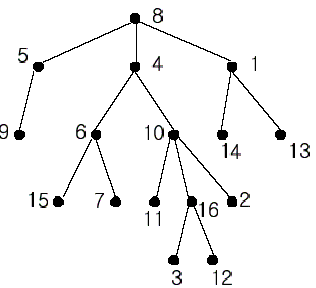
In the figure, each node is labeled with an integer from {1, 2,...,16}. Node 8 is the root of the tree. Node x is an ancestor of node y if node x is in the path between the root and node y. For example, node 4 is an ancestor of node 16. Node 10 is also an ancestor of node 16. As a matter of fact, nodes 8, 4, 10, and 16 are the ancestors of node 16. Remember that a node is an ancestor of itself. Nodes 8, 4, 6, and 7 are the ancestors of node 7. A node x is called a common ancestor of two different nodes y and z if node x is an ancestor of node y and an ancestor of node z. Thus, nodes 8 and 4 are the common ancestors of nodes 16 and 7. A node x is called the nearest common ancestor of nodes y and z if x is a common ancestor of y and z and nearest to y and z among their common ancestors. Hence, the nearest common ancestor of nodes 16 and 7 is node 4. Node 4 is nearer to nodes 16 and 7 than node 8 is.
For other examples, the nearest common ancestor of nodes 2 and 3 is node 10, the nearest common ancestor of nodes 6 and 13 is node 8, and the nearest common ancestor of nodes 4 and 12 is node 4. In the last example, if y is an ancestor of z, then the nearest common ancestor of y and z is y.
Write a program that finds the nearest common ancestor of two distinct nodes in a tree.
Input
Output
Sample Input
2

16

1 14

8 5

10 16

5 9

4 6

8 4

4 10

1 13

6 15

10 11

6 7

10 2

16 3

8 1

16 12

16 7

5

2 3

3 4

3 1

1 5

3 5
Sample Output
4

3
 /* ***********************************************

 Author        :kuangbin

 Created Time  :2013-9-5 0:09:55

 File Name     :F:\2013ACM练习\专题学习\LCA\POJ1330.cpp

 ************************************************ */

 #include <stdio.h>

 #include <string.h>

 #include <iostream>

 #include <algorithm>

 #include <vector>

 #include <queue>

 #include <set>

 #include <map>

 #include <string>

 #include <math.h>

 #include <stdlib.h>

 #include <time.h>

 using namespace std;

 /*

  * LCA  (POJ 1330)

  * 在线算法 DFS + ST

  */

 const int MAXN = ;

 int rmq[*MAXN];//rmq数组,就是欧拉序列对应的深度序列

 struct ST

 {

     int mm[*MAXN];

     int dp[*MAXN][];//最小值对应的下标

     void init(int n)

     {

         mm[] = -;

         for(int i = ;i <= n;i++)

         {

             mm[i] = ((i&(i-)) == )?mm[i-]+:mm[i-];

             dp[i][] = i;

         }

         for(int j = ; j <= mm[n];j++)

             for(int i = ; i + (<<j) -  <= n; i++)

                 dp[i][j] = rmq[dp[i][j-]] < rmq[dp[i+(<<(j-))][j-]]?dp[i][j-]:dp[i+(<<(j-))][j-];

     }

     int query(int a,int b)//查询[a,b]之间最小值的下标

     {

         if(a > b)swap(a,b);

         int k = mm[b-a+];

         return rmq[dp[a][k]] <= rmq[dp[b-(<<k)+][k]]?dp[a][k]:dp[b-(<<k)+][k];

     }

 };

 //边的结构体定义

 struct Edge

 {

     int to,next;

 };

 Edge edge[MAXN*];

 int tot,head[MAXN];

 int F[MAXN*];//欧拉序列,就是dfs遍历的顺序,长度为2*n-1,下标从1开始

 int P[MAXN];//P[i]表示点i在F中第一次出现的位置

 int cnt;

 ST st;

 void init()

 {

     tot = ;

     memset(head,-,sizeof(head));

 }

 void addedge(int u,int v)//加边,无向边需要加两次

 {

     edge[tot].to = v;

     edge[tot].next = head[u];

     head[u] = tot++;

 }

 void dfs(int u,int pre,int dep)

 {

     F[++cnt] = u;

     rmq[cnt] = dep;

     P[u] = cnt;

     for(int i = head[u];i != -;i = edge[i].next)

     {

         int v = edge[i].to;

         if(v == pre)continue;

         dfs(v,u,dep+);

         F[++cnt] = u;

         rmq[cnt] = dep;

     }

 }

 void LCA_init(int root,int node_num)//查询LCA前的初始化

 {

     cnt = ;

     dfs(root,root,);

     st.init(*node_num-);

 }

 int query_lca(int u,int v)//查询u,v的lca编号

 {

     return F[st.query(P[u],P[v])];

 }

 bool flag[MAXN];

 int main()

 {

     //freopen("in.txt","r",stdin);

     //freopen("out.txt","w",stdout);

     int T;

     int N;

     int u,v;

     scanf("%d",&T);

     while(T--)

     {

         scanf("%d",&N);

         init();

         memset(flag,false,sizeof(flag));

         for(int i = ; i < N;i++)

         {

             scanf("%d%d",&u,&v);

             addedge(u,v);

             addedge(v,u);

             flag[v] = true;

         }

         int root;

         for(int i = ; i <= N;i++)

             if(!flag[i])

             {

                 root = i;

                 break;

             }

         LCA_init(root,N);

         scanf("%d%d",&u,&v);

         printf("%d\n",query_lca(u,v));

     }

     return ;

 }
POJ 1330 Nearest Common Ancestors (LCA,dfs+ST在线算法)的更多相关文章
- POJ - 1330 Nearest Common Ancestors(dfs+ST在线算法|LCA倍增法)
1.输入树中的节点数N,输入树中的N-1条边.最后输入2个点,输出它们的最近公共祖先. 2.裸的最近公共祖先. 3. dfs+ST在线算法: /* LCA(POJ 1330) 在线算法 DFS+ST ...
- POJ 1330 Nearest Common Ancestors (dfs+ST在线算法)
详细讲解见:https://blog.csdn.net/liangzhaoyang1/article/details/52549822 zz:https://www.cnblogs.com/kuang ...
- POJ.1330 Nearest Common Ancestors (LCA 倍增)
POJ.1330 Nearest Common Ancestors (LCA 倍增) 题意分析 给出一棵树,树上有n个点(n-1)条边,n-1个父子的边的关系a-b.接下来给出xy,求出xy的lca节 ...
- poj 1330 Nearest Common Ancestors lca 在线rmq
Nearest Common Ancestors Description A rooted tree is a well-known data structure in computer scienc ...
- POJ 1330 Nearest Common Ancestors LCA题解
Nearest Common Ancestors Time Limit: 1000MS Memory Limit: 10000K Total Submissions: 19728 Accept ...
- poj 1330 Nearest Common Ancestors LCA
题目链接:http://poj.org/problem?id=1330 A rooted tree is a well-known data structure in computer science ...
- POJ 1330 Nearest Common Ancestors (LCA,倍增算法,在线算法)
/* *********************************************** Author :kuangbin Created Time :2013-9-5 9:45:17 F ...
- POJ 1330 Nearest Common Ancestors(LCA模板)
给定一棵树求任意两个节点的公共祖先 tarjan离线求LCA思想是,先把所有的查询保存起来,然后dfs一遍树的时候在判断.如果当前节点是要求的两个节点当中的一个,那么再判断另外一个是否已经访问过,如果 ...
- POJ 1330 Nearest Common Ancestors / UVALive 2525 Nearest Common Ancestors (最近公共祖先LCA)
POJ 1330 Nearest Common Ancestors / UVALive 2525 Nearest Common Ancestors (最近公共祖先LCA) Description A ...
- POJ 1330 Nearest Common Ancestors 倍增算法的LCA
POJ 1330 Nearest Common Ancestors 题意:最近公共祖先的裸题 思路:LCA和ST我们已经很熟悉了,但是这里的f[i][j]却有相似却又不同的含义.f[i][j]表示i节 ...
随机推荐
- dc
http://www.cnblogs.com/yjmyzz/p/docker-install-tutorial.html https://segmentfault.com/a/119000000510 ...
- mac系统安装redis
1.下载 打开官网:https://redis.io/ Download---Stable---Download3.2.8,下载最新稳定版,这里是3.2.8 2.安装 下载完成后,打开命令行工具,执行 ...
- Codeforces 946D Timetable(预处理+分组背包)
题目链接:http://codeforces.com/problemset/problem/946/D 题目大意:有n个字符串,代表n天的课表,1表示这个时间要上课,0表示不要上课,一天在学校时间为第 ...
- Springboot + Vue + shiro 实现前后端分离、权限控制
本文总结自实习中对项目对重构.原先项目采用Springboot+freemarker模版,开发过程中觉得前端逻辑写的实在恶心,后端Controller层还必须返回Freemarker模版的ModelA ...
- 毕设demo写好
2015年1月20日 14:41:47 阶段性暂停!! 把运行结果截图给了老师,老师说先整理下文档,然后下学期来了再部署到服务器上. 那么,下学期来了,估计也要把Epm和CR1000什么的搞好了. 先 ...
- 百度Webuploader 大文件分片上传(.net接收)
前阵子要做个大文件上传的功能,找来找去发现Webuploader还不错,关于她的介绍我就不再赘述. 动手前,在园子里找到了一篇不错的分片上传的帖子,参考之后,踏出了第一步.此文记录我这次实践的点滴,仅 ...
- 继承的基本概念: (1)Java不支持多继承,也就是说子类至多只能有一个父类。 (2)子类继承了其父类中不是私有的成员变量和成员方法,作为自己的成员变量和方法。 (3)子类中定义的成员变量和父类中定义的成员变量相同时,则父类中的成员变量不能被继承。 (4)子类中定义的成员方法,并且这个方法的名字返回类型,以及参数个数和类型与父类的某个成员方法完全相同,则父类的成员方法不能被继承。 分析以上程
继承的基本概念: (1)Java不支持多继承,也就是说子类至多只能有一个父类. (2)子类继承了其父类中不是私有的成员变量和成员方法,作为自己的成员变量和方法.(3)子类中定义的成员变量和父类中定义的 ...
- 【Java网络编程】基于 UDP 的聊天通信
使用 udp 协议,写一个基于命令行的聊天软件:客户端跟服务端分别在命令行启动之后,客户端和服务器端可以互相发送数据. 代码实现如下: 一.创建线程 sendThread 和 receiveThrea ...
- 关于ueditor的使用心得
http://blog.csdn.net/baronyang/article/details/45640181 1.取编辑器内的内容: <span style="font-size:1 ...
- 《Android源码设计模式》--模板方法模式
No1: 模板方法模式包括:抽象类(其中定义了一系列顺序方法).具体实现类A.具体实现类B 如果子类有实现不一样的细节,重写父类的某个方法即可 No2: AsyncTask对象调用execute方法后 ...