
spark 笔记 8: Stage
/**
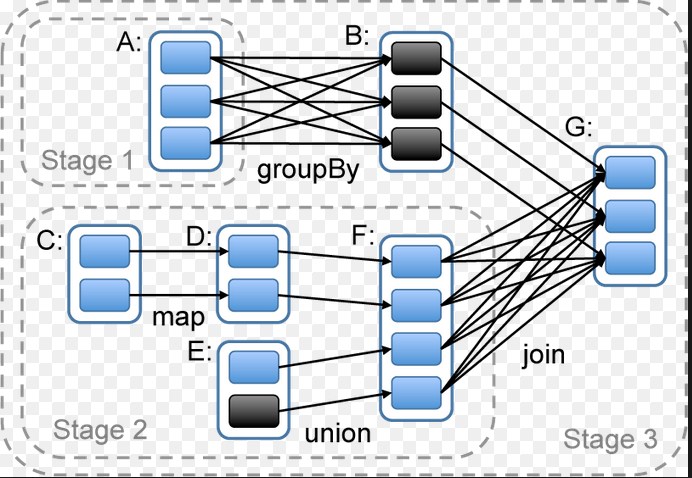
 * A stage is a set of independent tasks all computing the same function that need to run as part
 * of a Spark job, where all the tasks have the same shuffle dependencies. Each DAG of tasks run
 * by the scheduler is split up into stages at the boundaries where shuffle occurs, and then the
 * DAGScheduler runs these stages in topological order.
 *
 * Each Stage can either be a shuffle map stage, in which case its tasks' results are input for
 * another stage, or a result stage, in which case its tasks directly compute the action that
 * initiated a job (e.g. count(), save(), etc). For shuffle map stages, we also track the nodes
 * that each output partition is on.
 *
 * Each Stage also has a jobId, identifying the job that first submitted the stage.  When FIFO
 * scheduling is used, this allows Stages from earlier jobs to be computed first or recovered
 * faster on failure.
 *
 * The callSite provides a location in user code which relates to the stage. For a shuffle map
 * stage, the callSite gives the user code that created the RDD being shuffled. For a result
 * stage, the callSite gives the user code that executes the associated action (e.g. count()).
 *
 * A single stage can consist of multiple attempts. In that case, the latestInfo field will
 * be updated for each attempt.
 *
 */
private[spark] class Stage(
    val id: Int,
    val rdd: RDD[_],
    val numTasks: Int,
    val shuffleDep: Option[ShuffleDependency[_, _, _]],  // Output shuffle if stage is a map stage
    val parents: List[Stage],
    val jobId: Int,
    val callSite: CallSite)
  extends Logging {
val isShuffleMap = shuffleDep.isDefined
val numPartitions = rdd.partitions.size
val outputLocs = Array.fill[List[MapStatus]](numPartitions)(Nil)
var numAvailableOutputs = 0

/** Set of jobs that this stage belongs to. */
val jobIds = new HashSet[Int]

/** For stages that are the final (consists of only ResultTasks), link to the ActiveJob. */
var resultOfJob: Option[ActiveJob] = None
var pendingTasks = new HashSet[Task[_]]
def addOutputLoc(partition: Int, status: MapStatus) {
/**
 * Result returned by a ShuffleMapTask to a scheduler. Includes the block manager address that the
 * task ran on as well as the sizes of outputs for each reducer, for passing on to the reduce tasks.
 * The map output sizes are compressed using MapOutputTracker.compressSize.
 */
private[spark] class MapStatus(var location: BlockManagerId, var compressedSizes: Array[Byte])
spark 笔记 8: Stage的更多相关文章
- spark笔记 环境配置
spark笔记 spark简介 saprk 有六个核心组件: SparkCore.SparkSQL.SparkStreaming.StructedStreaming.MLlib,Graphx Spar ...
- Spark 资源调度包 stage 类解析
spark 资源调度包 Stage(阶段) 类解析 Stage 概念 Spark 任务会根据 RDD 之间的依赖关系, 形成一个DAG有向无环图, DAG会被提交给DAGScheduler, DAGS ...
- spark 笔记 15: ShuffleManager,shuffle map两端的stage/task的桥梁
无论是Hadoop还是spark,shuffle操作都是决定其性能的重要因素.在不能减少shuffle的情况下,使用一个好的shuffle管理器也是优化性能的重要手段. ShuffleManager的 ...
- spark 笔记 13: 再看DAGScheduler,stage状态更新流程
当某个task完成后,某个shuffle Stage X可能已完成,那么就可能会一些仅依赖Stage X的Stage现在可以执行了,所以要有响应task完成的状态更新流程. ============= ...
- 大数据学习——spark笔记
变量的定义 val a: Int = 1 var b = 2 方法和函数 区别:函数可以作为参数传递给方法 方法: def test(arg: Int): Int=>Int ={ 方法体 } v ...
- spark 笔记 16: BlockManager
先看一下原理性的文章:http://jerryshao.me/architecture/2013/10/08/spark-storage-module-analysis/ ,http://jerrys ...
- spark 笔记 9: Task/TaskContext
DAGScheduler最终创建了task set,并提交给了taskScheduler.那先得看看task是怎么定义和执行的. Task是execution执行的一个单元. Task: execut ...
- spark 笔记 7: DAGScheduler
在前面的sparkContex和RDD都可以看到,真正的计算工作都是同过调用DAGScheduler的runjob方法来实现的.这是一个很重要的类.在看这个类实现之前,需要对actor模式有一点了解: ...
- spark 笔记 2: Resilient Distributed Datasets: A Fault-Tolerant Abstraction for In-Memory Cluster Computing
http://www.cs.berkeley.edu/~matei/papers/2012/nsdi_spark.pdf ucb关于spark的论文,对spark中核心组件RDD最原始.本质的理解, ...
随机推荐
- execjs执行js代码报错:Exception in thread Thread-1
最近在爬一个js数据加密的网站的时候,出了点问题,困扰了我两天 直接运行js文件的时候正常,但是用execjs运行js代码的时候总是会报错 最后翻了很多博客之后,终于找到了原因:原因是有一个程序在使用 ...
- Stream 分布式数据流的轻量级异步快照
1. 概述 分布式有状态流处理支持在云中部署和执行大规模连续计算,主要针对低延迟和高吞吐量.这种模式的一个最根本的挑战就是在可能的失败情况下提供处理保证.现有方法依赖于可用于故障恢复的周期性全局状态快 ...
- MySQL索引详解(优缺点,何时需要/不需要创建索引,索引及sql语句的优化)
一.什么是索引? 索引是对数据库表中的一列或多列值进行排序的一种结构,使用索引可以快速访问数据库表中的特定信息. 二.索引的作用? 索引相当于图书上的目录,可以根据目录上的页码快速找到所需的内容,提 ...
- 帝国cms所有一级栏目遍历,如果有子栏目的话,遍历出来
所有一级栏目遍历,如果有子栏目的话,遍历出来. 注意下方的bclassid是可以改变的.可以改成自己想要设置的父栏目id. 遍历所有栏目,如果有二级栏目的话显示 [e:loop={"sele ...
- js 重要函数
1. Array.some some() 方法用于检测数组中的元素是否满足指定条件(函数提供) 如果有一个元素满足条件,则表达式返回true , 剩余的元素不会再执行检测.如果没有满足条件的元素,则返 ...
- 防范DDoS攻击的15个方法
0x01 背景 为了对抗 DDoS(分布式拒绝服务)攻击,你需要对攻击时发生了什么有一个清楚的理解..简单来讲,DDoS 攻击可以通过利用服务器上的漏洞,或者消耗服务器上的资源(例如 内存.硬盘等等) ...
- 自学Python-基于tcp协议的socket
自学Python之路-Python基础+模块+面向对象自学Python之路-Python网络编程自学Python之路-Python并发编程+数据库+前端自学Python之路-django 自学Pyth ...
- python 的ConfigParser模块
Python 之ConfigParser模块 一.ConfigParser简介 ConfigParser 是用来读取配置文件的包.配置文件的格式如下:中括号“[ ]”内包含的为section.sect ...
- LOJ-6284-数列分块入门8
链接: https://loj.ac/problem/6284 题意: 给出一个长为 的数列,以及 个操作,操作涉及区间询问等于一个数 的元素,并将这个区间的所有元素改为 . 思路: 维护一个分块是否 ...
- 项目的Servlet类找不到
先右击项目,