
【转】How-to: Enable User Authentication and Authorization in Apache HBase
With the default Apache HBase configuration, everyone is allowed to read from and write to all tables available in the system. For many enterprise setups, this kind of policy is unacceptable.
Administrators can set up firewalls that decide which machines are allowed to communicate with HBase. However, machines that can pass the firewall are still allowed to read from and write to all tables. This kind of mechanism is effective but insufficient because HBase still cannot differentiate between multiple users that use the same client machines, and there is still no granularity with regard to HBase table, column family, or column qualifier access.
In this post, we will discuss how Kerberos is used with Hadoop and HBase to provide User Authentication, and how HBase implements User Authorization to grant users permissions for particular actions on a specified set of data.
Secure HBase: Authentication & Authorization
A secure HBase aims to protect against sniffers, unauthenticated/unauthorized users and network-based attacks. It does not protect against authorized users who accidentally delete all the data.
HBase can be configured to provide User Authentication, which ensures that only authorized users can communicate with HBase. The authorization system is implemented at the RPC level, and is based on the Simple Authentication and Security Layer (SASL), which supports (among other authentication mechanisms) Kerberos. SASL allows authentication, encryption negotiation and/or message integrity verification on a per connection basis ( “hbase.rpc.protection” configuration property).
The next step after enabling User Authentication is to give an admin the ability to define a series of User Authorization rules that allow or deny particular actions. The Authorization system, also known as the Access Controller Coprocessor or Access Control List (ACL), is available from HBase 0.92 (CDH4) onward and gives the ability to define authorization policy (Read/Write/Create/Admin), with table/family/qualifier granularity, for a specified user.
Kerberos
Kerberos is a networked authentication protocol. It is designed to provide strong authentication for client/server applications by using secret-key cryptography. The Kerberos protocol uses strong cryptography (AES, 3DES, …) so that a client can prove its identity to a server (and vice versa) across an insecure network connection. After a client and server have used Kerberos to prove their identities, they can also encrypt all of their communications to assure privacy and data integrity as they go about their business.
Ticket exchange protocol
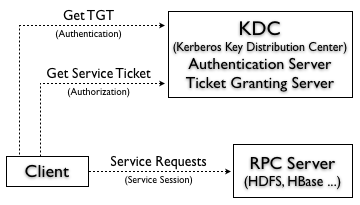
At a high level, to access a service using Kerberos, each client must follow three steps:
- Kerberos Authentication: The client authenticates itself to the Kerberos Authentication Server and receive a Ticket Granting Ticket (TGT).
- Kerberos Authorization: The client request a service ticket from the Ticket Granting Server, which issues a ticket and a session key if the client TGT sent with the request is valid.
- Service Request: The client uses the service ticket to authenticate itself to the server that is providing the service the client is using (e.g. HDFS, HBase, …)
HBase, HDFS, ZooKeeper SASL
Since HBase depends on HDFS and ZooKeeper, secure HBase relies on a secure HDFS and a secure ZooKeeper. This means that the HBase servers need to create a secure service session, as described above, to communicate with HDFS and ZooKeeper.
All the files written by HBase are stored in HDFS. As in Unix filesystems, the access control provided by HDFS is based on users, groups and permissions. All the files created by HBase have “hbase” as user, but this access control is based on the username provided by the system, and everyone that can access the machine is potentially able to “sudo” as the user “hbase”. Secure HDFS adds the authentication steps that guarantee that the “hbase” user is trusted.
ZooKeeper has an Access Control List (ACL) on each znode that allows read/write access to the users based on user information in a similar manner to HDFS.
HBase ACL
Now that our users are authenticated via Kerberos, we are sure that the username that we received is one of our trusted users. Sometimes this is not enough granularity – we want to control that a specified user is able to read or write a table. To do that, HBase provides an Authorization mechanism that allows restricted access for specified users.
To enable this feature, you must enable the Access Controller coprocessor, by adding it to hbase-site.xml under the master and region server coprocessor classes. (See how to setup the HBase security configuration here.)
A coprocessor is code that runs inside each HBase Region Server and/or Master. It is able to intercept most operations (put, get, delete, …), and run arbitrary code before and/or after the operation is executed.
Using this ability to execute some code before each operation, the Access Controller coprocessor can check the user rights and decide if the user can or cannot execute the operation.
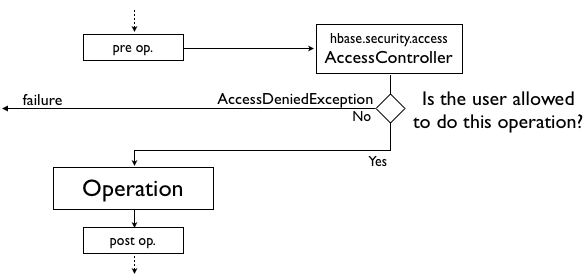
Rights management and _acl_ table
The HBase shell has a couple of commands that allows an admin to manage the user rights:
grant [table] [family] [qualifier]revoke [table] [family] [qualifier]
As you see, an admin has the ability to restrict user access based on the table schema:
- Give User-W only read rights to Table-X/Family-Y (
grant 'User-W', 'R', 'Table-X', 'Family-Y') - Give User-W the full read/write rights to Qualifier-Z (
grant 'User-W', 'RW', 'Table-X', 'Family-Y', 'Qualifier-Z')
An admin also has the ability to grant global rights, which operate at the cluster level, such as creating tables, balancing regions, shutting down the cluster and so on:
- Give User-W the ability to create tables (
grant 'User-W', 'C') - Give User-W the ability to manage the cluster (
grant 'User-W', 'A')
All the permissions are stored in a table created by the Access Controller coprocessor, called _acl_. The primary key of this table is the table name that you specify in the grant command. The _acl_ table has just one column family and each qualifier describes the granularity of rights for a particular table/user. The value contains the actual rights granted.
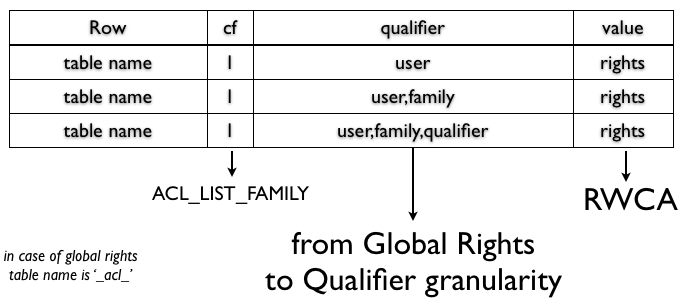
As you can see, the HBase shell commands are tightly related to how the data is stored. The grant command adds or updates one row, and the revoke command removes one row from the _acl_ table.
Access Controller under the hood
As mentioned previously, the Access Controller coprocessor uses the ability to intercept each user request, and check if the user has the rights to execute the operations.
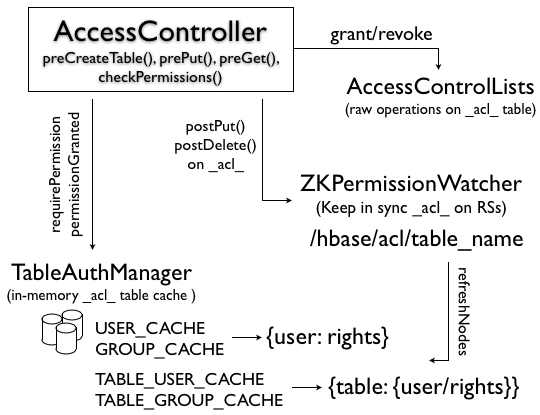
For each operation, the Access Controller needs to query the _acl_ table to see if the user has the rights to execute the operation.
However, this operation can have a negative impact on performance. The solution to fix this problem is using the _acl_ table for persistence and ZooKeeper to speed up the rights lookup. Each region server loads the _acl_ table in memory and get notified of changes by the ZkPermissionWatcher. In this way, every region server has the updated value every time and each permission check is performed by using an in-memory map.
Roadmap
While Kerberos is a stable, well-tested and proven authentication system, the HBase ACL feature is still very basic and its semantics are still evolving. HBASE-6096 is the umbrella JIRA as reference for all the improvements to ship in a v2 of the ACL feature.
Another open topic on authorization and access control is implementing a per-KeyValue security system (HBASE-6222) that will give the ability to have different values on the same cell associated with a security tag. That would allow to showing a particular piece of information based on the user’s permissions.
Conclusion
HBase Security adds two extra features that allow you to protect your data against sniffers or other network attacks (by using Kerberos to authenticate users and encrypt communications between services), and allow you to define User Authorization policies, restrict operations, and limit data visibility for particular users.
原文地址:http://blog.cloudera.com/blog/2012/09/understanding-user-authentication-and-authorization-in-apache-hbase/
【转】How-to: Enable User Authentication and Authorization in Apache HBase的更多相关文章
- How-to: Enable User Authentication and Authorization in Apache HBase
With the default Apache HBase configuration, everyone is allowed to read from and write to all table ...
- Claims-Based Authentication and Authorization
Introduction You can download the Visual Studio solutions for this article at this location. With al ...
- Authentication和Authorization的区别
搞不太清楚Authentication和Authorization的区别,在网上搜了一下,lucky16的一篇文章讲的通俗,看了就懂,记录下来: 你要登机,你需要出示你的身份证和机票,身份证是为了证明 ...
- Authentication and Authorization in ASP.NET Web API
You've created a web API, but now you want to control access to it. In this series of articles, we ...
- authentication vs authorization 验证与授权的区别
认证和授权的区别 Authentication vs. Authorization简单来说,认证(Authentication )是用来回答以下问题: 用户是谁 当前用户是否真的是他所代表的角色 通常 ...
- ASP.NET Core Authentication and Authorization
最近把一个Asp .net core 2.0的项目迁移到Asp .net core 3.1,项目启动的时候直接报错: InvalidOperationException: Endpoint CoreA ...
- WebApi2官网学习记录--- Authentication与Authorization
Authentication(认证) WebAPI中的认证既可以使用HttpModel也可以使用HTTP message handler,具体使用哪个可以参考一下依据: 一个HttpModel可以 ...
- authentication 和 authorization
单词 词性 解释 authentication n. 认证 authentic adj. 真实的 authorization n. 授权 authorise vt. 授权 authentication ...
- 认证和授权(Authentication和Authorization)
什么是OAuth 如今很多网站的功能都强调彼此间的交互,因此我们需要一种简单,标准的解决方案来安全的完成应用的授权,于是,OAuth应运而生,看看官网对其的定义: An open protocol t ...
随机推荐
- 关于python导包问题
讨论采用 * 模糊导入或者 单独导入变量 会在不同文件生成不同的对象 .a └── mypackage ├── a.py ├── b.py ├── c.py b.py内容如下 import c d ...
- 分布式特点理解-Zookeeper准备
分布式环境特点 分布性 地域,区域,机房,服务器不同导致分布性 并发性 程序运行中,并发性操作很常见,比如同一个分布式系统中的多个节点,同时访问一个共享资源(数据库,分布式存储) 无序性 进程之间的消 ...
- php自定义json_encode()和json_decode()函数
json数据大家应该遇到过,json_encode()和json_decode()是php5.0以后加上的内置函数,如果低版本要使用,需加扩展,很多时候我们无权改变服务器的配置,我们只能通过自定义函数 ...
- zencart批量设置热卖商品 best seller、点击最高最受欢迎产品 most popular
zencart批量设置某分类下热卖商品数 best seller ; ,,,,,); zencart批量设置某产品点击最高最受欢迎产品 most popular ; ,,,,,);
- JAVA项目中的常用的异常处理情况总结
可能遇见的异常或错误: 检查性异常:最具代表的检查性异常是用户错误或问题引起的异常,这是程序员无法预见的.例如要打开一个不存在文件时,一个异常就发生了,这些异常在编译时不能被简单地忽略. 运行时异常: ...
- ESXi与物理交换机静态链路聚合配置过程中的小陷阱
作者:陆斌文章来自微信公众号:平台人生 内容简介:ESXi与物理交换机之间配置静态链路聚合时,因为静态链路聚合的特点,在进行down网卡和从虚拟交换机移除网卡的操作时,可能会无法完成故障流量切换,影响 ...
- mysql单表操作与多表操作
0. null和notnull: 使用null的时候: create table t8( id int auto_increment primary key, name varchar(32), em ...
- HihoCoder1087Hamiltonian Cycle(DP状态压缩)
时间限制:10000ms 单点时限:1000ms 内存限制:256MB 描述 Given a directed graph containing n vertice (numbered from 1 ...
- 用Python实现九九乘法表打印
#!usr/bin/env python # -*- coding:utf-8 -*- # dic={ # 'apple':10, # 'iphon':5000, # 'wwatch Tv':3000 ...
- 绑定与非绑定方法及反射,isinstance和issubclass内置函数
目录 绑定方法与非绑定方法 1.绑定方法 2.非绑定方法(staticmethod) isinstance和issubclass 内置函数 1.isinstance 2.issubclass 反射(面 ...