
算法(Algorithms)第4版 练习 1.5.3
id数组和treesize数组变化情况:
0 1 2 3 4 5 6 7 8 9

1 1 1 1 1 1 1 1 1 1

10 components

9 0

 1 2 3 4 5 6 7 8 9

1 1 1 1 1 1 1 1 1

9 components

3 4

9 1 2 3  5 6 7 8 9

1 1 1  1 1 1 1 1 2

8 components

5 8

9 1 2 3 3 5 6 7  9

1 1 1 2 1  1 1 1 2

7 components

7 2

9 1  3 3 5 6 7 5 9

1 1 1 2 1 2 1  1 2

6 components

2 1

9  7 3 3 5 6 7 5 9

1 1 1 2 1 2 1  1 2

5 components

5 7

9 7 7 3 3  6 7 5 9

1 1 1 2 1 2 1  1 2

4 components

0 3

9 7 7  3 7 6 7 5 9

1 1 1 2 1 2 1 5 1

3 components

4 2

9 7 7 9 3 7 6 7 5

1 1 1 2 1 2 1  1 4

2 components
森林图:
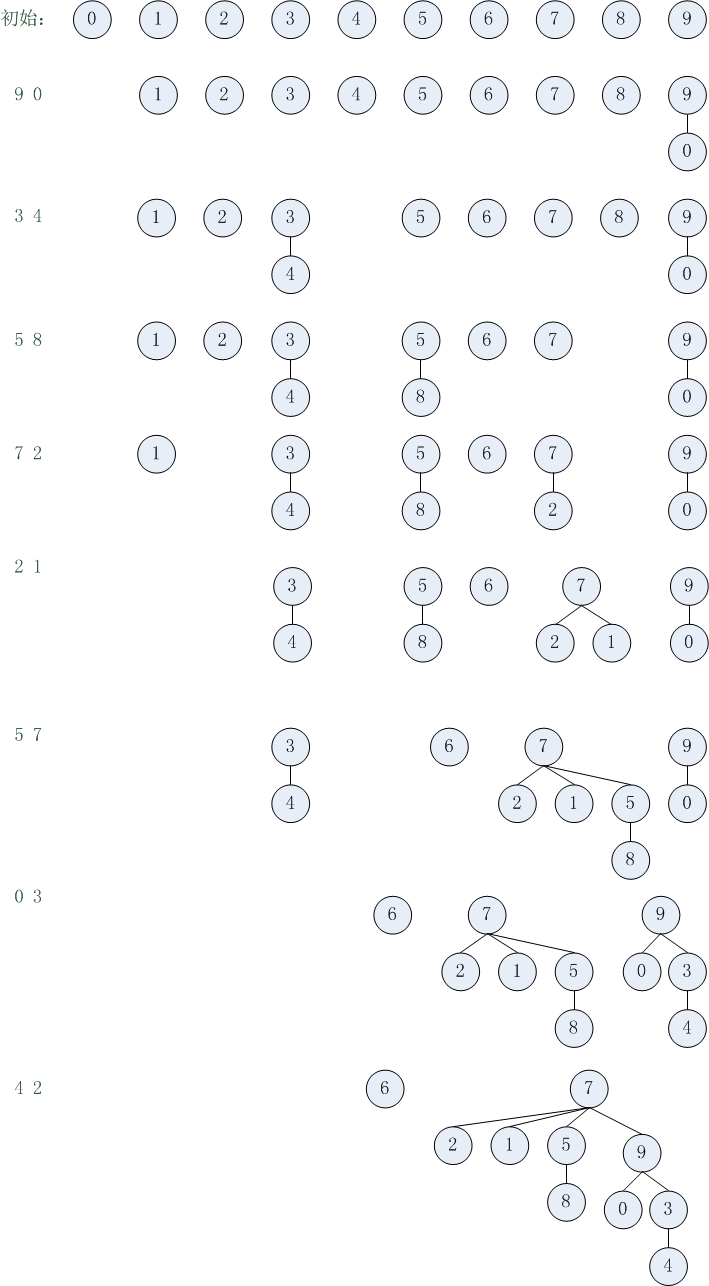
操作次数分析:
find函数每次访问数组次数是1 + 2 * depth
connected函数每次调用两次find函数
union函数每次调用两次find函数(如果两个连接点不在同一个树的话,则多一次数组访问)
    public static void main(String[] args) {

        //initialize N components

        int N = StdIn.readInt();

        UFWeightedQuickUnion uf = new UFWeightedQuickUnion(N);

        StdOut.println(uf);

        while(!StdIn.isEmpty()) {

            int p = StdIn.readInt();

            int q = StdIn.readInt();

            if(uf.connected(p, q)) {//ignore if connected

                StdOut.println(p + " " + q + " is connected");

                continue;

            }

            uf.union(p, q);//connect p and q

            StdOut.println(p + " " + q);

            StdOut.println(uf);

        }

    }
对于这个client,对每个数据对,都调用一次connected函数和union函数。
下边对数组访问次数进行分析:
9 0:9和0的深度都为0,find访问数组次数为1,connected为2 * 1, union为2 * 1 + 5,总的为2 * 1 + 2 * 1 + 5
3 4:3和4的深度都为0,find访问数组次数为1,connected为2 * 1, union为2 * 1 + 5,总的为2 * 1 + 2 * 1 + 5
5 8:5和8的深度都为0,find访问数组次数为1,connected为2 * 1, union为2 * 1 + 5,总的为2 * 1 + 2 * 1 + 5
7 2:7和2的深度都为0,find访问数组次数为1,connected为2 * 1, union为2 * 1 + 5,总的为2 * 1 + 2 * 1 + 5
2 1:2的深度为1,1的深度为0。find访问数组次数分别为3、1,connected为3 + 1, union为3 + 1 + 5,总的为3 + 1 +3 + 1 + 5
5 7:5的深度为0,7的深度为0。find访问数组次数分别为1、1,connected为1 + 1, union为1 + 1 + 5,总的为1 + 1 +1 + 1 + 5
0 3:0的深度为1,3的深度为0。find访问数组次数分别为3、1,connected为3 + 1, union为3 + 1 + 5,总的为3 + 1 +3 + 1 + 5
4 2:4的深度为2,2的深度为1。find访问数组次数分别为5、3,connected为5 + 3, union为5 + 3 + 5,总的为5 + 3 +5 + 3 + 5
源代码:
package com.qiusongde;

import edu.princeton.cs.algs4.StdIn;

import edu.princeton.cs.algs4.StdOut;

public class UFWeightedQuickUnion {

    private int[] id;//parent link(site indexed)

    private int[] treesize;//size of component for roots(site indexed)

    private int count;//number of components

    public UFWeightedQuickUnion(int N) {

        count = N;

        id = new int[N];

        for(int i = 0; i < N; i++)

            id[i] = i;

        treesize = new int[N];

        for(int i = 0; i < N; i++)

            treesize[i] = 1;

    }

    public int count() {

        return count;

    }

    public boolean connected(int p, int q) {

        return find(p) == find(q);

    }

    public int find(int p) {

        while(p != id[p])

            p = id[p];

        return p;

    }

    public void union(int p, int q) {

        int pRoot = find(p);

        int qRoot = find(q);

        if(pRoot == qRoot)

            return;

        //make smaller root point to larger one

        if(treesize[pRoot] < treesize[qRoot]) {

            id[pRoot] = qRoot;

            treesize[qRoot] += treesize[pRoot];

        } else {

            id[qRoot] = pRoot;

            treesize[pRoot] += treesize[qRoot];

        }

        count--;

    }

    @Override

    public String toString() {

        String s = "";

        for(int i = 0; i < id.length; i++) {

            s += id[i] + " ";

        }

        s += "\n";

        for(int i = 0; i < treesize.length; i++) {

            s += treesize[i] + " ";

        }

        s += "\n" + count + " components";

        return s;

    }

    public static void main(String[] args) {

        //initialize N components

        int N = StdIn.readInt();

        UFWeightedQuickUnion uf = new UFWeightedQuickUnion(N);

        StdOut.println(uf);

        while(!StdIn.isEmpty()) {

            int p = StdIn.readInt();

            int q = StdIn.readInt();

            if(uf.connected(p, q)) {//ignore if connected

                StdOut.println(p + " " + q + " is connected");

                continue;

            }

            uf.union(p, q);//connect p and q

            StdOut.println(p + " " + q);

            StdOut.println(uf);

        }

    }

}
算法(Algorithms)第4版 练习 1.5.3的更多相关文章
- 1.2 Data Abstraction(算法 Algorithms 第4版)
1.2.1 package com.qiusongde; import edu.princeton.cs.algs4.Point2D; import edu.princeton.cs.algs4.St ...
- 1.1 BASIC PROGRAMMING MODEL(算法 Algorithms 第4版)
1.1.1 private static void exercise111() { StdOut.println("1.1.1:"); StdOut.println((0+15)/ ...
- ubuntu命令行下java工程编辑与算法(第四版)环境配置
ubuntu命令行下java工程编辑与算法(第四版)环境配置 java 命令行 javac java 在学习算法(第四版)中的实例时,因需要安装配套的java编译环境,可是在编译java文件的时候总是 ...
- 配置算法(第4版)的Java编译环境
1. 下载 1.1 JDK http://www.oracle.com/technetwork/java/javase/downloads/index.html选择“Windows x64 180.5 ...
- 算法(第四版)C# 习题题解——1.3.49 用 6 个栈实现一个 O(1) 队列
因为这个解法有点复杂,因此单独开一贴介绍. 那么这里就使用六个栈来解决这个问题. 这个算法来自于这篇论文. 原文里用的是 Pure Lisp,不过语法很简单,还是很容易看懂的. 先导知识——用两个栈模 ...
- 在Eclipse下配置算法(第四版)运行环境
第一步:配置Eclipse运行环境 Eclipse运行环境配置过程是很简单的,用过Eclipse进行java开发或学习的同学应该都很熟悉这个过程了. 配置过程: (1)系统环境:Windows7 64 ...
- 排序算法总结(C语言版)
排序算法总结(C语言版) 1. 插入排序 1.1 直接插入排序 1.2 Shell排序 2. 交换排序 2.1 冒泡排序 2.2 快速排序 3. 选择 ...
- 算法(第四版)C#题解——2.1
算法(第四版)C#题解——2.1 写在前面 整个项目都托管在了 Github 上:https://github.com/ikesnowy/Algorithms-4th-Edition-in-Csh ...
- 《算法》第四版 IDEA 运行环境的搭建
<算法>第四版 IDEA 运行环境的搭建 新建 模板 小书匠 在搭建之初,我是想不到会出现如此之多的问题.我看了网上的大部分教程,都是基于Eclipse搭建的,还没有使用IDEA搭建的教程 ...
- 常见排序算法题(java版)
常见排序算法题(java版) //插入排序: package org.rut.util.algorithm.support; import org.rut.util.algorithm.Sor ...
随机推荐
- java数字签名算法之RSA
© 版权声明:本文为博主原创文章,转载请注明出处 实例 1.项目结构 2.pom.xml <project xmlns="http://maven.apache.org/POM/4.0 ...
- spring的xml配置文件出现故障
今天在断网的情况下,spring的applicationContext.xml文件开头部分出现红叉 <span style="font-size:18px;">< ...
- java多线程之happens-before
1.背景问题 在讲happens-before之前,先引入一个例子: 假定我们有已经被初始化的变量: int counter = 0; 这个 counter 变量被两个线程所共有,也就是说线程A和线程 ...
- cocos2dx 3.0rc怎样创建项目
转自官网的文档. How to Run cpp-tests on win32 In this article, I will show you how to run cpp-tests on your ...
- BZOJ 2176 Strange string 最小表示法
题目大意:给定一个串S,求最小表示法 n<=1000W,实在不敢写后缀自己主动机,就去学了最小表示法= = 记得用unsigned char不然WA= = 数据真是逗- - #include & ...
- 【Atheros】Ath9k速率调整算法源码走读
上一篇文章介绍了驱动中minstrel_ht速率调整算法,atheros中提供了可选的的两种速率调整算法,分别是ath9k和minstrel,这两个算法分别位于: drivers\net\wirele ...
- PHP-Manual的学习----【语言参考】----【类型】-----【array数组】
1.Array 数组 PHP 中的 数组 实际上是一个有序映射.映射是一种把 values 关联到 keys 的类型.此类型在很多方面做了优化,因此可以把它当成真正的数组,或列表(向量),散列表(是 ...
- python 深复制与浅复制------copy模块
模块解读: 浅复制: x = copy.copy(y)深复制: x = copy.deepcopy(y)(注:模块特有的异常,copy.Error) 深copy与浅copy的差别主要体现在当有混合对象 ...
- EasyDSS流媒体解决方案实现的RTMP/HLS视频直播、直播鉴权(如何完美将EasyDSS过渡到新版)
上一篇博文介绍了EasyDSS点播功能,然后作为RTMP流媒体服务器,接受RTMP推流.进行实时的直播流分发又是自身一大核心功能. 需求背景: 写本篇博文的一个目的是向大家介绍一下EasyDSS新版的 ...
- SpringMVC拦截器实现用户登录拦截
本例实现登陆时的验证拦截,采用SpringMVC拦截器来实现 当用户点击到网站主页时要进行拦截,用户登录了才能进入网站主页,否则进入登陆页面 核心代码 首先是index.jsp,显示链接 1 < ...