
Java实验--统计字母出现频率及其单词个数
本周的实验要求在之前实现统计单词的基础之上(可以见之前博客的统计单词的那个实验),对其进行修改成所需要的格式,统计字母出现频率的功能,并按照一定的格式把最终结果的用特定的格式在文本中显示出来
统计过程的实现并不太麻烦,在原来的基础上导入导出函数的基础上修改成通用的类型,统计单词的那一部分的单个字符读取那一段加上统计字母的情况,并加上判断把大小写字母统一起来。
同时,在统计单词的那里加上一个无用字母的表格。这样就可以统计有用意义的前n个最常用的单词了。
实验的代码如下所示:
package pipei;

//洪鼎淇 20173627 信1705-3

import java.io.File;

import java.io.FileInputStream;

import java.io.FileOutputStream;

import java.io.IOException;

import java.io.InputStreamReader;

import java.io.OutputStreamWriter;

import java.text.DecimalFormat;

import java.util.HashMap;

import java.util.Map;

//哈利波特单词统计

public class Pipei {

    public static Map<String,Integer> map1=new HashMap<String,Integer>();

    static int g_Wordcount[]=new int[27];

    static int g_Num[]=new int[27];

    static String []unUse=new String[] {

        "it",

        "in",

        "to",

        "of",

        "the",

        "and",

        "that",

        "for"

    };

    public static void main(String arg[]) {

        daoruFiles("piao.txt","tongji");

        traverseFolder2("C:\\Users\\Halo\\javatest\\pipei\\piao");

    }

    public static void daoruFiles(String a,String dc)

    {

        map1.clear();

        try {

            daoru(a);

        } catch (IOException e) {

            // TODO 自动生成的 catch 块

            e.printStackTrace();

        }

        String sz[];

        Integer num[];

        final int MAXNUM=10; //统计的单词出现最多的前n个的个数

        for(int i=0;i<g_Wordcount.length;i++)

        {

            g_Wordcount[i]=0;

            g_Num[i]=i;

        }

        sz=new String[MAXNUM+1];

        num=new Integer[MAXNUM+1];

        Pipei pipei=new Pipei();

        int account =1;

        //Vector<String> ve1=new Vector<String>();

        try {

            daoru(a);

        } catch (IOException e) {

            // TODO 自动生成的 catch 块

            e.printStackTrace();

        }

        System.out.println("英文单词的出现情况如下:");

        int g_run=0;

        for(g_run=0;g_run<MAXNUM+1;g_run++)

        {

            account=1;

            for(Map.Entry<String,Integer> it : Pipei.map1.entrySet())

            {

                if(account==1)

                {

                    sz[g_run]=it.getKey();

                    num[g_run]=it.getValue();

                    account=2;

                }

                if(account==0)

                {

                    account=1;

                    continue;

                }

                if(num[g_run]<it.getValue())

                {

                    sz[g_run]=it.getKey();

                    num[g_run]=it.getValue();

                }

                //System.out.println("英文单词: "+it.getKey()+" 该英文单词出现次数: "+it.getValue());

            }

            Pipei.map1.remove(sz[g_run]);

        }

        int g_count=1;

        String tx1=new String();

        String tx2=new String();

        for(int i=0;i<g_run;i++)

        {

            if(sz[i]==null)

                continue;

            if(sz[i].equals(""))

                continue;

            tx1+="出现次数第"+(g_count)+"多的单词为:"+sz[i]+"\t\t\t出现次数: "+num[i]+"\r\n";

            System.out.println("出现次数第"+(g_count)+"多的单词为:"+sz[i]+"\t\t\t出现次数: "+num[i]);

            g_count++;

        }

        try {

            daochu(tx1,dc+"2.txt");

        } catch (IOException e) {

            // TODO 自动生成的 catch 块

            e.printStackTrace();

        }

        //------------------------------

        int temp=g_Wordcount[0];

        int numtemp=0;

        for(int i=0;i<26;i++)

        {

            for(int j=i;j<26;j++)

            {

                if(g_Wordcount[j]>g_Wordcount[i])

                {

                    temp=g_Wordcount[i];

                    g_Wordcount[i]=g_Wordcount[j];

                    g_Wordcount[j]=temp;

                    numtemp=g_Num[i];

                    g_Num[i]=g_Num[j];

                    g_Num[j]=numtemp;

                }

            }

        }

        int sum=0;

        for(int i=0;i<26;i++)

        {

            sum+=g_Wordcount[i];

        }

        for(int i=0;i<26;i++)

        {

            char c=(char) ('a'+g_Num[i]);

            tx2+=c+":"+String.format("%.2f%% \r\n", (double)g_Wordcount[i]/sum*100);

        }

        try {

            daochu(tx2,dc+"1.txt");

        } catch (IOException e) {

            // TODO 自动生成的 catch 块

            e.printStackTrace();

        }

        //------------------------------

    }

    public static void daoru(String s) throws IOException

    {

        File a=new File(s);

        FileInputStream b = new FileInputStream(a);

        InputStreamReader c=new InputStreamReader(b,"UTF-8");

        String string2=new String("");

        while(c.ready())

        {

            char string1=(char) c.read();

            if(WordNum(string1)>=0)

            {

                g_Wordcount[WordNum(string1)]+=1;

            }

            //------------------------

            if(!isWord(string1))

            {

                if(!isBaseWord(string2))

                {

                    if(map1.containsKey(string2.toLowerCase()))

                    {

                        Integer num1=map1.get(string2.toLowerCase())+1;

                        map1.put(string2.toLowerCase(),num1);

                    }

                    else

                    {

                        Integer num1=1;

                        map1.put(string2.toLowerCase(),num1);

                    }

                }

                string2="";

            }

            else

            {

                if(isInitWord(string1))

                {

                    string2+=string1;

                }

            }

        }

        if(!string2.isEmpty())

        {

            if(!isBaseWord(string2))

            {

                if(map1.containsKey(string2.toLowerCase()))

                {

                    Integer num1=map1.get(string2.toLowerCase())+1;

                    map1.put(string2.toLowerCase(),num1);

                }

                else

                {

                    Integer num1=1;

                    map1.put(string2.toLowerCase(),num1);

                }

            }

            string2="";

        }

        c.close();

        b.close();

    }

    public static void daochu(String txt,String outfile) throws IOException

    {

        File fi=new File(outfile);

        FileOutputStream fop=new FileOutputStream(fi);

        OutputStreamWriter ops=new OutputStreamWriter(fop,"UTF-8");

        ops.append(txt);

        ops.close();

        fop.close();

    }

    public static boolean isWord(char a)

    {

        if(a<='z'&&a>='a'||a<='Z'&&a>='A'||a=='\'')

            return true;

        return false;

    }

    public static boolean isInitWord(char a)

    {

        if(a<='z'&&a>='a'||a<='Z'&&a>='A'||a>'0'&&a<'9'||a=='\'')

            return true;

        return false;

    }

    public static boolean isBaseWord(String word)

    {

        for(int i=0;i<unUse.length;i++)

        {

            if(unUse[i].equals(word)||word.length()==1)

                return true;

        }

        return false;

    }

    public static int WordNum(char a)

    {

        if(a<='z'&&a>='a')

            return a-'a';

        else if(a<='Z'&&a>='A')

            return a-'A';

        return -1;

    }

    //----递归文件夹

    public static void traverseFolder2(String path) {

        File file = new File(path);

        if (file.exists()) {

            File[] files = file.listFiles();

            if (null == files || files.length == 0) {

                System.out.println("文件夹是空的!");

                return;

            } else {

                for (File file2 : files) {

                    if (file2.isDirectory()) {

                        System.out.println("文件夹:" + file2.getAbsolutePath());

                        traverseFolder2(file2.getAbsolutePath());

                    } else {

                        System.out.println("文件:" + file2.getAbsolutePath());

                        String name=file2.getName();

                        daoruFiles(file2.getAbsolutePath(), file2.getParentFile()+"\\"+name.replace(".txt", "")+"tongji");

                    }

                }

            }

        } else {

            System.out.println("文件不存在!");

        }

    }

}
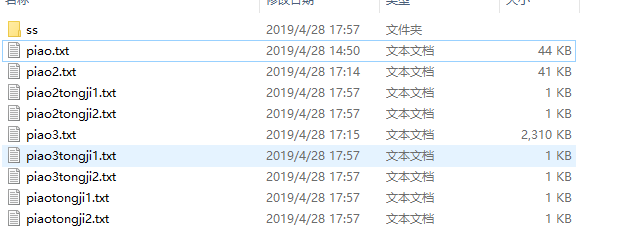
将飘的整本小说及其分章节放在一个文件夹中,最终的实验结果如下:
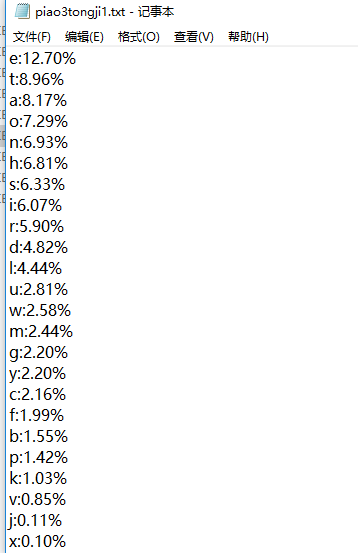
tongji1位后缀的是文章字母构成比例(以整本飘的英文小说为例子):
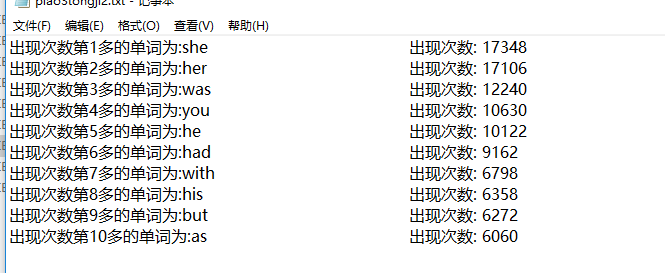
tongji2的实验结果是有意义单词的出现次数前10的排名:
对整本飘小说处理的时间级别在1秒以内,处理大文件及其多文件的过程在测试过程中没有出现问题。
Java实验--统计字母出现频率及其单词个数的更多相关文章
- JAVA实验--统计文章中单词的个数并排序
分析: 1)要统计单词的个数,就自己的对文章中单词出现的判断的理解来说是:当出现一个非字母的字符的时候,对前面的一部分字符串归结为单词 2)对于最后要判断字母出现的个数这个问题,我认为应该是要用到ma ...
- Java版统计文件中的每个单词出现次数
正则表达式之Pattern和Matcher,请参见转载博客 http://www.cnblogs.com/haodawang/p/5967219.html 代码实现: import java.i ...
- [Java]对字符串中的每一个单词个数进行统计
这是来自一道电面的题. 单词统计非常easy想到用Map来统计,于是想到了用HashMap. 可是我却没有想到用split来切割单词,想着用遍历字符的方式来推断空格.人家面试官就说了,假设单词之间不止 ...
- 初学Java 数组统计字母
public class CountLetterInArray { public static void main(String[] args) { char[] chars = createArra ...
- Java查找统计文中字母,单词
package io; import java.io.BufferedReader; import java.io.File; import java.io.FileOutputStream; imp ...
- 统计英文文章中各单词的频率,打印频率最高的十个单词(C语言实现)
一.程序思路及相关代码 首先打开文件,代码如下 FILE *fp; char fname[10]; printf("请输入要分析的文件名:\n"); scanf("%s ...
- 用java 集合和映射实现文章的单词数目统计
package 一_统计字母出现; import java.io.File; import java.io.FileNotFoundException; import java.util.HashMa ...
- Java实现 蓝桥杯VIP 算法训练 统计单词个数
题目描述 给出一个长度不超过200的由小写英文字母组 成的字母串(约定;该字串以每行20个字母的方式输入,且保证每行一定为20个).要求将此字母串分成k份 (1< k< =40),且每份中 ...
- C++读取文件统计单词个数及频率
1.Github链接 GitHub链接地址https://github.com/Zzwenm/PersonProject-C2 2.PSP表格 PSP2.1 Personal Software Pro ...
随机推荐
- UVA 11922 Permutation Transformer (Splay树)
题意: 给一个序列,是从1~n共n个的自然数,接下来又m个区间,对于每个区间[a,b],从第a个到第b个从序列中分离出来,翻转后接到尾部.输出最后的序列. 思路: 这次添加了Split和Merge两个 ...
- 洛谷 P3038 [USACO11DEC]牧草种植Grass Planting
题目描述 Farmer John has N barren pastures (2 <= N <= 100,000) connected by N-1 bidirectional road ...
- 中间件及tomcat的内存溢出调优
主要是这三个选项的调整需要根据主机的内存配置 以及业务量的使用情况调节 -Xmx4g -Xms4g -Xmn2g xmx 与xms一般设置为一样 xmn大致设置为xmx xms的三分之一 可以使用 ...
- Postman 安装及使用入门教程 | 前后台 写接口的 徐工给的
https://www.cnblogs.com/mafly/p/postman.html
- [kuangbin带你飞]专题五 并查集
并查集的介绍可以看下https://www.cnblogs.com/jkzr/p/10290488.html A - Wireless Network POJ - 2236 An earthquake ...
- poj3710 Christmas Game
题目描述 题解: 树上删边. 对于奇数长度的环,可以看做一条边. 对于偶数长度的环,可以看做什么都没有. 没有特别好的解释…… 代码: #include<cstdio> #include& ...
- SCOI2013 数数
题目描述 题解: 很玄学的一道数位$dp$,看了很多篇题解才懂. 直接挂$l$的题解. 代码: #include<cstdio> #include<cstring> #incl ...
- 华为S5700交换机初始化和配置SSH和TELNET远程登录方法
基础设置: 配置登陆IP地址<Quidway> system-view ...
- HTML、CSS 和 JS框架之Bootstrap
一.Bootstrap简介: Bootstrap 是最受欢迎的 HTML.CSS 和 JS 框架,用于开发响应式布局.移动设备优先的 WEB 项目. 详细参考内容:Bootstrap_v3 二.Boo ...
- [NOI2001] 炮兵阵地 (状压Dp经典例题)
如果您的电脑比较优秀能在 1sec 内跑过 2^1000 的时间复杂度,不妨你可以尝试一下,其实实际时间复杂度远远少于 2^1000,作为骗分不错的选择QAQ,然后我们来分析一下正解: 很显然此题是一 ...