
Design Pattern - Service Locator Pattern--转载
原文地址:http://www.tutorialspoint.com/design_pattern/service_locator_pattern.htm
The service locator design pattern is used when we want to locate various services using JNDI lookup. Considering high cost of looking up JNDI for a service, Service Locator pattern makes use of caching technique. For the first time a service is required, Service Locator looks up in JNDI and caches the service object. Further lookup or same service via Service Locator is done in its cache which improves the performance of application to great extent. Following are the entities of this type of design pattern.
Service - Actual Service which will process the request. Reference of such service is to be looked upon in JNDI server.
Context / Initial Context - JNDI Context carries the reference to service used for lookup purpose.
Service Locator - Service Locator is a single point of contact to get services by JNDI lookup caching the services.
Cache - Cache to store references of services to reuse them
Client - Client is the object that invokes the services via ServiceLocator.
Implementation
We are going to create a ServiceLocator,InitialContext, Cache, Service as various objects representing our entities.Service1 and Service2 represent concrete services.
ServiceLocatorPatternDemo, our demo class, is acting as a client here and will useServiceLocator to demonstrate Service Locator Design Pattern.
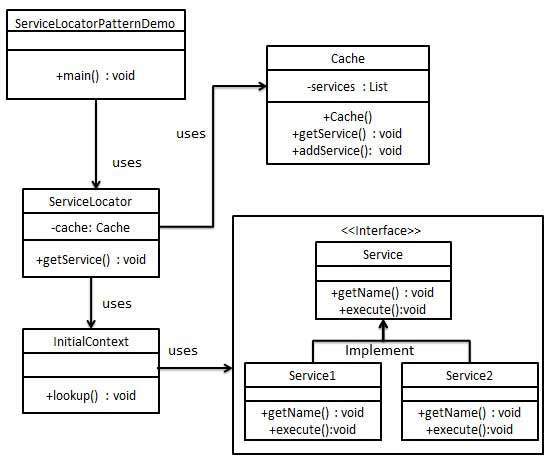
Step 1
Create Service interface.
Service.java
public interface Service {

   public String getName();

   public void execute();

}
Step 2
Create concrete services.
Service1.java
public class Service1 implements Service {

   public void execute(){

      System.out.println("Executing Service1");

   }

   @Override

   public String getName() {

      return "Service1";

   }

}
Service2.java
public class Service2 implements Service {

   public void execute(){

      System.out.println("Executing Service2");

   }

   @Override

   public String getName() {

      return "Service2";

   }

}
Step 3
Create InitialContext for JNDI lookup
InitialContext.java
public class InitialContext {

   public Object lookup(String jndiName){

      if(jndiName.equalsIgnoreCase("SERVICE1")){

         System.out.println("Looking up and creating a new Service1 object");

         return new Service1();

      }

      else if (jndiName.equalsIgnoreCase("SERVICE2")){

         System.out.println("Looking up and creating a new Service2 object");

         return new Service2();

      }

      return null;

   }

}
Step 4
Create Cache
Cache.java
import java.util.ArrayList;

import java.util.List;

public class Cache {

   private List<Service> services;

   public Cache(){

      services = new ArrayList<Service>();

   }

   public Service getService(String serviceName){

      for (Service service : services) {

         if(service.getName().equalsIgnoreCase(serviceName)){

            System.out.println("Returning cached  " + serviceName + " object");

            return service;

         }

      }

      return null;

   }

   public void addService(Service newService){

      boolean exists = false;

      for (Service service : services) {

         if(service.getName().equalsIgnoreCase(newService.getName())){

            exists = true;

         }

      }

      if(!exists){

         services.add(newService);

      }

   }

}
Step 5
Create Service Locator
ServiceLocator.java
public class ServiceLocator {

   private static Cache cache;

   static {

      cache = new Cache();

   }

   public static Service getService(String jndiName){

      Service service = cache.getService(jndiName);

      if(service != null){

         return service;

      }

      InitialContext context = new InitialContext();

      Service service1 = (Service)context.lookup(jndiName);

      cache.addService(service1);

      return service1;

   }

}
Step 6
Use the ServiceLocator to demonstrate Service Locator Design Pattern.
ServiceLocatorPatternDemo.java
public class ServiceLocatorPatternDemo {

   public static void main(String[] args) {

      Service service = ServiceLocator.getService("Service1");

      service.execute();

      service = ServiceLocator.getService("Service2");

      service.execute();

      service = ServiceLocator.getService("Service1");

      service.execute();

      service = ServiceLocator.getService("Service2");

      service.execute();

   }

}
Step 7
Verify the output.
Looking up and creating a new Service1 object

Executing Service1

Looking up and creating a new Service2 object

Executing Service2

Returning cached  Service1 object

Executing Service1

Returning cached  Service2 object

Executing Service2
Design Pattern - Service Locator Pattern--转载的更多相关文章
- [Design Pattern] Service Locator Pattern 简单案例
Service Locator Pattern,即服务定位模式,用于定位不同的服务.考虑到 InitialContext::lookup 的成本比较高,提供了 Cache 类缓存以定位到的服务. 代码 ...
- Service Locator Pattern 服务定位
https://www.geeksforgeeks.org/service-locator-pattern/ Service Locator Pattern Last Updated: 06-03-2 ...
- .NET 服务器定位模式(Service Locator Pattern)——Common Service Locator
本文内容 场景 目标 解决方案 实现细节 思考 相关模式 更多信息 参考资料 Common Service Locator 代码很简单,它一般不会单独使用,而是作为一个单件模式,与像 .net Uni ...
- 《Prism 5.0源码走读》Service Locator Pattern
在Prism Bootstrapper里面取实例的时候使用 ServiceLocator模式,使用的是CommonServiceLocator库 (http://commonservicelocato ...
- [Architecture Pattern] Singleton Locator
[Architecture Pattern] Singleton Locator 目的 组件自己提供Service Locator模式,用来降低组件的耦合度. 情景 在开发系统时,底层的Infrast ...
- Atitit。如何实现dip, di ,ioc ,Service Locator的区别于联系
Atitit.如何实现dip, di ,ioc ,Service Locator的区别于联系 1. Dip原则又来自于松耦合思想方向1 2. 要实现dip原则,有以下俩个模式1 3. Ioc和di的 ...
- 【转】Understanding Inversion of Control, Dependency Injection and Service Locator Print
原文:https://www.dotnettricks.com/learn/dependencyinjection/understanding-inversion-of-control-depende ...
- Service Locator 模式
什么是Service Locator 模式? 服务定位模式(Service Locator Pattern)是一种软件开发中的设计模式,通过应用强大的抽象层,可对涉及尝试获取一个服务的过程进行封装.该 ...
- [Design Patterns] 3. Software Pattern Overview
When you're on the way which is unknown and dangerous, just follow your mind and steer the boat. 软件模 ...
随机推荐
- Ubuntu16.04 lnmp 环境搭建
Ubuntu16.04 lnmp 环境搭建 nginx 安装 sudo apt-add-repository ppa:nginx/stablesudo apt-add-repository ppa:o ...
- 洛谷 P1070 道路游戏
设为第i秒获得的最大值 表示从当前世界是j,从pos走k步到当前点i的最大价值 注意这里的sum可以利用前面的值逐步累加. 我开始做的时候没有想到这一点单独求,然后就超时了. 同时要注意循环的循序问题 ...
- 什么是面向对象以及其意义,prototpye原型
什么是面向对象: 使用对象时,只关注对象提供的功能,不关注其内部的细节 例如:jquery 什么是对象: 对象是一个整体对外提供一些操作,比如 收音机 面向对象编程OOP的特点: 1.抽象:把主要的特 ...
- ormlite 中的onUpgrade
public class DBHelper extends OrmLiteSqliteOpenHelper { public static final String DB_NAME = "y ...
- UVALive 6084 Happy Camper(数学题)
题目链接:https://icpcarchive.ecs.baylor.edu/index.php?option=com_onlinejudge&Itemid=8&page=show_ ...
- 英语影视台词---六、Saving Private Ryan Quotes
英语影视台词---六.Saving Private Ryan Quotes 一.总结 一句话总结: Saving Private Ryan is a 1998 American epic war fi ...
- matlab subplot(figure)如何设置使得图像最终显示出来不一样大小
1. 问题描述 figure subplot(1, 2, 1), imshow(A) subplot(1, 2, 2), imshow(B) 无论 A 和 B 的 size 是否一致,最终显示出来的 ...
- leetcode 新题型----SQL,shell,system design
leetcode 主要是一个针对北美的coder人群找工作的代码练习网站,我在2015年初次接触这个网站的时候,总共只有200多道题目,是一个类似acm 的a题网站.这些年变化越来越大,主要是因为找工 ...
- PHP万能的连接数据库
<?php class DB{ const HOST='127.0.0.1'; const USER='root'; const PASS='root'; const DATA='mooc'; ...
- Kinect 人机交互开发实践
Kinect for Windows SDK 骨骼追踪 —— 对在Kinect视野范围内移动的一个或两个人进行骨骼追踪,可追踪到人体的20个节点 深度摄像头 —— 通过深度传感器获取到视野内的环境三维 ...