
LC 499. The Maze III 【lock,hard】
There is a ball in a maze with empty spaces and walls. The ball can go through empty spaces by rolling up(u), down (d), left (l) or right (r), but it won't stop rolling until hitting a wall. When the ball stops, it could choose the next direction. There is also a hole in this maze. The ball will drop into the hole if it rolls on to the hole.
Given the ball position, the hole position and the maze, find out how the ball could drop into the hole by moving the shortest distance. The distance is defined by the number of empty spaces traveled by the ball from the start position (excluded) to the hole (included). Output the moving directions by using 'u', 'd', 'l' and 'r'. Since there could be several different shortest ways, you should output the lexicographically smallest way. If the ball cannot reach the hole, output "impossible".
The maze is represented by a binary 2D array. 1 means the wall and 0 means the empty space. You may assume that the borders of the maze are all walls. The ball and the hole coordinates are represented by row and column indexes.
Example 1:
Input 1: a maze represented by a 2D array

0 0 0 0 0

1 1 0 0 1

0 0 0 0 0

0 1 0 0 1

0 1 0 0 0

Input 2: ball coordinate (rowBall, colBall) = (4, 3)

Input 3: hole coordinate (rowHole, colHole) = (0, 1)

Output: "lul"

Explanation: There are two shortest ways for the ball to drop into the hole.

The first way is left -> up -> left, represented by "lul".

The second way is up -> left, represented by 'ul'.

Both ways have shortest distance 6, but the first way is lexicographically smaller because 'l' < 'u'. So the output is "lul".
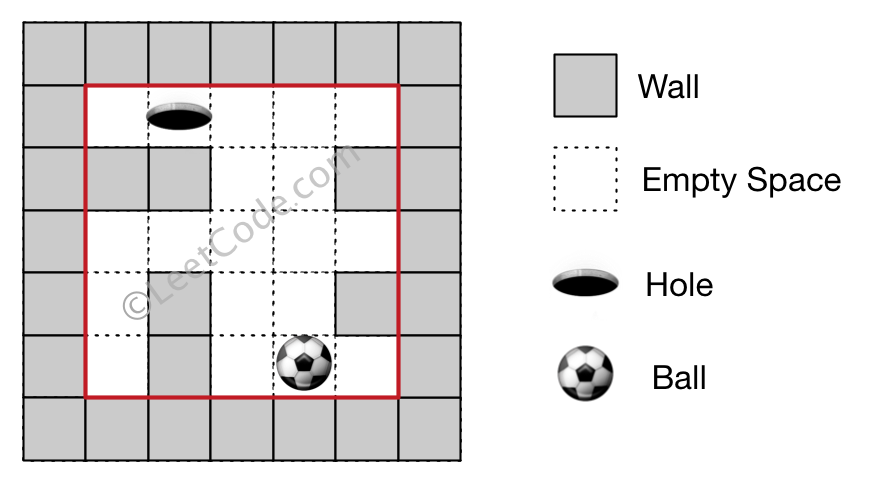
Example 2:
Input 1: a maze represented by a 2D array

0 0 0 0 0

1 1 0 0 1

0 0 0 0 0

0 1 0 0 1

0 1 0 0 0

Input 2: ball coordinate (rowBall, colBall) = (4, 3)

Input 3: hole coordinate (rowHole, colHole) = (3, 0)

Output: "impossible"

Explanation: The ball cannot reach the hole.
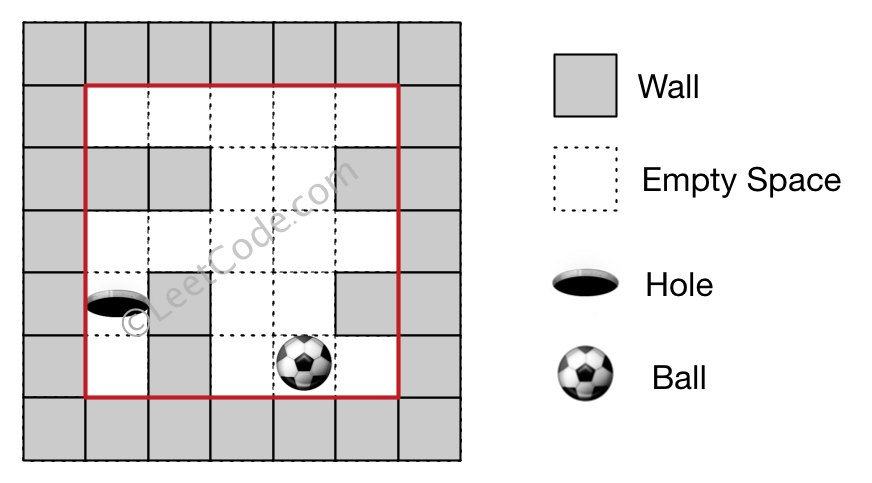
Note:
- There is only one ball and one hole in the maze.
- Both the ball and hole exist on an empty space, and they will not be at the same position initially.
- The given maze does not contain border (like the red rectangle in the example pictures), but you could assume the border of the maze are all walls.
- The maze contains at least 2 empty spaces, and the width and the height of the maze won't exceed 30.
这道题DEBUG,DE了半天,用了朴素的DFS,但还是超时在大case上了。果然已经超出了我的能力范围。
class Solution {

private:

    int arr[][] = { { , },{ ,- },{ , },{ -, } };

    vector<string> directions = { "r","l","d","u" };

public:

    string findShortestWay(vector<vector<int>>& maze, vector<int>& ball, vector<int>& hole) {

        vector<string> ret;

        set<int> visited;

        helper(maze, ball[], ball[], hole, ret, visited, "");

        sort(ret.begin(), ret.end());

        string tmpstr = "";

        if (ret.empty()) return "impossible";

        //for(auto str : ret)cout << str << endl;

        for (int i = ; i < ret[].size(); i++) {

            if (tmpstr.empty()) {

                tmpstr += ret[][i];

            }

            else {

                if (tmpstr.back() != ret[][i]) {

                    tmpstr += ret[][i];

                }

            }

        }

        return tmpstr;

    }

    void helper(vector<vector<int>>& maze, int x, int y, vector<int>& hole, vector<string>& ret, set<int>& visited, string path) {

        int m = maze.size();

        int n = maze[].size();

        if (visited.count(x * n + y)) return;

        if (!ret.empty() && path.size() > ret[].size()) return;

        visited.insert(x*n + y);

        for (int i = ; i<; i++) {

            int dx = arr[i][];

            int dy = arr[i][];

            int tmpx, tmpy;

            tmpx = x + dx;

            tmpy = y + dy;

            string tmppath = path;

            while (tmpx < m && tmpx >=  && tmpy<n && tmpy >=  && maze[tmpx][tmpy] != ) {

                    tmppath += directions[i];

                if (tmpx == hole[] && tmpy == hole[]) {

                    // cout << tmppath << endl;

                     if(ret.empty() || tmppath.size() < ret[].size()){

                       ret.clear();

                       ret.push_back(tmppath);

                     }

                     else if(tmppath.size() == ret[].size()){

                       ret.push_back(tmppath);

                     }

                    //ret.push_back(tmppath);

                    //visited.erase(x*n + y);

                    //return;

                }

                tmpx += dx; tmpy += dy;

            }

            tmpx -= dx; tmpy -= dy;

            if (tmpx == x && tmpy == y) continue;

            //cout << "tmp location " << tmpx << " and " << tmpy << endl;

            //cout << path << endl;

            helper(maze, tmpx, tmpy, hole, ret, visited, tmppath);

        }

        visited.erase(x*n + y);

    }

};
下面是我的解法的改进版,调了两个小时...
核心在于初始化一个最大值数组,记录每一个小球能滞留的点,如果这个点的值被更新且小于当前的cost直接返回,因为之前经过这个点的时候,就已经是比现在小的cost,再搜索下去没有意义。
然后在找到终点之后,更新结果,AC的结果依旧惨不忍睹。
Runtime: 160 ms, faster than 8.20% of C++ online submissions for The Maze III.
class Solution {

private:

    int arr[][] = { { , },{ ,- },{ , },{ -, } };

    vector<string> directions = { "r","l","d","u" };

public:

    string findShortestWay(vector<vector<int>>& maze, vector<int>& ball, vector<int>& hole) {

        string ret = "";

        vector<vector<int>> visited(maze.size(), vector<int>(maze[].size(), INT_MAX));

        helper(maze, ball[], ball[], hole, ret, visited, "", );

        if (ret.empty()) return "impossible";

        return ret;

    }

    void helper(vector<vector<int>>& maze, int x, int y, vector<int>& hole, string& ret, vector<vector<int>>& visited, string path, int cost) {

        int m = maze.size();

        int n = maze[].size();

        if (visited[x][y] >= cost) {

            visited[x][y] = cost;

        }

        else {

            return;

        }

        for (int i = ; i<; i++) {

            int dx = arr[i][];

            int dy = arr[i][];

            int tmpx, tmpy, tmpcost = cost;

            bool check = false, found = false, inloop = false;

            tmpx = x;

            tmpy = y;

            string tmppath = path;

            while (tmpx < m && tmpx >=  && tmpy<n && tmpy >=  && maze[tmpx][tmpy] != ) {

                if (!check) {

                    tmppath += directions[i];

                    check = true;

                }

                if (tmpx == hole[] && tmpy == hole[]) {

                    if (visited[tmpx][tmpy] > tmpcost) {

                        visited[tmpx][tmpy] = tmpcost;

                        ret = tmppath;

                    }

                    else if(visited[tmpx][tmpy] == tmpcost && ret > tmppath){

                        ret = tmppath;

                    }

                    found = true;

                }

                tmpx += dx; tmpy += dy;

                tmpcost++;

                inloop = true;

            }

            if (inloop) {

                tmpx -= dx;

                tmpy -= dy;

                tmpcost--;

            }

            if (tmpx == x && tmpy == y) continue;

            //if (found) continue;

            //cout << "tmp location " << tmpx << " and " << tmpy << endl;

            //cout << path << endl;

            helper(maze, tmpx, tmpy, hole, ret, visited, tmppath, tmpcost);

        }

    }

};
下面是网上的解法,用的是BFD。要求图上某一个点到已知点距离最近的方法就是BFS。但我觉得能存在更好的办法(Dijkstra)。
Runtime: 4 ms, faster than 100.00% of C++ online submissions for The Maze III.
#include "header.h"

class Solution {

public:

    vector<vector<int>> dir = { { ,,  },{ ,, },{ -,, },{ ,-, } };

    vector<string> ds = { "d", "r", "u", "l" };

    //d, r, u, l

    string findShortestWay(vector<vector<int>>& maze, vector<int>& ball, vector<int>& hole) {

        //2018-12-18 解决了maze I and maze II,我觉得本质上还是BFS的问题,这个时候的destination只是说变成了如果掉进了hole,那么就不在运动了这样

        //哈哈哈哈哈哈一次AC!赞!

        if (maze.empty()) return "";

        int m = maze.size();

        int n = maze[].size();

        vector<vector<pair<int, string> >> check(m, vector<pair<int, string> >(n, { INT_MAX, "" }));

        check[ball[]][ball[]] = { , "" };

        queue<pair<int, int>> q;

        q.push({ ball[], ball[] });

        while (!q.empty()) {

            int len = q.size();

            while (len) {

                auto p = q.front(); q.pop(); len--;

                for (auto d : dir) {

                    int steps = ;

                    int i = p.first; int j = p.second;

                    while (i + d[] >=  && i + d[] < m && j + d[] >=  && j + d[] < n && !maze[i + d[]][j + d[]]) {

                        i = i + d[]; j = j + d[]; steps++;

                        if (i == hole[] && j == hole[]) { break; }

                    }

                    if (check[i][j].first > check[p.first][p.second].first + steps) {

                        check[i][j].first = check[p.first][p.second].first + steps;

                        check[i][j].second = check[p.first][p.second].second + ds[d[]];

                        q.push({ i, j });

                    }

                    else if (check[i][j].first == check[p.first][p.second].first + steps) {

                        if (check[i][j].second > check[p.first][p.second].second + ds[d[]]) {

                            q.push({ i, j });

                            check[i][j].second = check[p.first][p.second].second + ds[d[]];

                        }

                    }

                }

            }

        }

        return check[hole[]][hole[]].first == INT_MAX ? "impossible" : check[hole[]][hole[]].second;

    }

};
LC 499. The Maze III 【lock,hard】的更多相关文章
- LC 245. Shortest Word Distance III 【lock, medium】
Given a list of words and two words word1 and word2, return the shortest distance between these two ...
- LC 759. Employee Free Time 【lock, hard】
We are given a list schedule of employees, which represents the working time for each employee. Each ...
- Leetcode: The Maze III(Unsolved Lock Problem)
There is a ball in a maze with empty spaces and walls. The ball can go through empty spaces by rolli ...
- LeetCode 499. The Maze III
原题链接在这里:https://leetcode.com/problems/the-maze-iii/ 题目: There is a ball in a maze with empty spaces ...
- [LeetCode] 499. The Maze III 迷宫 III
There is a ball in a maze with empty spaces and walls. The ball can go through empty spaces by rolli ...
- LC 871. Minimum Number of Refueling Stops 【lock, hard】
A car travels from a starting position to a destination which is target miles east of the starting p ...
- LC 660. Remove 9 【lock, hard】
Start from integer 1, remove any integer that contains 9 such as 9, 19, 29... So now, you will have ...
- LC 656. Coin Path 【lock, Hard】
Given an array A (index starts at 1) consisting of N integers: A1, A2, ..., AN and an integer B. The ...
- LC 244. Shortest Word Distance II 【lock, Medium】
Design a class which receives a list of words in the constructor, and implements a method that takes ...
随机推荐
- Go学习笔记【一、概述】
工作需要,即将要把部分查询计算的逻辑翻译成Go语言,来提升查询效率 在此需要对Go语言进行学习,先把入门教程浏览了一遍,发现有些语法和C很类似,还有部分类似于Python,还没有深入学习,先开个坑,业 ...
- MySQL数据库笔记二:数据类型及数据库操作
三.MySQL数据库数据类型 MySQL数据库中支持多种数据类型:数值型.字符型.日期型 常用的数据类型: 1.整型 int:整形,存储整数 int(M):M表示预期值.与存储大小和数值的范围无关. ...
- centos php7 amqp
yum install -y librabbitmq-devel /home/git/php/bin/pecl install amqp echo "extension=amqp.so&qu ...
- java_day07_异常
第七章: 异常 1.异常概述 在我们日常生活中,有时会出现各种各样的异常,例如:职工小王开车去上班,在正常情况下,小王会准时到达单位.但是天有不测风云,在小王去上班时,可能会遇到一些异常情况,比如小王 ...
- Delphi 音频播放
樊伟胜
- Delphi 图形图像对象组件
- 理解函数声明--signal函数的声明
1.显示调用首地址为0的例程:(*(void(*)())0)() 显示调用首地址为0的例程的表达式为:(*(void(*)())0)() 分两步分析: 假定变量fp是一个函数指针,调用方法如下:(*f ...
- markdown实现点击链接下载文件
今天用Markdown工具,需要实现一个点连接下载文件的功能,看起来很多简单我也没多想就直接写了,并且单个页面测试的时候也挺正常,就发布了,但是发布后使用的时候发现问题了,浏览器中直接点击链接没反应, ...
- linux常用命令(centos)
linux 命令有很多,常用的很少. #######################系统相关############################ lsb_release -a 查看系统信息 cat ...
- Android 计算器制作 2.注册View 构建函数
鄙人新手 整了 快两天 终于搞定了.. 1.首先是MainActivity 中 在Oncreate函数中 注册 2.按+ 或者 - 号 来分成两大字符串 s1 和 s2 再将s2 分为更小的s1 和 ...