
[LeetCode] 499. The Maze III 迷宫 III
There is a ball in a maze with empty spaces and walls. The ball can go through empty spaces by rolling up (u), down (d), left (l) or right (r), but it won't stop rolling until hitting a wall. When the ball stops, it could choose the next direction. There is also a hole in this maze. The ball will drop into the hole if it rolls on to the hole.
Given the ball position, the hole position and the maze, find out how the ball could drop into the hole by moving the shortest distance. The distance is defined by the number of empty spaces traveled by the ball from the start position (excluded) to the hole (included). Output the moving directions by using 'u', 'd', 'l' and 'r'. Since there could be several different shortest ways, you should output the lexicographically smallest way. If the ball cannot reach the hole, output "impossible".
The maze is represented by a binary 2D array. 1 means the wall and 0 means the empty space. You may assume that the borders of the maze are all walls. The ball and the hole coordinates are represented by row and column indexes.
Example 1
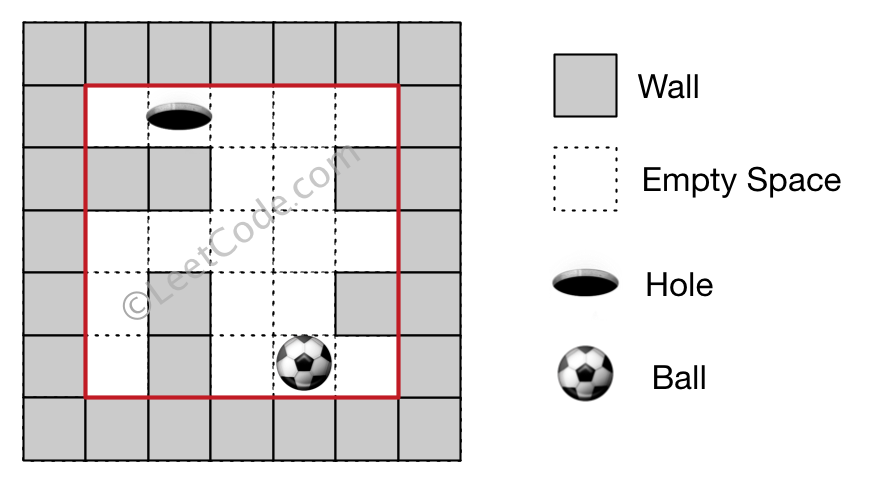
Input 1: a maze represented by a 2D array

0 0 0 0 0

1 1 0 0 1

0 0 0 0 0

0 1 0 0 1

0 1 0 0 0

Input 2: ball coordinate (rowBall, colBall) = (4, 3)

Input 3: hole coordinate (rowHole, colHole) = (0, 1)

Output: "lul"

Explanation: There are two shortest ways for the ball to drop into the hole.

The first way is left -> up -> left, represented by "lul".

The second way is up -> left, represented by 'ul'.

Both ways have shortest distance 6, but the first way is lexicographically smaller because 'l' < 'u'. So the output is "lul".
Example 2
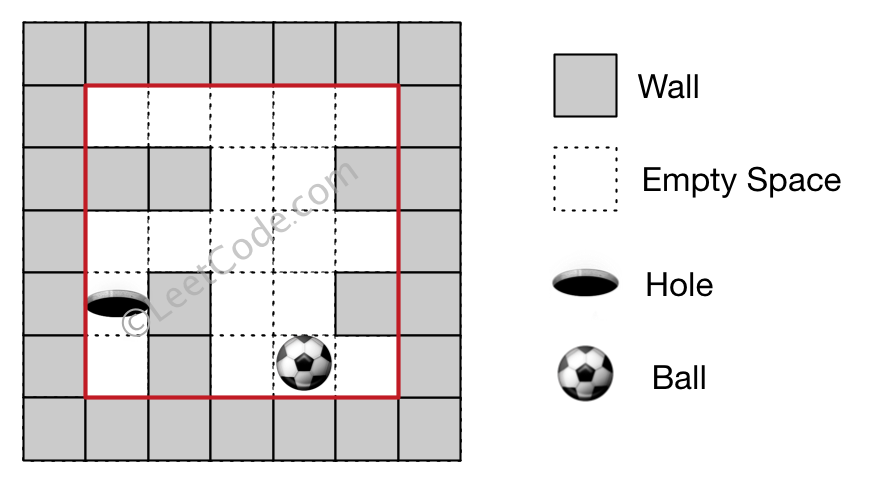
Input 1: a maze represented by a 2D array

0 0 0 0 0

1 1 0 0 1

0 0 0 0 0

0 1 0 0 1

0 1 0 0 0

Input 2: ball coordinate (rowBall, colBall) = (4, 3)

Input 3: hole coordinate (rowHole, colHole) = (3, 0)

Output: "impossible"

Explanation: The ball cannot reach the hole.
Note:
- There is only one ball and one hole in the maze.
- Both the ball and hole exist on an empty space, and they will not be at the same position initially.
- The given maze does not contain border (like the red rectangle in the example pictures), but you could assume the border of the maze are all walls.
- The maze contains at least 2 empty spaces, and the width and the height of the maze won't exceed 30.
490. The Maze 和 505. The Maze II 迷宫 II 的变形,在二维空间中放了洞,用u, r, d, l 这四个字母来分别表示上右下左,求让球掉入洞中的最小移动距离的移动方向字符串。在步数相等的情况下,返回按字母排序最小的答案。
解法1: BFS
解法2: DFS
Java:BFS,时间复杂度O(m * n * Max(m,n)),空间复杂度O(mn)
class Solution {

    class Point {

        int row, col, dist;

        public Point(int row, int col, int dist) {

            this.row = row;

            this.col = col;

            this.dist = dist;

        }

    }

    public String findShortestWay(int[][] maze, int[] ball, int[] hole) {

        if (maze == null || maze.length == 0) {

            return "";

        }

        int m = maze.length, n = maze[0].length;

        int[][] distance = new int[m][n];

        for (int i = 0; i < m; i++) {

            Arrays.fill(distance[i], Integer.MAX_VALUE);

        }

        distance[ball[0]][ball[1]] = 0;

        int[][] directions = {{-1, 0}, {1, 0}, {0, -1}, {0, 1}};

        String[] ways = {"u", "d", "l", "r"};

        Map<Integer, String> map = new HashMap<>();

        Queue<Point> queue = new LinkedList<>();

        queue.add(new Point(ball[0], ball[1], 0));

        findShortestWayByBFS(maze, queue, map, distance, hole, ways, directions);

        return map.containsKey(hole[0] * n + hole[1]) ? map.get(hole[0] * n + hole[1]) : "impossible";

    }

    public void findShortestWayByBFS(int[][] maze, Queue<Point> queue, Map<Integer, String> map, int[][] distance, int[] hole, String[] ways, int[][] directions) {

        int n = maze[0].length;

        while (!queue.isEmpty()) {

            Point curPoint = queue.remove();

            for (int i = 0; i < 4; i++) {

                int row = curPoint.row, col = curPoint.col, dist = curPoint.dist;

                String path = map.getOrDefault(row * n + col, "");

                while (isValid(row, col, maze, hole)) {

                    row += directions[i][0];

                    col += directions[i][1];

                    ++dist;

                }

                if (row != hole[0] || col != hole[1]) {

                    row -= directions[i][0];

                    col -= directions[i][1];

                    --dist;

                }

                path += ways[i];

                if (dist < distance[row][col]) {

                    distance[row][col] = dist;

                    map.put(row * n + col, path);

                    queue.add(new Point(row, col, dist));

                }

                else if (dist == distance[row][col] && path.compareTo(map.getOrDefault(row * n + col, "")) < 0) {

                    map.put(row * n + col, path);

                    queue.add(new Point(row, col, dist));

                }

            }

        }

    }

    public boolean isValid(int row, int col, int[][] maze, int[] hole) {

        return row >= 0 && row < maze.length && col >= 0 && col < maze[0].length && maze[row][col] == 0 && (row != hole[0] || col != hole[1]);

    }

}
Java:
public class Solution {

    public String findShortestWay(int[][] maze, int[] ball, int[] hole) {

        Queue<Point> queue = new LinkedList<>();

        int row = maze.length;

        int col = maze[0].length;

        Point[][] points = new Point[row][col];

        for (int i = 0; i < row; i++) {

            for (int j = 0; j < col; j++) {

                Point point = new Point(i, j);

                points[i][j] = point;

                if (i == hole[0] && j == hole[1]) {

                    point.path = "impossible";

                }

            }

        }

        int[] dirX = {0, -1, 1, 0}; // d, l, r, u

        int[] dirY = {1, 0, 0, -1};

        String[] dir = {"d", "l", "r", "u"};

        Point startPoint = points[ball[0]][ball[1]];

        startPoint.dis = 0;

        queue.add(startPoint);

        while (!queue.isEmpty()) {

            Point point = queue.poll();

            for (int i = 0; i < 4; i++) {

                int x = point.x;

                int y = point.y;

                int dis = point.dis;

                String path = point.path;

                boolean inHole = false;

                while (x >= 0 && x < row && y >= 0 && y < col && maze[x][y] == 0) {

                    x += dirX[i];

                    y += dirY[i];

                    dis++;

                    if (x == hole[0] && y == hole[1]) {

                        inHole = true;

                        break;

                    }

                }

                if (!inHole) {

                    x -= dirX[i];

                    y -= dirY[i];

                    dis--;

                }

                Point newPoint = points[x][y];

                if (newPoint.dis > dis) {

                    newPoint.dis = dis;

                    newPoint.path = String.join("", point.path, dir[i]);

                    if (!inHole) {

                        queue.add(newPoint);

                    }

                } else if (newPoint.dis == dis) {

                    boolean updated = false;

                    String newPath = String.join("", point.path, dir[i]);

                    for (int k = 0; k < newPoint.path.length() && k < newPath.length(); k++) {

                        if (newPoint.path.charAt(k) > newPath.charAt(k)) {

                            updated = true;

                            newPoint.path = newPath;

                            break;

                        }

                    }

                    if (!updated && newPoint.path.length() > newPath.length()) {

                        newPoint.path = newPath;

                    }

                }

            }

        }

        return points[hole[0]][hole[1]].path;

    }

}

class Point {

    int x;

    int y;

    String path;

    int dis;

    public Point(int x, int y) {

        this.x = x;

        this.y = y;

        this.path = "";

        this.dis = Integer.MAX_VALUE;

    }

}
C++:
class Solution {

public:

    string findShortestWay(vector<vector<int>>& maze, vector<int>& ball, vector<int>& hole) {

        int m = maze.size(), n = maze[0].size();

        vector<vector<int>> dists(m, vector<int>(n, INT_MAX));

        vector<vector<int>> dirs{{0,-1},{-1,0},{0,1},{1,0}};

        vector<char> way{'l','u','r','d'};

        queue<pair<int, int>> q;

        unordered_map<int, string> u;

        dists[ball[0]][ball[1]] = 0;

        q.push({ball[0], ball[1]});

        while (!q.empty()) {

            auto t = q.front(); q.pop();

            for (int i = 0; i < 4; ++i) {

                int x = t.first, y = t.second, dist = dists[x][y];

                string path = u[x * n + y];

                while (x >= 0 && x < m && y >= 0 && y < n && maze[x][y] == 0 && (x != hole[0] || y != hole[1])) {

                    x += dirs[i][0]; y += dirs[i][1]; ++dist;

                }

                if (x != hole[0] || y != hole[1]) {

                    x -= dirs[i][0]; y -= dirs[i][1]; --dist;

                }

                path.push_back(way[i]);

                if (dists[x][y] > dist) {

                    dists[x][y] = dist;

                    u[x * n + y] = path;

                    if (x != hole[0] || y != hole[1]) q.push({x, y});

                } else if (dists[x][y] == dist && u[x * n + y].compare(path) > 0) {

                    u[x * n + y] = path;

                    if (x != hole[0] || y != hole[1]) q.push({x, y});

                }

            }

        }

        string res = u[hole[0] * n + hole[1]];

        return res.empty() ? "impossible" : res;

    }

};
C++: DFS
class Solution {

public:

    vector<vector<int>> dirs{{0,-1},{-1,0},{0,1},{1,0}};

    vector<char> way{'l','u','r','d'};

    string findShortestWay(vector<vector<int>>& maze, vector<int>& ball, vector<int>& hole) {

        int m = maze.size(), n = maze[0].size();

        vector<vector<int>> dists(m, vector<int>(n, INT_MAX));

        unordered_map<int, string> u;

        dists[ball[0]][ball[1]] = 0;

        helper(maze, ball[0], ball[1], hole, dists, u);

        string res = u[hole[0] * n + hole[1]];

        return res.empty() ? "impossible" : res;

    }

    void helper(vector<vector<int>>& maze, int i, int j, vector<int>& hole, vector<vector<int>>& dists, unordered_map<int, string>& u) {

        if (i == hole[0] && j == hole[1]) return;

        int m = maze.size(), n = maze[0].size();

        for (int k = 0; k < 4; ++k) {

            int x = i, y = j, dist = dists[x][y];

            string path = u[x * n + y];

            while (x >= 0 && x < m && y >= 0 && y < n && maze[x][y] == 0 && (x != hole[0] || y != hole[1])) {

                x += dirs[k][0]; y += dirs[k][1]; ++dist;

            }

            if (x != hole[0] || y != hole[1]) {

                x -= dirs[k][0]; y -= dirs[k][1]; --dist;

            }

            path.push_back(way[k]);

            if (dists[x][y] > dist) {

                dists[x][y] = dist;

                u[x * n + y] = path;

                helper(maze, x, y, hole, dists, u);

            } else if (dists[x][y] == dist && u[x * n + y].compare(path) > 0) {

                u[x * n + y] = path;

                helper(maze, x, y, hole, dists, u);

            }

        }

    }

};
类似题目:
[LeetCode] 505. The Maze II 迷宫 II
All LeetCode Questions List 题目汇总
[LeetCode] 499. The Maze III 迷宫 III的更多相关文章
- [LeetCode] 505. The Maze II 迷宫 II
There is a ball in a maze with empty spaces and walls. The ball can go through empty spaces by rolli ...
- LeetCode 499. The Maze III
原题链接在这里:https://leetcode.com/problems/the-maze-iii/ 题目: There is a ball in a maze with empty spaces ...
- [LeetCode] 505. The Maze II 迷宫之二
There is a ball in a maze with empty spaces and walls. The ball can go through empty spaces by rolli ...
- 【LeetCode】556. Next Greater Element III 解题报告(Python)
[LeetCode]556. Next Greater Element III 解题报告(Python) 标签(空格分隔): LeetCode 作者: 负雪明烛 id: fuxuemingzhu 个人 ...
- 3299: [USACO2011 Open]Corn Maze玉米迷宫
3299: [USACO2011 Open]Corn Maze玉米迷宫 Time Limit: 10 Sec Memory Limit: 128 MBSubmit: 137 Solved: 59[ ...
- [LeetCode] The Maze III 迷宫之三
There is a ball in a maze with empty spaces and walls. The ball can go through empty spaces by rolli ...
- LC 499. The Maze III 【lock,hard】
There is a ball in a maze with empty spaces and walls. The ball can go through empty spaces by rolli ...
- [LeetCode] The Maze II 迷宫之二
There is a ball in a maze with empty spaces and walls. The ball can go through empty spaces by rolli ...
- [LeetCode] 490. The Maze 迷宫
There is a ball in a maze with empty spaces and walls. The ball can go through empty spaces by rolli ...
随机推荐
- 洛谷 P1032 字串变换题解
题目链接:https://www.luogu.org/problem/P1032 题目描述 已知有两个字串A,BA,B及一组字串变换的规则(至多66个规则): A_1A1 ->B_1B1 A ...
- P5431 【【模板】乘法逆元2】
卡常毒瘤题.交了一页的我. 首先容易想出暴力的做法,直接逆元累加,复杂度\(O(nlogn)\). for(register int i=1;i<=n;++i){ ll a=read(); an ...
- Python爬虫爬企查查数据
因为制作B2b网站需要,需要入库企业信息数据.所以目光锁定企查查数据,废话不多说,开干! #-*- coding-8 -*- import requests import lxml import sy ...
- Python基础初始之二
1.格式化的输出 当你遇到这样的需要:字符串中想让某些位置变成动态可传入的,首先考虑用格式化输出 1.格式化输出:% 2. 格式化输出:format 3. 格式化输出:f 2.运算符 3.编码 待续
- python_并发编程——数据共享
1.数据共享 实现进程之间的数据共享 from multiprocessing import Manager,Process class MyPro(Process): def __init__(se ...
- java项目部署
本文章只为帮助大家学习项目的发布,为基础篇,在此给大家示范在window环境下的项目部署及运维. 以下版本为讲解示例,可自行改至匹配版本. 服务器:window service2008 R2 Stan ...
- Mybatis框架-update节点元素的使用
今天我们学习一下mybatis框架中的update节点元素的使用 需求:修改用户表中的一条数据记录,修改编号为21的用户的密码 UserMapper.xml UserMapper.java 编写测试方 ...
- L1141(bfs思想)
一,看 1,整个方格图其实可以看做是一些不连通的图. 当然图内部必然是联通的. 2,遍历的技巧没什么. 方格图入队的技巧..额,是这样的 int gtid(int x,int y) { return ...
- LeetCode 708. Insert into a Cyclic Sorted List
原题链接在这里:https://leetcode.com/problems/insert-into-a-cyclic-sorted-list/ 题目: Given a node from a cycl ...
- S1_搭建分布式OpenStack集群_03 Mysql、MQ、Memcached、ETCD安装配置
一.安装mysql(contorller)controller ~]# yum -y install mariadb mariadb-server python2-PyMySQL 配置my.cnf文件 ...