
【python实现卷积神经网络】开始训练
代码来源:https://github.com/eriklindernoren/ML-From-Scratch
卷积神经网络中卷积层Conv2D(带stride、padding)的具体实现:https://www.cnblogs.com/xiximayou/p/12706576.html
激活函数的实现(sigmoid、softmax、tanh、relu、leakyrelu、elu、selu、softplus):https://www.cnblogs.com/xiximayou/p/12713081.html
损失函数定义(均方误差、交叉熵损失):https://www.cnblogs.com/xiximayou/p/12713198.html
优化器的实现(SGD、Nesterov、Adagrad、Adadelta、RMSprop、Adam):https://www.cnblogs.com/xiximayou/p/12713594.html
卷积层反向传播过程:https://www.cnblogs.com/xiximayou/p/12713930.html
全连接层实现:https://www.cnblogs.com/xiximayou/p/12720017.html
批量归一化层实现:https://www.cnblogs.com/xiximayou/p/12720211.html
池化层实现:https://www.cnblogs.com/xiximayou/p/12720324.html
padding2D实现:https://www.cnblogs.com/xiximayou/p/12720454.html
Flatten层实现:https://www.cnblogs.com/xiximayou/p/12720518.html
上采样层UpSampling2D实现:https://www.cnblogs.com/xiximayou/p/12720558.html
Dropout层实现:https://www.cnblogs.com/xiximayou/p/12720589.html
激活层实现:https://www.cnblogs.com/xiximayou/p/12720622.html
定义训练和测试过程:https://www.cnblogs.com/xiximayou/p/12725873.html
代码在mlfromscratch/examples/convolutional_neural_network.py 中:
from __future__ import print_function

from sklearn import datasets

import matplotlib.pyplot as plt

import math

import numpy as np

# Import helper functions

from mlfromscratch.deep_learning import NeuralNetwork

from mlfromscratch.utils import train_test_split, to_categorical, normalize

from mlfromscratch.utils import get_random_subsets, shuffle_data, Plot

from mlfromscratch.utils.data_operation import accuracy_score

from mlfromscratch.deep_learning.optimizers import StochasticGradientDescent, Adam, RMSprop, Adagrad, Adadelta

from mlfromscratch.deep_learning.loss_functions import CrossEntropy

from mlfromscratch.utils.misc import bar_widgets

from mlfromscratch.deep_learning.layers import Dense, Dropout, Conv2D, Flatten, Activation, MaxPooling2D

from mlfromscratch.deep_learning.layers import AveragePooling2D, ZeroPadding2D, BatchNormalization, RNN

def main():

    #----------

    # Conv Net

    #----------

    optimizer = Adam()

    data = datasets.load_digits()

    X = data.data

    y = data.target

    # Convert to one-hot encoding

    y = to_categorical(y.astype("int"))

    X_train, X_test, y_train, y_test = train_test_split(X, y, test_size=0.4, seed=1)

    # Reshape X to (n_samples, channels, height, width)

    X_train = X_train.reshape((-1,1,8,8))

    X_test = X_test.reshape((-1,1,8,8))

    clf = NeuralNetwork(optimizer=optimizer,

                        loss=CrossEntropy,

                        validation_data=(X_test, y_test))

    clf.add(Conv2D(n_filters=16, filter_shape=(3,3), stride=1, input_shape=(1,8,8), padding='same'))

    clf.add(Activation('relu'))

    clf.add(Dropout(0.25))

    clf.add(BatchNormalization())

    clf.add(Conv2D(n_filters=32, filter_shape=(3,3), stride=1, padding='same'))

    clf.add(Activation('relu'))

    clf.add(Dropout(0.25))

    clf.add(BatchNormalization())

    clf.add(Flatten())

    clf.add(Dense(256))

    clf.add(Activation('relu'))

    clf.add(Dropout(0.4))

    clf.add(BatchNormalization())

    clf.add(Dense(10))

    clf.add(Activation('softmax'))

    print ()

    clf.summary(name="ConvNet")

    train_err, val_err = clf.fit(X_train, y_train, n_epochs=50, batch_size=256)

    # Training and validation error plot

    n = len(train_err)

    training, = plt.plot(range(n), train_err, label="Training Error")

    validation, = plt.plot(range(n), val_err, label="Validation Error")

    plt.legend(handles=[training, validation])

    plt.title("Error Plot")

    plt.ylabel('Error')

    plt.xlabel('Iterations')

    plt.show()

    _, accuracy = clf.test_on_batch(X_test, y_test)

    print ("Accuracy:", accuracy)

    y_pred = np.argmax(clf.predict(X_test), axis=1)

    X_test = X_test.reshape(-1, 8*8)

    # Reduce dimension to 2D using PCA and plot the results

    Plot().plot_in_2d(X_test, y_pred, title="Convolutional Neural Network", accuracy=accuracy, legend_labels=range(10))

if __name__ == "__main__":

    main()
我们还是一步步进行分析:
1、优化器使用Adam()
2、数据集使用的是sklearn.datasets中的手写数字,其部分数据如下:
(1797, 64)

(1797,)

[[ 0.  0.  5. 13.  9.  1.  0.  0.  0.  0. 13. 15. 10. 15.  5.  0.  0.  3.

  15.  2.  0. 11.  8.  0.  0.  4. 12.  0.  0.  8.  8.  0.  0.  5.  8.  0.

   0.  9.  8.  0.  0.  4. 11.  0.  1. 12.  7.  0.  0.  2. 14.  5. 10. 12.

   0.  0.  0.  0.  6. 13. 10.  0.  0.  0.]

 [ 0.  0.  0. 12. 13.  5.  0.  0.  0.  0.  0. 11. 16.  9.  0.  0.  0.  0.

   3. 15. 16.  6.  0.  0.  0.  7. 15. 16. 16.  2.  0.  0.  0.  0.  1. 16.

  16.  3.  0.  0.  0.  0.  1. 16. 16.  6.  0.  0.  0.  0.  1. 16. 16.  6.

   0.  0.  0.  0.  0. 11. 16. 10.  0.  0.]

 [ 0.  0.  0.  4. 15. 12.  0.  0.  0.  0.  3. 16. 15. 14.  0.  0.  0.  0.

   8. 13.  8. 16.  0.  0.  0.  0.  1.  6. 15. 11.  0.  0.  0.  1.  8. 13.

  15.  1.  0.  0.  0.  9. 16. 16.  5.  0.  0.  0.  0.  3. 13. 16. 16. 11.

   5.  0.  0.  0.  0.  3. 11. 16.  9.  0.]

 [ 0.  0.  7. 15. 13.  1.  0.  0.  0.  8. 13.  6. 15.  4.  0.  0.  0.  2.

   1. 13. 13.  0.  0.  0.  0.  0.  2. 15. 11.  1.  0.  0.  0.  0.  0.  1.

  12. 12.  1.  0.  0.  0.  0.  0.  1. 10.  8.  0.  0.  0.  8.  4.  5. 14.

   9.  0.  0.  0.  7. 13. 13.  9.  0.  0.]

 [ 0.  0.  0.  1. 11.  0.  0.  0.  0.  0.  0.  7.  8.  0.  0.  0.  0.  0.

   1. 13.  6.  2.  2.  0.  0.  0.  7. 15.  0.  9.  8.  0.  0.  5. 16. 10.

   0. 16.  6.  0.  0.  4. 15. 16. 13. 16.  1.  0.  0.  0.  0.  3. 15. 10.

   0.  0.  0.  0.  0.  2. 16.  4.  0.  0.]

 [ 0.  0. 12. 10.  0.  0.  0.  0.  0.  0. 14. 16. 16. 14.  0.  0.  0.  0.

  13. 16. 15. 10.  1.  0.  0.  0. 11. 16. 16.  7.  0.  0.  0.  0.  0.  4.

   7. 16.  7.  0.  0.  0.  0.  0.  4. 16.  9.  0.  0.  0.  5.  4. 12. 16.

   4.  0.  0.  0.  9. 16. 16. 10.  0.  0.]

 [ 0.  0.  0. 12. 13.  0.  0.  0.  0.  0.  5. 16.  8.  0.  0.  0.  0.  0.

  13. 16.  3.  0.  0.  0.  0.  0. 14. 13.  0.  0.  0.  0.  0.  0. 15. 12.

   7.  2.  0.  0.  0.  0. 13. 16. 13. 16.  3.  0.  0.  0.  7. 16. 11. 15.

   8.  0.  0.  0.  1.  9. 15. 11.  3.  0.]

 [ 0.  0.  7.  8. 13. 16. 15.  1.  0.  0.  7.  7.  4. 11. 12.  0.  0.  0.

   0.  0.  8. 13.  1.  0.  0.  4.  8.  8. 15. 15.  6.  0.  0.  2. 11. 15.

  15.  4.  0.  0.  0.  0.  0. 16.  5.  0.  0.  0.  0.  0.  9. 15.  1.  0.

   0.  0.  0.  0. 13.  5.  0.  0.  0.  0.]

 [ 0.  0.  9. 14.  8.  1.  0.  0.  0.  0. 12. 14. 14. 12.  0.  0.  0.  0.

   9. 10.  0. 15.  4.  0.  0.  0.  3. 16. 12. 14.  2.  0.  0.  0.  4. 16.

  16.  2.  0.  0.  0.  3. 16.  8. 10. 13.  2.  0.  0.  1. 15.  1.  3. 16.

   8.  0.  0.  0. 11. 16. 15. 11.  1.  0.]

 [ 0.  0. 11. 12.  0.  0.  0.  0.  0.  2. 16. 16. 16. 13.  0.  0.  0.  3.

  16. 12. 10. 14.  0.  0.  0.  1. 16.  1. 12. 15.  0.  0.  0.  0. 13. 16.

   9. 15.  2.  0.  0.  0.  0.  3.  0.  9. 11.  0.  0.  0.  0.  0.  9. 15.

   4.  0.  0.  0.  9. 12. 13.  3.  0.  0.]]

[0 1 2 3 4 5 6 7 8 9]
3、接着有一个to_categorical()函数,在mlfromscratch.utils下的data_manipulation.py中:
def to_categorical(x, n_col=None):

    """ One-hot encoding of nominal values """

    if not n_col:

        n_col = np.amax(x) + 1

    one_hot = np.zeros((x.shape[0], n_col))

    one_hot[np.arange(x.shape[0]), x] = 1

    return one_hot
用于将标签转换为one-hot编码。
4、划分训练集和测试集:train_test_split(),在mlfromscratch.utils下的data_manipulation.py中:
def train_test_split(X, y, test_size=0.5, shuffle=True, seed=None):

    """ Split the data into train and test sets """

    if shuffle:

        X, y = shuffle_data(X, y, seed)

    # Split the training data from test data in the ratio specified in

    # test_size

    split_i = len(y) - int(len(y) // (1 / test_size))

    X_train, X_test = X[:split_i], X[split_i:]

    y_train, y_test = y[:split_i], y[split_i:]

    return X_train, X_test, y_train, y_test
5、由于卷积神经网络的输入是[batchsize,channel,wheight,width]的维度,因此要将原始数据进行转换,即将(1797,64)转换为(1797,1,8,8)格式的数据。这里batchsize就是样本的数量。
6、定义卷积神经网络的训练和测试过程:包括优化器、损失函数、测试数据
7、定义模型结构
8、输出模型每层的类型、参数数量以及输出大小
9、将数据输入到模型中,设置epochs的大小以及batch_size的大小
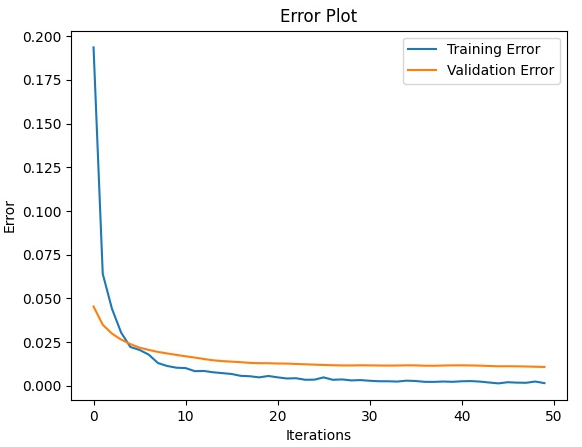
10、计算训练和测试的错误,并绘制成图
11、计算准确率
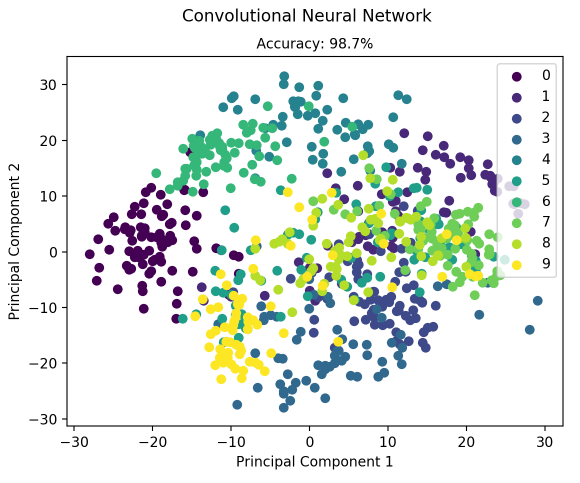
12、绘制测试集中每一类预测的结果,这里有一个plot_in_2d()函数,位于mlfromscratch.utils下的misc.py中
 # Plot the dataset X and the corresponding labels y in 2D using PCA.

    def plot_in_2d(self, X, y=None, title=None, accuracy=None, legend_labels=None):

        X_transformed = self._transform(X, dim=2)

        x1 = X_transformed[:, 0]

        x2 = X_transformed[:, 1]

        class_distr = []

        y = np.array(y).astype(int)

        colors = [self.cmap(i) for i in np.linspace(0, 1, len(np.unique(y)))]

        # Plot the different class distributions

        for i, l in enumerate(np.unique(y)):

            _x1 = x1[y == l]

            _x2 = x2[y == l]

            _y = y[y == l]

            class_distr.append(plt.scatter(_x1, _x2, color=colors[i]))

        # Plot legend

        if not legend_labels is None:

            plt.legend(class_distr, legend_labels, loc=1)

        # Plot title

        if title:

            if accuracy:

                perc = 100 * accuracy

                plt.suptitle(title)

                plt.title("Accuracy: %.1f%%" % perc, fontsize=10)

            else:

                plt.title(title)

        # Axis labels

        plt.xlabel('Principal Component 1')

        plt.ylabel('Principal Component 2')

        plt.show()
接下来就可以实际进行操作了,我是在谷歌colab中,首先使用:
!git clone https://github.com/eriklindernoren/ML-From-Scratch.git
将相关代码复制下来。
然后进行安装:在ML-From-Scratch目录下输入:
!python setup.py install
最后输入:
!python mlfromscratch/examples/convolutional_neural_network.py
最终结果:
+---------+

| ConvNet |

+---------+

Input Shape: (1, 8, 8)

+----------------------+------------+--------------+

| Layer Type           | Parameters | Output Shape |

+----------------------+------------+--------------+

| Conv2D               | 160        | (16, 8, 8)   |

| Activation (ReLU)    | 0          | (16, 8, 8)   |

| Dropout              | 0          | (16, 8, 8)   |

| BatchNormalization   | 2048       | (16, 8, 8)   |

| Conv2D               | 4640       | (32, 8, 8)   |

| Activation (ReLU)    | 0          | (32, 8, 8)   |

| Dropout              | 0          | (32, 8, 8)   |

| BatchNormalization   | 4096       | (32, 8, 8)   |

| Flatten              | 0          | (2048,)      |

| Dense                | 524544     | (256,)       |

| Activation (ReLU)    | 0          | (256,)       |

| Dropout              | 0          | (256,)       |

| BatchNormalization   | 512        | (256,)       |

| Dense                | 2570       | (10,)        |

| Activation (Softmax) | 0          | (10,)        |

+----------------------+------------+--------------+

Total Parameters: 538570

Training: 100% [------------------------------------------------] Time:  0:01:32

<Figure size 640x480 with 1 Axes>

Accuracy: 0.9846796657381616

<Figure size 640x480 with 1 Axes>
至此,结合代码一步一步看卷积神经网络的整个实现过程就完成了。通过结合代码的形式,可以加深对深度学习中卷积神经网络相关知识的理解。
【python实现卷积神经网络】开始训练的更多相关文章
- 基于Python的卷积神经网络和特征提取
基于Python的卷积神经网络和特征提取 用户1737318发表于人工智能头条订阅 224 在这篇文章中: Lasagne 和 nolearn 加载MNIST数据集 ConvNet体系结构与训练 预测 ...
- 《TensorFlow实战》中AlexNet卷积神经网络的训练中
TensorFlow实战中AlexNet卷积神经网络的训练 01 出错 TypeError: as_default() missing 1 required positional argument: ...
- python机器学习卷积神经网络(CNN)
卷积神经网络(CNN) 关注公众号"轻松学编程"了解更多. 一.简介 卷积神经网络(Convolutional Neural Network,CNN)是一种前馈神经网络,它的人 ...
- 【python实现卷积神经网络】定义训练和测试过程
代码来源:https://github.com/eriklindernoren/ML-From-Scratch 卷积神经网络中卷积层Conv2D(带stride.padding)的具体实现:https ...
- Python CNN卷积神经网络代码实现
# -*- coding: utf-8 -*- """ Created on Wed Nov 21 17:32:28 2018 @author: zhen "& ...
- 使用卷积神经网络CNN训练识别mnist
算的的上是自己搭建的第一个卷积神经网络.网络结构比较简单. 输入为单通道的mnist数据集.它是一张28*28,包含784个特征值的图片 我们第一层输入,使用5*5的卷积核进行卷积,输出32张特征图, ...
- 【python实现卷积神经网络】卷积层Conv2D反向传播过程
代码来源:https://github.com/eriklindernoren/ML-From-Scratch 卷积神经网络中卷积层Conv2D(带stride.padding)的具体实现:https ...
- 【python实现卷积神经网络】激活函数的实现(sigmoid、softmax、tanh、relu、leakyrelu、elu、selu、softplus)
代码来源:https://github.com/eriklindernoren/ML-From-Scratch 卷积神经网络中卷积层Conv2D(带stride.padding)的具体实现:https ...
- 【python实现卷积神经网络】损失函数的定义(均方误差损失、交叉熵损失)
代码来源:https://github.com/eriklindernoren/ML-From-Scratch 卷积神经网络中卷积层Conv2D(带stride.padding)的具体实现:https ...
随机推荐
- Natas32 Writeup(Perl 远程代码执行)
Natas32: 打开后和natas31相似的界面,并且提示,这次您需要证明可以远程代码执行,Webroot中有一个二进制文件可以执行. my $cgi = CGI->new; if ($cgi ...
- Natas20 Writeup(Session登录,注入参数)
Natas20: 读取源码,发现把sessionID存到了文件中,按键值对存在,以空格分隔,如果$_SESSION["admin"]==1,则成功登陆,得到flag.并且通过查询所 ...
- weblogic漏洞练习
About WebLogic WebLogic是美商Oracle的主要产品之一,系购并得来.是商业市场上主要的Java(J2EE)应用服务器软件(application server)之一,是世界上第 ...
- python https请求报错:SSLCertVerificationError: [SSL: CERTIFICATE_VERIFY_FAILED]
python爬虫,使用requests库发送https请求报错:SSLCertVerificationError: [SSL: CERTIFICATE_VERIFY_FAILED] 解决方法: imp ...
- 五分钟学后端技术:如何学习Redis、memcache等常用缓存技术
原创声明 本文作者:黄小斜 转载请务必在文章开头注明出处和作者. 本文思维导图 什么是缓存 计算机中的缓存 做后端开发的同学,想必对缓存都不会陌生了,平时我们可能会使用Redis,MemCache这类 ...
- 回文串的Manacher算法
Manacher算法较传统算法的优化之处在于它对每个回文中心寻找回文半径的时候并不是都从半径为1开始找的,而是利用前面已经完成的任务,寻找一个初始的开始搜索的半径大小,复杂度是线性的. 参考博客:ht ...
- [dfs] HDU 2019 Multi-University Training Contest 10 - Block Breaker
Block Breaker Time Limit: 2000/2000 MS (Java/Others) Memory Limit: 524288/524288 K (Java/Others)T ...
- OpenCV-Python 理解特征 | 三十六
目标 在本章中,我们将尝试理解什么是特征,为什么拐角重要等等 解释 你们大多数人都会玩拼图游戏.你会得到很多小图像,需要正确组装它们以形成大的真实图像.问题是,你怎么做?将相同的理论投影到计算机程序上 ...
- Docker容器入门-基本命令的使用
目前容器技术使用相当广泛 不会或者没有使用过容器感觉都不像是个搞技术的 所以,我也就docker相关内容做一个整理 只有不断的学习,才能保持自己的竞争力 什么是容器? 容器是一种轻量级.可移植.自包含 ...
- [一起读源码]走进C#并发队列ConcurrentQueue的内部世界
决定从这篇文章开始,开一个读源码系列,不限制平台语言或工具,任何自己感兴趣的都会写.前几天碰到一个小问题又读了一遍ConcurrentQueue的源码,那就拿C#中比较常用的并发队列Concurren ...