
S-Trees UVA - 712
A Strange Tree (S-tree) over the variable set Xn = {x1,x2,...,xn} is a binary tree representing a Boolean function f : {0,1}n → {0,1}. Each path of the S-tree begins at the root node and consists of n + 1 nodes. Each of the S-tree’s nodes has a depth, which is the amount of nodes between itself and the root (so the root has depth 0). The nodes with depth less than n are called non-terminal nodes. All non-terminal nodes have two children: the right child and the left child. Each non-terminal node is marked with some variable xi from the variable set Xn. All non-terminal nodes with the same depth are marked with the same variable, and non-terminal nodes with different depth are marked with different variables. So, there is a unique variable xi1 corresponding to the root, a unique variable xi2 corresponding to the nodes with depth 1, and so on. The sequence of the variables xi1, xi2, ..., xi**n is called the variable ordering. The nodes having depth n are called terminal nodes. They have no children and are marked with either 0 or 1. Note that the variable ordering and the distribution of 0’s and 1’s on terminal nodes are sufficient to completely describe an S-tree.
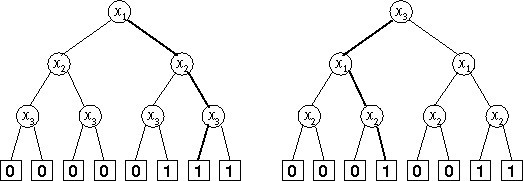
As stated earlier, each S-tree represents a Boolean function f. If you have an S-tree and values for the variables x1, x2, ..., xn, then it is quite simple to find out what f(x1,x2,...,xn) is: start with the root. Now repeat the following: if the node you are at is labelled with a variable xi, then depending on whether the value of the variable is 1 or 0, you go its right or left child, respectively. Once you reach a terminal node, its label gives the value of the function.
Figure 1: S-trees for the function x1∧ (x2∨ x3)
On the picture, two S-trees representing the same Boolean function, f(x1,x2,x3) = x1∧ (x2∨ x3), are shown. For the left tree, the variable ordering is x1,x2,x3, and for the right tree it is x3,x1,x2.
The values of the variables x1, x2, ..., xn, are given as a Variable Values Assignment (VVA)
(x1 = b1,x2 = b2,...,xn = bn)
with b1,b2,...,bn ∈ {0,1}. For instance, (x1 = 1, x2 = 1, x3 = 0) would be a valid VVA for n = 3, resulting for the sample function above in the value f(1,1,0) = 1 ∧ (1 ∨ 0) = 1. The corresponding paths are shown bold in the picture.
Your task is to write a program which takes an S-tree and some VVAs and computes f(x1,x2,...,xn) as described above.
Input
The input file contains the description of several S-trees with associated VVAs which you have to process. Each description begins with a line containing a single integer n, 1 ≤ n ≤ 7, the depth of the S-tree. This is followed by a line describing the variable ordering of the S-tree. The format of that line is xi1 xi2 ... xi**n. (There will be exactly n different space-separated strings). So, for n = 3 and the variable ordering x3, x1, x2, this line would look as follows: x3 x1 x2
In the next line the distribution of 0’s and 1’s over the terminal nodes is given. There will be exactly 2n characters (each of which can be ‘0’ or ‘1’), followed by the new-line character. The characters are given in the order in which they appear in the S-tree, the first character corresponds to the leftmost terminal node of the S-tree, the last one to its rightmost terminal node.
The next line contains a single integer m, the number of VVAs, followed by m lines describing them. Each of the m lines contains exactly n characters (each of which can be ‘0’ or ‘1’), followed by a new-line character. Regardless of the variable ordering of the S-tree, the first character always describes the value of x1, the second character describes the value of x2, and so on. So, the line
110
corresponds to the VVA (x1 = 1, x2 = 1, x3 = 0).
The input is terminated by a test case starting with n = 0. This test case should not be processed.
Output
For each S-tree, output the line ‘S-Tree #j:’, where j is the number of the S-tree. Then print a line that contains the value of f(x1,x2,...,xn) for each of the given m VVAs, where f is the function defined by the S-tree.
Output a blank line after each test case.
Sample Input
3

x1 x2 x3

00000111

4

000

010

111

110

3

x3 x1 x2

00010011

4

000

010

111

110

0
Sample Output
S-Tree #1:

0011

S-Tree #2:

0011
HINT
理解这个题意需要知道以下几点:
- 二叉树为满二叉树,编号为k的结点必须有两个孩子,左节点的编号为2k,右节点的编号为2k+1.
- 每一层都对应一个变量,比如第一、二、三层对应变量分别为 x2,x1,x3。
- 二叉树最大右7层,利用暑促足以存储满二叉树。
- 计算VVA时,输入的每一个字符串都是从对应的x1,x2,x3...的顺序展开。即:第一个字符总是描述x1的值,第二个字符描述x2的值,以此类推。因此,第110行对应于VVA(x1= 1,x2= 1,x3= 0)。
- 输出VAA的时候要输出连个回车我,也即是没两个样例有一个空行,包括最后一行。
解决思路:
由于每一等的变量的编号可能发生变化,因此使用输出来存储对应的变量编号,如第一层为x3,则数组x[0]=3。然后根据输入的串一直计算到叶子结点的位置,保存,输出。
Accepted
#include<bits/stdc++.h>

using namespace std;

int main() {

	int deep, num,sum,temp,tree=1;

	string s,vva,result;

	vector<int>x;

	while (cin >> deep && deep) {

		x.clear();result.clear();temp = 1;

		sum = pow(2,deep);

		for (int i = 0;i < deep;i++) {

			cin >> s;

			x.push_back(((int)(s.back() - '0')));

		}

		cin >> s >> num;

		for (int i = 0;i < num;i++) {

			cin >> vva;

			for (int j=0;j < vva.length();j++) {

				if (vva[x[j]-1] == '1')temp = 2 * temp + 1;

				else if (vva[x[j]-1] == '0')temp = 2 * temp;

			}

			result.push_back(s[temp - sum]);temp = 1;

		}

		cout << "S-Tree #" << tree++ << ':' << endl << result << endl << endl;

	}

}
S-Trees UVA - 712的更多相关文章
- UVa 712 S树
https://uva.onlinejudge.org/index.php?option=com_onlinejudge&Itemid=8&page=show_problem& ...
- UVA 712 S-Trees
二叉树? 怒水~~ 注意一下查询与x值的对应关系就好~ #include <iostream> #include <cstring> #include <cstdio&g ...
- BFS+数据处理 Under the Trees UVa
题意:将多叉树转化为括号表示法,每个非叶结点的正下方都有一个'|'然后下方是一排'-'和字符,恰好覆盖所有子结点的正上方,单独的一行'#'为数据的结束标志 解题思路:用gets将字符数组输入,本题不用 ...
- UVa 712
这个题根本不用建树,因为是完全二叉树,可以把这个想成二进制.对于根是二进制数的首位,之后依次类推.到最后的叶子节点就是从0到pow(2,n)-1. 关键在于在第一次输入的不是按照x1,x2,x3,x4 ...
- 【紫书】Undraw the Trees UVA - 10562 递归,字符串
题意:给你画了一颗树,你要把它的前序输出. 题解:读进到二维数组.边解析边输出. 坑:少打了个-1. #define _CRT_SECURE_NO_WARNINGS #include<cstri ...
- 看图写树 (Undraw the Trees UVA - 10562)
题目描述: 原题:https://vjudge.net/problem/UVA-10562 题目思路: 递归找结点 //自己的代码测试过了,一直WA,贴上紫书的代码 AC代码 #include< ...
- UVa 712 S-Trees(二进制转换 二叉树叶子)
题意: 给定一颗n层的二叉树的叶子, 然后给定每层走的方向, 0代表左边, 1代表右边, 求到达的是那一个叶子. 每层有一个编号, 然后n层的编号是打乱的, 但是给的顺序是从1到n. 分析: 先用一个 ...
- 【习题 6-2 UVA - 712】S-Trees
[链接] 我是链接,点我呀:) [题意] 在这里输入题意 [题解] dfs模拟一下就好. 先预处理一个dfs. 搞出来x叶子节点它的值是什么 [代码] /* 1.Shoud it use long l ...
- UVA - 712 S-Trees(S树)
题意:0往左走,1往右走,已知所有叶子的值,每个查询都是根结点到叶子结点的路径,路径的每一个点分别对应着x1,x2,x3……但是实际上的S树的路径可能并非是x1,x2,x3…… 分析:先存路径变量的顺 ...
随机推荐
- linux 安装软件步骤
1,下载wget http://www.erlang.org/download/otp_src_R16B02.tar.gz2,解压 tar -zxvf otp_src_R16B02.tar.gz3,编 ...
- mysql索引的性能分析
[前言]上一篇博客介绍了InnoDB引擎的索引机制,主要围绕B+树的建立,目录项记录里主键和页号,到页目录下的二分法定位数据:二级索引里的主键和索引列,及其回表操作.这一篇分析一下索引的性能,围绕如何 ...
- 由剑指offer引发的思考——对象中虚函数指针的大小
先看一个简单的问题: 一.定义一个空的类型,对于其对象我们sizeof其大小,是1字节.因为我们定义一个类型,编译器必须为其分配空间,具体分配多少是编译器决定,vs是1字节,分配在栈区. 那,这一个字 ...
- new String("abc"),到底在不在常量池中存储"abc"?
String str = new String("Hello World"); 问之:这行代码到底有没有在字符串常量池中创建"Hello World"字符串呢? ...
- add_header被覆盖 -配置错误
Nginx的配置文件分为Server.Location.If等一些配置块,并且存在包含关系,和编程语言比较类似.如果在外层配置的一些选项,是可以被继承到内层的. 但这里的继承也有一些特性,比如add_ ...
- C# 应用 - 多线程 5) 死锁
两个线程中的每一个线程都尝试锁定另外一个线程已锁定的资源时,就会发生死锁. 两个线程都不能继续执行. 托管线程处理类的许多方法都提供了超时设定,有助于检测死锁. 例如,下面的代码尝试在 lockObj ...
- ProBuilder快速原型开发技术 ---模型精细化操作
前面我们讲解了很多ProBuilder功能,但是对于制作一款复杂的模型来说,还远远不够.需要更多的对于模型细节的处理,这就是本篇文章要讲解的"模型精细化操作"技术. 关于PB对于模 ...
- postman接口自动化测试之添加Tests检查点
一.概念 Postman的Tests本质上是JavaScript代码,通过我们编写测试代码,每一个Tests返回True,或是False,以判断接口返回的正确性. 其实,每一个Tests实际上就是一个 ...
- Java并发编程之同步/并发集合
同步集合 Java中同步集合如下: Vector:基于数组的线程安全集合,扩容默认增加1倍(ArrayList50%) Stack:继承于Vector,基于动态数组实现的一个线程安全的栈 Hashta ...
- [换根DP]luogu P3647 [APIO2014]连珠线
题面 https://www.luogu.com.cn/problem/P3647 不重复地取树中相邻的两条边,每次得分为两条边权和,问最大得分 分析 容易想到状态 f[i][0/1] 分别表示 i ...