
《机器学习Python实现_10_10_集成学习_xgboost_原理介绍及回归树的简单实现》
一.简介
xgboost在集成学习中占有重要的一席之位,通常在各大竞赛中作为杀器使用,同时它在工业落地上也很方便,目前针对大数据领域也有各种分布式实现版本,比如xgboost4j-spark,xgboost4j-flink等。xgboost的基础也是gbm,即梯度提升模型,它在此基础上做了进一步优化...
二.损失函数:引入二阶项
xgboost的损失函数构成如下,即一个经验损失项+正则损失项:
\]
这里\(n\)表示样本数,\(F_{m-1}\)表示前\(m-1\)轮模型,\(f_m\)表示第\(m\)轮新训练模型,所以\(F_m=F_{m-1}+f_m\),\(\Omega(f_m)\)是对第\(m\)轮新训练模型进行约束的正则化项,在前面第6小节做过探索,对损失函数近似做二阶泰勒展开,并对近似损失函数做优化,通常会收敛的更快更好,接下里看下对第\(i\)个样本的经验项损失函数做二阶展开:
\]
这里:
h_i=\frac{\partial^2 L(y_i,F_{m-1}(x_i))}{\partial {F_{m-1}(x_i)}^2}
\]
对于第\(m\)轮,\(L(y_i,F_{m-1}(x_i))\)为常数项,不影响优化,可以省略掉,所以损失函数可以表示为如下:
\]
这便是xgboost的学习框架,针对不同问题,比如回归、分类、排序,会有不同的\(L(\cdot)\)以及\(\Omega(\cdot)\),另外由于需要二阶信息,所以\(L(\cdot)\)必须要能二阶可微,接下来对基学习器为决策树的情况做推导
三.基学习器:回归决策树
下面推导一下基学习器为回归树的情况,当选择决策树时,它的正则化项如下:
\]
其中,\(j=1,2,...,T\)表达对应的叶节点编号,\(\omega_j\)表示落在第\(j\)个叶节点的样本的预测值,即:
\]
\(I_j\)表示第\(j\)个叶子节点所属区域,所以决策树的损失函数可以改写为如下:
\]
这其实是关于\(\omega\)的一元二次函数,直接写出它的最优解:
\]
这里\(G_j=\sum_{i\in I_j}g_i,H_j=\sum_{i\in I_j}h_i\),可见\(L_2\)正则项起到了缩小叶子节点权重的效果,减少其对整个预测结果的影响,从而防止过拟合,将\(\omega_j^*\)带入可得损失值:
\]
特征选择
很显然,上面的损失函数可以直接用于特征选择中,对某节点在分裂前的评分为:
\]
分裂后,左右子节点的评分和为:
\]
所以分裂所能带来的增益:
\]
这里\(G=G_L+G_R,H=H_L+H_R\)
四.代码实现
这部分对xgboost中的回归树做简单实现,大体流程其实与CART回归树差不多,下面说下它与CART回归树不一样的几个点:
(1)这里fit与之前的CART回归树有些不一样了,之前是fit(x,y),而现在需要fit(x,g,h);
(2)特征选择不一样了,之前是求平方误差的增益,现在需要利用一阶和二阶导数信息,见上面的\(Score\)
(3)叶子节点的预测值不一样了,之前是求均值,现在需利用一阶和二阶导数信息,见上面的\(w_j^*\)
接下来对xgboost所需要用到的回归树做简单实现
import os

os.chdir('../')

import numpy as np

from ml_models.wrapper_models import DataBinWrapper

"""

xgboost基模型:回归树的实现,封装到ml_models.ensemble

"""

class XGBoostBaseTree(object):

    class Node(object):

        """

        树节点,用于存储节点信息以及关联子节点

        """

        def __init__(self, feature_index: int = None, feature_value=None, y_hat=None, score=None,

                     left_child_node=None, right_child_node=None, num_sample: int = None):

            """

            :param feature_index: 特征id

            :param feature_value: 特征取值

            :param y_hat: 预测值

            :param score: 损失函数值

            :param left_child_node: 左孩子结点

            :param right_child_node: 右孩子结点

            :param num_sample:样本量

            """

            self.feature_index = feature_index

            self.feature_value = feature_value

            self.y_hat = y_hat

            self.score = score

            self.left_child_node = left_child_node

            self.right_child_node = right_child_node

            self.num_sample = num_sample

    def __init__(self, max_depth=None, min_samples_split=2, min_samples_leaf=1, gamma=1e-2, lamb=1e-1,

                 max_bins=10):

        """

        :param max_depth:树的最大深度

        :param min_samples_split:当对一个内部结点划分时,要求该结点上的最小样本数,默认为2

        :param min_samples_leaf:设置叶子结点上的最小样本数,默认为1

        :param gamma:即损失函数中的gamma

        :param lamb:即损失函数中lambda

        """

        self.max_depth = max_depth

        self.min_samples_split = min_samples_split

        self.min_samples_leaf = min_samples_leaf

        self.gamma = gamma

        self.lamb = lamb

        self.root_node: self.Node = None

        self.dbw = DataBinWrapper(max_bins=max_bins)

    def _score(self, g, h):

        """

        计算损失损失评分

        :param g:一阶导数

        :param h: 二阶导数

        :return:

        """

        G = np.sum(g)

        H = np.sum(h)

        return -0.5 * G ** 2 / (H + self.lamb) + self.gamma

    def _build_tree(self, current_depth, current_node: Node, x, g, h):

        """

        递归进行特征选择,构建树

        :param x:

        :param y:

        :param sample_weight:

        :return:

        """

        rows, cols = x.shape

        # 计算G和H

        G = np.sum(g)

        H = np.sum(h)

        # 计算当前的预测值

        current_node.y_hat = -1 * G / (H + self.lamb)

        current_node.num_sample = rows

        # 判断停止切分的条件

        current_node.score = self._score(g, h)

        if rows < self.min_samples_split:

            return

        if self.max_depth is not None and current_depth > self.max_depth:

            return

        # 寻找最佳的特征以及取值

        best_index = None

        best_index_value = None

        best_criterion_value = 0

        for index in range(0, cols):

            for index_value in sorted(set(x[:, index])):

                left_indices = np.where(x[:, index] <= index_value)

                right_indices = np.where(x[:, index] > index_value)

                criterion_value = current_node.score - self._score(g[left_indices], h[left_indices]) - self._score(

                    g[right_indices], h[right_indices])

                if criterion_value > best_criterion_value:

                    best_criterion_value = criterion_value

                    best_index = index

                    best_index_value = index_value

        # 如果减少不够则停止

        if best_index is None:

            return

        # 切分

        current_node.feature_index = best_index

        current_node.feature_value = best_index_value

        selected_x = x[:, best_index]

        # 创建左孩子结点

        left_selected_index = np.where(selected_x <= best_index_value)

        # 如果切分后的点太少,以至于都不能做叶子节点,则停止分割

        if len(left_selected_index[0]) >= self.min_samples_leaf:

            left_child_node = self.Node()

            current_node.left_child_node = left_child_node

            self._build_tree(current_depth + 1, left_child_node, x[left_selected_index], g[left_selected_index],

                             h[left_selected_index])

        # 创建右孩子结点

        right_selected_index = np.where(selected_x > best_index_value)

        # 如果切分后的点太少,以至于都不能做叶子节点,则停止分割

        if len(right_selected_index[0]) >= self.min_samples_leaf:

            right_child_node = self.Node()

            current_node.right_child_node = right_child_node

            self._build_tree(current_depth + 1, right_child_node, x[right_selected_index], g[right_selected_index],

                             h[right_selected_index])

    def fit(self, x, g, h):

        # 构建空的根节点

        self.root_node = self.Node()

        # 对x分箱

        self.dbw.fit(x)

        # 递归构建树

        self._build_tree(1, self.root_node, self.dbw.transform(x), g, h)

    # 检索叶子节点的结果

    def _search_node(self, current_node: Node, x):

        if current_node.left_child_node is not None and x[current_node.feature_index] <= current_node.feature_value:

            return self._search_node(current_node.left_child_node, x)

        elif current_node.right_child_node is not None and x[current_node.feature_index] > current_node.feature_value:

            return self._search_node(current_node.right_child_node, x)

        else:

            return current_node.y_hat

    def predict(self, x):

        # 计算结果

        x = self.dbw.transform(x)

        rows = x.shape[0]

        results = []

        for row in range(0, rows):

            results.append(self._search_node(self.root_node, x[row]))

        return np.asarray(results)
下面简单测试一下功能,假设\(F_0(x)=0\),损失函数为平方误差的情况,则其一阶导为\(g=F_0(x)-y=-y\),二阶导为\(h=1\)
#构造数据

data = np.linspace(1, 10, num=100)

target1 = 3*data[:50] + np.random.random(size=50)*3#添加噪声

target2 = 3*data[50:] + np.random.random(size=50)*10#添加噪声

target=np.concatenate([target1,target2])

data = data.reshape((-1, 1))
import matplotlib.pyplot as plt

%matplotlib inline

model=XGBoostBaseTree(lamb=0.1,gamma=0.1)

model.fit(data,-1*target,np.ones_like(target))

plt.scatter(data, target)

plt.plot(data, model.predict(data), color='r')
[<matplotlib.lines.Line2D at 0x1d8fa8fd828>]

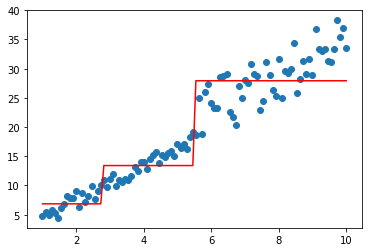
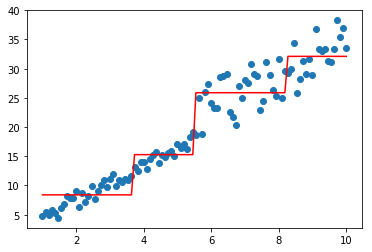
分别看看lambda和gamma的效果
model=XGBoostBaseTree(lamb=1,gamma=0.1)

model.fit(data,-1*target,np.ones_like(target))

plt.scatter(data, target)

plt.plot(data, model.predict(data), color='r')
[<matplotlib.lines.Line2D at 0x1d8eb88cf60>]
model=XGBoostBaseTree(lamb=0.1,gamma=100)

model.fit(data,-1*target,np.ones_like(target))

plt.scatter(data, target)

plt.plot(data, model.predict(data), color='r')
[<matplotlib.lines.Line2D at 0x1d8fc9e3b38>]
《机器学习Python实现_10_10_集成学习_xgboost_原理介绍及回归树的简单实现》的更多相关文章
- 简单物联网:外网访问内网路由器下树莓派Flask服务器
最近做一个小东西,大概过程就是想在教室,宿舍控制实验室的一些设备. 已经在树莓上搭了一个轻量的flask服务器,在实验室的路由器下,任何设备都是可以访问的:但是有一些限制条件,比如我想在宿舍控制我种花 ...
- 利用ssh反向代理以及autossh实现从外网连接内网服务器
前言 最近遇到这样一个问题,我在实验室架设了一台服务器,给师弟或者小伙伴练习Linux用,然后平时在实验室这边直接连接是没有问题的,都是内网嘛.但是回到宿舍问题出来了,使用校园网的童鞋还是能连接上,使 ...
- 外网访问内网Docker容器
外网访问内网Docker容器 本地安装了Docker容器,只能在局域网内访问,怎样从外网也能访问本地Docker容器? 本文将介绍具体的实现步骤. 1. 准备工作 1.1 安装并启动Docker容器 ...
- 外网访问内网SpringBoot
外网访问内网SpringBoot 本地安装了SpringBoot,只能在局域网内访问,怎样从外网也能访问本地SpringBoot? 本文将介绍具体的实现步骤. 1. 准备工作 1.1 安装Java 1 ...
- 外网访问内网Elasticsearch WEB
外网访问内网Elasticsearch WEB 本地安装了Elasticsearch,只能在局域网内访问其WEB,怎样从外网也能访问本地Elasticsearch? 本文将介绍具体的实现步骤. 1. ...
- 怎样从外网访问内网Rails
外网访问内网Rails 本地安装了Rails,只能在局域网内访问,怎样从外网也能访问本地Rails? 本文将介绍具体的实现步骤. 1. 准备工作 1.1 安装并启动Rails 默认安装的Rails端口 ...
- 怎样从外网访问内网Memcached数据库
外网访问内网Memcached数据库 本地安装了Memcached数据库,只能在局域网内访问,怎样从外网也能访问本地Memcached数据库? 本文将介绍具体的实现步骤. 1. 准备工作 1.1 安装 ...
- 怎样从外网访问内网CouchDB数据库
外网访问内网CouchDB数据库 本地安装了CouchDB数据库,只能在局域网内访问,怎样从外网也能访问本地CouchDB数据库? 本文将介绍具体的实现步骤. 1. 准备工作 1.1 安装并启动Cou ...
- 怎样从外网访问内网DB2数据库
外网访问内网DB2数据库 本地安装了DB2数据库,只能在局域网内访问,怎样从外网也能访问本地DB2数据库? 本文将介绍具体的实现步骤. 1. 准备工作 1.1 安装并启动DB2数据库 默认安装的DB2 ...
- 怎样从外网访问内网OpenLDAP数据库
外网访问内网OpenLDAP数据库 本地安装了OpenLDAP数据库,只能在局域网内访问,怎样从外网也能访问本地OpenLDAP数据库? 本文将介绍具体的实现步骤. 1. 准备工作 1.1 安装并启动 ...
随机推荐
- SQLFlow——一个强大的可视化SQL关系分析工具
SQLFlow 摘要 本文主要介绍SQLFlow是什么,以及它的功能及使用场景 SQLFlow是什么 SQLFlow是一个可视化的在线处理SQL对象依赖关系的工具,只需要上传你的SQL脚本,它可以自动 ...
- 与find不同,locate并不是实时查找。你需要更新数据库,以获得最新的文件索引信息。updatedb
find是实时查找,如果需要更快的查询,可试试locate:locate会为文件系统建立索引数据库,如果有文件更新,需要定期执行更新命令来更新索引库: $locate string 寻找包含有stri ...
- SystemVerilog 编写FSM
SystemVerilog 编写FSM 题目 SystemVerilog实现 仿真 SystemVerilog 编写FSM 好书: https://github.com/yllinux/blogPic ...
- ARP欺骗-断网小技巧
警告:请勿用于非法用途,后果自负! 环境: 攻击方: Kali Linux 被攻击方: Windows XP 二者在同一局域网下 步骤 1.查看Windows的IP,联网状态 在Windows的cmd ...
- Linux_搭建NFS服务(基础)
[RHEL8]-NFSserver :[Centos7]-NFSclient !!!测试环境我们首关闭防火墙和selinux(NFSserver和NFSclient都需要) [root@localho ...
- 012.Python的字典和集合的相关函数
一 字典的相关函数 1.1 增函数 dictvar = {"a":1,"b":2} dictvar["c"] = 3 print(dictv ...
- Stream中的Peek操作
1.引言 如果你试图对流操作中的流水线进行调试, 了解stream流水线每个操作之前和操作之后的中间值, 该如何去做? 首先我们看一个例子, 使用forEach将流操作的结果打印出来. 1 /** 2 ...
- Step By Step(Lua面向对象)
Step By Step(Lua面向对象) Lua中的table就是一种对象,但是如果直接使用仍然会存在大量的问题,见如下代码: 1 Account = {balance = 0}2 function ...
- Selenium八种元素定位方法源码阅读
接触过Selenium的都知道元素定位有八种方法,但用不同的方法在执行时有什么区别呢? 元素定位8种方法(Python版),当然还有每一个方法对应的find_elements方法 find_eleme ...
- MinkowskiEngine语义分割
MinkowskiEngine语义分割 要运行示例,请安装Open3D与PIP安装open3d-python. cd /path/to/MinkowskiEngine python -m exampl ...