
On Explainability of Deep Neural Networks
On Explainability of Deep Neural Networks
On Explainability of Deep Neural Networks
During a discussion yesterday with software architect extraordinaire David Lazar regarding how everything old is new again, the topic of deep neural networks and its amazing success was brought up. Unless one is living under a rock for past five years, the advancements in artificial neural networks (ANN) has been quite significant and noteworthy. Since the thaw of AI winter, the frowned-upon wave has come a long way to be a successful and relied upon technique in multiple problem spaces. From an interestingapocryphal which sums up the state of ANN back in the day to its current state of ConvNets with Google Translate squeezing deep learning onto a phone, there has been significant progress made. We all have seen the dreamy images of Inceptionism: Going Deeper into Neural Network with great results in image classification and speech recognition while fine tuning network parameters. Beyond the classical feats of Reading Digits in Natural Images with Unsupervised Feature Learning Deep Neural Networks (DNNs) have shown outstanding performance on image classification tasks. We now have excellent results on MNIST, Imagenet classification with deep convolutional neural networks, and effective use of Deep Neural Networks for Object Detection.
Otavio Good of Google puts it quite well,
Five years ago, if you gave a computer an image of a cat or a dog, it had trouble telling which was which. Thanks to convolutional neural networks, not only can computers tell the difference between cats and dogs, they can even recognize different breeds of dogs.
Geoffrey Hinton et al noted that
Best system in 2010 competition got 47% error for its first choice and 25% error for its top 5 choices. A very deep neural net (Krizhevsky et. al. 2012) gets less than 40% error for its first choice and less than 20% for its top 5 choices

Courtesy: XKCD and http://pekalicious.com/blog/training/
So with all this fanfare, what could possibly go wrong?
In deep learning systems where both the classifiers and the features are learned automatically, neural networks possess a grey side, the explain-ability problem.
Explain-ability and determinism in ML systems is a larger discussion, but limiting the scope to stay within the context of neural nets when you see the Unreasonable Effectiveness of Recurrent Neural Networks, it is important to pause and ponder, why does it work? Is it good enough that I can peek into this black-box by getting strategic heuristics out of the network, or infer the concept of cat from a trained neural network by Building High-level Features Using Large Scale Unsupervised Learning? Does it make it a ‘grey-box’ if we can figure out word embedding extractions from the network in high dimensional space, and therefore exploit similarities among languages for machine translation? The very idea of this non deterministic nature is problematic; as in context of how you choose the initial parameters such as starting point for gradient descent when training the back-propagation being of key importance. How about retain-ability? The imperviousness makes troubleshooting harder to say the least.
If you haven’t noticed, I am trying hard not make this a pop-science alarmist post but here is the leap I am going to take; that the relative lack of explain-ability and transparency inherent in the neural networks (and research community’s relative complacency towards the approach ‘because it just works’), this idea of black-boxed-intelligence is probably what may lead to larger issues identified by Gates, Hawking, and Musk. I would be the first one to state that this argument might be a stretch or over generalization of the shortcomings of a specific technique to create the doomsday scenario, and we might be able to ‘decrypt’ the sigmoid and all these fears will go away. However, my fundamental argument stays; if the technique isn’t quite as explainable, and with the ML proliferation as we have today, the unintended consequences might be too real to ignore.
With the ensemble of strong AI from weak AI, the concern towards explain-ability enlarges. There is no denying that it can be challenging to understand what a neural network is really doing under those layers approximating functions. For a happy path scenario when a network is trained well, we have seen repeatedly that it does achieve high quality results. However, it is still perplexing to comprehend the underpinnings as to how it is doing so? Even more alarmingly, if the network fails, it is hard to understand what went wrong. Can we really shrug off the skeptics fearful about the dangers that seemingly sentient Artificial Intelligence (AI) poses. As Bill Gates said articulately (practically refuting Eric Horvitz's position)
I am in the camp that is concerned about super intelligence. First the machines will do a lot of jobs for us and not be super intelligent. That should be positive if we manage it well. A few decades after that though the intelligence is strong enough to be a concern. I agree with Elon Musk and some others on this and don’t understand why some people are not concerned.
The non-probabilistic nature of a technique like neural network pose a larger concerns in terms of understanding the confidence of the classifier? The convergence of a neural network isn’t really clear but alternatively for SVM, it’s fairly trivial to validate. Depicting the approximation of an ‘undocumented’ function as a black-box is most probably a fundamentally flawed idea in itself. If we equate this with the biological thought process, the signals and the corresponding trained behavior, we have an expected output based on the training set as an observer. However, in the non-identifiable model, the approximation provided by the neural network is fairly impenetrable for all intents and purposes.
I don’t think anyone with deep understanding of AI and machine learning is really worried about Skynet, at this point. Like Andrew Ng said
“Fearing a rise of killer robots is like worrying about overpopulation on Mars.”
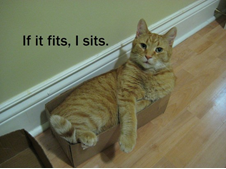
The concern is more about adhering to “but it works!” aka If-I-fits-I-sits approach (the mandatory cat meme goes here).
The sociological challenges associated with self-driving trucks, taxis, delivery people and employment are real but these are regulatory issues. The key issue lies in the heart of the technology and our understanding of its internals. Stanford's Katie Malone said it quite well in linear digressions episode on Neural Nets
Even though it sounds like common sense that we would like to have controls in place where automation should not be allowed to engage targets without human intervention, and luminaries like Hawking, Musk and Wozniak would like to Ban autonomous weapons, urging AI experts, our default reliance on black-box approaches may make this nothing more than wishful thinking. As Stephen Hawking said
“The primitive forms of artificial intelligence we already have, have proved very useful. But I think the development of full artificial intelligence could spell the end of the human race. Once humans develop artificial intelligence it would take off on its own and redesign itself at an ever-increasing rate. Humans, who are limited by slow biological evolution, couldn’t compete and would be superseded.”
It might be fair to say that since we don’t completely understand a new technique, it makes us afraid (of change), and will be adapted as the research moves forward. As great as the results are, for non-black box models or interpretable models such as regression (closed form approximation) and decision trees / belief nets (graphical representations of deterministic and probabilistic beliefs) there is the comfort of determinism and understanding. We know today that smaller changes in NN can lead to significant changes as one of the “Intriguing” properties of neural networks. In their paper, authors demonstrated that small changes can cause larger issues
We find that deep neural networks learn input-output mappings that are fairly discontinuous to a significant extent. We can cause the network to misclassify an image by applying a certain hardly perceptible perturbation, which is found by maximizing the network’s prediction error….
We demonstrated that deep neural networks have counter-intuitive properties both with respect to the semantic meaning of individual units and with respect to their discontinuities.
The existence of the adversarial negatives appears to be in contradiction with the network’s ability to achieve high generalization performance. Indeed, if the network can generalize well, how can it be confused by these adversarial negatives, which are indistinguishable from the regular examples? Possible explanation is that the set of adversarial negatives is of extremely low probability….. However, we don’t have a deep understanding of how often adversarial negatives appears…
Let’s be clear that when we discuss the black-box nature of ANN, we are not talking about Single-unit perceptron only being capable of learning linearly separable patterns (Minsky et al, 69). It is well established that XOR functions inability to learn in single layer networks does not extend to multi-layer perceptron (MLP). Convolutional Neural Networks (CNN) are therefore a working proof to the contrary; the biologically-inspired variants of MLPs with the explicit assumption that the input comprises of images hence certain properties can be embedded into the architecture. The point here is against the rapid adaption of a technique which is black-box in nature with greater computational burden, inherent non-determinism, and over-fitting proneness over its “better” counterparts. To paraphrase Jitendra Malik without being an NN skeptic, there is no reason that multi-layer random forests or SVM cannot achieve the same results. During AI winter we made ANN pariah, aren’t we repeating the same mistake with other techniques now?
Recently Elon Musk has tweeted
Worth reading Superintelligence by Bostrom. We need to be super careful with AI. Potentially more dangerous than nukes.
And even though things might not be so bad right now, let’s conclude this with the following quote fromMichael Jordan from IEEE spectrum.
Sometimes those go beyond where the achievements actually are. Specifically on the topic of deep learning, it’s largely a rebranding of neural networks, which go back to the 1980s. … In the current wave, the main success story is the convolutional neural network, but that idea was already present in the previous wave. And one of the problems … is that people continue to infer that something involving neuroscience is behind it, and that deep learning is taking advantage of an understanding of how the brain processes information, learns, makes decisions, or copes with large amounts of data. And that is just patently false.
Now this also leaves the other fundamental question is that if the pseudo-mimicry of biological neural nets actually a good approach to emulate intelligence? Or may be Noam Chomsky on Where Artificial Intelligence Went Wrong?
That we will talk about some other day.
References
- Neural Networks, Manifolds, and Topology
- The Future of AI: A Non-Alarmist Viewpoint
- Stephen Hawking warns artificial intelligence could end mankind’
- A shallow introduction to the deep machine learning
- Computer science: The learning machines
- DARPA SyNAPSE Program artificialbrains.com
- On explainability in Machine Learning
- Killed by AI Much? A Rise of Non-deterministic Security!
On Explainability of Deep Neural Networks的更多相关文章
- Training Deep Neural Networks
http://handong1587.github.io/deep_learning/2015/10/09/training-dnn.html //转载于 Training Deep Neural ...
- Introduction to Deep Neural Networks
Introduction to Deep Neural Networks Neural networks are a set of algorithms, modeled loosely after ...
- 深度神经网络入门教程Deep Neural Networks: A Getting Started Tutorial
Deep Neural Networks are the more computationally powerful cousins to regular neural networks. Learn ...
- Classifying plankton with deep neural networks
Classifying plankton with deep neural networks The National Data Science Bowl, a data science compet ...
- (Deep) Neural Networks (Deep Learning) , NLP and Text Mining
(Deep) Neural Networks (Deep Learning) , NLP and Text Mining 最近翻了一下关于Deep Learning 或者 普通的Neural Netw ...
- Must Know Tips/Tricks in Deep Neural Networks
Must Know Tips/Tricks in Deep Neural Networks (by Xiu-Shen Wei) Deep Neural Networks, especially C ...
- Coursera Deep Learning 2 Improving Deep Neural Networks: Hyperparameter tuning, Regularization and Optimization - week1, Assignment(Initialization)
声明:所有内容来自coursera,作为个人学习笔记记录在这里. Initialization Welcome to the first assignment of "Improving D ...
- Neural Networks and Deep Learning 课程笔记(第四周)深层神经网络(Deep Neural Networks)
1. 深层神经网络(Deep L-layer neural network ) 2. 前向传播和反向传播(Forward and backward propagation) 3. 总结 4. 深层网络 ...
- 目标检测--Scalable Object Detection using Deep Neural Networks(CVPR 2014)
Scalable Object Detection using Deep Neural Networks 作者: Dumitru Erhan, Christian Szegedy, Alexander ...
随机推荐
- php 提示Warning: mysql_fetch_array() expects
我的高度代码如下 include("conn.php"); if(!empty($_GET['id'])){ $sql="select * from ne ...
- ElasticSearch.js
ElasticSearch是一个基于Lucene的搜索服务器.它提供了一个分布式多用户能力的全文搜索引擎,基于RESTful web接口.Elasticsearch是用Java开发的,并作为Apach ...
- Web Service 和WCF的比较
Web Service 的工作原理 Web Service也叫XML Web Service WebService是一种可以接收从Internet或者Intranet上的其它系统中传递过来的请求,轻量 ...
- C语言中进制知识总结
1.什么是进制 进制是一种计数的方式,常用的有二进制.八进制.十进制.十六进制.任何数据在计算机内存中都是以二进制的形式存放的. 我对进制的个人理解,二进制数是以2为计算单元,满2进1位的数:八进制数 ...
- 【转】Hibernate入门实例
1. 环境配置 1.1 hiberante环境配置 hibernate可实现面向对象的数据存储.hibernate的官网:http://hibernate.org/ 官网上选择hibernate OR ...
- 应聘复习基础笔记1:网络编程之TCP与UDP的优缺点,TCP三次握手、四次挥手、传输窗口控制、存在问题
重要性:必考 一.TCP与UDP的优缺点 ①TCP---传输控制协议,提供的是面向连接.可靠的字节流服务.当客户和服务器彼此交换数据前,必须先在双方之间建立一个TCP连接,之后才能传输数据.TCP提供 ...
- oracle11g 数据文件误删恢复(无备份)
OS: Oracle Linux Server release 5.7 DB: Oracle Database 11g Enterprise Edition Release 11.2.0.3.0 - ...
- Apache+tomcat集群配置
一.软件准备 Apache 2.2 : http://httpd.apache.org/download.cgi,下载msi安装程序,选择no ssl版本 Tomcat 6.0 : http://to ...
- Android--简单开发和使用ContentProvider数据共享
今天学习的时候学到了ContentProvider数据共享这个东东,所以自己写了个小例子: 我们要开发ContentProvider的话,需要创建一个类去继承ContentProvider,里面会让你 ...
- python小算法(二)
有两个序列a,b,大小都为n,序列元素的值任意整形数,无序: 要求:通过交换a,b中的元素,使[序列a元素的和]与[序列b元素的和]之间的差最小.(华为面试) def diff(sorted_list ...