
Training Deep Neural Networks
http://handong1587.github.io/deep_learning/2015/10/09/training-dnn.html //转载于
Training Deep Neural Networks
Tutorials
Popular Training Approaches of DNNs — A Quick Overview
Activation functions
Rectified linear units improve restricted boltzmann machines (ReLU)
Rectifier Nonlinearities Improve Neural Network Acoustic Models (leaky-ReLU, aka LReLU)
Delving Deep into Rectifiers: Surpassing Human-Level Performance on ImageNet Classification (PReLU)
- keywords: PReLU, Caffe “msra” weights initilization
- arXiv: http://arxiv.org/abs/1502.01852
Empirical Evaluation of Rectified Activations in Convolutional Network (ReLU/LReLU/PReLU/RReLU)
Deep Learning with S-shaped Rectified Linear Activation Units (SReLU)
Parametric Activation Pools greatly increase performance and consistency in ConvNets
Noisy Activation Functions
Weights Initialization
An Explanation of Xavier Initialization
Deep Neural Networks with Random Gaussian Weights: A Universal Classification Strategy?
All you need is a good init
Data-dependent Initializations of Convolutional Neural Networks
What are good initial weights in a neural network?
- stackexchange: http://stats.stackexchange.com/questions/47590/what-are-good-initial-weights-in-a-neural-network
RandomOut: Using a convolutional gradient norm to win The Filter Lottery
Batch Normalization
Batch Normalization: Accelerating Deep Network Training by Reducing Internal Covariate Shift(ImageNet top-5 error: 4.82%)
- arXiv: http://arxiv.org/abs/1502.03167
- blog: https://standardfrancis.wordpress.com/2015/04/16/batch-normalization/
- notes: http://blog.csdn.net/happynear/article/details/44238541
Weight Normalization: A Simple Reparameterization to Accelerate Training of Deep Neural Networks
- arxiv: http://arxiv.org/abs/1602.07868
- github(Lasagne): https://github.com/TimSalimans/weight_norm
- notes: http://www.erogol.com/my-notes-weight-normalization/
Normalization Propagation: A Parametric Technique for Removing Internal Covariate Shift in Deep Networks
Loss Function
The Loss Surfaces of Multilayer Networks
Optimization Methods
On Optimization Methods for Deep Learning
On the importance of initialization and momentum in deep learning
Invariant backpropagation: how to train a transformation-invariant neural network
A practical theory for designing very deep convolutional neural network
- kaggle: https://www.kaggle.com/c/datasciencebowl/forums/t/13166/happy-lantern-festival-report-and-code/69284
- paper: https://kaggle2.blob.core.windows.net/forum-message-attachments/69182/2287/A%20practical%20theory%20for%20designing%20very%20deep%20convolutional%20neural%20networks.pdf?sv=2012-02-12&se=2015-12-05T15%3A40%3A02Z&sr=b&sp=r&sig=kfBQKduA1pDtu837Y9Iqyrp2VYItTV0HCgOeOok9E3E%3D
- slides: http://vdisk.weibo.com/s/3nFsznjLKn
Stochastic Optimization Techniques
- intro: SGD/Momentum/NAG/Adagrad/RMSProp/Adadelta/Adam/ESGD/Adasecant/vSGD/Rprop
- blog: http://colinraffel.com/wiki/stochastic_optimization_techniques
Alec Radford’s animations for optimization algorithms
http://www.denizyuret.com/2015/03/alec-radfords-animations-for.html
Faster Asynchronous SGD (FASGD)
An overview of gradient descent optimization algorithms (★★★★★)

Exploiting the Structure: Stochastic Gradient Methods Using Raw Clusters
Writing fast asynchronous SGD/AdaGrad with RcppParallel
Regularization
DisturbLabel: Regularizing CNN on the Loss Layer [University of California & MSR] (2016)
- intro: “an extremely simple algorithm which randomly replaces a part of labels as incorrect values in each iteration”
- paper: http://research.microsoft.com/en-us/um/people/jingdw/pubs/cvpr16-disturblabel.pdf
Dropout
Improving neural networks by preventing co-adaptation of feature detectors (Dropout)
Regularization of Neural Networks using DropConnect
- homepage: http://cs.nyu.edu/~wanli/dropc/
- gitxiv: http://gitxiv.com/posts/rJucpiQiDhQ7HkZoX/regularization-of-neural-networks-using-dropconnect
- github: https://github.com/iassael/torch-dropconnect
Regularizing neural networks with dropout and with DropConnect
Fast dropout training
- paper: http://jmlr.org/proceedings/papers/v28/wang13a.pdf
- github: https://github.com/sidaw/fastdropout
Dropout as data augmentation
- paper: http://arxiv.org/abs/1506.08700
- notes: https://www.evernote.com/shard/s189/sh/ef0c3302-21a4-40d7-b8b4-1c65b8ebb1c9/24ff553fcfb70a27d61ff003df75b5a9
A Theoretically Grounded Application of Dropout in Recurrent Neural Networks
Improved Dropout for Shallow and Deep Learning
Gradient Descent
Fitting a model via closed-form equations vs. Gradient Descent vs Stochastic Gradient Descent vs Mini-Batch Learning. What is the difference?(Normal Equations vs. GD vs. SGD vs. MB-GD)
http://sebastianraschka.com/faq/docs/closed-form-vs-gd.html
An Introduction to Gradient Descent in Python
Train faster, generalize better: Stability of stochastic gradient descent
A Variational Analysis of Stochastic Gradient Algorithms
The vanishing gradient problem: Oh no — an obstacle to deep learning!
Gradient Descent For Machine Learning
http://machinelearningmastery.com/gradient-descent-for-machine-learning/
Revisiting Distributed Synchronous SGD
Accelerate Training
Acceleration of Deep Neural Network Training with Resistive Cross-Point Devices
Image Data Augmentation
DataAugmentation ver1.0: Image data augmentation tool for training of image recognition algorithm
Caffe-Data-Augmentation: a branc caffe with feature of Data Augmentation using a configurable stochastic combination of 7 data augmentation techniques
Papers
Scalable and Sustainable Deep Learning via Randomized Hashing
Tools
pastalog: Simple, realtime visualization of neural network training performance
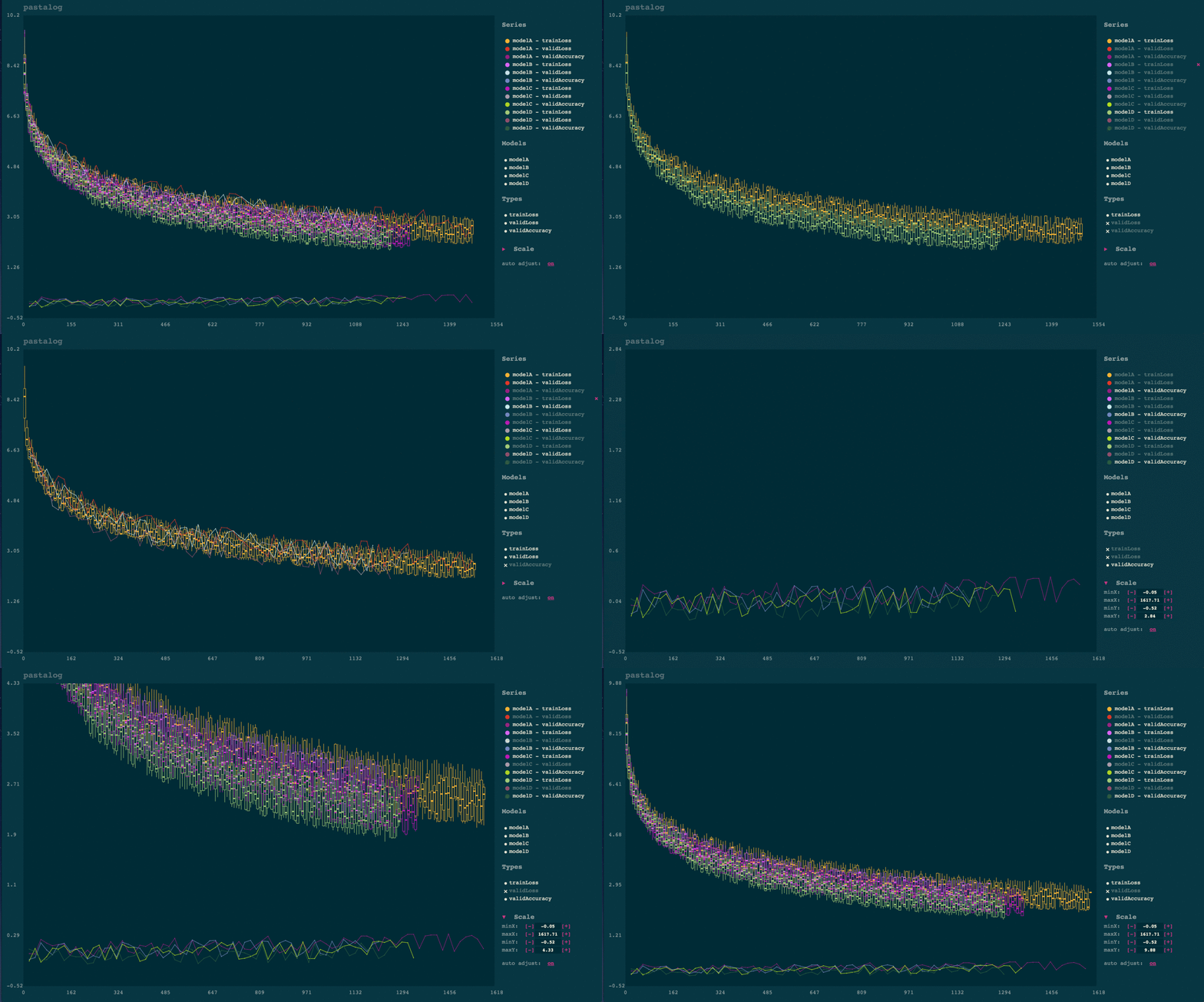
torch-pastalog: A Torch interface for pastalog - simple, realtime visualization of neural network training performance
Training Deep Neural Networks的更多相关文章
- Training (deep) Neural Networks Part: 1
Training (deep) Neural Networks Part: 1 Nowadays training deep learning models have become extremely ...
- CVPR 2018paper: DeepDefense: Training Deep Neural Networks with Improved Robustness第一讲
前言:好久不见了,最近一直瞎忙活,博客好久都没有更新了,表示道歉.希望大家在新的一年中工作顺利,学业进步,共勉! 今天我们介绍深度神经网络的缺点:无论模型有多深,无论是卷积还是RNN,都有的问题:以图 ...
- 论文翻译:BinaryConnect: Training Deep Neural Networks with binary weights during propagations
目录 摘要 1.引言 2.BinaryConnect 2.1 +1 or -1 2.2确定性与随机性二值化 2.3 Propagations vs updates 2.4 Clipping 2.5 A ...
- 论文翻译:BinaryNet: Training Deep Neural Networks with Weights and Activations Constrained to +1 or −1
目录 摘要 引言 1.BinaryNet 符号函数 梯度计算和累积 通过离散化传播梯度 一些有用的成分 算法1 使用BinaryNet训练DNN 算法2 批量标准化转换(Ioffe和Szegedy,2 ...
- 为什么深度神经网络难以训练Why are deep neural networks hard to train?
Imagine you're an engineer who has been asked to design a computer from scratch. One day you're work ...
- This instability is a fundamental problem for gradient-based learning in deep neural networks. vanishing exploding gradient problem
The unstable gradient problem: The fundamental problem here isn't so much the vanishing gradient pro ...
- [C4] Andrew Ng - Improving Deep Neural Networks: Hyperparameter tuning, Regularization and Optimization
About this Course This course will teach you the "magic" of getting deep learning to work ...
- [Box] Robust Training and Initialization of Deep Neural Networks: An Adaptive Basis Viewpoint
目录 概 主要内容 LSGD Box 初始化 Box for Resnet 代码 Cyr E C, Gulian M, Patel R G, et al. Robust Training and In ...
- On Explainability of Deep Neural Networks
On Explainability of Deep Neural Networks « Learning F# Functional Data Structures and Algorithms is ...
随机推荐
- python的json模块
Python JSON 本章节我们将为大家介绍如何使用 Python 语言来编码和解码 JSON 对象. 环境配置 在使用 Python 编码或解码 JSON 数据前,我们需要先安装 JSON 模块. ...
- BRD
搜索 复制
- su和su-命令的本质区别
su命令和su -命令最大的本质区别就是:前者只是切换了root身份,但Shell环境仍然是普通用户的Shell: 而后者连用户和Shell环境一起切换成root身份了.只有切换了Shell环境才不会 ...
- centos之Haproxy 负载均衡学习笔记
HAProxy的特点是:1.支持两种代理模式:TCP(四层)和HTTP(七层),支持虚拟主机:2.能够补充Nginx的一些缺点比如Session的保持,Cookie的引导等工作3.支持url检测后端的 ...
- No.1__C#
这是第一篇C#的日记,到现在为止已经学习了一个礼拜的C#了.由于是实习中才开始学习,所以这次不准备像在大学学习那样,拿着课本划重点,背概念.这应当是一门实践的课程,应该一边编程,一边学.这是到公司第一 ...
- 剑指Offer:面试题23——从上往下打印二叉树(java实现)
问题描述: 从上往下打印出二叉树的每个节点,同层节点从左至右打印. 思路: 按照层次遍历的方法,使用队列辅助. 1.将根结点加入队列. 2.循环出队,打印当前元素,若该结点有左子树,则将其加入队列,若 ...
- jeecg扩展封装tag的那些事
版权声明:本文为楼主原创文章,未经楼主允许不得转载,如要转载请注明来源. 目前公司开发一直使用的是jeecg框架,简单好用,但有时候不如自己写的随心所欲.最近项目遇到一个需求, 想封装配置加解密,本来 ...
- DEV中dx:ASPxPopupControl 控件的使用(在窗口关闭或隐藏时,清楚文本框中的内容)
//在窗口关闭或隐藏时,清楚文本框中的内容(核心代码) function(s, e) { ASPxClientEdit.ClearGroup('entryGroup'); } <asp:Cont ...
- js获取浏览器语言(ie、ff、chrome)、contextpath
/js获取浏览器语言(ie.ff.chrome) var language_en_us = "en-us"; var language_zh_cn = "zh-cn&qu ...
- Hadoop HDFS编程 API入门系列之HdfsUtil版本1(六)
不多说,直接上代码. 代码 package zhouls.bigdata.myWholeHadoop.HDFS.hdfs2; import java.io.FileOutputStream;impor ...