
PAT A1127 ZigZagging on a Tree (30 分)——二叉树,建树,层序遍历
Suppose that all the keys in a binary tree are distinct positive integers. A unique binary tree can be determined by a given pair of postorder and inorder traversal sequences. And it is a simple standard routine to print the numbers in level-order. However, if you think the problem is too simple, then you are too naive. This time you are supposed to print the numbers in "zigzagging order" -- that is, starting from the root, print the numbers level-by-level, alternating between left to right and right to left. For example, for the following tree you must output: 1 11 5 8 17 12 20 15.
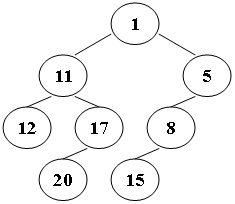
Input Specification:
Each input file contains one test case. For each case, the first line gives a positive integer N (≤30), the total number of nodes in the binary tree. The second line gives the inorder sequence and the third line gives the postorder sequence. All the numbers in a line are separated by a space.
Output Specification:
For each test case, print the zigzagging sequence of the tree in a line. All the numbers in a line must be separated by exactly one space, and there must be no extra space at the end of the line.
Sample Input:
8

12 11 20 17 1 15 8 5

12 20 17 11 15 8 5 1
Sample Output:
1 11 5 8 17 12 20 15
 #include <stdio.h>

 #include <algorithm>

 #include <queue>

 using namespace std;

 const int maxn=;

 int pos[maxn],in[maxn];

 int n,m;

 vector<int> res[];

 struct node{

     int data;

     node* left,*right;

     int lvl;

 };

 node* create(int inl,int inr,int posl,int posr){

     if(inl > inr) return NULL;

     node* root = new node;

     root->data = pos[posr];

     int k;

     for(k=inl;k<=inr;k++){

         if(pos[posr]==in[k]) break;

     }

     int numleft=k-inl;

     root->left = create(inl,k-,posl,posl+numleft-);

     root->right = create(k+,inr,posl+numleft,posr-);

     return root;

 }

 void pr(node* root){

     queue<node*> q;

     root->lvl=;

     q.push(root);

     while(!q.empty()){

         node* now=q.front();

         q.pop();

         res[now->lvl].push_back(now->data);

         if(now->left!=NULL){

             now->left->lvl=now->lvl+;

             q.push(now->left);

         }

         if(now->right!=NULL){

             now->right->lvl=now->lvl+;

             q.push(now->right);

         }

     }

 }

 int main(){

     scanf("%d",&n);

     for(int i=;i<n;i++){

         scanf("%d",&in[i]);

     }

     for(int i=;i<n;i++){

         scanf("%d",&pos[i]);

     }

     node* root = create(,n-,,n-);

     pr(root);

     int cnt=;

     for(int i=;i<;i++){

         if(i%==){

             for(int j=res[i].size()-;j>=;j--){

                 printf("%d",res[i][j]);

                 cnt++;

                 if(cnt<n)printf(" ");

             }

         }

         else{

             for(int j=;j<res[i].size();j++){

                 printf("%d",res[i][j]);

                 cnt++;

                 if(cnt<n)printf(" ");

             }

         }

         if(cnt==n)break;

     }

 }
注意点:最简单的一道30分题了。只要会建树,再层序遍历,把每层的数据保存起来,再根据层数正着输出或是反向输出就ac了。
ps:也可以用deque双向队列更方便的实现。每层的输出其实可以不用开vector数组,一层遍历完后输出就好了。
PAT A1127 ZigZagging on a Tree (30 分)——二叉树,建树,层序遍历的更多相关文章
- PAT A1127 ZigZagging on a Tree (30 分)
Suppose that all the keys in a binary tree are distinct positive integers. A unique binary tree can ...
- PAT甲级:1064 Complete Binary Search Tree (30分)
PAT甲级:1064 Complete Binary Search Tree (30分) 题干 A Binary Search Tree (BST) is recursively defined as ...
- PAT甲级 1127. ZigZagging on a Tree (30)
1127. ZigZagging on a Tree (30) 时间限制 400 ms 内存限制 65536 kB 代码长度限制 16000 B 判题程序 Standard 作者 CHEN, Yue ...
- pat 甲级 1127. ZigZagging on a Tree (30)
1127. ZigZagging on a Tree (30) 时间限制 400 ms 内存限制 65536 kB 代码长度限制 16000 B 判题程序 Standard 作者 CHEN, Yue ...
- PAT 甲级 1064 Complete Binary Search Tree (30 分)(不会做,重点复习,模拟中序遍历)
1064 Complete Binary Search Tree (30 分) A Binary Search Tree (BST) is recursively defined as a bin ...
- PTA 04-树6 Complete Binary Search Tree (30分)
题目地址 https://pta.patest.cn/pta/test/16/exam/4/question/669 5-7 Complete Binary Search Tree (30分) A ...
- PAT-2019年冬季考试-甲级 7-4 Cartesian Tree (30分)(最小堆的中序遍历求层序遍历,递归建树bfs层序)
7-4 Cartesian Tree (30分) A Cartesian tree is a binary tree constructed from a sequence of distinct ...
- Leetcode 102. Binary Tree Level Order Traversal(二叉树的层序遍历)
Given a binary tree, return the level order traversal of its nodes' values. (ie, from left to right, ...
- LeetCode:144_Binary Tree Preorder Traversal | 二叉树的前序遍历 | Medium
题目:Binary Tree Preorder Traversal 二叉树的前序遍历,同样使用栈来解,代码如下: struct TreeNode { int val; TreeNode* left; ...
随机推荐
- 【读书笔记】iOS-Apple的移动设备硬件
本书中有一个关键观点是:“硬件并不是特别重要,用户体验才是真正的杀手级应用.“尽管如此,多了解一些你使用的硬件的相关知识,对于整个项目来说是必备的,而对于设计和开发高质量的作品来说敢是不可或缺的. 人 ...
- Android Studio 在项目中引用第三方jar包
在Android Studio项目中引用第三方jar包的方法: 步骤: 1.在build.gradle文件中添加如下代码: 备注:要添加在Android作用域下 sourceSets { main { ...
- tab 页形式展现多张报表
业务系统中,很多报表都是沿用之前 EXCEL 的报表样式,原来以 sheet 格式显示的表,客户在 web 端展现的时候也希望也有同样的格式,润乾在实现这种效果和 EXCEL 一样简单灵活,轻松将数据 ...
- MVP模式及性能优化
1.base BaseActivity public abstract class BaseActivity<V,P extends BasePresenter<V>>exte ...
- Expo大作战(三十四)--expo sdk api之LinearGradient(线性渐变),KeepAwake(保持屏幕不休眠),IntentLauncherAndroid,Gyroscope,
简要:本系列文章讲会对expo进行全面的介绍,本人从2017年6月份接触expo以来,对expo的研究断断续续,一路走来将近10个月,废话不多说,接下来你看到内容,讲全部来与官网 我猜去全部机翻+个人 ...
- Scrapy爬虫入门
1.安装Scrapy 打开Anaconda Prompt,执行:pip install Scrapy执行安装! 注意:要是安装过程中抛出: error: Microsoft Visual C++ 14 ...
- linq Distinct 自定义去重字段
一.定义 1.Falcon_PumpX_Equal_Comparer :类名,随便取名 2.IEqualityComparer:必须继承这个接口 3.Falcon_PumpX:需要去重的对象 4.IE ...
- ALSA声卡驱动的DAPM(二)-建立过程
在上一篇文章中,我们重点介绍了widget.path.route之间的关系及其widget的注册: http://www.cnblogs.com/linhaostudy/p/8509899.html ...
- Linux MySql 安装与配置
为什么选择MySQL数据库? 毫无疑问,绝大多数的使用linux操作系统的大中小型互联网网站都在使用MySQL作为其后端的数据库存储,从大型的BAT门户,到电商平台,分类门户等无一例都使用MySQL数 ...
- 在Centos7下搭建Git服务器
① 安装 Git ② 服务器端创建 git 用户,用来管理 Git 服务,并为 git 用户设置密码 ③ 服务器端创建 Git 仓库 ④ 客户端 clone 远程仓库 ⑤ 客户端创建 SSH 公钥和私 ...