
PAT A1127 ZigZagging on a Tree (30 分)
Suppose that all the keys in a binary tree are distinct positive integers. A unique binary tree can be determined by a given pair of postorder and inorder traversal sequences. And it is a simple standard routine to print the numbers in level-order. However, if you think the problem is too simple, then you are too naive. This time you are supposed to print the numbers in "zigzagging order" -- that is, starting from the root, print the numbers level-by-level, alternating between left to right and right to left. For example, for the following tree you must output: 1 11 5 8 17 12 20 15.
Input Specification:
Each input file contains one test case. For each case, the first line gives a positive integer N (≤30), the total number of nodes in the binary tree. The second line gives the inorder sequence and the third line gives the postorder sequence. All the numbers in a line are separated by a space.
Output Specification:
For each test case, print the zigzagging sequence of the tree in a line. All the numbers in a line must be separated by exactly one space, and there must be no extra space at the end of the line.
Sample Input:
8

12 11 20 17 1 15 8 5

12 20 17 11 15 8 5 1
Sample Output:
1 11 5 8 17 12 20 15
result:
 #include<cstdio>

 #include<vector>

 #include<algorithm>

 using namespace std;

 const int maxn = ;

 int n,postOrder[maxn],inOrder[maxn];

 vector<vector<int> > ans(maxn);

 int level1=;

 void createTree(int inL,int inR,int postL,int postR,int level2){

     if(postR<postL || inR<inL) return ;

     int data = postOrder[postR];

     ans[level2].push_back(data);

 //    printf("%d ",data);

     level1 = max(level1,level2);

     int num=;

     while(inOrder[inL+num] != postOrder[postR]){

         num++;

     }

     // 这样生成的num指的是有num个lchild;

     createTree(inL,inL+num-,postL,postL +num-,level2+);

     createTree(inL+num+,inR,postL +num,postR - ,level2+);

     return ;

 }

 int main(){

     scanf("%d",&n);

     for(int i=;i<n;i++){

         scanf("%d",&inOrder[i]);

     }

     for(int i=;i<n;i++){

         scanf("%d",&postOrder[i]);

     }

     createTree(,n-,,n-,);

     int s = ;

     bool flag = false;

     for(vector<vector<int> >::iterator i=ans.begin();i!=ans.end();++i){

         if(flag){

             for(vector<int>::iterator j=(*i).begin();j !=(*i).end();++j){

                 printf("%d",(*j));

                 s++;

                 if(s<n) printf(" ");

             }

             flag=false;

         }else{

             reverse((*i).begin(),(*i).end());

             for(vector<int>::iterator j=(*i).begin(); j !=(*i).end();++j){

                 printf("%d",(*j));

                 s++;

                 if(s<n) printf(" ");

             }

             flag=true;

         }

     }

 }
收获:
此题主要的问题是如何生成蛇形层次排序法。首先想到的存储结构是按照二维数组ans[level][]保存结果。
如果以int ans[][]定义的话需要面对阈值问题,以及设计计数器问题。看题目里是没有阈值限制的,所以还需要自己设置。对于考试来说,也是可以实现的。
另外一种方式是利用vector<int>;在此题我首次体验了一下二维的vector<vector<int> >; 需要注意的是,普通二维数组需要确定第二维度的阈值;而在vector中,需要声明第一维度的阈值。而且设置阈值的方式是用小括号,而非数组形式的中括号。
对于vector<>进行迭代有两种方法,一种是用下标进行访问。使用下标访问需要结合vector<>的生成方式配合使用。一般是int i =0;i< vector.size();i++的方式;但是对于比较妖怪的存储方法,或者间断的存储方式,下标访问不是很方便。
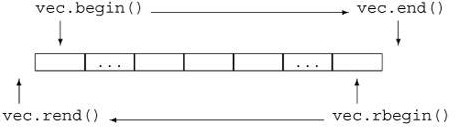
一种是用迭代器访问,如上代码,清晰的给出了二维向量的访问方法。这里需要注意的是对于vector<>,弄清楚 front,back,begin,end四个方法的具体区别。简单说front,back可以直接引用首尾向量;begin,end返回的是vector<>首尾的迭代器。其中begin和front效果一致,但end指的是空迭代器;这也是为何遍历的时候结束条件是i!=vector.end();
使用迭代器还需要掌握一点是逆序遍历迭代器。逆序遍历有两种方法可以实现。
1)利用algorithm::reverse(a,b)先互换begin(),end();其他完全不变的方式实现。(如上代码);
同样的方法也可以换个写法:
 // sorts vector in "normal" order

 sort(vector.begin(), vector.end());

 // sorts in reverse: puts smallest element at the end of vector

 sort(vector.rbegin(), vector.rend());
这是利用了vector<>自身方法的解决方案,下图是begin(),end(),rend(),rbegin()四者的关系。
2)生成反向迭代器
 for(vector<int>::reverse_iterator  j=(*i).rbegin(); j !=(*i).rend();++j){

     printf("%d",(*j));

     s++;

     if(s<n) printf(" ");

 }
PAT A1127 ZigZagging on a Tree (30 分)的更多相关文章
- PAT A1127 ZigZagging on a Tree (30 分)——二叉树,建树,层序遍历
Suppose that all the keys in a binary tree are distinct positive integers. A unique binary tree can ...
- PAT甲级:1064 Complete Binary Search Tree (30分)
PAT甲级:1064 Complete Binary Search Tree (30分) 题干 A Binary Search Tree (BST) is recursively defined as ...
- PAT甲级 1127. ZigZagging on a Tree (30)
1127. ZigZagging on a Tree (30) 时间限制 400 ms 内存限制 65536 kB 代码长度限制 16000 B 判题程序 Standard 作者 CHEN, Yue ...
- pat 甲级 1127. ZigZagging on a Tree (30)
1127. ZigZagging on a Tree (30) 时间限制 400 ms 内存限制 65536 kB 代码长度限制 16000 B 判题程序 Standard 作者 CHEN, Yue ...
- PAT 甲级 1064 Complete Binary Search Tree (30 分)(不会做,重点复习,模拟中序遍历)
1064 Complete Binary Search Tree (30 分) A Binary Search Tree (BST) is recursively defined as a bin ...
- PTA 04-树6 Complete Binary Search Tree (30分)
题目地址 https://pta.patest.cn/pta/test/16/exam/4/question/669 5-7 Complete Binary Search Tree (30分) A ...
- PAT-2019年冬季考试-甲级 7-4 Cartesian Tree (30分)(最小堆的中序遍历求层序遍历,递归建树bfs层序)
7-4 Cartesian Tree (30分) A Cartesian tree is a binary tree constructed from a sequence of distinct ...
- PAT 1127 ZigZagging on a Tree[难]
1127 ZigZagging on a Tree (30 分) Suppose that all the keys in a binary tree are distinct positive in ...
- [PAT] 1143 Lowest Common Ancestor(30 分)
1143 Lowest Common Ancestor(30 分)The lowest common ancestor (LCA) of two nodes U and V in a tree is ...
随机推荐
- .NET预处理器指令
.NET预处理器指令 做开发以来很少接触到这部分内容,基本上没有用到,偶尔在一些框架中和一些开源项目中会见到,常常因为只关心实现逻辑忽略了这部分的功能.现在自己有点时间了,还是希望能够完整的对这部分做 ...
- coder/programmer engineer Chirf Technology Offcer
大概是某个C轮融资的医疗网站CTO被离职.而CTO是一个知乎大V和微信大号.此事一出,在微信群有支持也有反对之声.支持此CTO被离职的认为其在工作时没有Review程序,自己不写代码,而是热衷出没于技 ...
- RunDll32.exe 详解及[Windows批处理]清除IE缓存
Rundll32命令详解 文件作用:执行32位DLL文件中的内部函数 位置:X:(当前系统分区)\windows\system32 命令语法: Rundll32.exe DLLname,Functio ...
- mysql实现‘主从复制’
mysql主从复制(超简单) 怎么安装mysql数据库,这里不说了,只说它的主从复制,步骤如下: 首先准备多台服务器,其中一台作为主服务器,从服务器数量自定. 1.主从服务器分别作以下操作: 主服务器 ...
- SAP人工智能服务Recast.AI的一个简单例子
关于这个例子的完整介绍,请参考公众号 "汪子熙"的两篇文章: SAP C/4HANA与人工智能和增强现实(AR)技术结合的又一个创新案例 和使用Recast.AI创建具有人工智能的 ...
- SQLmap简介以及防火墙绕过方法
简介 许多现实中对于网站的攻击往往是由于网站没有及时更新或者对于用户的输入没有进行检查.从缓冲区溢出说起,这样一种针对系统脆弱性的威胁,最根本的问题还是在于对于用户的输入没有进行检查.作为主要威胁之一 ...
- mongoDB学习之旅(一)
首先自己去https://www.mongodb.org/官网下载哦~ 我的是64位的 安装就简单讲下吧...下载个安装包, 随便安装, 只要你找到的... cmd进去你的安装目录下/bin文件夹.. ...
- JavaScript的DOM_处理空白节点
一.空白节点产生的原因 在非 IE6,7,8 中,标准的 DOM 具有识别空白文本节点的功能. 在火狐浏览器等其他浏览器中是 7个,而 IE6,7,8 自动忽略了,如果要保持一致的子元素节点,需要手 ...
- java里面list是引用的好例子
java里面的赋值和引用是不同的,以后要详细总结一下! 看一个例子: public static void main(String[] args) { List<String> list ...
- 【剑指offer】字符串的组合
版权声明:本文为博主原创文章,未经博主同意不得转载. https://blog.csdn.net/mmc_maodun/article/details/26405471 转载请注明出处:http:// ...