
Announcing Zuul: Edge Service in the Cloud--转
原文地址:http://techblog.netflix.com/2013/06/announcing-zuul-edge-service-in-cloud.html
Today, we are pleased to introduce Zuul our answer to these challenges and the latest addition to our our open source suite of software Although Zuul is an edge service originally designed to front the Netflix API, it is now being used in a variety of ways by a number of systems throughout Netflix.
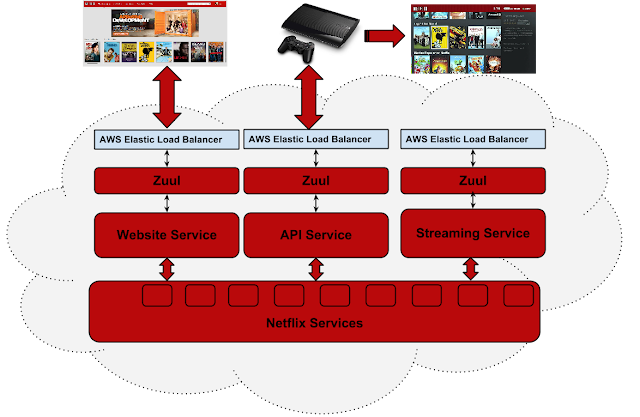 |
| Zuul in Netflix's Cloud Architecture |
How Does Zuul Work?
At the center of Zuul is a series of filters that are capable of performing a range of actions during the routing of HTTP requests and responses. The following are the key characteristics of a Zuul filter:
- Type: most often defines the stage during the routing flow when the filter will be applied (although it can be any custom string)
- Execution Order: applied within the Type, defines the order of execution across multiple filters
- Criteria: the conditions required in order for the filter to be executed
- Action: the action to be executed if the Criteria are met
Here is an example of a simple filter that delays requests from a malfunctioning device in order to distribute the load on our origin:
1 |
class DeviceDelayFilter extends ZuulFilter {
def static Random rand = new Random()
@Override
|
Zuul provides a framework to dynamically read, compile, and run these filters. Filters do not communicate with each other directly - instead they share state through a RequestContext which is unique to each request.
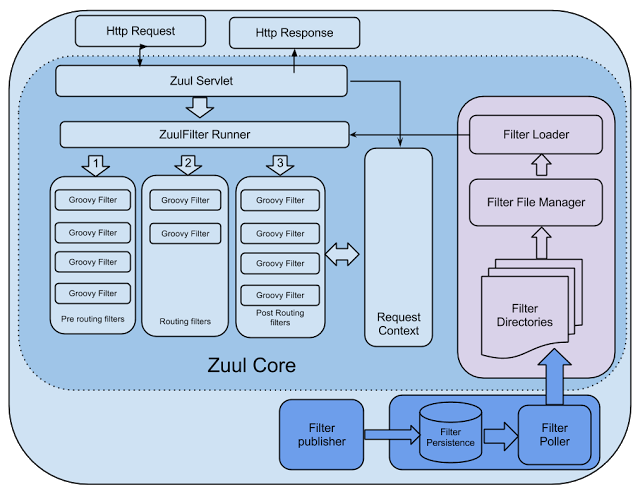
Filters are currently written in Groovy, although Zuul supports any JVM-based language. The source code for each filter is written to a specified set of directories on the Zuul server that are periodically polled for changes. Updated filters are read from disk, dynamically compiled into the running server, and are invoked by Zuul for each subsequent request.
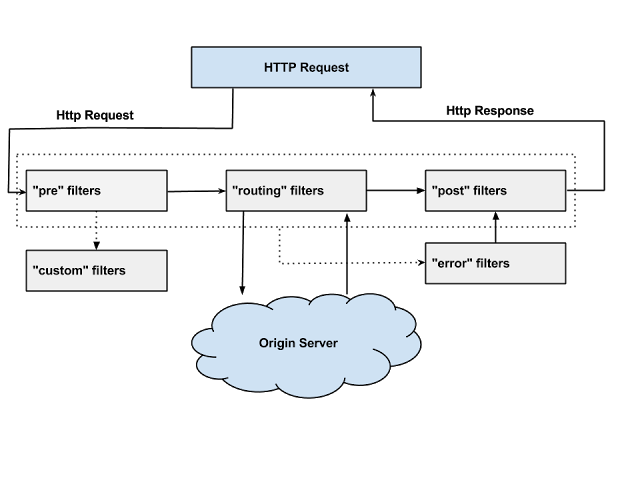
There are several standard filter types that correspond to the typical lifecycle of a request:
- PRE filters execute before routing to the origin. Examples include request authentication, choosing origin servers, and logging debug info.
- ROUTING filters handle routing the request to an origin. This is where the origin HTTP request is built and sent using Apache HttpClient or Netflix Ribbon.
- POST filters execute after the request has been routed to the origin. Examples include adding standard HTTP headers to the response, gathering statistics and metrics, and streaming the response from the origin to the client.
- ERROR filters execute when an error occurs during one of the other phases.
Alongside the default filter flow, Zuul allows us to create custom filter types and execute them explicitly. For example, Zuul has a STATIC type that generates a response within Zuul instead of forwarding the request to an origin.
How We Use Zuul
There are many ways in which Zuul helps us run the Netflix API and the overall Netflix streaming application. Here is a short list of some of the more common examples, and for some we will go into more detail below:
- Authentication
- Insights
- Stress Testing
- Canary Testing
- Dynamic Routing
- Load Shedding
- Security
- Static Response handling
- Multi-Region Resiliency
Insights
Zuul gives us a lot of insight into our systems, in part by making use of other Netflix OSS components. Hystrix is used to wrap calls to our origins, which allows us to shed and prioritize traffic when issues occur. Ribbon is our client for all outbound requests from Zuul, which provides detailed information into network performance and errors, as well as handles software load balancing for even load distribution. Turbine aggregates fine-grained metrics in real-time so that we can quickly observe and react to problems. Archaius handles configuration and gives the ability to dynamically change properties.
Because Zuul can add, change, and compile filters at run-time, system behavior can be quickly altered. We add new routes, assign authorization access rules, and categorize routes all by adding or modifying filters. And when unexpected conditions arise, Zuul has the ability to quickly intercept requests so we can explore, workaround, or fix the problem.
The dynamic filtering capability of Zuul allows us to find and isolate problems that would normally be difficult to locate among our large volume of requests. A filter can be written to route a specific customer or device to a separate API cluster for debugging. This technique was used when a new page from the website needed tuning. Performance problems, as well as unexplained errors were observed. It was difficult to debug the issues because the problems were only happening for a small set of customers. By isolating the traffic to a single instance, patterns and discrepancies in the requests could be seen in real time. Zuul has what we call a “SurgicalDebugFilter”. This is a special “pre” filter that will route a request to an isolated cluster if the patternMatches() criteria is true. Adding this filter to match for the new page allowed us to quickly identify and analyze the problem. Prior to using Zuul, Hadoop was being used to query through billions of logged requests to find the several thousand requests for the new page. We were able to reduce the problem to a search through a relatively small log file on a few servers and observe behavior in real time.
The following is an example of the SurgicalDebugFilter that is used to route matched requests to a debug cluster:
1 |
class SharpDebugFilter extends SurgicalDebugFilter {
|
In addition to dynamically re-routing requests that match a specified criteria, we have an internal system, built on top of Zuul and Turbine, that allows us to display a real-time streaming log of all matching requests/responses across our entire cluster. This internal system allows us to quickly find patterns of anomalous behavior, or simply observe that some segment of traffic is behaving as expected, (by asking questions such as "how many PS3 API requests are coming from Sao Paolo”)?
Stress Testing
Gauging the performance and capacity limits of our systems is important for us to predict our EC2 instance demands, tune our autoscaling policies, and keep track of general performance trends as new features are added. An automated process that uses dynamic Archaius configurations within a Zuul filter steadily increases the traffic routed to a small cluster of origin servers. As the instances receive more traffic, their performance characteristics and capacity are measured. This informs us of how many EC2 instances will be needed to run at peak, whether our autoscaling policies need to be modified, and whether or not a particular build has the required performance characteristics to be pushed to production.
Multi-Region Resiliency
Zuul is central to our multi-region ELB resiliency project called Isthmus. As part of Isthmus, Zuul is used to bridge requests from the west coast cloud region to the east coast to help us have multi-region redundancy in our ELBs for our critical domains. Stay tuned for a tech blog post about our Isthmus initiative.
Zuul OSS
Today, we are open sourcing Zuul as a few different components:
- zuul-core - A library containing a set of core features.
- zuul-netflix - An extension library using many Netflix OSS components:
- Servo for insights, metrics, monitoring
- Hystrix for real time metrics with Turbine
- Eureka for instance discovery
- Ribbon for routing
- Archaius for real-time configuration
- Astyanax for and filter persistence in Cassandra
- zuul-filters - Filters to work with zuul-core and zuul-netflix libraries
- zuul-webapp-simple - A simple example of a web application built on zuul-core including a few basic filters
- zuul-netflix-webapp- A web application putting zuul-core, zuul-netflix, and zuul-filters together.

Putting everything together, we are also providing a web application built on zuul-core and zuul-netflix. The application also provides many helpful filters for things such as:
- Weighted load balancing to balance a percentage of load to a certain server or cluster for capacity testing
- Request debugging
- Routing filters for Apache HttpClient and Netflix Ribbon
- Statistics collecting
We hope that this project will be useful for your application and will demonstrate the strength of our open source projects when using Zuul as a glue across them, and encourage you to contribute to Zuul to make it even better. Also, if this type of technology is as exciting to you as it is to us, please see current openings on our team: jobs
Announcing Zuul: Edge Service in the Cloud--转的更多相关文章
- 最全面的改造Zuul网关为Spring Cloud Gateway(包含Zuul核心实现和Spring Cloud Gateway核心实现)
前言: 最近开发了Zuul网关的实现和Spring Cloud Gateway实现,对比Spring Cloud Gateway发现后者性能好支持场景也丰富.在高并发或者复杂的分布式下,后者限流和自定 ...
- Windows Azure Cloud Service (44) 将Cloud Service加入Virtual Network Subnet,并固定Virtual IP Address(VIP)
<Windows Azure Platform 系列文章目录> 在之前的文章中,笔者已经详细介绍了如何将Virtual Machine加入Virtual Network,并且绑定固定的Pr ...
- Windows Azure Cloud Service (47) 修改Cloud Service时区
<Windows Azure Platform 系列文章目录> 本文介绍内容适合于Azure Global和Azure China 我们在使用Cloud Service的时候,会发现默认的 ...
- Spring Cloud 入门 之 Zuul 篇(五)
原文地址:Spring Cloud 入门 之 Zuul 篇(五) 博客地址:http://www.extlight.com 一.前言 随着业务的扩展,微服务会不对增加,相应的其对外开放的 API 接口 ...
- 玩转Spring Cloud之API网关(zuul)
最近因为工作原因,一直没有空写文章,所以都是边忙项目,边利用空闲时间,周末时间学习总结,最终在下班回家后加班加点写完本篇文章,若有不足之处,还请谅解,谢谢! 本文内容导航: 一.网关的作用 二.网关与 ...
- Spring Cloud Zuul 网关使用与 OAuth2.0 认证授权服务
API 网关的出现的原因是微服务架构的出现,不同的微服务一般会有不同的服务地址,而外部客户端可能需要调用多个服务的接口才能完成一个业务需求,如果让客户端直接与各个微服务通信,会有以下的问题: 客户端会 ...
- Spring Cloud (十三) Zuul:静态路由、静态过滤器与动态路由的实现
前言 本文起笔于2018-06-26周二,接了一个这周要完成的开发任务,需要先等其他人的接口,可能更新的会慢一些,还望大家见谅.这篇博客我们主要讲Spring Cloud Zuul.项目地址:我的gi ...
- 纠错帖:Zuul & Spring Cloud Gateway & Linkerd性能对比 (转载)
纠错帖:Zuul & Spring Cloud Gateway & Linkerd性能对比 Spring Cloud Spring Cloud Spring Cloud Gatew ...
- 微服务网关哪家强?一文看懂Zuul, Nginx, Spring Cloud, Linkerd性能差异
导语:API Gateway是实现微服务重要的组件之一.面对诸多的开源API Gateway,如何进行选择也是架构师需要关注的焦点.本文作者对几个较大的开源API Gateway进行了压力测试,对 ...
随机推荐
- 【codeforces 196B】Infinite Maze
[题目链接]:http://codeforces.com/problemset/problem/196/B [题意] 给你一个n*m的棋盘; 然后你能够无限复制这个棋盘; 在这个棋盘上你有一个起点s; ...
- 【codeforces 22C】 System Administrator
[题目链接]:http://codeforces.com/problemset/problem/22/C [题意] 给你n个点; 要求你构造一个含m条边的无向图; 使得任意两点之间都联通; 同时,要求 ...
- MySQL锁定状态查看命令
1 show processlist; SHOW PROCESSLIST显示哪些线程正在运行.您也可以使用mysqladmin processlist语句得到此信息.如果您有SUPER权限,您可以看到 ...
- 【C语言】递归函数DigitSum(n)
//写一个递归函数DigitSum(n),输入一个非负整数,返回组成它的数字之和, //比如,调用DigitSum(1729),则应该返回1+7+2+9,它的和是19 #include <std ...
- FZOJ--2212--Super Mobile Charger(水题)
Problem 2212 Super Mobile Charger Accept: 3 Submit: 11 Time Limit: 1000 mSec Memory Limit : 32 ...
- hdoj--2138--How many prime numbers(暴力模拟)
How many prime numbers Time Limit: 3000/1000 MS (Java/Others) Memory Limit: 32768/32768 K (Java/O ...
- BZOJ 1336&1337最小圆覆盖
思路: http://blog.csdn.net/commonc/article/details/52291822 (照着算法步骤写--) 已知三点共圆 求圆心的时候 就设一下圆心坐标(x,y) 解个 ...
- NodeJS学习笔记 进阶 (1)Nodejs进阶:服务端字符编解码&乱码处理(ok)
个人总结:这篇文章主要讲解了Nodejs处理服务器乱码及编码的知识,读完这篇文章需要10分钟. 摘选自网络 写在前面 在web服务端开发中,字符的编解码几乎每天都要打交道.编解码一旦处理不当,就会出现 ...
- ES6学习笔记(十二)异步解决方案Promise
1.Promise 的含义 Promise 是异步编程的一种解决方案,比传统的解决方案——回调函数和事件——更合理和更强大.它由社区最早提出和实现,ES6 将其写进了语言标准,统一了用法,原生提供了P ...
- Python解析Socket数据流异常bytes问题
Python解析Socket数据流异常bytes问题 -- 2019-03-12 python在通过socket发送数据时,英文字符转义后为原来本身的字符,占一个字节(如:s转移后为s),而中文字符在 ...