
jieba、NLTK学习笔记
中文分词 - jiebaimport re
import jieba

news_CN = '''

央视315晚会曝光湖北省知名的神丹牌、莲田牌“土鸡蛋”实为普通鸡蛋冒充,同时在商标上玩猫腻,

分别注册“鲜土”、注册“好土”商标,让消费者误以为是“土鸡蛋”。3月15日晚间,新京报记者就此

事致电湖北神丹健康食品有限公司方面,其工作人员表示不知情,需要了解清楚情况,截至发稿暂未

取得最新回应。新京报记者还查询发现,湖北神丹健康食品有限公司为农业产业化国家重点龙头企

业、高新技术企业,此前曾因涉嫌虚假宣传“中国最大的蛋品企业”而被罚6万元。

'''

# 字符串清洗

string = re.sub('[^\w]', '', news_CN)   #使用正则去符号,之后都是用这个str字符串

# 分词

seg_list = jieba.cut(string, cut_all=False, HMM=False) #精确模式(默认)| 全模式

#seg_list = jieba.cut_for_search(string, HMM=False)  #搜索引擎模式,粒度较细

#jieba.lcut(), jieba.lcut_for_search()  #直接返回list,不加返回生成器

print('/'.join(seg_list))

# 返回词语在原文中出现位置

seg_list = jieba.tokenize(u'自然语言处理非常有用')  #[('自然语言', 0, 4), ...]

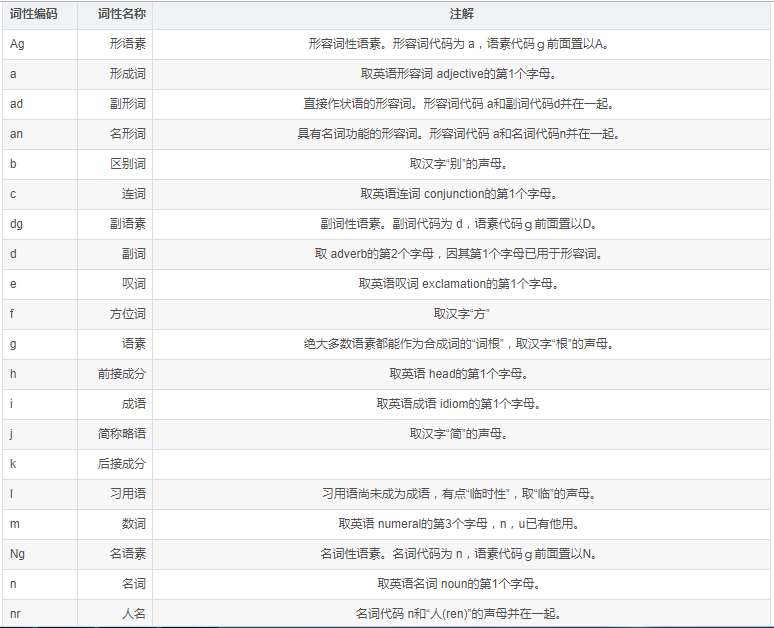
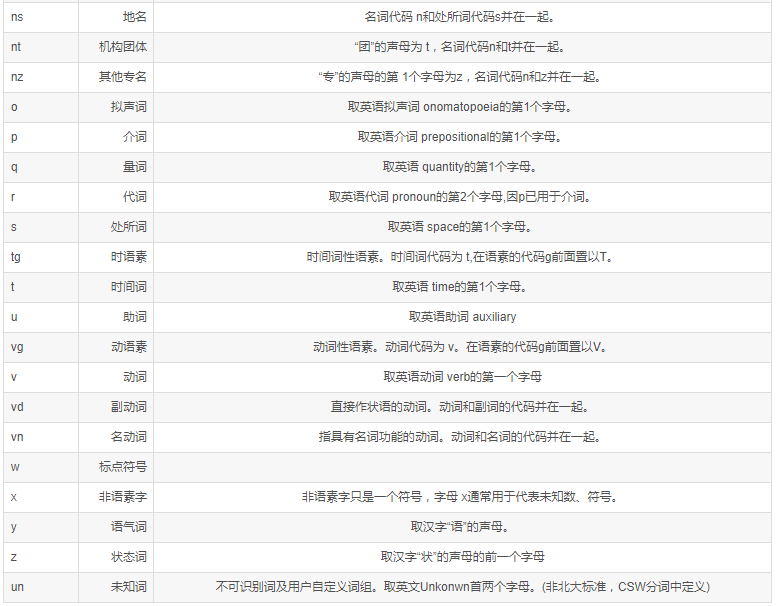
# 词性标注

import jieba.posseg as psg

seg_list = psg.cut(news_CN)

'''psg.POSTokenizer(tokenizer=None)

#tokenizer参数可使用 jieba.Tokenizer(dictionary=DEFUALT_DICT)  #新建自定义分词器,可用于同时使用不同字典

#jieba.posseg.dt为默认词性标注分词器

'''

print(' '.join(['{0}/{1}'.format(w, t) for w, t in seg_list]))

'''

path = ''

file=open(path,'r')

jieba.load_userdict(file)

file.close()

'''

# 加载自定义词

'''

userdict.txt

一个词占一行

每一行分三部分:词语、词频(可省略)、词性(可省略)

用空格隔开,顺序不可颠倒

file_name

若为路径或二进制方式打开的文件,则文件必须为UTF-8编码

'''

# 结巴默认词库位置: {basepath}\Lib\site-packages\jieba\dict.txt

#如果不知道新加词汇的词频词性的话,可写成:词 3 n

jieba.set_dictionary('./data/dict.txt.big')  #加载系统词典

jieba.load_userdict(['神丹牌','莲花牌','土鸡蛋','新京报'])  #载入词典, filename='userdict.txt'

jieba.add_word('自定义词', freq=None, tag=None)  #动态修改词典

jieba.del_word('自定义词')

jieba.get_FREQ('神丹牌')

jieba.suggest_freq(('龙头企业','高新技术企业'), True)  #调节单个词语的词频,使其能(或不能)被分出来

seg_list = jieba.cut(string, cut_all=False) #精确模式  str 为之前的字符串

print('/'.join(seg_list))  #词典中指定的词不会拆分

# 基于TF-IDF算法的关键词抽取

import jieba.analyse as aly

#aly.TFIDF(idf_path=None)

aly.set_idf_path('./data/idf.txt.big')  #加载自定义idf词典

aly.set_stop_words('./data/stop_words.utf8')  #加载停用词典

keywords = aly.extract_tags(news_CN, topK=10, withWeight=True, allowPOS=())  #allowPOS为保留词性,为空不过滤

keywords = aly.textrank(news_CN, topK=10, withWeight=True, allowPOS=('ns', 'n', 'vn', 'v'))  #为空过滤所有

from sklearn.feature_extraction.text import CountVectorizer, TfidfTransformer

corpus = [

        'This is the first document.',

        'This is the second document.',

        'And the third one.'

        ]

#words = CountVectorizer().fit_transform(corpus)

#tfidf = TfidfTransformer().fit_transform(words)  #稀疏矩阵

tfidf = TfidfTransformer().fit_transform(corpus)  #结果一样

print(tfidf)

# 并行分词
# 按行多进程并行,基于 python 自带的 multiprocessing 模块,目前暂不支持 Windows

jieba.enable_parallel(4)

jieba.disable_parallel()
英文分词 - NLTK
import nltk

# ------------------------------------

#先分句再分词

text = "And now for something completely different. I love you."

sentences = nltk.sent_tokenize(text)

words = []

for sent in sentences:

    words.append(nltk.word_tokenize(sent))

    #words_tagged += nltk.pos_tag(nltk.word_tokenize(sent))

# ------------------------------------

#分词

words = nltk.word_tokenize("good good study, day day up!")

# ------------------------------------

#词性标注

tagged = nltk.pos_tag(words)

print (tagged[0:6])

for word in tagged:

    if 'NNP' == word[1]:  #首字母大写都判为专有名词了

        print(word)

#命名实体识别

entities = nltk.chunk.ne_chunk(tagged)  #树

print (entities)

# ------------------------------------

#词频统计

words = nltk.word_tokenize("good good study, day day up!")

fdist = nltk.FreqDist(words)

fdist.N()  #总词数

fdist.B()  #词典大小

fdist['good']  #频数

fdist.freq('good') * 100  #频率

fdist.tabulate(5, cumulative=False)  #前5个词的频数分布

fdist.plot(5, cumulative=True)  #前5个词的累计频数分布图

#词组统计

bgrams = nltk.bigrams(words)

bgfdist = nltk.FreqDist(list(bgrams))

bgfdist.plot(10)  #前十词组
基于TF-IDF算法的关键词提取
- jieba.analyse.extract_tags(sentence, topK=20, withWeight=False, allowPOS=())
其中需要说明的是:
1.sentence 为待提取的文本
2.topK 为返回几个 TF/IDF 权重最大的关键词,默认值为 20
3.withWeight 为是否一并返回关键词权重值,默认值为 False
4.allowPOS 仅包括指定词性的词,默认值为空,即不筛选
- jieba.analyse.TFIDF(idf_path=None) 新建 TFIDF 实例,idf_path 为 IDF 频率文件
#设置逆文档频率语料库

#jieba.analyse.set_idf_path(file_name)

#劳动防护 13.900677652 勞動防護 13.900677652 ...

#设置停用词语料库

#jieba.analyse.set_stop_words(file_name)

import jieba

import jieba.analyse

#读取文件,返回一个字符串,使用utf-8编码方式读取,该文档位于此python同以及目录下

content  = open(u'人民的名义.txt','r',encoding='utf-8').read()

jieba.analyse.set_stop_words("stopwords.txt")

tags = jieba.analyse.extract_tags(content, topK=10,withWeight=True)

for tag in tags:

	print("tag:%s\t\t weight:%f"%(tag[0],tag[1]))
英文分词 - NLTK - 词形还原、词性还原、词干提取
转自:NLTK英文分词尝试
NLP Lemmatisation(词性还原) 和 Stemming(词干提取) NLTK pos_tag word_tokenize
Python nltk.WordNetLemmatizer() Examples
import re, time, collections, nltk

from sklearn.datasets import fetch_20newsgroups

from nltk.stem.wordnet import WordNetLemmatizer

from nltk.tokenize import word_tokenize

from nltk.corpus import stopwords

# -----------------------------------

''' 词形还原 '''

# 正则表达式过滤特殊符号用空格符占位,双引号、单引号、句点、逗号

pat_letter = re.compile(r'[^a-zA-Z \']+')

# 还原常见缩写单词

pat_is = re.compile("(it|he|she|that|this|there|here)(\'s)", re.I)

pat_s = re.compile("(?<=[a-zA-Z])\'s") # 找出字母后面的字母

pat_s2 = re.compile("(?<=s)\'s?")

pat_not = re.compile("(?<=[a-zA-Z])n\'t") # not的缩写

pat_would = re.compile("(?<=[a-zA-Z])\'d") # would的缩写

pat_will = re.compile("(?<=[a-zA-Z])\'ll") # will的缩写

pat_am = re.compile("(?<=[I|i])\'m") # am的缩写

pat_are = re.compile("(?<=[a-zA-Z])\'re") # are的缩写

pat_have = re.compile("(?<=[a-zA-Z])\'ve") # have的缩写

def replace_abbreviations(text):

    new_text = text

    new_text = pat_letter.sub(' ', text).strip().lower()

    new_text = pat_is.sub(r"\1 is", new_text)

    new_text = pat_s.sub("", new_text)

    new_text = pat_s2.sub("", new_text)

    new_text = pat_not.sub(" not", new_text)

    new_text = pat_would.sub(" would", new_text)

    new_text = pat_will.sub(" will", new_text)

    new_text = pat_am.sub(" am", new_text)

    new_text = pat_are.sub(" are", new_text)

    new_text = pat_have.sub(" have", new_text)

    new_text = new_text.replace('\'', ' ')

    return new_text

# -----------------------------------

''' 词干提取 '''

# 基于Porter词干提取算法

from nltk.stem.porter import PorterStemmer

porter_stemmer = PorterStemmer()

porter_stemmer.stem('leaves')  #输出:leav,实际:leaf

porter_stemmer.stem('maximum')

# 基于Lancaster 词干提取算法

from nltk.stem.lancaster import LancasterStemmer

lancaster_stemmer = LancasterStemmer()

lancaster_stemmer.stem('maximum')

# 基于Snowball 词干提取算法

from nltk.stem import SnowballStemmer

snowball_stemmer = SnowballStemmer('english')

snowball_stemmer.stem('maximum')

# -----------------------------------

''' 词性还原 '''

def lemmatize_all(sentence, stopWords):

    # lemmatize()方法将word单词还原成pos词性的形式

    wnl = WordNetLemmatizer()

    for word, tag in nltk.pos_tag(word_tokenize(sentence)):

        if word in stopWords:

            continue

        elif tag.startswith('NN'):

            #pos = nltk.corpus.wordnet.NOUN

            yield wnl.lemmatize(word, pos='n')

        elif tag.startswith('VB'):

            #pos = nltk.corpus.wordnet.VERB

            yield wnl.lemmatize(word, pos='v')

        elif tag.startswith('JJ'):

            #pos = nltk.corpus.wordnet.ADJ

            yield wnl.lemmatize(word, pos='a')

        elif tag.startswith('R'):

            #pos = nltk.corpus.wordnet.ADV

            yield wnl.lemmatize(word, pos='r')

        else:

            #按词性剔除

            continue

            #yield word

#查看词性说明

nltk.help.upenn_tagset('JJ')

# -----------------------------------

''' 词频统计 '''

def word_frequency_count(contents, stopWords):

    word_count_dict = collections.defaultdict(lambda:0)

    for text in contents:

        new_text = replace_abbreviations(text)

        words = lemmatize_all(new_text, stopWords)

        word_dict = collections.Counter(words)

        for key in word_dict:

            word_count_dict[key] += word_dict[key]

    return word_count_dict

if __name__=='__main__':

    t0 = time.time()

    news = fetch_20newsgroups(subset='all')

    stopWords = set(stopwords.words('english')) | set(['the','a'])

    word_count_dict = word_frequency_count(news.data[:30], stopWords)

    #print('高频词:', word_count_dict.most_common())

    word_items = list(word_count_dict.items())

    word_items.sort(key=lambda x:-x[1])

    print('高频词:', word_items[:50])

    print('总耗时:', time.time() - t0)
实例1:根据人名预测性别
from nltk.corpus import names

from nltk.classify import NaiveBayesClassifier

# 导入数据 [(u'Aaron', 'male'), (u'Abbey', 'male')]

data = ([(name, 'male') for name in names.words('male.txt')] +

     [(name, 'female') for name in names.words('female.txt')])

# 提取特征

def gender_features(word):

    return {'last_letter': word[-1]}

train_set = [(gender_features(n), g) for (n,g) in data]

# 训练模型

classifier = NaiveBayesClassifier.train(train_set)

classifier.classify(gender_features('Frank'))
实例2:确定积极评论和消极评论所占的比例
from nltk.classify import NaiveBayesClassifier

positive_vocab = [ 'awesome', 'outstanding', 'fantastic', 'terrific', 'good', 'nice', 'great', ':)' ]

negative_vocab = [ 'bad', 'terrible','useless', 'hate', ':(' ]

neutral_vocab = [ 'movie','the','sound','was','is','actors','did','know','words','not' ]

def word_feats(words):

    return dict([(word, True) for word in words])

positive_features = [(word_feats(pos), 'pos') for pos in positive_vocab]

negative_features = [(word_feats(neg), 'neg') for neg in negative_vocab]

neutral_features = [(word_feats(neu), 'neu') for neu in neutral_vocab]

train_set = negative_features + positive_features + neutral_features

classifier = NaiveBayesClassifier.train(train_set)

neg = 0

pos = 0

sentence = "Awesome movie, I liked it"

sentence = sentence.lower()

words = sentence.split(' ')

for word in words:

    classResult = classifier.classify(word_feats(word))

    if classResult == 'neg':

        neg = neg + 1

    if classResult == 'pos':

        pos = pos + 1

print('Positive: ' + str(float(pos) / len(words)))

print('Negative: ' + str(float(neg) / len(words)))
参考链接:
官方文档:Natural Language Toolkit — NLTK 3.3 documentation
解决jieba分词 load_userdict 加载自定义词库太慢的问题
jieba、NLTK学习笔记的更多相关文章
- NLTK学习笔记(三):NLTK的一些工具
主要总结一下简单的工具:条件频率分布.正则表达式.词干提取器和归并器. 条件分布频率 <自然语言学习>很多地方都用到了条件分布频率,nltk提供了两种常用的接口:FreqDist 和 Co ...
- NLTK学习笔记(六):利用机器学习进行文本分类
目录 一.监督式分类:建立在训练语料基础上的分类 特征提取器和朴素贝叶斯分类器 过拟合:当特征过多 错误分析 二.实例:文本分类和词性标注 文本分类 词性标注:"决策树"分类器 三 ...
- NLTK学习笔记(一):语言处理和Python
目录 [TOC] nltk资料下载 import nltk nltk.download() 其中,download() 参数默认是all,可以在脚本里面加上nltk.download(需要的资料库) ...
- NLTK学习笔记(四):自然语言处理的一些算法研究
自然语言处理中算法设计有两大部分:分而治之 和 转化 思想.一个是将大问题简化为小问题,另一个是将问题抽象化,向向已知转化.前者的例子:归并排序:后者的例子:判断相邻元素是否相同(与排序). 这次总结 ...
- NLTK学习笔记(八):文法--词关系研究的工具
[TOC] 对于一门语言来说,一句话有无限可能.问题是我们只能通过有限的程序来分析结构和含义.尝试将"语言"理解为:仅仅是所有合乎文法的句子的大集合.在这个思路的基础上,类似于 w ...
- NLTK学习笔记(七):文本信息提取
目录 实体识别:分块技术 分块语法的构建 树状图 IOB标记 开发和评估分块器 命名实体识别和信息提取 如何构建一个系统,用于从非结构化的文本中提取结构化的信息和数据?哪些方法使用这类行为?哪些语料库 ...
- NLTK学习笔记(五):分类和标注词汇
目录 词性标注器 标注语料库 表示已经标注的标识符:nltk.tag.str2tuple('word/类型') 读取已经标注的语料库 名词.动词.形容词等 尝试找出每个名词类型中最频繁的名词 探索已经 ...
- NLTK学习笔记(二):文本、语料资源和WordNet汇总
目录 语料库基本函数表 文本语料库分类 常见语料库及其用法 载入自定义语料库 词典资源 停用词语料库 WordNet面向语义的英语字典 语义相似度 语料库基本函数表 示例 描述 fileids() 语 ...
- 学习笔记之Data Science
Data science - Wikipedia https://en.wikipedia.org/wiki/Data_science Data science, also known as data ...
随机推荐
- All 432 functions were compiled because no usable IPDB/IOBJ from previous compilation was found
解决方法: 将: 链接器——>优化——>链接时间代码生成——>使用快速链接时间代码生成(/LTCG:incremental). 改为: 链接器——>优化——>链接时间代码 ...
- PUT和POST区别
POST是用来提交数据的.提交的数据放在HTTP请求的正文里,目的在于提交数据并用于服务器端的存储,而不允许用户过多的更改相应数据(主要是相对于在url 修改要麻烦很多).PUT操作是幂等的.所谓幂等 ...
- hdu6521 吉司机线段树
http://acm.hdu.edu.cn/showproblem.php?pid=6521 待填 代码 #include<bits/stdc++.h> #define ls o<& ...
- js a 标签 通过download 实现下载功能
download 属性规定被下载的超链接目标. 在 <a> 标签中必须设置 href 属性. 该属性也可以设置一个值来规定下载文件的名称.所允许的值没有限制,浏览器将自动检测正确的文件扩展 ...
- 《细说PHP》第四版 样章 第二章 PHP的应用与发展 1
<细说PHP>第四版 样章 第二章 PHP的应用与发展 1 学习任何编程语言之前,先了解一下它的应用与发展是很有必要的.从Web开发的历史看来,PHP.Python和Ruby几乎是同时出现 ...
- 前端笔记之Vue(六)分页排序|酷表单实战&Vue-cli
一.分页排序案例 后端负责提供接口(3000) 前端负责业务逻辑(8080) 接口地址:从8080跨域到3000拿数据 http://127.0.0.1:3000/shouji http://127. ...
- rxjava介绍
Observable 在RxJava1.x中,最熟悉的莫过于Observable这个类了,笔者刚使用RxJava2.x时,创建一个Observable后,顿时是懵逼的.因为我们熟悉的Subscribe ...
- 计算机组成原理——cache高速缓存存储器
转载自https://blog.csdn.net/chen1083376511/article/details/8187481 cache-高速缓存存储器 在主存与CPU之间插入一级或多级SRAM组成 ...
- docker安装完报错:Failed to start docker.service: Unit docker.service is masked
执行 systemctl start docker 报错 Failed to start docker.service: Unit docker.service is masked. 解决 syste ...
- 朋友想玩下百度的ORC我鼓捣鼓捣thinkphp3集成百度sdk
他想玩的是文字识别 那就玩下 咱们开始 1 先到百度文字识别 添加个应用 这样就有了APPID API KEY SECRET KEY https://console.bce.baidu.com ...