
hdfs 如何实现退役节点快速下线(也就是退役节点上的数据块快速迁移)speed up decommission blocks removal
以下是选择复制源节点的代码
代码总结:
A=datanode上要复制block的Queue size与 target datanode没被选出之前待处理复制工作数之和。

1. 优先选择退役中的节点,因为其无写入请求,负载低。

2. 不会选择退役完成的节点。

3. 如果A未达到复制限制(<maxReplicationStreams,conf配置名为dfs.namenode.replication.max-streams),在nodelist中随机选择节点

4. 如果A达到复制限制(>=maxReplicationStreams),除非blockQueue是最高优先级的,会随机选一台节点,否者会pass掉(代码中为continue)。

5. 如果A达到复制硬限制(>=replicationStreamsHardLimit,conf配置为dfs.namenode.replication.max-streams-hard-limit),无论满足什么条件都会pass。
 /**

   * Parse the data-nodes the block belongs to and choose one,

   * which will be the replication source.

   *

   * We prefer nodes that are in DECOMMISSION_INPROGRESS state to other nodes

   * since the former do not have write traffic and hence are less busy.

   * We do not use already decommissioned nodes as a source.

   * Otherwise we choose a random node among those that did not reach their

   * replication limits.  However, if the replication is of the highest priority

   * and all nodes have reached their replication limits, we will choose a

   * random node despite the replication limit.

   *

   * In addition form a list of all nodes containing the block

   * and calculate its replication numbers.

解析块所属的数据节点并选择一个,这将是复制源。

我们更偏向处于DECOMMISSION_INPROGRESS(退役中)状态的节点到其他节点,因为前者没有写入流量,因此不太忙。

我们不使用已经退役的节点作为源。

除此之外,我们会在未达到复制限制的节点中选择一个随机节点(<maxReplicationStreams)。

但是,如果复制到达最高优先级并且所有节点都已达到其复制限制(>=maxReplicationStreams,当然如果>=replicationStreamsHardLimit最算是最高优先级也是不行的),我们将随机选择一个节点,尽管有复制限制。

另外,形成包含块的所有节点的列表并计算其复制数。

   *

   * @param block Block for which a replication source is needed

   * @param containingNodes List to be populated with nodes found to contain the

   *                        given block

   * @param nodesContainingLiveReplicas List to be populated with nodes found to

   *                                    contain live replicas of the given block

   * @param numReplicas NumberReplicas instance to be initialized with the

   *                                   counts of live, corrupt, excess, and

   *                                   decommissioned replicas of the given

   *                                   block.

   * @param priority integer representing replication priority of the given

   *                 block

   * @return the DatanodeDescriptor of the chosen node from which to replicate

   *         the given block

   */

   @VisibleForTesting

   DatanodeDescriptor chooseSourceDatanode(Block block,

       List<DatanodeDescriptor> containingNodes,

       List<DatanodeStorageInfo>  nodesContainingLiveReplicas,

       NumberReplicas numReplicas,

       int priority) {

    containingNodes.clear();

    nodesContainingLiveReplicas.clear();

    DatanodeDescriptor srcNode = null;

    int live = 0;

    int decommissioned = 0;

    int corrupt = 0;

    int excess = 0;

    Collection<DatanodeDescriptor> nodesCorrupt = corruptReplicas.getNodes(block);

    for(DatanodeStorageInfo storage : blocksMap.getStorages(block)) {

      final DatanodeDescriptor node = storage.getDatanodeDescriptor();

      LightWeightLinkedSet<Block> excessBlocks =

        excessReplicateMap.get(node.getDatanodeUuid());

      int countableReplica = storage.getState() == State.NORMAL ? 1 : 0;

      if ((nodesCorrupt != null) && (nodesCorrupt.contains(node)))

        corrupt += countableReplica;

      else if (node.isDecommissionInProgress() || node.isDecommissioned())

        decommissioned += countableReplica;

      else if (excessBlocks != null && excessBlocks.contains(block)) {

        excess += countableReplica;

      } else {

        nodesContainingLiveReplicas.add(storage);

        live += countableReplica;

      }

      containingNodes.add(node);

      // Check if this replica is corrupt

      // If so, do not select the node as src node

      if ((nodesCorrupt != null) && nodesCorrupt.contains(node))

        continue;

      if(priority != UnderReplicatedBlocks.QUEUE_HIGHEST_PRIORITY

          && node.getNumberOfBlocksToBeReplicated() >= maxReplicationStreams)

      {

        continue; // already reached replication limit

      }

      if (node.getNumberOfBlocksToBeReplicated() >= replicationStreamsHardLimit)

      {

        continue;

      }

      // the block must not be scheduled for removal on srcNode

      if(excessBlocks != null && excessBlocks.contains(block))

        continue;

      // never use already decommissioned nodes

      if(node.isDecommissioned())

        continue;

      // we prefer nodes that are in DECOMMISSION_INPROGRESS state

      // 如果你是退役中的节点会被优先选择并把你赋值给srcNode,后期的判断就基本跳过DFSUtil.getRandom().nextBoolean(),因为在 if(srcNode.isDecommissionInProgress()) continue;直接continue了。

      if(node.isDecommissionInProgress() || srcNode == null) {

        srcNode = node;

        continue;

      }

      if(srcNode.isDecommissionInProgress())

        continue;

      // switch to a different node randomly

      // this to prevent from deterministically selecting the same node even

      // if the node failed to replicate the block on previous iterations

      // 这里主要是防止一直选相同节点,如果所遍历的node是退役中节点,不会走这个方法(在上层就continue了),如果某个待复制的block(正常块,不存在损坏超额等问题)所在的三个节点都是普通正常节点,那具体选择哪个node就完全随机了,虽然是个伪随机。

      if(DFSUtil.getRandom().nextBoolean())

        srcNode = node;

    }

    if(numReplicas != null)

      numReplicas.initialize(live, decommissioned, corrupt, excess, 0);

    return srcNode;

  }
加快退役的三个参数
默认数分别为2,4,2 修改为 10,20,5 后
测试2w+个块(15G左右)迁移,后者比前者(默认参数)快4-5倍左右
但是如果线上不建议开过大,会严重影响线上正常服务
<!-- speed up decommission  -->

<property>

	<name>dfs.namenode.replication.max-streams</name>

	<value>10</value>

</property>

<property>

	<name>dfs.namenode.replication.max-streams-hard-limit</name>

	<value>20</value>

</property>

<property>

	<name>dfs.namenode.replication.work.multiplier.per.iteration</name>

	<value>5</value>

</property>
前两个参数已经介绍完了,下面来介绍下第三个参数的用途
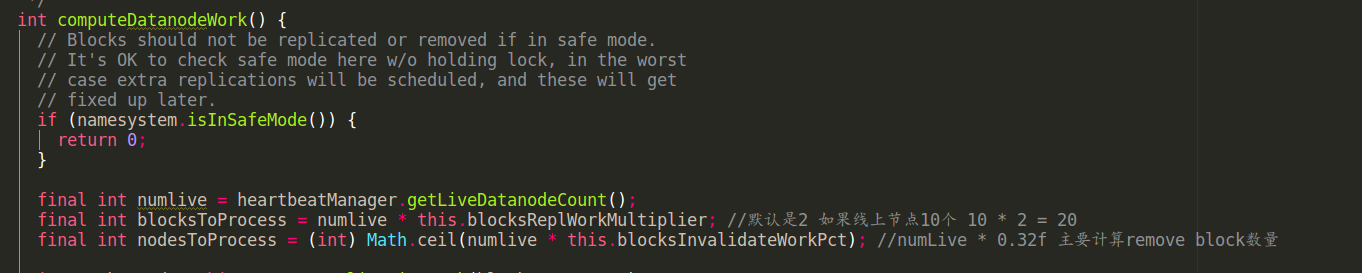
dfs.namenode.replication.work.multiplier.per.iteration 参数决定了可以从很多under replication blocks中选出多少个block 准备进行复制。
可以选出的block数与集群live 的datadnode 成正比。
int blocksToProcess = numlive * this.blocksReplWorkMultiplier(就是这个参数dfs.namenode.replication.work.multiplier.per.iteration),如果线上有10个in service datanode 那默认就可以选出 10 * 2 = 20个block 准备进行replicate
源码如图:
总结一下这三个参数:
这三个参数其实就是个限流参数

第三个参数相当于入口限流参数,决定了可以从under replication blocks 的集合中选出多少个blocks 加到复制队列中准备进行复制。

前两个参数相当于出口限流,他们是在遍历复制队列中的blocks时,决定是否给当前block一个srcNode(也可能返回null)。如果满足限流条件,srcNode=当前node;如果不满足就contiune,直到找到满足的node,如果所有node都不满足就返回null(如果返回null 该block是不会relicate的);
问题:

1. 队列中的block 最高优先级指什么,是live的副本数远小于默认的副本数吗?

2. "ask: srcNode" 日志中的srcNode 节点不只是退役中的节点,为什么?
问题1解答:
block所在队列的优先级有五个,源码如下:
   /** The total number of queues : {@value} */

// 共五个等级

  static final int LEVEL = 5;

  /** The queue with the highest priority: {@value} */

//最高优先级queue:这些blocks会被优先复制。只有一个副本的块或者这些块有0个live副本,1个副本在正在退役的节点.如果这些blocks所在的磁盘或者服务器出现问题,这些blocks有丢失风险。

  static final int QUEUE_HIGHEST_PRIORITY = 0;

  /** The queue for blocks that are way below their expected value : {@value} */

//第二优先级: 这些blocks的副本远低于他们所期望的值。目前意味着实际的比例时少于1/3,虽然这些blocks可能并没有风险,但是他们清楚地考虑到blocks重要性。

  static final int QUEUE_VERY_UNDER_REPLICATED = 1;

  /** The queue for "normally" under-replicated blocks: {@value} */

//第三优先级:这些blocks 也低于所期望值(同样处于复制状态的块),以及 实际:预期的比例 足够好(不少与1/3),以至于它们不需要进入队列

  static final int QUEUE_UNDER_REPLICATED = 2;

  /** The queue for blocks that have the right number of replicas,

   * but which the block manager felt were badly distributed: {@value}

   */

//第四优先级:一个block满足要求的最小副本数,但是由于分布不充分,如果一个机架当机可能导致所有的副本丢失/下线

  static final int QUEUE_REPLICAS_BADLY_DISTRIBUTED = 3;

  /** The queue for corrupt blocks: {@value} */

//第五优先级:这适用于已损坏的块,并且当前有可用的非损坏副本(当前)。这里的策略是保持这些损坏的块被复制,但是给出不是更高优先级的块。

  static final int QUEUE_WITH_CORRUPT_BLOCKS = 4;
问题2的解答:( xx.x.x.34为退役中节点)
1.退役节点的上要replica 的block非常多,有些block还没来得及replica 就已经过期了,所以不能把退役中的节点作为srcNode
2.由于前期以退役节点为srcNode较多,已经有达到了dfs.namenode.replication.max-streams 或 dfs.namenode.replication.max-streams-hard-limit 的上限,所以只能选其他节点作为srcNode
这是复制block日志可以说明问题2, xx.x.x.34 达到上限10(也可能是20)后,就会选择其他节点作为srcNode了(共70个)。
2018-09-25 11:38:01,439 INFO BlockStateChange: BLOCK* ask xx.x.x.34:50010 to replicate blk_1298821823_225481125 to datanode(s) xx.x.x.28:50010

2018-09-25 11:38:01,439 INFO BlockStateChange: BLOCK* ask xx.x.x.34:50010 to replicate blk_1298821896_225481198 to datanode(s) xx.x.x.36:50010

2018-09-25 11:38:01,439 INFO BlockStateChange: BLOCK* ask xx.x.x.34:50010 to replicate blk_1298821588_225480890 to datanode(s) xx.x.x.45:50010

2018-09-25 11:38:01,439 INFO BlockStateChange: BLOCK* ask xx.x.x.34:50010 to replicate blk_1298821581_225480883 to datanode(s) xx.x.x.30:50010

2018-09-25 11:38:01,439 INFO BlockStateChange: BLOCK* ask xx.x.x.34:50010 to replicate blk_1282045832_208688251 to datanode(s) xx.x.x.30:50010

2018-09-25 11:38:01,439 INFO BlockStateChange: BLOCK* ask xx.x.x.34:50010 to replicate blk_1282045861_208688280 to datanode(s) xx.x.x.44:50010

2018-09-25 11:38:01,439 INFO BlockStateChange: BLOCK* ask xx.x.x.34:50010 to replicate blk_1282045812_208688231 to datanode(s) xx.x.x.31:50010

2018-09-25 11:38:01,439 INFO BlockStateChange: BLOCK* ask xx.x.x.34:50010 to replicate blk_1282045643_208688062 to datanode(s) xx.x.x.11:50010

2018-09-25 11:38:01,439 INFO BlockStateChange: BLOCK* ask xx.x.x.34:50010 to replicate blk_1282045478_208687897 to datanode(s) xx.x.x.43:50010

2018-09-25 11:38:01,439 INFO BlockStateChange: BLOCK* ask xx.x.x.34:50010 to replicate blk_1282045530_208687949 to datanode(s) xx.x.x.22:50010

2018-09-25 11:38:01,439 INFO BlockStateChange: BLOCK* ask xx.x.x.41:50010 to replicate blk_1206547507_133106764 to datanode(s) xx.x.x.42:50010

2018-09-25 11:38:01,439 INFO BlockStateChange: BLOCK* ask xx.x.x.41:50010 to replicate blk_1206548077_133107334 to datanode(s) xx.x.x.28:50010

2018-09-25 11:38:01,439 INFO BlockStateChange: BLOCK* ask xx.x.x.11:50010 to replicate blk_1206548222_133107479 to datanode(s) xx.x.x.19:50010

2018-09-25 11:38:01,439 INFO BlockStateChange: BLOCK* ask xx.x.x.11:50010 to replicate blk_1189768077_116313696 to datanode(s) xx.x.x.45:50010

......
解释下图字段的含义:
Node :退役中的节点hostname
Last contact:节点心跳,这里为空,在页面上面会展示心跳信息
Under replicated blocks:当前block的副本 < 所设置的副本(默认就是小于3) 数量
Blocks with no live replicas:没有live 的副本,存在的副本可能都在退役中的节点上
Under Replicated Blocks In files under construction: 当前正在复制中的block个数

可以通过 这个命令看内存的配置key-value
hdfs getconf -confkey xxx
hdfs 如何实现退役节点快速下线(也就是退役节点上的数据块快速迁移)speed up decommission blocks removal的更多相关文章
- HDFS源码分析数据块复制选取复制源节点
数据块的复制当然需要一个源数据节点,从其上拷贝数据块至目标数据节点.那么数据块复制是如何选取复制源节点的呢?本文我们将针对这一问题进行研究. 在BlockManager中,chooseSourceDa ...
- Hadoop源码分析之数据节点的握手,注册,上报数据块和心跳
转自:http://www.it165.net/admin/html/201402/2382.html 在上一篇文章Hadoop源码分析之DataNode的启动与停止中分析了DataNode节点的启动 ...
- HDFS各个进程存储在磁盘上的数据含义和注意事项
本文地址:http://www.cnblogs.com/qiaoyihang/p/6293402.html (一)Namenode的目录结构 HDFS进行初次格式化之后将会在$dfs.namenode ...
- HDFS源码分析数据块校验之DataBlockScanner
DataBlockScanner是运行在数据节点DataNode上的一个后台线程.它为所有的块池管理块扫描.针对每个块池,一个BlockPoolSliceScanner对象将会被创建,其运行在一个单独 ...
- HDFS源码分析数据块汇报之损坏数据块检测checkReplicaCorrupt()
无论是第一次,还是之后的每次数据块汇报,名字名字节点都会对汇报上来的数据块进行检测,看看其是否为损坏的数据块.那么,损坏数据块是如何被检测的呢?本文,我们将研究下损坏数据块检测的checkReplic ...
- HDFS源码分析之数据块及副本状态BlockUCState、ReplicaState
关于数据块.副本的介绍,请参考文章<HDFS源码分析之数据块Block.副本Replica>. 一.数据块状态BlockUCState 数据块状态用枚举类BlockUCState来表示,代 ...
- HDFS源码分析之数据块Block、副本Replica
我们知道,HDFS中的文件是由数据块Block组成的,并且为了提高容错性,每个数据块Block都会在不同数据节点DataNode上有若干副本Replica.那么,什么是Block?什么又是Replic ...
- HDFS中的数据块(Block)
我们在分布式存储原理总结中了解了分布式存储的三大特点: 数据分块,分布式的存储在多台机器上 数据块冗余存储在多台机器以提高数据块的高可用性 遵从主/从(master/slave)结构的分布式存储集群 ...
- HDFS中数据节点数据块存储示例
数据块在数据节点上是按照如下方式存储的. 首先是一个存储的根目录/Hadoop/data/dfs/dn,如下图所示: 接着进入current目录,如下图所示: 再进入后续的BP-433072574-1 ...
随机推荐
- PowerPoint’s Menu is Too Big
转自: http://jdav.is/2016/08/31/powerpoints-menu-is-too-big/ It seems that when Microsoft deployed the ...
- BlueZone automation note1
To run the patch test cases in C:\sliData\TAF\bzw\test-packs\run_jobs via run_example_tests_smoke_te ...
- ALGO-145_蓝桥杯_算法训练_4-1打印下述图形
记: 这里用到了printf("%*s%s%*s\n",n-i,"",arr,n-i,"");的写法, 其中%*s中的*代表该字符串s的个数 ...
- ALGO-30_蓝桥杯_算法训练_入学考试DP)
问题描述 辰辰是个天资聪颖的孩子,他的梦想是成为世界上最伟大的医师.为此,他想拜附近最有威望的医师为师.医师为了判断他的资质,给他出了一个难题.医师把他带到一个到处都是草药的山洞里对他说:“孩子,这个 ...
- 2.Linux技能要求
Linux嵌入式工程师技能要求: 1.C语言 具备C语言基础.理解C语言基础编程及高级编程,包括:数据类型.数组.指针.结构体.链表.文件操作.队列.栈. ...
- PAT 乙级 1048 数字加密(20) C++版
1048. 数字加密(20) 时间限制 400 ms 内存限制 65536 kB 代码长度限制 8000 B 判题程序 Standard 作者 CHEN, Yue 本题要求实现一种数字加密方法.首先固 ...
- sudo 命令报错的解决方法
尝试着用终端打开Mac的安全权限(sudo spctl --master-disable),却显示以下提示,望高手解答. sudo: /etc/sudoers is world writablesud ...
- flume 1.7在windows下的安装与运行
flume 1.7在windows下的安装与运行 一.安装 安装java,配置环境变量. 安装flume,flume的官网http://flume.apache.org/,下载地址,下载后直接解压即可 ...
- 服务容错保护断路器Hystrix之五:配置
接着<服务容错保护断路器Hystrix之二:Hystrix工作流程解析>中的<2.8.关于配置>再列举重要的配置如下 一.hystrix在生产中的建议 1.保持timeout的 ...
- MySQL并发复制系列一:binlog组提交 (转载)
http://blog.csdn.net/woqutechteam/article/details/51178803 MySQL Binary log在MySQL 5.1版本后推出主要用于主备复制的 ...