
PCI Express(四) - The transaction layer
原文出处:http://www.fpga4fun.com/PCI-Express4.html
感觉没什么好翻译的,都比较简单,主要讲了TLP的帧结构
In the transaction layer, we receive "packets". There is a 32-bits bus and the packets arrive on the bus (packet lengths are always multiples of 32-bits). Maybe one packet will says "write data 0x1234 at address 0xABCD", and another will say "read from address 0xDCBA (and return a response packet)".
There are many types of packets: memory read, memory write, I/O read, I/O write, message, completion, etc... Our job in the transaction layer is to accept packets and issue packets. The packets are presented to us in a specific format called "transaction layer packets" (TLPs), and each 32-bits data arriving on the bus is called a "double word" (or DW in short).
So a packet (oops sorry, a TLP) is a bunch of DWs.
How a TLP looks
TLPs are pretty simple to interpret. Here's a general view of their structure.
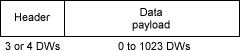
The header contains 3 or 4 DWs but the most important fields are part of the first DW.

The "Fmt" field tells how long is the header, and if a data payload is present.
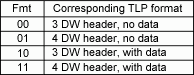
Then together with "Type", it describes the TLP operation. The remainder of the TLP header content depends of the TLP operation.
For example, here's a 32-bits memory write TLP header, where you can see that the write address is at the end of the header (and the write data is not shown as it is in the payload after the header).
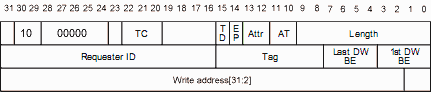
The "Fmt" field is "10" which means "3 DW, with data". That makes sense, a memory write needs data to write, so upon getting the data payload after the header, we write that data to some memory (or use it somehow) and we are done with it. The Field "Length" tells how many DWs are in the payload (from 0 to 1023). Commonly, it's a single DW to write, in which case length is equal to 1 and the total TLP length is 4 DWs (3 for the header and 1 of the payload).
Now what about a memory read? Somehow we have to return data.
Completion with data
If the TLP is a memory read instead of a write, we have to execute the read and then respond. There is a special TLP for that response, it is called CplD (completion with data) and its payload contains the data that we want to return.
Let's take a closer look at the 32-bit memory read TLP header - it is very similar to the 32-bit memory write we had previously.
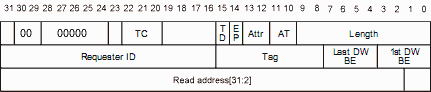
One difference is the Fmt=00, which means "no data". Makes sense, we don't need data to do a read, just an address. But we now have to respond with data. And as important, the response will need to be routed back to whoever asked for the read... Do you see the problem?
Ok, we received a read request. Did it come from the CPU? Or from the interrupt controller? Or from a graphic card? After all, many devices are capable of issuing such request. The answer is given in the "Requester ID" - it shows who requested the read. So when we create the CplD TLP, we have to recopy the "Requester ID" in it. This way, it'll be routed where it belongs by the PCI Express bridge(s). BTW, we also have to recopy the "Tag" (which is useful in case of multiple reads pending).
TLP size
A typical 32-bit address/data memory read TLP is made of 3 DWs in the header and no payload (so 96 bits total), while a similar memory write is made of 4 DWs (3 for the header and 1 for the payload). That's not very efficient in term of bandwidth because of the TLP header overhead, so it is better to use bigger TLP payloads when possible. A TLP payload can theoretically be as big as 1023 DWs, pretty handy for burst reads and writes, although PCs can limit the maximum size to a lower value (32 DWs is typical).
For more information, check the official PCI Express specification by googling something like PCI_Express_Base_11.pdf
Enough with theory, let's have some fun and play with the Xilinx PCI Express wizard.
PCI Express(四) - The transaction layer的更多相关文章
- PCI Express(六) - Simple transactions
原文地址:http://www.fpga4fun.com/PCI-Express6.html Let's try to control LEDs from the PCI Express bus. X ...
- PCI Express(三) - A story of packets, stack and network
原文出处:http://www.fpga4fun.com/PCI-Express3.html Packetized transactions PCI express is a serial bus. ...
- Down to the TLP: How PCI express devices talk (Part I)
http://xillybus.com/tutorials/pci-express-tlp-pcie-primer-tutorial-guide-1 Down to the TLP: How PCI ...
- PCI Express
1.1课题研究背景 在目前高速发展的计算机平台上,应用软件的开发越来越依赖于硬件平台,尤其是随着大数据.云计算的提出,人们对计算机在各个领域的性能有更高的需求.日常生活中的视频和图像信息包含大量的数据 ...
- Down to the TLP: How PCI express devices talk (Part II)
http://xillybus.com/tutorials/pci-express-tlp-pcie-primer-tutorial-guide-2 Data Link Layer Packets A ...
- [中英对照]How PCI Express Works | PCIe工作原理
How PCI Express Works | PCIe工作原理 PCI Express is a high-speed serial connection that operates more li ...
- 002 PCI Express体系结构(二)
一.PCI总线的信号定义 PCI总线是一条共享总线,在一条PCI总线上可以挂接多个PCI设备.这些PCI设备通过一系列信号与PCI总线相连,这些信号由地址/数据信号.控制信号.仲裁信号.中断信号等多种 ...
- 001 PCI Express体系结构(一)
一 .PCI总线的基本知识 PCI总线作为处理器系统的局部总线,主要目的是为了连接外部设备,而不是作为处理器的系统总线连接Cache和主存储器.但是PCI总线.系统总线和处理器体系结构之间依然存在着紧 ...
- PCI Express(五) - Xilinx wizard
原文地址:http://www.fpga4fun.com/PCI-Express5.html Xilinx makes using PCI express easy - they provide a ...
随机推荐
- Spark随笔(二):深入学习
一.如何选择粗粒度和细粒度 从底层往上引申来理解粗粒度与细粒度. 一层:一个类,具有三个属性值.为了查询这个类的所有实例,细粒度查询的程度为属性值,即依次查询每个实例化对象的属性值,查询三次:粗粒度按 ...
- 详解Android功耗分析工具Power Tutor的使用
简介: PowerTutor 是由美国密歇根大学在谷歌的指导下开发的.它是用来展示google智能手机中主要组件或应用功耗的一种应用程序.例如,CPU,网络链接,LCD显示屏,GPS等.它允许开发者很 ...
- java项目部署在服务器环境配置以及命令的编写
在往项目上部署java项目(即打成的jar包),要为相应的项目配置环境变量,即项目运行所需要的jar或其他第三方的jar包,java -cp derivativeAccording.jar:lib/c ...
- .vimrc常用
vim 的環境設定參數 :set nu:set nonu 行号 :set tabstop=4 :set softtabstop=4 :set shiftwidth=4 tab :set hlsea ...
- 1-Recyclerview使用系列之Recyclerview的列表数据显示
使用步骤已经写到我的公众号,二维码在下面,欢迎关注,谢谢. 本人联系方式: 更多精彩分享,可关注我的微信公众号: 若想给予我分享更多知识的动力,请扫描下面的微信打赏二维码,谢谢!: 微信号:Weixi ...
- jQuery-2.1.4.min.js:4 Uncaught TypeError: Illegal invocation
jQuery-2.1.4.min.js:4 Uncaught TypeError: Illegal invocation 此错误与crsf有关
- 【转载】ANSYS有限元分析中的单位问题
原文地址:http://www.cnblogs.com/ylhome/archive/2009/02/26/1398756.html ansys中没有单位的概念,只要统一就行了.所以,很多人在使用时, ...
- C#中动态读写App.config配置文件
转自:http://blog.csdn.net/taoyinzhou/article/details/1906996 app.config 修改后,如果使用cofnigurationManager立即 ...
- jQuery的ajax()、post()方法提交数组,参数[] 问题
当用$.ajax()向后台提交参数时,如果参数中数组的话一般在后台会用List,或Integer[] 等数组对象进行接收. 比如: $.ajax({ type: "POST", ...
- js 操作COOKE备忘
function getCookie(c_name) { if (document.cookie.length > 0) { c_start = document.cookie.indexOf( ...