
【JDK】JDK源码分析-CyclicBarrier
概述
CyclicBarrier 是并发包中的一个工具类,它的典型应用场景为:几个线程执行完任务后,执行另一个线程(回调函数,可选),然后继续下一轮,如此往复。
打个通俗的比方,可以把 CyclicBarrier 的执行流程比作:几个人(类比线程)围着操场跑圈,所有人都到达终点后(终点可理解为“屏障(barrier)”,到达次序可能有先后,对应线程执行任务有快慢),执行某个操作(回调函数),然后再继续跑下一圈(下一次循环),如此往复。
该类与 CountDownLatch 相比,可以把后者理解为“一次性(one-shot)”操作,而前者是“可循环”的操作,下面分析其代码实现。
代码分析
CyclicBarrier 的主要方法如下:
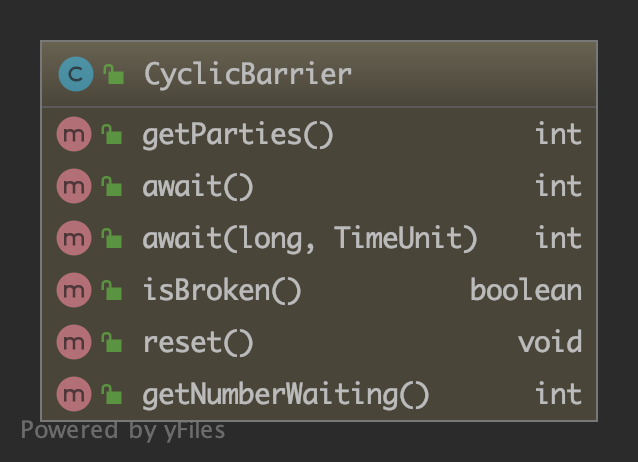
其中常用的是两个 await 方法,作用是让当前线程进入等待状态。
成员变量及嵌套类:
// 内部嵌套类

private static class Generation {

    boolean broken = false;

}

/** The lock for guarding barrier entry */

private final ReentrantLock lock = new ReentrantLock();

/** Condition to wait on until tripped */

private final Condition trip = lock.newCondition();

/** The number of parties */

private final int parties;

/* The command to run when tripped */

private final Runnable barrierCommand;

/** The current generation */

private Generation generation = new Generation();

/**

 * Number of parties still waiting. Counts down from parties to 0

 * on each generation.  It is reset to parties on each new

 * generation or when broken.

 */

private int count;
内部嵌套类 Generation 表示代数,每次屏障(barrier)破坏之前属于同一代,之后进入下一代。
构造器
// 无回调函数

public CyclicBarrier(int parties) {

    this(parties, null);

}

// 有回调函数

public CyclicBarrier(int parties, Runnable barrierAction) {

    if (parties <= 0) throw new IllegalArgumentException();

    this.parties = parties;

    this.count = parties;

    this.barrierCommand = barrierAction;

}
CyclicBarrier 有两个构造器,其中后者可以传入一个回调函数(barrierAction),parties 表示调用 await 的线程数。
await 方法
// 阻塞式等待

public int await() throws InterruptedException, BrokenBarrierException {

    try {

        return dowait(false, 0L);

    } catch (TimeoutException toe) {

        throw new Error(toe); // cannot happen

    }

}

// 有超时的等待

public int await(long timeout, TimeUnit unit)

    throws InterruptedException,

           BrokenBarrierException,

           TimeoutException {

    return dowait(true, unit.toNanos(timeout));

}
可以看到两个 await 方法都是调用 dowait 方法来实现的(该方法也是 CyclicBarrier 的核心方法),如下:
private int dowait(boolean timed, long nanos)

    throws InterruptedException, BrokenBarrierException,

           TimeoutException {

    final ReentrantLock lock = this.lock;

    lock.lock();

    try {

        // 获取当前代

        final Generation g = generation;

        // 若屏障破坏,则抛出异常

        if (g.broken)

            throw new BrokenBarrierException();

        if (Thread.interrupted()) {

            breakBarrier();

            throw new InterruptedException();

        }

        // count 减 1

        int index = --count;

        if (index == 0) {  // tripped

            // count 减到 0 时触发的操作

            boolean ranAction = false;

            try {

                // 传入的回调函数

                final Runnable command = barrierCommand;

                if (command != null)

                    // 若传了回调函数,则执行回调函数

                    // PS: 由此可知,回调函数由最后一个执行结束的线程执行

                    command.run();

                ranAction = true;

                // 进入下一代(下一轮操作)

                nextGeneration();

                return 0;

            } finally {

                if (!ranAction)

                    breakBarrier();

            }

        }

        // loop until tripped, broken, interrupted, or timed out

        for (;;) {

            try {

                // count 不为 0 时,当前线程进入等待状态

                if (!timed)

                    trip.await();

                else if (nanos > 0L)

                    nanos = trip.awaitNanos(nanos);

            } catch (InterruptedException ie) {

                if (g == generation && ! g.broken) {

                    breakBarrier();

                    throw ie;

                } else {

                    // We're about to finish waiting even if we had not

                    // been interrupted, so this interrupt is deemed to

                    // "belong" to subsequent execution.

                    Thread.currentThread().interrupt();

                }

            }

            if (g.broken)

                throw new BrokenBarrierException();

            if (g != generation)

                return index;

            if (timed && nanos <= 0L) {

                breakBarrier();

                throw new TimeoutException();

            }

        }

    } finally {

        lock.unlock();

    }

}
nextGeneration 和 breakBarrier:
// 进入下一轮

private void nextGeneration() {

    // signal completion of last generation

    trip.signalAll();

    // set up next generation

    count = parties;

    generation = new Generation();

}

// 破坏屏障

private void breakBarrier() {

    generation.broken = true;

    count = parties;

    trip.signalAll();

}
执行流程:初始化时 parties 和 count 的值相同(由构造器 parties 参数传入),之后每有一个线程调用 await 方法 count 值就减 1,直至 count 为 0 时(若不为 0 则等待),执行传入的回调函数 barrierCommand(若不为空),然后唤醒所有线程,并将 count 重置为 parties,开始下一轮操作。
场景举例
为了便于理解 CyclicBarrier 的用法,下面简单举例演示(仅供参考):
public class CyclicBarrierTest {

  private static final int COUNT = 3;

  public static void main(String[] args) throws InterruptedException {

    // 初始化 CyclicBarrier 对象及回调函数

    CyclicBarrier cyclicBarrier = new CyclicBarrier(COUNT, () -> {

      // 模拟回调函数的操作(模拟写操作)

      System.out.println(Thread.currentThread().getName() + " start writing..");

      try {

        TimeUnit.SECONDS.sleep(1);

      } catch (InterruptedException e) {

        e.printStackTrace();

      }

      System.out.println("---------");

    });

    while (true) {

      // 创建几个线程执行任务

      for (int i = 0; i < COUNT; i++) {

        new Thread(() -> {

          // 模拟读操作

          System.out.println(Thread.currentThread().getName() + " is reading..");

          try {

            TimeUnit.SECONDS.sleep(3);

            // 等待

            cyclicBarrier.await();

          } catch (InterruptedException | BrokenBarrierException e) {

            e.printStackTrace();

          }

        }).start();

      }

      // 睡眠 10 秒,然后进入下一轮

      TimeUnit.SECONDS.sleep(10);

    }

  }

}

/*  执行结果(仅供参考):

    Thread-0 is reading..

    Thread-1 is reading..

    Thread-2 is reading..

    Thread-1 start writing..

    ---------

    Thread-3 is reading..

    Thread-4 is reading..

    Thread-5 is reading..

    Thread-5 start writing..

    ---------

*/
PS: 此处模拟多个线程执行读操作,都读完后再执行写操作;之后再读、再写……可以理解为简单的对账系统。
此处代码仅供参考,只为便于理解该类的用法。实际上每次创建线程是不合理的(可以使用线程池,由于未分析,这里暂不使用)。
小结
CyclicBarrier 也可以理解为倒数的计数器,它与 CountDownLatch 有些类似。后者是“一次性”的,而前者是“可循环使用”的
Stay hungry, stay foolish.

PS: 本文首发于微信公众号【WriteOnRead】。
【JDK】JDK源码分析-CyclicBarrier的更多相关文章
- JDK Collection 源码分析(2)—— List
JDK List源码分析 List接口定义了有序集合(序列).在Collection的基础上,增加了可以通过下标索引访问,以及线性查找等功能. 整体类结构 1.AbstractList 该类作为L ...
- JDK AtomicInteger 源码分析
@(JDK)[AtomicInteger] JDK AtomicInteger 源码分析 Unsafe 实例化 Unsafe在创建实例的时候,不能仅仅通过new Unsafe()或者Unsafe.ge ...
- 设计模式(十八)——观察者模式(JDK Observable源码分析)
1 天气预报项目需求,具体要求如下: 1) 气象站可以将每天测量到的温度,湿度,气压等等以公告的形式发布出去(比如发布到自己的网站或第三方). 2) 需要设计开放型 API,便于其他第三方也能接入气象 ...
- JDK Collection 源码分析(3)—— Queue
@(JDK)[Queue] JDK Queue Queue:队列接口,对于数据的存取,提供了两种方式,一种失败会抛出异常,另一种则返回null或者false. 抛出异常的接口:add,remove ...
- JDK Collection 源码分析(1)—— Collection
JDK Collection JDK Collection作为一个最顶层的接口(root interface),JDK并不提供该接口的直接实现,而是通过更加具体的子接口(sub interface ...
- 【JDK】JDK源码分析-AbstractQueuedSynchronizer(1)
概述 前文「JDK源码分析-Lock&Condition」简要分析了 Lock 接口,它在 JDK 中的实现类主要是 ReentrantLock (可译为“重入锁”).ReentrantLoc ...
- JDK源码分析—— ArrayBlockingQueue 和 LinkedBlockingQueue
JDK源码分析—— ArrayBlockingQueue 和 LinkedBlockingQueue 目的:本文通过分析JDK源码来对比ArrayBlockingQueue 和LinkedBlocki ...
- JDK 源码分析(4)—— HashMap/LinkedHashMap/Hashtable
JDK 源码分析(4)-- HashMap/LinkedHashMap/Hashtable HashMap HashMap采用的是哈希算法+链表冲突解决,table的大小永远为2次幂,因为在初始化的时 ...
- JDK源码分析(11)之 BlockingQueue 相关
本文将主要结合源码对 JDK 中的阻塞队列进行分析,并比较其各自的特点: 一.BlockingQueue 概述 说到阻塞队列想到的第一个应用场景可能就是生产者消费者模式了,如图所示: 根据上图所示,明 ...
随机推荐
- 004-python-列表、元组、字典
1. 什么是列表 列表是一个可变的数据类型 列表由[]来表示, 每一项元素使用逗号隔开. 列表什么都能装. 能装对象的对象. 列表可以装大量的数据 2. 列表的索引和切片 列表和字符串一样. 也有索引 ...
- Innovus教程 - Flow系列 - MMMC分析环境的配置概述(理论+实践+命令)
本文转自:自己的微信公众号<集成电路设计及EDA教程> <Innovus教程 - Flow系列 - MMMC分析环境的配置概述(理论+实践+命令)> 轻轻走过,悄悄看过,无 ...
- Oracle数据库---存储过程、存储函数
--创建存储过程CREATE OR REPLACE PROCEDURE first_procISBEGIN DBMS_OUTPUT.PUT_LINE('我是过程'); DBMS_OUTPUT.PUT_ ...
- Java连载5-标识符、关键字和字面值
一.标识符 1.标识符定义:在java源程序中凡是可以自己命名的单词 2.标识符可以标识什么元素? (1)类名(2)方法名(3)变量名(4)接口名(5)常量名 等等 3.标识符的命名要求 (1)一个合 ...
- C++学习书籍推荐《C++ Concurrency in Action》下载
百度云及其他网盘下载地址:点我 目录 Hello, world of concurrency in C++! Managing threads Sharing data between threads ...
- Docker学习第二天
CentOS 系列安装 Docker Docker 支持 CentOS6 及以后的版本. CentOS6 对于 CentOS6,可以使用 EPEL 库安装 Docker,命令如下 [root@MSJT ...
- cogs.12运输问题2题解
乍一看貌似和运输问题1没有任何区别,但本题有一个有意思的东西叫做下限,我个人称之为非强制下限,因为本题中要求的实际是我走这条边这条边才至少走下限的流,虽然出题人没说,但从样例来看确实是这样的,而强制下 ...
- 20190101.DDD笔记
建立领域模型步骤 根据提供的信息完善主要业务场景和业务流程: 根据业务流程识别领域事件并按照时序排列: 针对领域事件进行命令识别: 针对领域事件和命令进行聚合和子域的初步识别: 在识别的subdoma ...
- Spring 注解编程之 AnnotationMetadata
在上篇文章 Spring 注解编程之模式注解 中我们讲到 Spring 模式注解底层原理,依靠 AnnotationMetadata 接口判断是否存在指定元注解. 这篇文章我们主要深入 Annotat ...
- Java异常与处理机制
Java的异常层次体系 Java的所有异常对象都派生自Throwable类,下层有两个分支:error和exception. Error分支描述Java运行时系统内部错误或资源耗尽错误,遇到派生自Er ...