
二分类模型之logistic
liner classifiers
逻辑回归用在2分类问题上居多。它是一个非线性的回归模型,其最大的好处恰恰是可以解决二元类问题,目前在金融行业,基本都是使用Logistic回归来预判一个用户是否为好客户,因为它还弥补了其他黑盒模型(SVM、神经网络、随机森林等)不具解释性的缺点。知乎
1.logistic
- 逻辑回归其实是一个分类算法而不是回归算法。通常是利用已知的自变量来预测一个离散型因变量的值(像二进制值0/1,是/否,真/假)。简单来说,它就是通过拟合一个逻辑函数(logit fuction)来预测一个事件发生的概率。所以它预测的是一个概率值,自然,它的输出值应该在0到1之间。--计算的是单个输出
1.2 sigmoid
逻辑函数
\(g(z)=\frac{1}{1+e^{-z}}\)
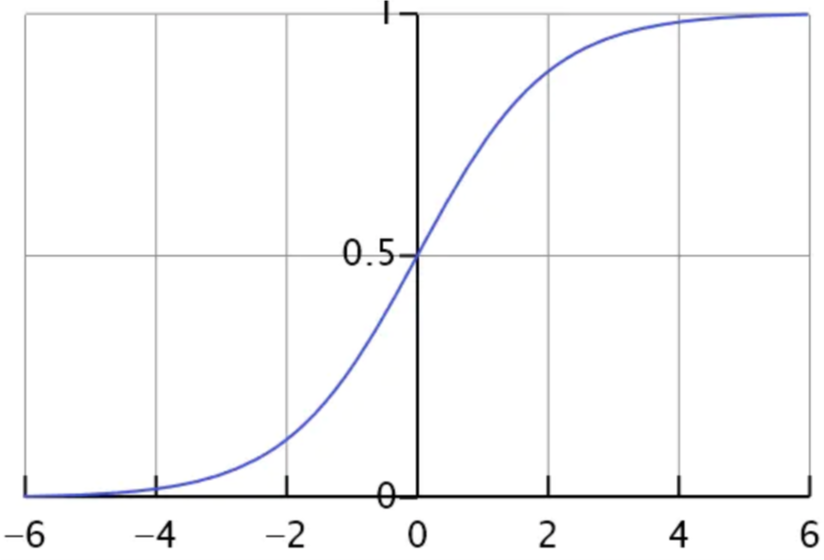
- sigmoid函数是一个s形的曲线,它的取值在[0, 1]之间,在远离0的地方函数的值会很快接近0或者1。它的这个特性对于解决二分类问题十分重要
- 二分类中,输出y的取值只能为0或者1,所以在线性回归的假设函数外包裹一层Sigmoid函数,使之取值范围属于(0,1),完成了从值到概率的转换。逻辑回归的假设函数形式如下
\(h_{\theta}(x)=g\left(\theta^{T} x\right)=\frac{1}{1+e^{-\theta^{T} x}}=P(y=1 | x ; \theta)\)
则若\(P(y=1 | x ; \theta)=0.7\),则表示输入为x的时候,y=1的概率为0.7
1.3 决策边界
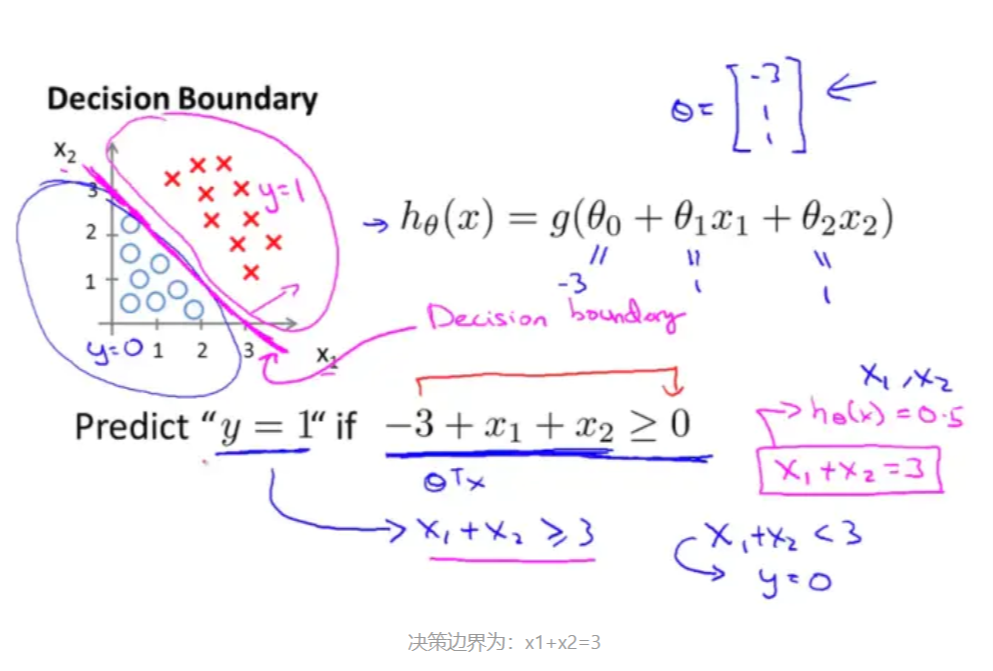
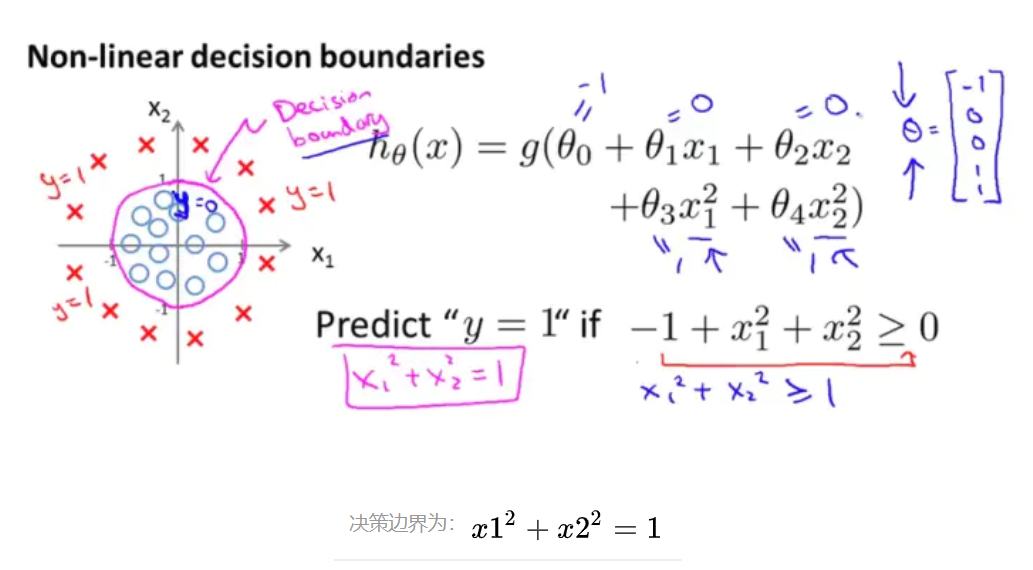
决策边界,也称为决策面,是用于在N维空间,将不同类别样本分开的直线或曲线,平面或曲面
根据以上假设函数表示概率,我们可以推得
if \(h_{\theta}(x) \geqslant 0.5 \Rightarrow y=1\)
if \(h_{\theta}(x)<0.5 \Rightarrow y=0\)
1.3.1 线性决策边界
1.3.2 非线性决策边界
1.4 代价函数/损失函数
在线性回归中的代价函数为
\(J(\theta)=\frac{1}{2 m} \sum_{i=1}^{m}\left(h_{\theta}\left(x^{(i)}\right)-y^{(i)}\right)^{2}\)
- 因为它是一个凸函数,所以可用梯度下降直接求解,局部最小值即全局最小值
- 只有把函数是或者转化为凸函数,才能使用梯度下降法进行求导哦
- 在逻辑回归中,\(h_{\theta }(x)\)是一个复杂的非线性函数,属于非凸函数,直接使用梯度下降会陷入局部最小值中。类似于线性回归,逻辑回归的\(J(\theta )\)的具体求解过程如下
- 对于输入x,分类结果为类别1和类别0的概率分别为:
\(P(y=1 | x ; \theta)=h(x) ; \quad P(y=0 | x ; \theta)=1-h(x)\) - 因此化简为一个式子可以写为
\(\left.P(y | x ; \theta)=(h(x))^{y}(1-h(x))^{(} 1-y\right)\)
1.4.1 似然函数
\(\begin{aligned} L(\theta) &=\prod_{i=1}^{m} P\left(y^{(i)} | x^{(i)} ; \theta\right) \\ &=\prod_{i=1}^{m}\left(h_{\theta}\left(x^{(i)}\right)\right)^{y^{(0)}}\left(1-h_{\theta}\left(x^{(i)}\right)\right)^{1-y^{(i)}} \end{aligned}\)
似然函数取对数之后
\(\begin{aligned} l(\theta) &=\log L(\theta) \\ &=\sum_{i=1}^{m}\left(y^{(i)} \log h_{\theta}\left(x^{(i)}\right)+\left(1-y^{(i)}\right) \log \left(1-h_{\theta}\left(x^{(i)}\right)\right)\right) \end{aligned}\)
- 根据最大似然估计,需要使用梯度上升法求最大值,因此,为例能够使用梯度下降法,需要将代价函数构造成为凸函数
因此
\(J(\theta )=-\frac{1}{m} l(\theta )\)
此时可以使用梯度下降求解了 - \(\theta_{j}\)更新过程为
\(\theta_{j}:=\theta_{j}-\alpha \frac{\partial}{\partial \theta_{j}} J(\theta)\)
中间求导过程省略
\(\theta_{j}:=\theta_{j}-\alpha \frac{1}{m} \sum_{i=1}^{m}\left(h_{\theta}\left(\mathrm{x}^{(i)}\right)-y^{(i)}\right) x_{j}^{(i)}, \quad(j=0 \ldots n)\)
1.5正则化
损失函数中增加惩罚项:参数值越大惩罚越大–>让算法去尽量减少参数值
损失函数 \(J(β)\)的简写形式:
\(J(\beta)=\frac{1}{m} \sum_{i=1}^{m} \cos (y, \beta)+\frac{\lambda}{2 m} \sum_{j=1}^{n} \beta_{j}^{2}\)
- 当模型参数 β 过多时,损失函数会很大,算法要努力减少 β 参数值来让损失函数最小。
- λ 正则项重要参数,λ 越大惩罚越厉害,模型越欠拟合,反之则倾向过拟合
1.5.1 lasso
l1正则化
\(J(\beta)=\frac{1}{m} \sum_{i=1}^{\mathrm{m}} \cos t(y, \beta)+\frac{\lambda}{2 m} \sum_{j=1}^{n}\left|\beta_{j}\right|\)
1.5.2 ridge
l2正则化
\(J(\beta)=\frac{1}{m} \sum_{i=1}^{\mathrm{m}} \cos t(y, \beta)+\frac{\lambda}{2 m} \sum_{j=1}^{n} \beta_{j}^{2}\)
1.6 python实现
class sklearn.linear_model.LogisticRegression(penalty='l2', dual=False, tol=0.0001, C=1.0, fit_intercept=True, intercept_scaling=1, class_weight=None, random_state=None, solver='lbfgs', max_iter=100, multi_class='auto', verbose=0, warm_start=False, n_jobs=None, l1_ratio=None
1.6.1 参数
- penalty:{‘l1’, ‘l2’, ‘elasticnet’, ‘none’}, default=’l2’ 正则项,默认是l2
- The ‘newton-cg’, ‘sag’ and ‘lbfgs’ solvers support only l2 penalties. ‘elasticnet’ is only supported by the ‘saga’ solver. If ‘none’ (not supported by the liblinear solver), no regularization is applied.LogisticRegression
- dual:bool, default=False
-Dual formulation is only implemented for l2 penalty with liblinear solver. Prefer dual=False when n_samples > n_features,一般情况下是false - tol:float, default=1e-4 阈值,迭代终止条件按
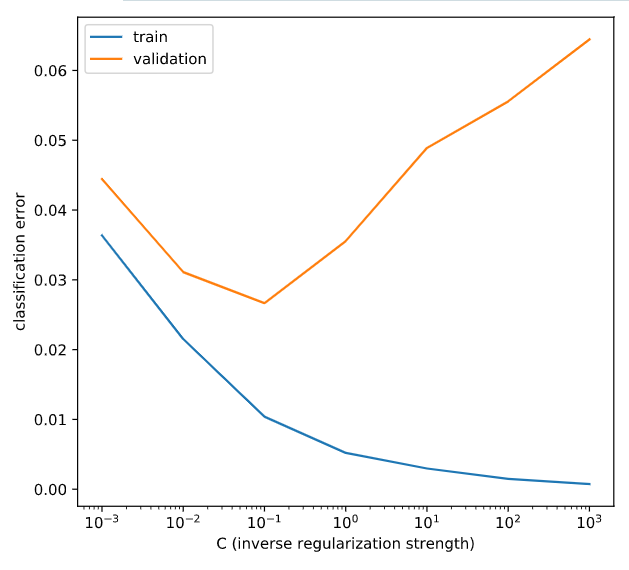
- C:float, default=1.0
- Inverse of regularization strength; must be a positive float. Like in support vector machines, smaller values specify stronger regularization,正则化强度的倒数;必须是正浮点数。与支持向量机一样,较小的值指定更强的正则化
-solver:{‘newton-cg’, ‘lbfgs’, ‘liblinear’, ‘sag’, ‘saga’}, default=’lbfgs’ - Algorithm to use in the optimization problem.
- For small datasets, ‘liblinear’ is a good choice, whereas ‘sag’ and ‘saga’ are faster for large ones.
- For multiclass problems, only ‘newton-cg’, ‘sag’, ‘saga’ and ‘lbfgs’ handle multinomial loss; ‘liblinear’ is limited to one-versus-rest schemes.
- ‘newton-cg’, ‘lbfgs’, ‘sag’ and ‘saga’ handle L2 or no penalty
- ‘liblinear’ and ‘saga’ also handle L1 penalty
- ‘saga’ also supports ‘elasticnet’ penalty
- ‘liblinear’ does not support setting penalty='none'
- Inverse of regularization strength; must be a positive float. Like in support vector machines, smaller values specify stronger regularization,正则化强度的倒数;必须是正浮点数。与支持向量机一样,较小的值指定更强的正则化
- multi_class:{‘auto’, ‘ovr’, ‘multinomial’}, default=’auto’ 这个参数是多元分类中用到的,二分类中不涉及
- If the option chosen is ‘ovr’, then a binary problem is fit for each label.
- For ‘multinomial’ the loss minimised is the multinomial loss fit across the entire probability distribution, even when the data is binary. **‘multinomial’ is unavailable when solver=’liblinear’. **
-‘auto’ selects ‘ovr’ if the data is binary, or if solver=’liblinear’, and otherwise selects ‘multinomial’.
1.6.1 属性
- classes_:ndarray of shape (n_classes, )属性数组
A list of class labels known to the classifier. - coef_:ndarray of shape (1, n_features) or (n_classes, n_features)属性和特征分类的数组
- Coefficient of the features in the decision function.
- coef_ is of shape (1, n_features) when the given problem is binary. In particular, when multi_class='multinomial', coef_ corresponds to outcome 1 (True) and -coef_ corresponds to outcome 0 (False).
- intercept_:ndarray of shape (1,) or (n_classes,)
Intercept (a.k.a. bias) added to the decision function.
If fit_intercept is set to False, the intercept is set to zero. intercept_ is of shape (1,) when the given problem is binary. In particular, when multi_class='multinomial', intercept_ corresponds to outcome 1 (True) and -intercept_ corresponds to outcome 0 (False).
n_iter_:ndarray of shape (n_classes,) or (1, )
Actual number of iterations for all classes. If binary or multinomial, it returns only 1 element. For liblinear solver, only the maximum number of iteration across all classes is given.
 # Create LogisticRegression object and fit

    lr = LogisticRegression(C=C_value)

    lr.fit(X_train, y_train)

    # Evaluate error rates and append to lists

    train_errs.append( 1.0 - lr.score(X_train, y_train) )

    valid_errs.append( 1.0 - lr.score(X_valid, y_valid) )

# Plot results

plt.semilogx(C_values, train_errs, C_values, valid_errs)

plt.legend(("train", "validation"))

plt.show()
二分类模型之logistic的更多相关文章
- 【AUC】二分类模型的评价指标ROC Curve
AUC是指:从一堆样本中随机抽一个,抽到正样本的概率比抽到负样本的概率大的可能性! AUC是一个模型评价指标,只能用于二分类模型的评价,对于二分类模型,还有很多其他评价指标,比如logloss,acc ...
- Logistic回归二分类Winner or Losser----台大李宏毅机器学习作业二(HW2)
一.作业说明 给定训练集spam_train.csv,要求根据每个ID各种属性值来判断该ID对应角色是Winner还是Losser(0.1分类). 训练集介绍: (1)CSV文件,大小为4000行X5 ...
- 逻辑回归(Logistic Regression)二分类原理及python实现
本文目录: 1. sigmoid function (logistic function) 2. 逻辑回归二分类模型 3. 神经网络做二分类问题 4. python实现神经网络做二分类问题 1. si ...
- Kaggle实战之二分类问题
0. 前言 1. MNIST 数据集 2. 二分类器 3. 效果评测 4. 多分类器与误差分析 5. Kaggle 实战 0. 前言 "尽管新技术新算法层出不穷,但是掌握好基础算法就能解决手 ...
- 分类模型的性能评价指标(Classification Model Performance Evaluation Metric)
二分类模型的预测结果分为四种情况(正类为1,反类为0): TP(True Positive):预测为正类,且预测正确(真实为1,预测也为1) FP(False Positive):预测为正类,但预测错 ...
- matlab 实现感知机线性二分类算法(Perceptron)
感知机是简单的线性分类模型 ,是二分类模型.其间用到随机梯度下降方法进行权值更新.参考他人代码,用matlab实现总结下. 权值求解过程通过Perceptron.m函数完成 function W = ...
- NLP(二十)利用BERT实现文本二分类
在我们进行事件抽取的时候,我们需要触发词来确定是否属于某个特定的事件类型,比如我们以政治上的出访类事件为例,这类事件往往会出现"访问"这个词语,但是仅仅通过"访问&q ...
- NLP(二十二)利用ALBERT实现文本二分类
在文章NLP(二十)利用BERT实现文本二分类中,笔者介绍了如何使用BERT来实现文本二分类功能,以判别是否属于出访类事件为例子.但是呢,利用BERT在做模型预测的时候存在预测时间较长的问题.因此 ...
- keras框架下的深度学习(二)二分类和多分类问题
本文第一部分是对数据处理中one-hot编码的讲解,第二部分是对二分类模型的代码讲解,其模型的建立以及训练过程与上篇文章一样:在最后我们将训练好的模型保存下来,再用自己的数据放入保存下来的模型中进行分 ...
随机推荐
- 批处理(BAT) Ping监控, 结果记录入日志文件
::执行效果 @echo off ::等待用户输入需要监控IP set /p ip=Input the IP required to monitor: echo executing...... :st ...
- Redis5.xc两种持久化方式以及主从复制配置
关注公众号:CoderBuff,回复"redis"获取<Redis5.x入门教程>完整版PDF. <Redis5.x入门教程>目录 第一章 · 准备工作 第 ...
- Ansible 学习目录
1. Ansible 安装 2. Ansible hosts 文件配置 3. Ansible 常用模块 4. Ansible playbook使用
- delphi制作res文件
第一步:将brcc32.exe拷贝到某个目录,如“res文件”第二步:制作rc文件1.在“res文件”中新建一个文本文件resources.rc:2.文本文件中每一行写一个资源,资源格式为:资源标识名 ...
- 搭建fastdfs文件服务器
一.安装FastDFS环境 1.跟踪服务器(Tracker Server) tracker1:192.168.2.134 tracker2:192.168.2.135 2.存储服务器(Storage ...
- Android更改popupmenu背景并显示图标
似乎popupmenu是无法单独设置style的,好像是由context决定的,前几天需要设置style,找了很久才找一一个办法,似乎是通过 ContextThemeWrapper 包装一个 Cont ...
- 记网站部署中一个奇葩BUG
网页中引用的文件名不要带 adv 等 近日在写好一个网页后就把他部署到apache上测试,结果用chrome访问时有个背景图片总显示不出来,但是用firefox等却一切正常, 关键是我用windows ...
- codewars--js--Convert all the cases!
问题描述: In this kata, you will make a function that converts between camelCase, snake_case, and kebab- ...
- centos 记录所有用户操作命令的脚本
使用history不能看到所有用户的命令记录,如何看所有用户的操作记录. 如下: 在 /etc/profile 最下面加入如下代码即可. PS1="`whoami`@`hostname`:& ...
- 轮播组件/瀑布流/组合搜索/KindEditor插件
一.企业官网 ### 瀑布流 Models.Student.objects.all() #获取所有学员信息 通过div进行循环图片和字幕 1.以template模板方法实现瀑布流以列为单位 ...