
FreeRTOS低功耗模式
在系统或电源复位以后,微控制器处于运行状态。当CPU不需继续运行时,可以利用多种低功耗模式来节省功耗,例如等待某个外部事件时,用户需要根据最低电源消耗,最快速启动时间和可用的唤醒源等条件,选定一个最佳的低功耗模式。
STM32有三种低功耗模式:
1.睡眠模式(Cortex内核停止,所有外设包括Cortex核心的外设,如NVIC,系统嘀嗒定时器Systick等仍在运行)
2.停机模式(所有的时钟都停止)
3.待机模式(1.8V电源关闭)
这三种模式的对比如下
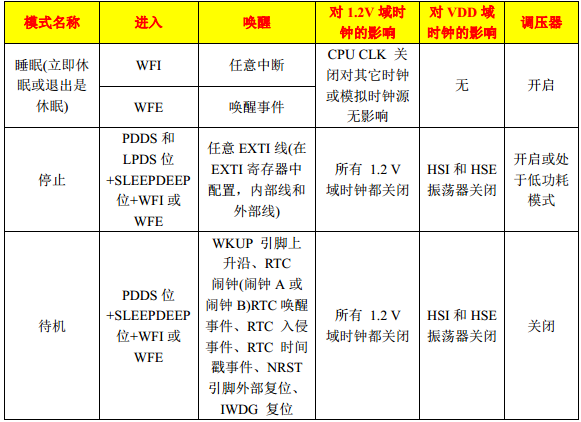
如何有效降低睡眠模式的功耗
设计低功耗主要从以下几个方面着手:
1.关闭可以关闭的外设时钟。
2.降低系统主频。WOM
3.注意I/O的状态,因为睡眠模式下,所有的I/O引脚都保持它们在运行模式时的状态。
如何有效降低停机模式的功耗
设计低功耗主要从以下几个方面着手
1.注意I/O的状态,因为在停机状态下,所有I/O都被保持在它们运行模式时的状态
2.注意I/O和外设IC的链接。
3.测试低功耗的时候,一定不要链接调试器,更不能边调试边侧电流。
* 关于低功耗的停机模式说明:
(1) 停止模式是在Corte的深睡眠模式基础上结合了外设的时钟控制机制,在停止模式下电压调节器可运行在正常或低功耗模式。此时在1.2V供电区域的的所有时钟都被停止,PLL、HSI和HSE的RC振荡器的功能被禁止,SRAM和寄存器内容被保留下来。
(2) 在停止模式下,所有的I/O引脚都保持它们在运行模式时的状态。
(3) 一定要关闭滴答定时器,实际测试发现滴答定时器中断也能唤醒停机模式。
(4) 当一个中断或唤醒事件导致退出停止模式时, HSI RC振荡器被选为系统时钟。
(5) 退出低功耗的停机模式后,需要重新配置使用HSE。
我们知道一般简单应用中处理器大量的时间都在处理空闲任务,所以我们就可以考虑处理器处理空闲任务的时候进入低功耗模式,当需要处理空闲任务的时候就进入了低功耗模式,当需要处理应用层代码的时候就将处理器从低功耗模式中唤醒。但FreeRTOS的系统时钟是由嘀嗒定时器中断来提供的,系统时钟频率越高,嘀嗒定时器中断频率也就越高。如果嘀嗒定时器中断频率太高的话会导致大量的能量和时间消耗再进出睡眠模式中,这样导致的结果就是低功耗模式的作用被大大的消弱。
为此,FreeRTOS提供了tickless模式,即当处理器进入空闲任务后关闭嘀嗒定时器中断,只有当其他中断发生或其他任务需要处理的时候才会从低功耗模式中唤醒。为此,需要解决两个问题
1.关闭嘀嗒定时器会导致系统节拍停止,系统时钟就会停止
可以记录下系统节拍中断的关闭时间,当系统节拍中断再次开启运行的时候补上这段时间
2.如何保证下一个要运行的任务能被准确的唤醒
在进入低功耗模式之前获取还有多长时间进行下一个任务
Tickless具体实现过程
1.宏configUSE_TICKLESS_IDLE
#define configUSE_TICKLESS_IDLE 1 //启用低功耗模式
2.宏portSUPPRESS_TICKS_AND_SLEEP()
使能Tickless后,符合下面两种情况会调用宏portSUPPRESS_TICKS_AND_SLEEP()来处理低功耗的工作
1.空闲任务是唯一可运行的任务,因为其他所有任务都处于阻塞态或挂起态
2.系统处于低功耗模式的时间至少大于configEXPECTED_IDLE_TIME_BEFORE_SLEEP个时钟节拍,宏configEXPECTED_IDLE_TIME_BEFORE_SLEEP默认在文件FreeRTOS.h中定义为2,重新定义大于2。
这里FreeRTOS已经帮我们实现了STM32的portSUPPRESS_TICKS_AND_SLEEP()函数,宏portSUPPRESS_TICKS_AND_SLEEP在文件portmacro.h中如下定义
#ifndef portSUPPRESS_TICKS_AND_SLEEP

    extern void vPortSuppressTicksAndSleep(TickType_t xExpectedIdleTime);

#define portSUPPRESS_TICKS_AND_SLEEP(xExpectedIdleTime)

    vPortSuppressTicksAndSleep(xExpectedIdleTime)

#endif
vPortSuppressTicksAndSleep()在port.c中实现如下
#if configUSE_TICKLESS_IDLE == 1

    __weak void vPortSuppressTicksAndSleep( TickType_t xExpectedIdleTime )

    {

    uint32_t ulReloadValue, ulCompleteTickPeriods, ulCompletedSysTickDecrements, ulSysTickCTRL;

    TickType_t xModifiableIdleTime;

        /* Make sure the SysTick reload value does not overflow the counter. */

        if( xExpectedIdleTime > xMaximumPossibleSuppressedTicks )

        {

            xExpectedIdleTime = xMaximumPossibleSuppressedTicks;

        }

        /* Stop the SysTick momentarily.  The time the SysTick is stopped for

        is accounted for as best it can be, but using the tickless mode will

        inevitably result in some tiny drift of the time maintained by the

        kernel with respect to calendar time. */

        portNVIC_SYSTICK_CTRL_REG &= ~portNVIC_SYSTICK_ENABLE_BIT;

        /* Calculate the reload value required to wait xExpectedIdleTime

        tick periods.  -1 is used because this code will execute part way

        through one of the tick periods. */

        ulReloadValue = portNVIC_SYSTICK_CURRENT_VALUE_REG + ( ulTimerCountsForOneTick * ( xExpectedIdleTime - 1UL ) );

        if( ulReloadValue > ulStoppedTimerCompensation )

        {

            ulReloadValue -= ulStoppedTimerCompensation;

        }

        /* Enter a critical section but don't use the taskENTER_CRITICAL()

        method as that will mask interrupts that should exit sleep mode. */

        __disable_irq();

        __dsb( portSY_FULL_READ_WRITE );

        __isb( portSY_FULL_READ_WRITE );

        /* If a context switch is pending or a task is waiting for the scheduler

        to be unsuspended then abandon the low power entry. */

        if( eTaskConfirmSleepModeStatus() == eAbortSleep )

        {

            /* Restart from whatever is left in the count register to complete

            this tick period. */

            portNVIC_SYSTICK_LOAD_REG = portNVIC_SYSTICK_CURRENT_VALUE_REG;

            /* Restart SysTick. */

            portNVIC_SYSTICK_CTRL_REG |= portNVIC_SYSTICK_ENABLE_BIT;

            /* Reset the reload register to the value required for normal tick

            periods. */

            portNVIC_SYSTICK_LOAD_REG = ulTimerCountsForOneTick - 1UL;

            /* Re-enable interrupts - see comments above __disable_irq() call

            above. */

            __enable_irq();

        }

        else

        {

            /* Set the new reload value. */

            portNVIC_SYSTICK_LOAD_REG = ulReloadValue;

            /* Clear the SysTick count flag and set the count value back to

            zero. */

            portNVIC_SYSTICK_CURRENT_VALUE_REG = 0UL;

            /* Restart SysTick. */

            portNVIC_SYSTICK_CTRL_REG |= portNVIC_SYSTICK_ENABLE_BIT;

            /* Sleep until something happens.  configPRE_SLEEP_PROCESSING() can

            set its parameter to 0 to indicate that its implementation contains

            its own wait for interrupt or wait for event instruction, and so wfi

            should not be executed again.  However, the original expected idle

            time variable must remain unmodified, so a copy is taken. */

            xModifiableIdleTime = xExpectedIdleTime;

            configPRE_SLEEP_PROCESSING( xModifiableIdleTime );

            if( xModifiableIdleTime >  )

            {

                __dsb( portSY_FULL_READ_WRITE );

                __wfi();

                __isb( portSY_FULL_READ_WRITE );

            }

            configPOST_SLEEP_PROCESSING( xExpectedIdleTime );

            /* Stop SysTick.  Again, the time the SysTick is stopped for is

            accounted for as best it can be, but using the tickless mode will

            inevitably result in some tiny drift of the time maintained by the

            kernel with respect to calendar time. */

            ulSysTickCTRL = portNVIC_SYSTICK_CTRL_REG;

            portNVIC_SYSTICK_CTRL_REG = ( ulSysTickCTRL & ~portNVIC_SYSTICK_ENABLE_BIT );

            /* Re-enable interrupts - see comments above __disable_irq() call

            above. */

            __enable_irq();

            if( ( ulSysTickCTRL & portNVIC_SYSTICK_COUNT_FLAG_BIT ) !=  )

            {

                uint32_t ulCalculatedLoadValue;

                /* The tick interrupt has already executed, and the SysTick

                count reloaded with ulReloadValue.  Reset the

                portNVIC_SYSTICK_LOAD_REG with whatever remains of this tick

                period. */

                ulCalculatedLoadValue = ( ulTimerCountsForOneTick - 1UL ) - ( ulReloadValue - portNVIC_SYSTICK_CURRENT_VALUE_REG );

                /* Don't allow a tiny value, or values that have somehow

                underflowed because the post sleep hook did something

                that took too long. */

                if( ( ulCalculatedLoadValue < ulStoppedTimerCompensation ) || ( ulCalculatedLoadValue > ulTimerCountsForOneTick ) )

                {

                    ulCalculatedLoadValue = ( ulTimerCountsForOneTick - 1UL );

                }

                portNVIC_SYSTICK_LOAD_REG = ulCalculatedLoadValue;

                /* The tick interrupt handler will already have pended the tick

                processing in the kernel.  As the pending tick will be

                processed as soon as this function exits, the tick value

                maintained by the tick is stepped forward by one less than the

                time spent waiting. */

                ulCompleteTickPeriods = xExpectedIdleTime - 1UL;

            }

            else

            {

                /* Something other than the tick interrupt ended the sleep.

                Work out how long the sleep lasted rounded to complete tick

                periods (not the ulReload value which accounted for part

                ticks). */

                ulCompletedSysTickDecrements = ( xExpectedIdleTime * ulTimerCountsForOneTick ) - portNVIC_SYSTICK_CURRENT_VALUE_REG;

                /* How many complete tick periods passed while the processor

                was waiting? */

                ulCompleteTickPeriods = ulCompletedSysTickDecrements / ulTimerCountsForOneTick;

                /* The reload value is set to whatever fraction of a single tick

                period remains. */

                portNVIC_SYSTICK_LOAD_REG = ( ( ulCompleteTickPeriods + 1UL ) * ulTimerCountsForOneTick ) - ulCompletedSysTickDecrements;

            }

            /* Restart SysTick so it runs from portNVIC_SYSTICK_LOAD_REG

            again, then set portNVIC_SYSTICK_LOAD_REG back to its standard

            value.  The critical section is used to ensure the tick interrupt

            can only execute once in the case that the reload register is near

            zero. */

            portNVIC_SYSTICK_CURRENT_VALUE_REG = 0UL;

            portENTER_CRITICAL();

            {

                portNVIC_SYSTICK_CTRL_REG |= portNVIC_SYSTICK_ENABLE_BIT;

                vTaskStepTick( ulCompleteTickPeriods );

                portNVIC_SYSTICK_LOAD_REG = ulTimerCountsForOneTick - 1UL;

            }

            portEXIT_CRITICAL();

        }

    }

#endif /* #if configUSE_TICKLESS_IDLE */

/*-----------------------------------------------------------*/

/*

 * Setup the SysTick timer to generate the tick interrupts at the required

 * frequency.

 */

#if configOVERRIDE_DEFAULT_TICK_CONFIGURATION == 0

    void vPortSetupTimerInterrupt( void )

    {

        /* Calculate the constants required to configure the tick interrupt. */

        #if configUSE_TICKLESS_IDLE == 1

        {

            ulTimerCountsForOneTick = ( configSYSTICK_CLOCK_HZ / configTICK_RATE_HZ );

            xMaximumPossibleSuppressedTicks = portMAX_24_BIT_NUMBER / ulTimerCountsForOneTick;

            ulStoppedTimerCompensation = portMISSED_COUNTS_FACTOR / ( configCPU_CLOCK_HZ / configSYSTICK_CLOCK_HZ );

        }

        #endif /* configUSE_TICKLESS_IDLE */

        /* Configure SysTick to interrupt at the requested rate. */

        portNVIC_SYSTICK_LOAD_REG = ( configSYSTICK_CLOCK_HZ / configTICK_RATE_HZ ) - 1UL;

        portNVIC_SYSTICK_CTRL_REG = ( portNVIC_SYSTICK_CLK_BIT | portNVIC_SYSTICK_INT_BIT | portNVIC_SYSTICK_ENABLE_BIT );

    }

#endif /* configOVERRIDE_DEFAULT_TICK_CONFIGURATION */

/*-----------------------------------------------------------*/
宏configPRE_SLEEP_PROCESSING()和configPOST_SLEEP_PROCESSING()
在真正的低功耗设计中不仅仅是将处理器设置到低功耗模式就行了,还需要做一些其他的处理,比如:
1.将处理器降低到合适的频率,因为频率越低功耗越小,甚至可以在进入低功耗以后关闭系统时钟。
2.修改时钟源,晶振的功耗肯定比处理器内部的时钟源高,进入低功耗模式以后可以切换到内部时钟源,比如STM32的内部RC振荡器
3.关闭其他外设时钟,比如IO口的时钟
4.关闭板子上其他功能模块电源,这个需要在产品硬件设计的时候就要处理好,比如可以通过MOS管来控制某个模快电源的开关,在处理器进入低功耗模式之前关闭这些模块的电源
/***************************************************************************************************************/

/*                                FreeRTOS与低功耗管理相关配置                                                    */

/***************************************************************************************************************/

extern void PreSleepProcessing(uint32_t ulExpectedIdleTime);

extern void PostSleepProcessing(uint32_t ulExpectedIdleTime);

#define configPRE_SLEEP_PROCESSING                   PreSleepProcessing        //进入低功耗模式前要做的处理

#define configPOST_SLEEP_PROCESSING                   PostSleepProcessing        //退出低功耗模式后要做的处理
宏conifgEXPECTED_IDLE_TIME_BEFORE_SLEEP
处理器工作咋在低功耗模式的时间虽说没有任何限制,但是时间太短也不行,所以需要做个限制,configEXPECTED_IDLE_TIME_BEFORE_SLEEP就是来完成这个功能的。
#ifndef configEXPECTED_IDLE_TIME_BEFORE_SLEEP

    #define configEXPECTED_IDLE_TIME_BEFORE_SLEEP 2

#endif

#if configEXPECTED_IDLE_TIME_BEFORE_SLEEP < 2

    #error configEXPECTED_IDLE_TIME_BEFORE_SLEEP must not be less than 2

#endif
此宏会在空闲任务函数prvIdleTask()中使用
FreeRTOS低功耗模式的更多相关文章
- FreeRTOS 低功耗之 tickless 模式
以下转载自安富莱电子: http://forum.armfly.com/forum.php 本章节为大家讲解 FreeRTOS 本身支持的低功耗模式 tickless 实现方法,tickless 低功 ...
- FreeRTOS 低功耗之停机模式
以下转载自安富莱电子: http://forum.armfly.com/forum.php STM32F103 如何进入停机模式在 FreeRTOS 系统中,让 STM32 进入停机模式比较容易,调用 ...
- FreeRTOS 低功耗之睡眠模式
以下转载自安富莱电子: http://forum.armfly.com/forum.php 低功耗是 MCU 的一项重要的指标,比如某些可穿戴的设备,其携带的电量有限,如果整个电路消耗的电量特别大的话 ...
- android wifi SWOL低功耗模式
1 睡眠模式RX代码流程 ar_wal_rx_patch.c::patch_rx_process_recv_status//调用rx_ctxt->data_ind_handler -> d ...
- msp430f149的低功耗模式
430的低功耗确实很强啊,虽然和VR单片机比起来速度慢了好多.在CPU进行工作时,如果没有什么事情干,就得进入低功耗模式啦,LMPX(0~4)这几种模式的具体事项就是如下的,得记住了. 一,运行模式M ...
- android蓝牙的调试(博通蓝牙工作 and 低功耗模式)
首先结合项目从整体上去把握这部分: 蓝牙模块中一个比较核心的文件是bluetooth.c, 在我们上电的时候, 会调用这个文件中bt_enable()这个函数, 在这个函数里面先调用set_bluet ...
- 【Debug】串口发送数据时部分字节被拉长,出现帧错误,原因MCU进入低功耗模式导致串口时钟停了!
串口发送数据时部分字节被拉长,出现帧错误,原因MCU进入低功耗模式导致串口时钟停了!
- MSP430 G2553 低功耗模式LPMx
MSP430除了正常运行时的active模式外,还支持五种低功耗模式(Low-power mode),分别为LPM0.LPM1.LPM2.LPM3.LPM4,由状态寄存器中的CPUOFF.OSCOFF ...
- STM32的低功耗模式
一 待机模式standby和STOP模式的区别: 进入低功耗模式:都一样,都是先关闭相应时钟,关闭相应外设,配置相应所有IO口(浮动输入),然后配置相应的唤醒中断源,中断影响的O口,然后调用相应函数进 ...
随机推荐
- tomcat最大线程数的设置
Tomcat的server.xml中连接器设置如下 <Connector port="8080" maxThreads="150" minSpareThr ...
- java 使用反射调用可变参数方法
使用反射操作对象-调用可变参数方法 要把可变参数都当做是其对应的数组类型参数; 如 show(XX... is)作为show(XX[] is)调用; 若可变参数元素类型是引用类型: JDK内部接收到参 ...
- P1038 间谍入侵
题目描述 爱丽丝魔法王国成立10周年,于是决定矩形国庆大阅兵. 在国庆大阅兵期间,为了防止暗黑王国的间谍乔装成平民混入,需要对每一个进城的人做检测. 因为暗黑王国的人长得和爱丽丝魔法王国的人长得很像, ...
- visual studio 2010问题修复
我在重新安装 Visual Studio 2010 和 SQL sever 2012 的时候,安装好的两个软件打开时都遇到了这个问题:“在此计算机中仅有部分 Microsoft Visual Stud ...
- 测试驱动开发实践—从testList开始
[内容指引]运行单元测试:装配一条数据:模拟更多数据测试列表:测试无搜索列表:测试标准查询:测试高级查询. 一.运行单元测试 我们以文档分类(Category)这个领域类为例,示范如何通过编写测试用例 ...
- 性能测试基础-SOCKET协议用例
1.首先在进行性能测试的时候,我们要了解软件的通信协议是什么,我们使用什么协议,如何去模拟.SOCKET协议主要应用于在C/S模式的系统. 作者本人已当初做过的C/S架构的系统做的脚本录制,在上面做脚 ...
- addEventListener() 方法,事件监听(去哪儿网用到过)
addEventListener() 方法,事件监听 你可以使用 removeEventListener() 方法来移除事件的监听. 语法 element.addEventListener(event ...
- Struts 2三种方式实现Ajax
Ajax本质上和普通的HTTP请求是一样的,只不过普通的HTTP请求是给人看的,而Ajax请求是给JS代码去用的. 所以Ajax请求的页面一般比普通的HTTP请求的响应内容还要简单,可能是一个页面的一 ...
- Spark MLlib 示例代码阅读
阅读前提:有一定的机器学习基础, 本文重点面向的是应用,至于机器学习的相关复杂理论和优化理论,还是多多看论文,初学者推荐Ng的公开课 /* * Licensed to the Apache Softw ...
- 基于bmob后端云小程序开发——口袋吉他
人的一生90%的时间都在做着无聊的事情,社会的发展使得我们的闲暇时间越来越多,我们把除了工作的其他时间放在各种娱乐活动上. 程序员有点特殊,他们把敲代码看成娱乐活动的一部分,以此打发时间的不占少数.这 ...